
EPISODE · Jun 6, 2026 · 19 MIN
Is There Really a Demographic Crisis? The Writing on the Wall
from Diabesity Decodified - Is Food the root cause of Type 2 Diabetes Mellitus pandemic?
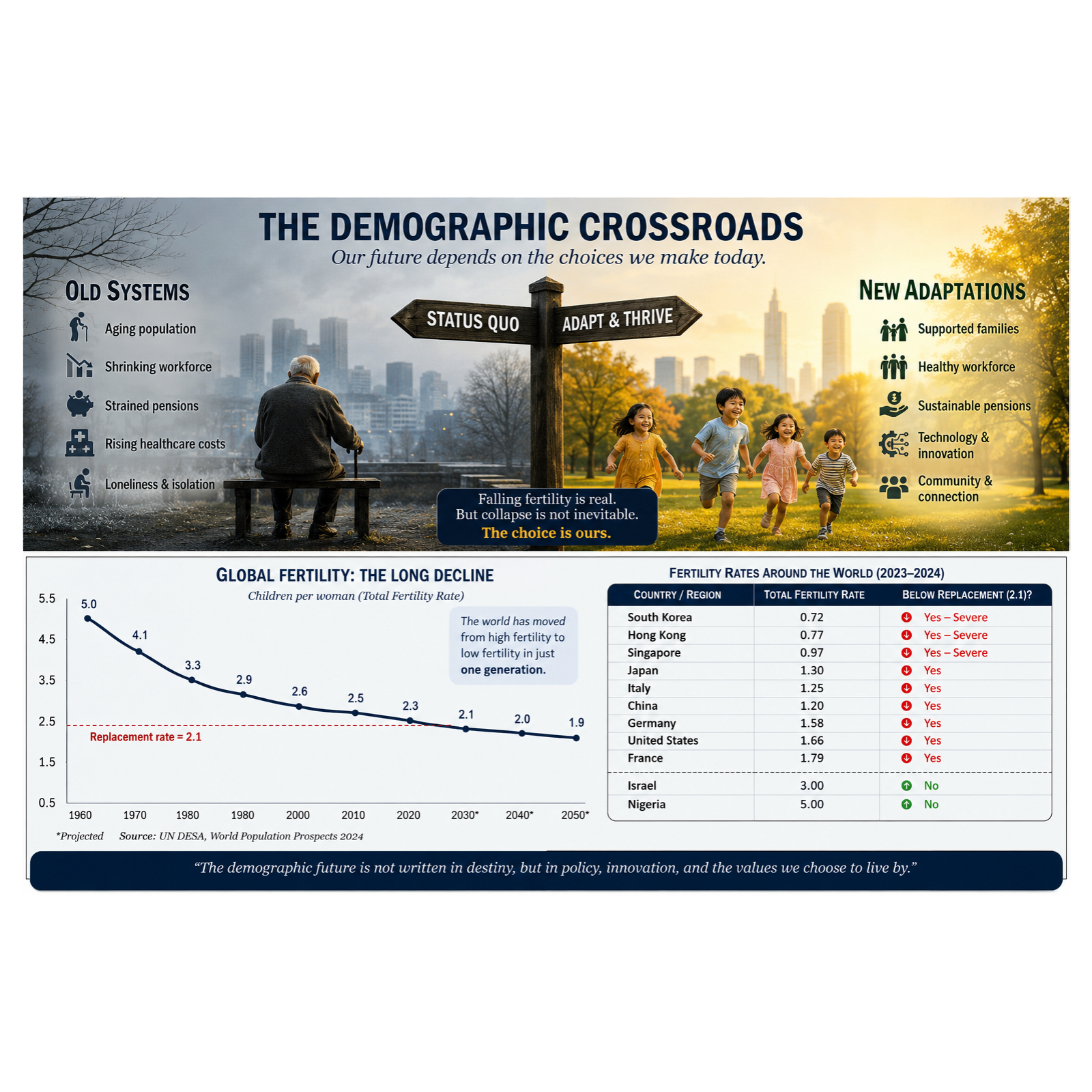
.Is There Really a Demographic Crisis? The Writing on the WallBy Professor Dr Pandiyan NatarajanBirth rates are falling across much of the world. Many countries, including Japan, Italy, South Korea, Germany, and China, now have fertility rates below the replacement level of 2.1 children per woman. As populations age and workforces shrink, concerns are growing about who will support pension systems, provide healthcare, and care for the elderly.Is this a demographic crisis—or a demographic transition that we have failed to understand?This question emerged from a lively debate between two friends. One argued that declining fertility is a genuine crisis and that replacement-level fertility is essential for the long-term survival of society. The other played devil’s advocate and questioned whether the problem lies in demography itself or in our failure to adapt social and economic systems to changing realities.The case for crisis appears compelling. Global fertility has fallen from about five children per woman in 1960 to around 2.3 today. In some countries, fertility has dropped below one child per woman. Fewer workers supporting more retirees can place pressure on pensions, healthcare services, and public finances. Immigration may help, but it cannot be a universal solution if fertility declines globally. Technology and robotics can assist, but they cannot fully replace human empathy and companionship.Yet there is another side to the argument.Falling fertility is not necessarily a sign of societal failure. It is often the consequence of developments that most societies celebrate: women’s education, effective contraception, urbanisation, economic opportunity, and rising living standards. Population stability and prosperity are not synonymous. A country with lower fertility, high productivity, strong institutions, and technological innovation may outperform one with replacement-level fertility but poor economic performance.The debate becomes sharper when discussing care for older people. Is the real problem a shortage of young people, or have we built systems that depend excessively on them? Better support for caregivers, improved assistive technologies, and pension reform could reduce many of the pressures associated with ageing populations.An intriguing evolutionary paradox also emerges. Humans evolved in environments where reproductive success drove evolutionary success. Yet the wealthiest, healthiest, and most educated societies now tend to have the fewest children. The very conditions that have helped humanity flourish appear to reduce fertility. Whether this represents progress, adaptation, or an unintended consequence of modern civilisation remains an open question.Both sides of the debate agree on one thing: extremely low fertility rates can create significant challenges. They also agree that children are far more than economic units. They represent continuity, meaning, hope, and the future.Falling fertility is real. Population ageing is real. Workforce shrinkage is real. But collapse is not inevitable. Adaptation is.Supporting families, investing in childcare, reforming pensions, improving productivity, embracing appropriate technology, and managing immigration thoughtfully may help societies navigate demographic change successfully.The demographic future is already arriving. People are living longer. Families are becoming smaller. Societies are ageing.The question is not whether the world will change.The question is whether our institutions will change with it.Human physiology did not fail us.Human policy might.
Embed this episode
Ready to play
Is There Really a Demographic Crisis? The Writing on the Wall
No transcript for this episode yet
Similar Episodes
No similar episodes found.
Similar Podcasts
No similar podcasts found.