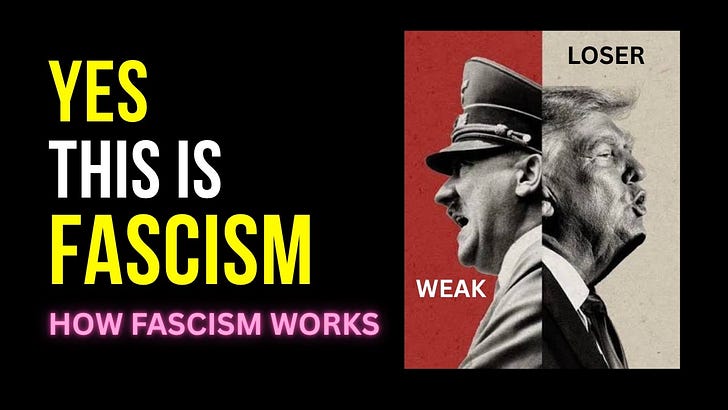
Is This Fascism? Yes
from Wicked Smart w/ Lucas Bean Hosted by Lucas Bean
In 1922, 30,000 men in black shirts marched on Rome and demanded control of the Italian government. The King of Italy could have used the military to stop them. He did not. He handed power to their leader, Benito Mussolini, rather than risk a civil war. Within three years Italy was a one-party fascist state. Within two decades tens of millions of people were dead. Fascism didn’t die with Mussolini or with Hitler. It’s a system. It has a structure. It has tactics that repeat across every country and every century where it appears. And in 2018, former Yale philosophy professor named Jason Stanley published a book identifying exactly what those tactics are. Stanley was the Jacob Urowsky Professor of Philosophy at Yale University. He is the child of refugees who escaped World War II Europe. He has spent his career studying authoritarianism and propaganda. His book “How Fascism Works: The Politics of Us and Them” identifies ten tactics that every fascist movement in history has used to take power. Not some of them. All of them. What Fascism Actually Is The word fascism gets used loosely. It gets thrown at anyone people disagree with. That carelessness is dangerous because fascism is not an insult. It is a system with a specific definition, a specific origin, and a specific set of mechanics. Fascism is a system where one man has total power over everything. The government. The military. The courts. The economy. And it is enforced by violence. You submit or you are punished. There is no middle ground. Fascism has no policies. It has no economic plan. No vision for how society should function. It is purely a mechanism for one man to seize absolute power and keep it. Everything else, the rallies, the slogans, the scapegoats, the culture wars, is just a tool to get there. Benito Mussolini invented it in Milan, Italy in 1919. The country had just come out of World War I on the winning side but got almost nothing from the peace deal. The economy was in ruins. People had no work. The national mood was humiliation and desperation. Mussolini exploited that desperation with three claims: your country used to be great, someone took that greatness from you, and democracy is too weak to get it back. His answer was to concentrate all power in a single leader, himself, who would punish the nation’s enemies and restore its strength. The trade was simple. Citizens give up their freedom, their right to question, their right to disagree. In return, the leader gives them someone to blame. That transaction sits at the center of every fascist movement in history. The leader needs an enemy because rage is the only glue holding the system together. Without someone to hate, the entire structure collapses. Fascism also leads with violence. Mussolini built a private militia called the Blackshirts. They attacked socialists, beat union organizers, and physically removed political opponents from local governments. Violence was not a byproduct of the movement. It was the operating system. In 1922, Mussolini marched 30,000 Blackshirts on Rome and demanded power. The King of Italy handed it to him rather than risk civil war. Hitler watched closely. He took Mussolini’s model and adapted it. Where Mussolini used brute force to seize power, Hitler used democracy itself. He ran in elections. He exploited free speech, free assembly, and every legal right available to citizens of a democratic republic. He used the system to get inside the system. Then he dismantled every one of those rights so no one could use them to challenge him. This is the mechanism that makes fascism uniquely dangerous among authoritarian systems. It weaponizes the openness of democracy against itself. It walks through the front door, smiles at everyone in the room, and then locks the door behind it. The Ten Tactics Jason Stanley’s framework is not a theory. It is a pattern extracted from the historical record of every fascist movement that has taken root over the past century. He drew on Mussolini’s Italy, Hitler’s Germany, Franco’s Spain, Orban’s Hungary, and dozens of other cases. He identified ten tactics that appear in every single one. What follows is each tactic, what Stanley found about how it operates, and what it looks like in practice in the United States right now. 1. The Mythic Past Every fascist movement begins with a fabricated golden age. The leader tells the public that the nation was once great, that the right people were in charge, and that a specific group of enemies destroyed that greatness. The historical accuracy of this claim is irrelevant. What matters is the emotional response it produces. Mussolini understood this completely. At the 1922 Fascist Congress in Naples, he told his followers openly: “We have created our myth. It is not necessary for it to be a reality or true.” The man who invented fascism admitted to his inner circle that the glorious past was a fabrication. He said it did not matter. The feeling was enough. Stanley’s research confirms that the mythic past serves a specific psychological function. It makes people feel robbed. And once people feel that something has been stolen from them, they will tolerate extreme measures to get it back. Mussolini promised to restore the Roman Empire. Hitler promised to restore a racially pure Germany. Neither past ever existed as described. Both populations believed in them anyway because the emotion was real even when the history was not. The Trump movement is organized entirely around four words: Make America Great Again. The slogan never identifies a specific era. It never points to a year, a decade, or a policy framework. It does not need to. It points to a feeling, the feeling that the country once belonged to a certain kind of person and that someone, immigrants, Democrats, intellectuals, took it from them. 2. Propaganda Fascist propaganda operates differently from ordinary political dishonesty. Standard political lies attempt to convince people that a false thing is true. Fascist propaganda does something far more destructive. It rewrites the shared framework through which people interpret reality so that the very concept of agreed-upon facts ceases to exist. Stanley found that the core function of fascist propaganda is to divide the world into friends and enemies. The political opponent is not merely someone who holds a different view on tax policy or foreign affairs. The political opponent is framed as a mortal threat to the survival of the nation itself. This distinction matters because it is the line between democratic politics and fascism. In a democracy, you disagree with your opponent. In fascism, your opponent is an enemy who must be eliminated. Hitler understood the role of media control in this process. He coined the term “Lugenpresse,” the lying press, and used it to discredit any outlet that reported unfavorably on his regime. Once the independent press was delegitimized, he replaced it with a state-controlled propaganda apparatus that told the German public what to think, who to fear, and who to hate. The parallels in the current American media landscape are difficult to ignore. Trump has called the press “the enemy of the people.” He has called Democrats “the enemy from within,” “vermin,” and said they are “more dangerous than Russia or China.” Fox News, Newsmax, and an ecosystem of aligned social media accounts repeat and amplify these characterizations nightly, labeling the political left as domestic terrorists, protesters as thugs, and anyone who dissents from the leader as a traitor. The result is not a news environment. It is a propaganda infrastructure operating around the clock, systematically constructing an enemy out of the leader’s own citizens. The language matters. When a political leader calls his opponents vermin and says they need to be rooted out, that is not hyperbole. That is the specific language fascist leaders have used historically in the period immediately before they began killing people. 3. Anti-Intellectualism In a functioning… This is a public episode. If you'd like to discuss this with other subscribers or get access to bonus episodes, visit lucasbean.substack.com/subscribe
Embed this episode
No transcript yet.