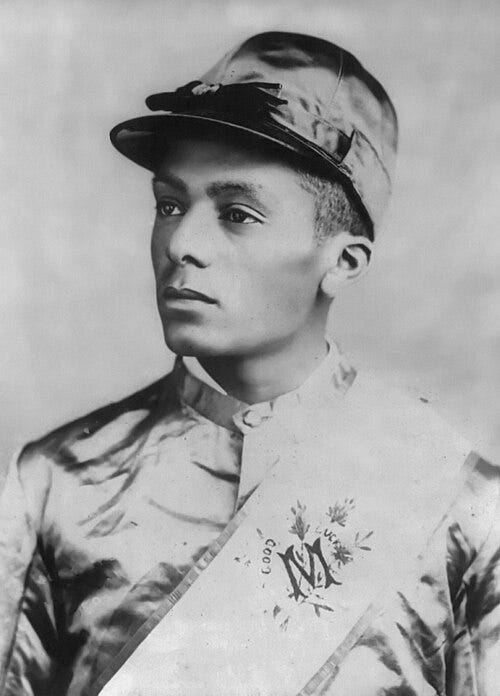
Isaac Burns Murphy
from Historical Snapshots Hosted by Historical Snapshots
In the first decades of American thoroughbred racing, black jockeys were among the masters of the sport. They rode the best horses, won the richest races, and helped make racing one of the great spectacles of nineteenth-century America. And among them, none stood higher than Isaac Burns Murphy. Many consider Isaac the greatest American jockey who ever lived. By the official record, he won 530 of his 1,538 races, a rate of about thirty-four percent. By his count, it was higher — 628 wins in 1,412 starts, nearly forty-four percent. The chart books of his era are incomplete, and some of his races may never have been entered in them. Either way, whichever figure one takes, no jockey has matched it. His victories included the Kentucky Derby three times, the Latonia Derby five times, and four of the first five runnings of the American Derby. Isaac was born in Kentucky’s Bluegrass country on New Year’s Day, 1861. His father, a formerly enslaved man, served in the Union Army and died before the war was over, when Isaac was still a small child. In those early years, Isaac grew up near Lexington, among the barns and horses and trainers and grooms of one of America’s great racing regions. The stable became his school. He learned the sounds and habits of horses, the language of the track, the discipline of the saddle. As a boy, he became an exercise rider. At fourteen, weighing less than ninety-five pounds, he was given his first mount, a replacement ride at Churchill Downs. He finished last. Isaac’s first national notice came in 1879, when he was eighteen. At Saratoga, aboard a horse named Falsetto, Isaac won the Travers Stakes, beating the Belmont winner Spendthrift and the celebrated jockey Edward Feakes. Afterward, the Spirit of the Times wrote that Isaac “is one of the best jockeys in America. He is very observant during the progress of a race, keeps a sharp lookout for danger, is quick to perceive the weak points of an adversary, and prompt to take advantage of them. He has a steady hand, a quick eye, a cool head, and a bold heart.” There was another part of his reputation, though, and on the nineteenth-century turf it counted nearly as much as winning. He was honest. Race-fixing was common in those years—bettors paid jockeys to “pull” a horse and lose—but Isaac refused. The same year, aboard the same horse, gamblers pressed him to throw the Kenner Stakes; he won it instead. To many, he was simply “Honest Isaac.” The trainer L.P. Tarlton later recalled that so few doubted his integrity that almost no one dared approach him, and that at the faintest suspicion of a fixed race, he would hand back the colors and refuse to ride. All of Isaac’s success made him rich. At his height, Isaac earned as much as ten to twenty thousand dollars a year, owned thoroughbreds of his own and a fine house in Lexington, and stood among the highest-paid athletes in the country. He was also one of its most famous. Yet he left little in his own words. He was literate but wrote almost nothing about himself and spoke sparingly of his victories, so the record holds what he did far better than what it cost him. And the latter was a lot. Beyond the struggles with racism, the profession exacted its own toll. To make weight, jockeys starved and sweated themselves down, year after year, and the strain left them poorly defended against illness. Isaac’s health failed while he was still a young man. He died of pneumonia in Lexington on February 12, 1896, at thirty-five. For a time, the man many had called the finest rider in America slipped from memory. His grave fell into neglect, and its location was lost. Years passed before anyone tracked it down. In 1967, his remains were reinterred beside Man o' War; when the Kentucky Horse Park opened in 1978, the two were moved there together, where Isaac rests today beside one of the greatest horses in racing history. Sources: * Bolus, Jim. "Honest Isaac's Legacy: The Greatest U.S. Jockey of the 19th Century Was a Black Man, Isaac Murphy." Sports Illustrated, vol. 84, no. 17, 29 Apr. 1996. * Isaac Murphy, head-and-shoulders portrait, in jockey uniform, facing left. Photograph. Retrieved from the Library of Congress, https://www.loc.gov/item/2005690025/ * “Isaac B. Murphy.” National Museum of Racing and Hall of Fame, https://www.racingmuseum.org/hall-of-fame/jockey/isaac-b-murphy * “Isaac Burns Murphy.” Kentucky Horse Park, https://kyhorsepark.com/explore/isaac-burns-murphy/ * MURRAY, ROBERT P., and Pellom Mc-Daniels. The Register of the Kentucky Historical Society, vol. 113, no. 1, 2015, pp. 93–96. JSTOR, https://www.jstor.org/stable/24641247. Accessed 28 Jun. 2026. * Wikimedia Commons, Wikimedia Foundation, https://commons.wikimedia.org/wiki/File:IsaacMurphy.jpg * Yang, Avery. "Black History Month: Isaac Murphy Became One of the Best Jockeys in History." Sports Illustrated, 25 Feb. 2020, www.si.com/horse-racing/2020/02/25/black-history-month-isaac-murphy. This is a public episode. If you'd like to discuss this with other subscribers or get access to bonus episodes, visit historicalsnapshots.substack.com/subscribe
Embed this episode
No transcript yet.