
EPISODE · Apr 6, 2023 · 30 MIN
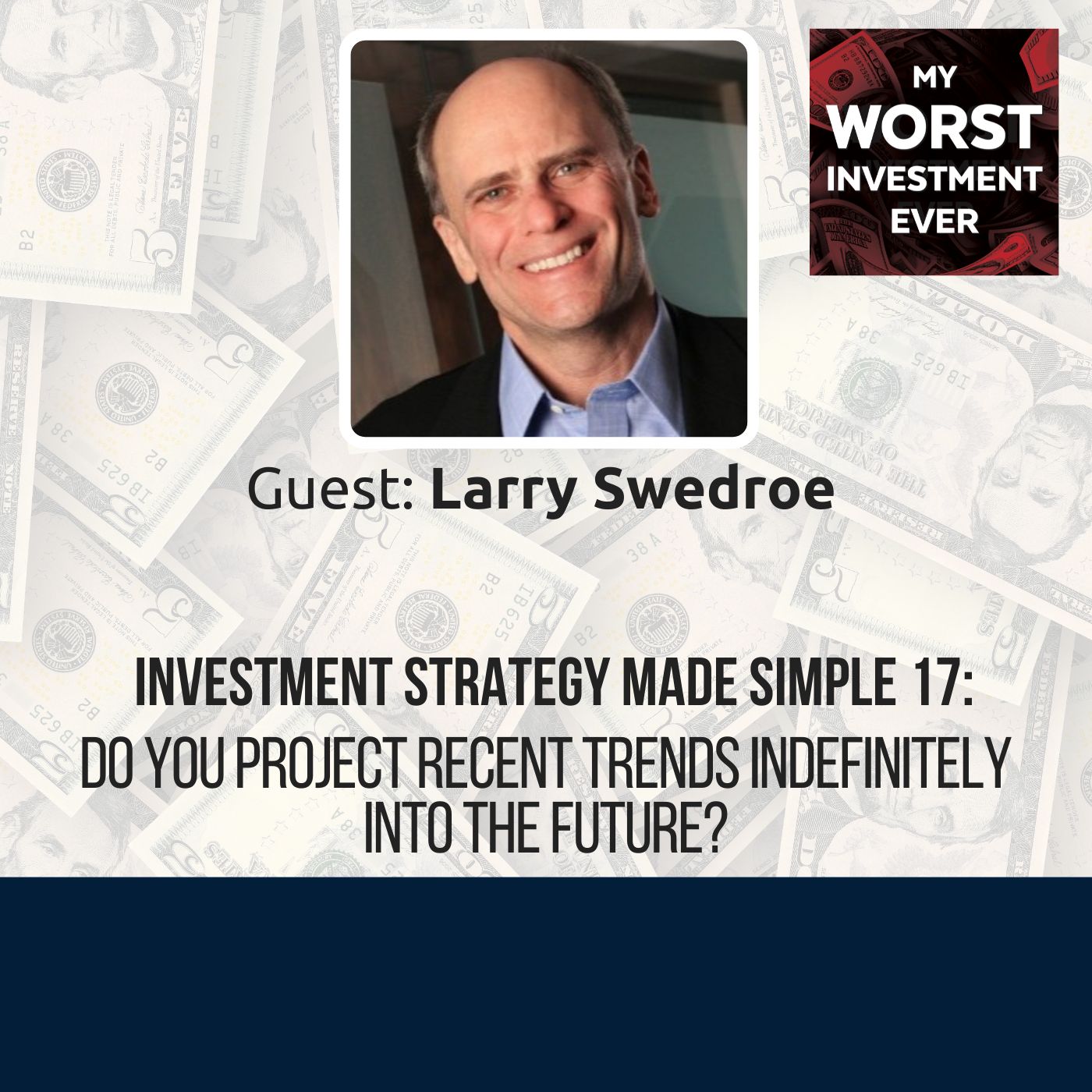
ISMS 17: Larry Swedroe – Do You Project Recent Trends Indefinitely Into the Future?
from My Worst Investment Ever Podcast
In this episode of Investment Strategy Made Simple (ISMS), Andrew and Larry discuss a chapter of Larry’s book Investment Mistakes Even Smart Investors Make and How to Avoid Them. In this second episode of the series, they talk about mistake number two: Do you project recent trends indefinitely into the future?LEARNING: Hyper-diversify and rebalance your portfolio. “You cannot run away from risks; you can only choose which risk you’re going to take. Hyper-diversify on as many different unique risks as you can, stay the cause, and rebalance.”Larry Swedroe In today’s episode, Andrew continues discussing with Larry Swedroe, head of financial and economic research at Buckingham Wealth Partners. You can learn more about Larry’s Worst Investment Ever story on Ep645: Beware of Idiosyncratic Risks.Larry deeply understands the world of academic research and investing, especially risk. Today Andrew and Larry discuss a chapter of Larry’s book Investment Mistakes Even Smart Investors Make and How to Avoid Them. In this second series, they talk about mistake number two: Do you project recent trends indefinitely into the future?Missed out on mistake number one? Check it out: ISMS 8: Investment Mistake No.1: Are You Overconfident in Your Skills?Recency bias explainedAccording to Larry, most investors suffer from recency bias. Recency bias is that we tend to overweight whatever has happened in the most recent past, whether it’s months or years, and ignore long-term evidence. Say you’re watching a stock and go back to 1995 and notice that technology stocks in ‘96, ‘97, and ‘98 performed well. So you think the same performance will prevail, and now you buy tech stocks based on that recent trend.If you buy things that have done well in the last few years, and now you think it’s safe, what you’ve done is bought high. You didn’t get those great returns but paid high prices. High prices generally mean you’ll get low expected returns.Larry reminds investors that knowing your history is the best way to overcome recency bias. History tells us that all risk assets, gold, real estate, US stocks, small stocks, value stocks, high-yield bonds, etc., go through very long periods of poor performance. That means you don’t want to be subject to recency bias because you think three, five, or even ten years is a long time to judge performance. It’s not; otherwise, there would be no risk for an investor with a 10-year horizon. So you just have to wait it out.An excellent example of that problem is when the S&P underperformed T bills for at least 13 years for three periods, from 1929 to 1943, from 1966 to 1982, and then again from 2000 to 2012. Of course, the stocks did great in the other half of that period, but you don’t get those returns if you’re subject to recency bias.The never-ending game of buying high and selling lowThe message that Larry tries to give investors is that there are no clear crystal balls. So don’t be subject to recency bias because you’ll forever chase and buy high and sell low. This is not a prescription for success. You cannot run away from risks; you can only choose which risk you’ll take. And if you don’t have a clear crystal ball, there’s only one logical answer; you should hyper-diversify on as many unique risks as possible and stay with the cause.Also, rebalance your portfolio and do what Warren Buffett, maybe the greatest investor of all time, has told people to do: don’t try to time the market. But if you’re going to because you can’t resist, buy when everyone else is panic selling and sell when everyone else is getting greedy.Reversion to the mean of abnormal returnsAccording to Larry, investors get hooked on recency bias and ignore that one of the most powerful forces in the universe is the reversion to the mean of abnormal returns, both good and bad. That’s not necessarily true of individual stocks. For example, a stock could do poorly and then eventually go bankrupt. But it’s true of country indices or any broadly diversified portfolio. When you have a terrible performance period, that’s likely a result of the fact that valuations are falling. And if valuations are falling, your earnings-to-price ratio is going up, which means your expected returns are going up. But investors run away from the bad performance instead of rebalancing their portfolio.Is recency bias symmetrical or asymmetrical in our decision-making?Larry believes recency bias is both symmetrical and asymmetrical in our decision-making. Whatever is done well, people jump on the bandwagon due to fear of missing out (FOMO). But on the downside, the impact is worse because losses have a much more significant effect than an equal-size gain and how we feel.So if you invest $100, for example, you feel twice as bad when you lose that $100 than if you make it. If you turn it around to a million dollars, the multiple effects may be 10X. The bigger the number, the worse that ratio becomes. So what happens is, when markets are going down, you feel that pain and project that it’s going to keep going down. Now you want to get out. The key to avoiding this is to avoid taking more risks than you can stomach in the first place. Then stick with your plan, and don’t chase returns.Larry also insists on being aware that our biases, like political bias, cause us to take action when inaction is almost always better.Your labor capital has to be low in correlation to the equity riskLarry says that many investors set up their asset allocation thinking they have a long investment horizon before they start to withdraw. So they believe they can wait out a bear market—and that’s true. But it’s only a necessary condition to take a high equity allocation, not a sufficient condition.Larry advises investors to take on the sufficient condition: their labor capital should be low in correlation to stocks’ economic risks. Because if the stock market goes down due to a recession and you get laid off, you have to sell stocks when the markets have already crashed to put food on the table, so you lose your investment. Therefore, people whose labor capital is closely tied to the economic cycle risk shouldn’t take as much equity risk in the first place.The risk of confirmation biasYou get an echo chamber effect when you read articles about disruptive industries, technologies, artificial intelligence, and all other hyped stocks. You hear precisely what you want, making you feel even better. Then you ignore all the other evidence. Now, you only see bullish signals, become more optimistic, and buy.However, if you’re more open-minded and look at the negative information about a stock, you get a more balanced view. You’ll do better in the market than a person who hears one side of the story. If you listen to both sides, you’ll still underperform the market because of trading costs and too efficient markets. Still, you’ll only lose by a small margin.Final thoughts from LarryWe’re all subjected to recency and confirmation biases. To overcome them, have a well-thought-out plan, write down your asset allocation, and hyper-diversify. Once a month or once a quarter, look at your portfolio and rebalance it. Then ignore what is going on in the market.About Larry SwedroeLarry Swedroe is head of financial and economic research at Buckingham Wealth Partners. Since joining the firm in 1996, Larry has spent his time, talent, and energy educating investors on the benefits of evidence-based investing with an enthusiasm few can match.Larry was among the first authors to publish a book that explained the science of investing in layman’s terms, “The Only Guide to a Winning Investment Strategy You’ll Ever Need.” He has authored or co-authored 18 books.Larry’s dedication to helping others has made him a sought-after national speaker. He has made appearances on national television on various outlets.Larry is a prolific writer, regularly contributing to multiple outlets, including AlphaArchitect, Advisor Perspectives, and Wealth Management. [spp-transcript] Connect with Larry SwedroeLinkedInTwitter<a...
Embed this episode
What this episode covers
In this episode of Investment Strategy Made Simple (ISMS), Andrew and Larry discuss a chapter of Larry’s book Investment Mistakes Even Smart Investors Make and How to Avoid Them. In this second episode of the series, they talk about mistake number two: Do you project recent trends indefinitely into the future?
Ready to play
ISMS 17: Larry Swedroe – Do You Project Recent Trends Indefinitely Into the Future?
No transcript for this episode yet
Similar Episodes
No similar episodes found.