It's a no-brainer
from Gnostic Reformation, Clear and Simple Hosted by Cyd Ropp
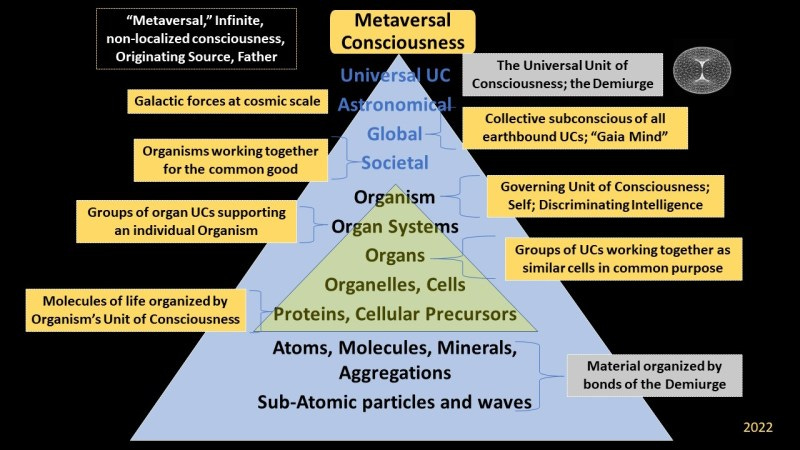
Welcome back to the Gnostic Reformation. I read a very interesting article this week from Scientific American, February 1st, 2024 edition. It’s a brand new article by a science writer called Rowan Jacobson. It was interesting to me because it just so happens to uphold—finally prove, in essence—one of the hypotheses of the Simple Explanation of Absolutely Everything. You know, my Simple Explanation theory of everything was written over 15 years ago. The blog’s been up that long, and there’s a book by the same name. If you haven’t gotten it yet, it’s a secular version of what we talk about here at Gnostic Insights, but it is gnosis nonetheless, because I believe that the universe was setting up for me in the Simple Explanation theory of everything, a way that I would then be able to read and interpret the gnostic gospel. That’s why the latest book is A Simple Explanation of the Gnostic Gospel, whereas the first book was A Simple Explanation of Absolutely Everything. And, in the Simple Explanation of Absolutely Everything, which was pre-gnostic gospel for me, I didn’t have a clear way to separate non-living material from living material. In my early diagrams, the hierarchy is a straight flow upward from the subatomic particles, on up through life, on up through cells. But, whereas in the gnostic gospel interpretation, there is a clear break provided to us by the Tripartite Tractate of the Nag Hammadi, there’s a clear break between the mud—that being the material that is not alive—and the meat—that being all of us animals, all of us creatures, everything that’s alive. Whether it’s a plant or a single celled organism or a human, every living creature is different in kind than the purely material objects. And the material objects are the subatomic particles, the particles, the atoms, the molecules, the elements, the aggregates of minerals on up to the hard rocky bodies, like comets and planets. According to the Tripartite Tractate, these are not alive. The bodies themselves are part of the Fall. They are the dead byproduct of the Fall. They don’t think; they have no consciousness. What does have consciousness is the ego of the Demiurge, and so, at least here in our cosmos that we are familiar with, every material object that is not considered living, such as rocks and sand, well, those are extensions of the Demiurge. Those are extensions like a puppet master and strings, right? They are the Demiurge’s extensions of its consciousness, and it is not fully conscious because it is lacking the One’s Self that comes from above. Its One Self fled, that being the Aeon known as Logos. So, Logos and its ego have become separated and it’s its ego that has constructed this material cosmos in which we dwell. Whereas Logos itself, the Aeon Logos, fled back up to the Fullness. Anyway, this is a long preamble to what we’re trying to actually get to here, and if all of this was just gobbledygook to you, you need to back up and become familiar with some of the terminology from the gnostic gospel that I present here. So I will put a link to a more basic type of introduction to these concepts right here in the transcript to this podcast. Back to the Scientific American article. It’s called Brains Are Not Required When It Comes to Thinking and Solving Problems, Simple Cells Can Do It. And the subtitle is Tiny clumps of cells show basic cognitive abilities, and some animals can remember things after losing their heads. So, what this article is about is a new branch of cognitive science called basal cognition, and they are coming to believe that the brain is not required for thinking. Well, that has been a tenet of the Simple Explanation going back 15 to 20 years now. The brain is not the origin of thought or consciousness, it’s merely like a radio that tunes it in. Your neurons are not where memories live. The memories are outside of us. What the neurons do is grow in response to the stimulus of those externalized thoughts, and some scientists are coming to recognize that fact now. They fought this all along. Most scientists, including most cognitive scientists who study the brain, keep looking for places in the brain where the memories live. But these basal cognition scientists now realize that the memory doesn’t live in the brain. And by the way, to skip to the conclusion of the article—where the memories reside as far as they are concerned is in the electromagnetic grid that the creature emits or dwells in. Rupert Sheldrake is a scientist who has for a long time been an outcast in the scientific community because he’s been saying that all along. His research and his books are about how our thoughts and our relationships with one another exist in a field around us and a field in between us. Like between two people who have love for each other, there’s a sort of a rubber band, I think he described it. A rubber band stretching between them, which is an electromagnetic field that keeps them connected. So, let me read you some of the main points out of this article, and then I’ll make comments on it as we go by. The article begins with a description of the research that a scientist named Michael Levin has done, and he studies planaria worms. The neat thing about planaria worms is that if you cut them in half, the head half will grow a new tail and the tail half will grow a new head. And, they are genetically identical to one another as clones. Now the interesting thing is that even though you chop off the head and the tail grows a new head, that new head knows everything that the old head knew. And this is a form of proof that the memories and knowledge that were contained in that planaria worm didn’t live in the head. They were somehow living in the entire worm. That’s groundbreaking research, believe it or not. Quoting from the article, “Until recently, most scientists held that true cognition arrived with the first brains half a billion years ago. Without intricate clusters of neurons, behavior was merely a kind of reflex, [and that is what most people still think]. But Levin and several other researchers believe otherwise. He doesn’t deny that brains are awesome paragons of computational speed, and power. But he sees the differences between cell clumps and brains as ones of degree, not kind. In fact, Levin suspects that cognition probably evolved as cells started to collaborate and carry out the incredibly difficult task of building complex organisms, and then got souped up into brains to allow animals to move and think faster.” OK, pause now. I’ll rerun, soon, my episodes concerning evolution because I don’t think evolution works that way. Evolution clearly does not work by things happening in the way that Darwinian evolution says they happen, that this works out well for an organism, so more of that organism survives, and then they breed, and now all of that organism is like that one that was successful. That’s the way Darwinism works. What I claim is that the patterns are inherent. The patterns come from above. They are in fact from the Aeons of the Fullness. They are aeonic that way, and these patterns are brought down with the creatures that instantiate them. We are all born with our aeonic pattern intact, and it has nothing to do with evolution down here. And, by the way, it can look like things are evolving, but that’s simply because we 2nd Order Powers were sent down one by one, from the simplest to the more complex. It even says that in the Tripartite Tractate. You know, that book is over 2,000 years old and how it can describe such things is really phenomenal. So yes, maybe the oceans were populated with single celled animals at first and then the jellyfish and whatnot, but then that’s because they were the ones that were first sent down from the Fullness. In my opinion, they did not evolve from each other. There’s no clear links between species and types of organisms in the way that Darwinism claimed, and they still haven’t found any. So, although Levin is working with t… This is a public episode. If you'd like to discuss this with other subscribers or get access to bonus episodes, visit cydropp.substack.com/subscribe
Embed this episode
No transcript yet.