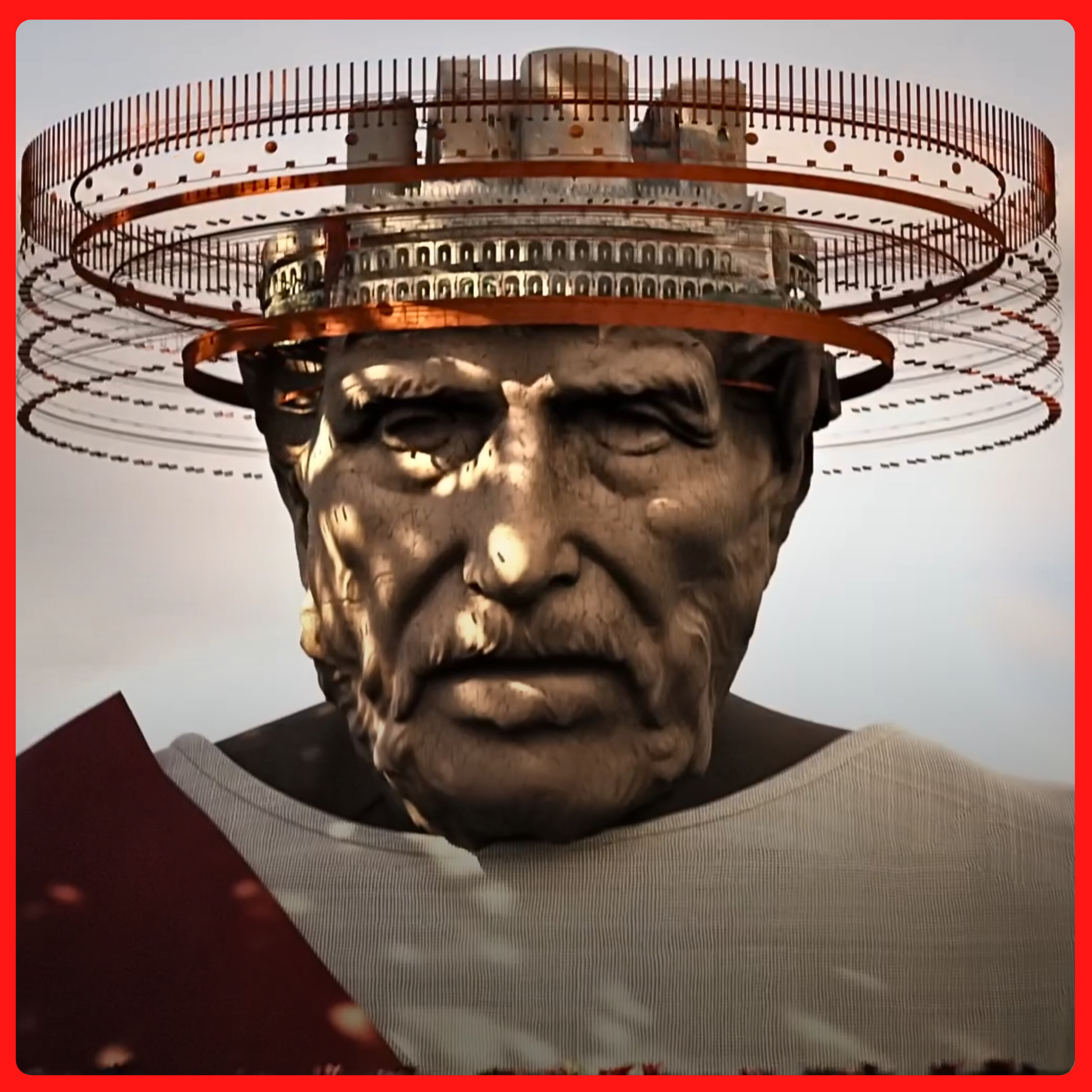
Welcome to the Daily Stoic Podcast, where each day we bring you a stoic inspired meditation designed to help you find strength and insight and wisdom into everyday life. Each one of these episodes is based on the 2000-year-old philosophy that has guided some of history's greatest men and women, help you learn from them. Follow in their example and to start your day off, the little dose of courage and discipline and justice in wisdom. For more, visit DailyStoic.com.
It's mostly froth and bubble. Awards and advertisements, celebrity scandals and local gossip, silly worries and petty rivalries. People arguing for no reason. People trying to accumulate more than they could ever need.
This is what we do, isn't it? What we've always done? In one of the more cynical passages of meditations, Marx really describes life in Rome as a pointless bustling of processions. Opera's, herds of sheep and cattle, military exercises.
A bone flung to pet poodles, a little food in the fish tank. The miserable servitude of ants, the scampering of frightened mice puppets jerked on strings. We fight over things. We entertain ourselves with trivialities.
We miss the point. We waste this thing called existence, led by our perceptions, our insecurities, our fears. Stoicism is supposed to be a dash of clarity. It's a hard dose of perspective.
It's what Marx was doing in that passage, contemptuously dismissing so much of what people take for granted, trying, as he said later in meditations, to strip things of the legend that encrusts them. Too much of life is froth and bubble. Too much of it is servitude and stupidity being jerked around like a puppet. You are better than that.
Time is too short for that. Make up. Stop it. Show up.
Be the person philosophy tried to make you see what it tried to show you. Being an effective leader is difficult, right? You've got to keep your ego in check. You've got to know how your business works, how the team operates for peak effectiveness.
But most leaders are making decisions about their team's based on assumptions and not reality. And that's exactly the problem that today's sponsor scribe was built to fix. Scribe optimized passively captures how your team works across approved business apps and uses AI to automatically surface workflows, inefficiencies and improvement opportunities. New interviews, no extra work for your team.
Scribe is trusted by 80,000 plus enterprises, including nearly half of the Fortune 500. Scribe optimized models work across every tool involved. If someone starts something that sells for some finishes, a completely different tool attracts it the whole way. And optimize shows you where your biggest inefficiencies are with AI-powered recommendations on how to fix them.
So you're not just identifying problems, you're getting clear directions on how to improve. The kind of visibility that used to take months now is always on. And optimize only works on applications your admin improves, so no personal activity is captured and no one's privacy is at risk. If you want to see what optimize could look like for your organization, visit scribe.hous.com or stoic scribe.how slash stoic.
When you're a productive person, when you've got a law on your plate, you don't have time to be groggy or unfocused just because you had a couple of drinks the night before. Cheers Restore After Alcohol Aid helps you have better mornings after drinking. You take it after your last drink or before bed and then it works while you sleep. Their claim to fame is that you will feel 50% better or your money back.
A lot of people think that dehydration is why you feel bad in the morning, but the real reason is what happens in your brain and liver while you sleep. When alcohol leaves your system, your brain goes into rebound mode and that's what makes you feel bad and the DHM in Cheers works while you sleep to smooth out that rebound. And at the same time, the alcohol converts into a toxic byproduct that your liver has to clear out and the cysteine in Cheers helps speed that up. Cheers is backed by doctors, PhDs and over a thousand verified clinicians.
Take Cheers Restore After Your Last Drink or Before You Go To Bed and wake up feeling at least 50% better or your money back. For a limited time, our listeners are getting 20% off their entire order at CheersHealth.com slash stoic. Hey, it's Ryan. Welcome to another episode of the Daily Stoic Podcast.
Weirdly, I'd never been to Vermont before until September. I landed, I think, in Boston and I drove up to Burlington. It was lovely. Had a great run there.
I went and I saw the World's Tallest Violin Cabinet, which I will say. Something was disappointing. I just said, if you had to guess how tall the World's Tallest Violin Cabinet was, just a bunch of violent comments stuck together, I'd hope it'd be more than like 10. I think it was like eight, but I would have guessed if you got 30.
And now my kids are bursting in. What are you doing, boy? Are you guys playing hide and seek? Okay.
He's not in here. I will tell you if you hide in here. Shut the door. I'm recording something, okay?
Oh, yeah. Why you didn't shut the door? That's what I'm dealing with. I just picked the kids up from school and they are running around before we go to Jiu Jitsu.
In any case, had a lovely time in Vermont, much colder there than in September than it is now in Texas. I think it was like 85 today. What does this have to do with today's episode? I was doing a talk in Vermont to this group called Exit 5, which is a membership community place for B2B marketers to get together.
So lovely chat. I didn't talk about stoicism so much as I talked about how I was able to take a scarce school of ancient philosophy and build it into something, which was always lovely to talk about. I was talking about more or less the ideas in perennial seller. In any case, afterwards, I got to answer some questions, a lot of which were about stoicism.
I'm going to bring you that for today's Q&A in related news. I'm going to be in Seattle on December 3rd, giving a talk much more about stoicism, but you can ask me questions about anything you want there in the Q&A or at the VIP. I think there's a few tickets left to that. And then I will be in San Diego and Phoenix in February.
You can grab tickets to all of those before they sell out at dailystowaklive.com. Thanks to Dave, the founder and CEO of Exit 5, he was a big data-stoke fan. He said, get to get to it to many people, including friends and family, which is very cool here. And I appreciate him inviting me.
Got another child interruption. What's up, buddy? You're locking the door. That's smart.
I will tell him I haven't seen you. I'm Phoenix and San Diego, dailystowaklive.com. Enjoy this episode of The Daily Stoke Podcast. Thanks to the high school teacher and I had a really big responsibility to sign this outside shop and get kids to believe themselves playing a much more behind on this.
I decided to cry for some of the crowd's shoes, and I decided to send it off so as a way to them. I called email you. You found it like 200 bucks a day and then tweeted it in the screen. Oh, that's a lot of the same thing.
We were talking about a thing about, I want to keep it related to marketing because I was about conspiracy when my first time. Okay. But, probably in line with the first one. I read yours.
I still think it was true. Unfortunately, yes. What do you see? The intersection between conspiracy and conspiracy pose, like, what do you use this for good?
Yes. What about pressing in line? Is there parts of that that you still see we can use for good today in marketing? Yeah.
So, I wrote a book, my first book I was saying, which came out in the last few years, basically about media systems and marketing that can be manipulated and how sort of the things that we find out about, like what's going on behind the curve? Why do we hear about something that's not other than things? A vision of art is sort of a knife fight for attention, attention being the sketch resource in this world. And that there are forces and a lot of bad actors involved in that system.
And then my argument was, like, you got to figure out how this system works because the fact that you have a cool cause or even a great product is not sufficient to break through with your help against these better funded or better organized groups and interests. So I think, how do you actually break through? What do you want to do to break through? To me, that's kind of the lesson of that book.
And I think we're watching too many people just presume that because their hearts are in the right place or presume because most reasonable people would agree with what they're saying, but that message is just going to get out. And that's not how it works. It's much more complicated than that. And I do think you got to figure out how the system works, particularly if you have something that actually works, seeing and hearing about.
And I think working in the world of AI is only going to be more difficult just because there's a endless amount of slop in here competing with. I think we're going out a little bit. Yeah? After you're done writing your first trial, I mentioned whether you put it in any process.
Sure. How do you know when you're doing this? I don't know what to say. Yeah.
He's a writer, by the way. In Praneo's salary, I split it. There's like a couple of four phases. There's writing.
There's editing. We're finding and crafting. There's marketing. And then there's a kind of this other stuff about a kind of a platform, all this stuff that sort of comes about towards the end.
I'm getting phases probably the most important in many ways. The book that I have coming out in October, I had to cut 20,000 words out of it. And that was the hardest and most visible of the edits. But I just finished the audio book.
And I was much of the shiver in my publisher even editing. Because now I'm having to read it out loud in a studio by myself. And there's just stuff that on the page seemed fine. But I just said this word three times on the same page.
And when I was editing it in Microsoft Word, nine months ago, those words weren't on the same page, just because the layout's compressed and moved stuff around. So I think editing is this ongoing thing. And as I said, I just had this weird experience doing the 10 year anniversary. I'm going to do a 15 year anniversary of Trustman's line.
There's still stuff I'm adding and changing as it goes. So it's not that it never stops. But I do think in a world where I could edit the book tomorrow, if there's something I want to change, I'm continuing. But to me, you do your draft, as I say, the first draft is just for you.
And then once you finish, now you can start to take a bunch of other considerations into consideration, everything from one to one. You can be allowed to say here, to who am I really trying to get this to land to with. And all of that is the painful, but necessary part of the process. Look at your list of books right now.
The one question I'm going to get is, what is your education process? How do you write such great stories that keep your audience engaged without being able to write a book? Yeah, look, I started as a research assistant. I was a research assistant at the writing of Robert Greene.
And his books are primarily the story of Gates. And I do think stories, parables, and I feel this is how we learn. This is what stays with us. So I tend to always be looking for stories.
And I have a whole method that I sort of read, synthesize, report across the stories. And then as I'm writing a book, I'm sort of moving and playing around and sharing my notebook. I do all that. But I usually have the idea for what I want to say about the argument and then what I'm looking for are stories that illustrate that idea.
So the writing role is you always show, don't tell. So I'm not saying, here's a logical proof for why this is true. I'm saying, let me show you what this looks like in practice. Let me show you someone violating the idea or observing the idea or proving it in some way.
That's kind of like, but stories, not just the correct story for the reading, but then what I like about the story is then it's very translatable to all these other mediums. So I might write a 5,000-word story in a book and then that story can condense down into a 30-second TikTok. It can be a 30-minute YouTube video. It could be a five-minute section in an hour talk.
And so the things are modular and I kind of move them around. I'm curious about your distribution. I'm going to talk about how much content you distributed and how it works in the team. But I'm also the dad.
I'm curious about the motivations behind it. Yeah, I'm a think believer in the sort of danger day format, which I didn't really know not much about before I wrote today. But I've gotten so much out of sort of having the surface, like one idea or one thing to think about each day. So days to open on 2016, the idea I can have two years ago, it just stories that illustrate the lessons that I think we all want to embody as parents.
But what I can do about it is, am I going to get better for doing the project? That's one of my sort of things. So the end of that book is also a day that goes out every day, this day that I've come. And the process of like, hey, what's something to meditate on, what's something to think about?
That's kind of how that is. And yeah, there's a team. I write all this stuff. But then people are just like, I would do this Spanish translation of my books.
Someone helps me translate that into, you know, okay, as I said, here's the TikTok version of this, and there's the YouTube version of this, and Instagram version of this, tweet version of this. So having to take this sort of core ideas, what I'm saying, and then find ways to reach people in all the different mediums that they're consuming content. And like, me, when I don't learn about an animated book, that's my medium. And that's not the dominant cultural medium these days.
And so I spend a lot of time trying to take what I do and make it work for wherever there's people. And then the idea is that sort of fun is back ultimately to the books, which is where I'm so most of my sort. You kind of have to live on this, but you may have been more on your process for sourcing ideas, like all the complaints for books and conversations you're doing, whatever. And then your daily practice sort of maintains that ability to do it for 50 plus years.
Yeah. The daily paper, like, hey, it's being unbelievably prolific. What does that look like when you actually sit down to write what do you do then? Yeah.
And I tend to find the best stuff when I'm not looking for it. So you know, I find stuff in novels. I find stuff in weird history books. I'm just reading where my interests take me, but it's like I'm kind of using the confirmation bias in my advantage.
Like, oh, that connects here. Oh, that's related to this. Oh, that was just thinking about something in this story that I'm reading, this three sentence anecdote in an history book happens to make me illustrate that idea. Now I need to go dive deeper into that and find out, you know, is actually an illustration of what I'm talking about in a sequence.
And so, yeah, kind of read widely. And then I, yeah, I'm just always doing it. I obviously had to advance. That's my job to read and find stories.
But I really love doing it. What I was doing when I had my marketing career is that I love to read. I love the history of learning all about stuff. And I try to find, you know, just stuff that I've heard of.
So that sort of curiosity is driving you. And you never know what you're going to find. But you need to have a process. Like, I think the reason I tend to read physical books instead of books and audiobooks, although I don't know if anyone that consumes anything in the light, is that I don't want to just go into some black hole somewhere.
For me, it's a process of taking the notes and recording and transferring it that allows me to develop what we call that I need to actually be able to use it at some time. I don't think everyone exists anymore. People are like, I've never heard somewhere. It's like, okay, but you don't actually have it.
You know, so to me, it's that process of finding, recording and then applying is really where it's found. Hey, it's Ryan. Thank you for listening to the Daily Stood Podcast. I just wanted to say we so appreciate it.
We love serving you. It's amazing to us that over 30 million people have downloaded these episodes in a couple years we've been doing it. It's an honor. Please spread the word, tell people about it.
And this isn't to sell anything. I just wanted to say thank you.