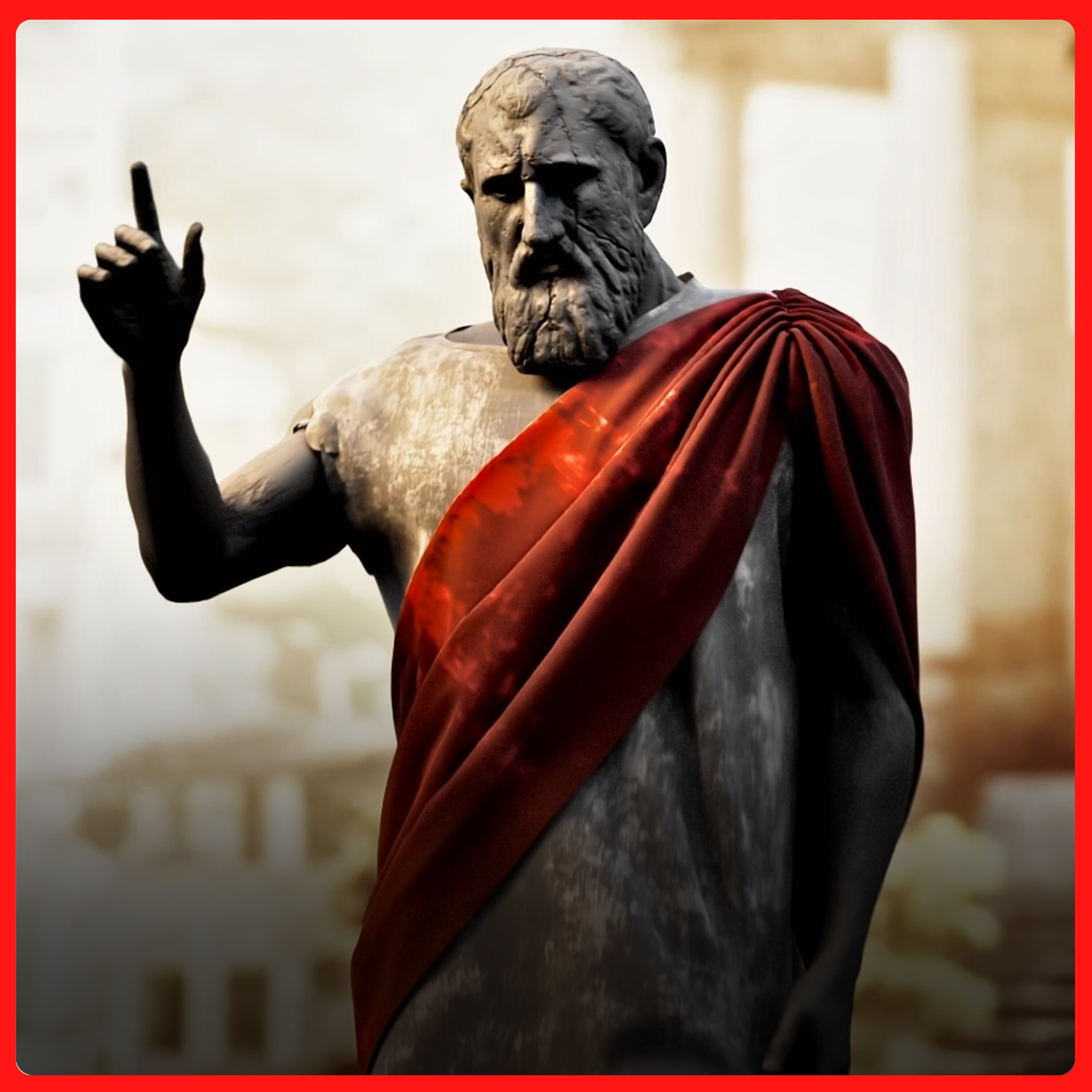
Welcome to the Daily Stoic Podcast, where each day we bring you a Stoic-inspired meditation designed to help you find strength and insight and wisdom into everyday life. Each one of these episodes is based on the 2,000-year-old philosophy that has guided some of history's greatest men and women, help you learn from them, to follow in their example, and to start your day off with a little dose of courage and discipline and justice and wisdom. For more, visit dailystoic.com. It's nothing without this.
We don't see enough of it. People are weak. People are scared. People are afraid to go for what they want.
They're afraid to fight, afraid to stand up, afraid to speak, afraid to try. It has always been thus. The virtue of courage, the first of the four Stoic virtues, is essential not just for a good life, but for a good world. And yet, as we've talked about before, none of the Stoic virtues are possible without the moderating and clarifying influences of the other virtues.
As Myron says to his son Alexis in the historical novel The Last for the Wine, set not long before Zeno would lay down the virtues of Stoicism, courage without conduct is the virtue of a robber or a tyrant. He is saying that courage separated from justice, separated from wisdom, is hardly a virtue at all. In fact, it may well be a recipe for evil. Cato's defiance, if paired with Caesar's selfish ambition, would have been a path to an even worse dictatorship.
If Stockdale's courage in the Hanoi Hilton was solely about self-preservation, as opposed to selfless leadership on behalf of his fellow prisoners, it would have been shameful instead of admirable. Stoicism, we must never forget, was not merely a tool for resilience and determination. It was resilience and determination in pursuit of what was right. Courage is a virtue only when aligned with just and honorable conduct.
It is only admirable when part of a fuller package of decency, honesty, integrity, and a commitment to the common good. The call to courage is not simply the call to conquer fear. It is the call to conquer fear in service of something greater than yourself. To speak the truth, even when it costs you, to do what's right, even when it's hard, to act, not for glory or for gain, but because virtue demands it.
Maybe you've been hearing the buzz about live shopping lately. I know I have, and it makes sense that people are already on their phones, they're hanging out, they're looking for stuff to do, so why wouldn't business want to meet people where they're at? If you're hoping for people to find your listing or waiting for them to walk into your store, I know a little bit about that, you're setting yourself up for disappointment. On Whatnot, you can go live and sell directly to people in real time.
They see what you've got, they ask questions, and they buy, and they keep coming back. Whatnot is the largest dedicated live shopping platform, whether it's beauty, collectibles, electronics, luxury fashion, even cookies. Whatnot buyers spend more than an hour a day on the app, and they're not just browsing their bidding and buying and coming back, so you can go live, show off your projects, and turn that into real income. People selling on Whatnot sell 10 times more than on other major marketplaces, and that's because you're not just listing products, you're building real connections with buyers.
For a limited time, Whatnot will match your first $150 sold in the first month. You just have to visit whatnot.com slash sell to start selling, w-h-a-t-n-o-t dot com slash sell, whatnot.com slash sell. Being an effective leader is difficult, right? You've got to keep your ego in check, you've got to know how your business works, how the team operates for peak effectiveness, but most leaders are making decisions about their teams based on assumptions and not reality, and that's exactly the problem that today's sponsor, Scribe, was built to fix.
Scribe Optimize passively captures how your team works across approved business apps, and it uses AI to automatically surface workflows, inefficiencies, and improvement opportunities. No interviews, no manual discovery, no extra work for your team. Scribe is trusted by 80,000 plus enterprises, including nearly half of the Fortune 500. Scribe Optimize follows work across every tool involved.
If someone starts something in Salesforce and finishes in a completely different tool, it tracks it the whole way, and Optimize shows you where your biggest inefficiencies are with AI-powered recommendations on how to fix them, so you're not just identifying problems, you're getting clear directions on how to improve. The kind of visibility that used to take months now is always on. And Optimize only works on applications your admin improves, so no personal activity is judge not lest you be judged. That's the November 17th entry in the Daily Stoic, and our quote today is from Seneca's Letters 103.
When philosophy is wielded with arrogance and stubbornly, it is the cause for the ruin of many. Let philosophy scrape off your own faults, rather than be a way to rail against the faults of others. And the meditation for today is remember the proper direction of philosophy of all things we're doing here. It is to be focused inward, to make ourselves better, and to leave other people to that task for themselves and their own journey.
Our faults are in our control, and so we turn to philosophy to help scrape them off. Like barnacles from the hull of a ship. Other people's faults? Not so much.
That's for them to do. Leave other people to their faults. Nothing in Stoic philosophy empowers you to judge them, only to accept them, especially when we have so many of our own. You know, it's interesting, both Seneca and Jesus have some observation around this idea of, like, why focus on the splinter in your neighbor's eye when you have a log in your own?
Seneca talks about why judge the pimples on someone else's face when you yourself are covered in sores? Judge not lest you be judged. This sort of essence of Christianity and also of Stoicism, I think, is the idea that you've got enough trouble at home, man. You don't need to be going around judging, condemning, critiquing, questioning what other people are doing.
And I think it's important that we remind ourselves of this because one of the things that I think social media does is give us so much more insight into what other people are doing. You know, you see some celebrities' marriage implode and you shake your head. But are you thinking about it and working on your own, right? You think this behavior or that behavior is improper.
Okay, don't do it then, man, right? That's the end of where you control things. This idea that we should be up in other people's business, that we should be policing, shaming, canceling, et cetera, is so often a distraction from our own work, right? That's what I think is so beautiful about Lincoln's second inaugural address, right?
He says, both read the same Bible and prayed to the same God and each invokes his aid against the other. It may seem strange that any man should dare to ask a just God's assistance in wringing their bread from the sweat of other men's faces, but let us judge not that we be not judged. His point was that slavery was as close to an indisputable evil as one could possibly get. And yet even there, right, what defines Lincoln in the Civil War is his understanding of the fact that if people from the North had been born into the South, they'd almost certainly think and act differently.
And if many of those people from the South had been born in the North, they would certainly think and act differently. And so by approaching it with this kind of empathy, right, that doesn't mean that he doesn't make very clear decisions about what he's okay with, that doesn't mean that he doesn't make very clear decisions about what he can change that is within his power, right? He's the president, so he has a lot more power than, say, your average person. But he realizes that judging and condemning and writing people off is not a constructive attitude, and it certainly does not make us better.
So I just try to take a cue from Marcus Aurelius here. Marcus Aurelius is famously very strict with himself, has very strong standards, but he works really hard not to project those onto other people, not to demand from other people things that they didn't sign up for, right? He's tolerant with others, but strict with himself. He judges himself quite harshly, holds himself to very high standards, but then he understands that other people are on another journey.
He tries to have a very clear understanding of where his circle of control begins and ends, which is what we must do. And we must have empathy and kindness and patience and love for other people, even when they're wrong, even when they're doing things we disagree with, even when they do things that we don't like. We can't cast them out, cast them aside, you know, act as if we are superior to them. We've got to leave those mistakes, as Marcus says, to their makers.
I'll leave that there, and I'll talk to you all soon. Hey, it's Ryan. Thank you for listening to the Daily Stoic Podcast. I just wanted to say we so appreciate it.
We love serving you. It's amazing to us that over 30 million people have downloaded these episodes in a couple years we've been doing it. It's an honor. Please spread the word.
Tell people about it. And this isn't just anything. I just wanted to say thank you.