This is a download from BFM 89.9, The Business Station. BFM 89.9, The Business Station. My name is Rich Bradbury. This is Matt Splaind.
Now, 20 years ago, Matt Armitage was an old man with crumbling wits and chronic arthritis. Now, thanks to quantum technologies, he's omnipresent and sharper than a weasel and a rabbit's warrant. All of which is a very strange way to introduce a show about an iPod. You've got to give people something, haven't you?
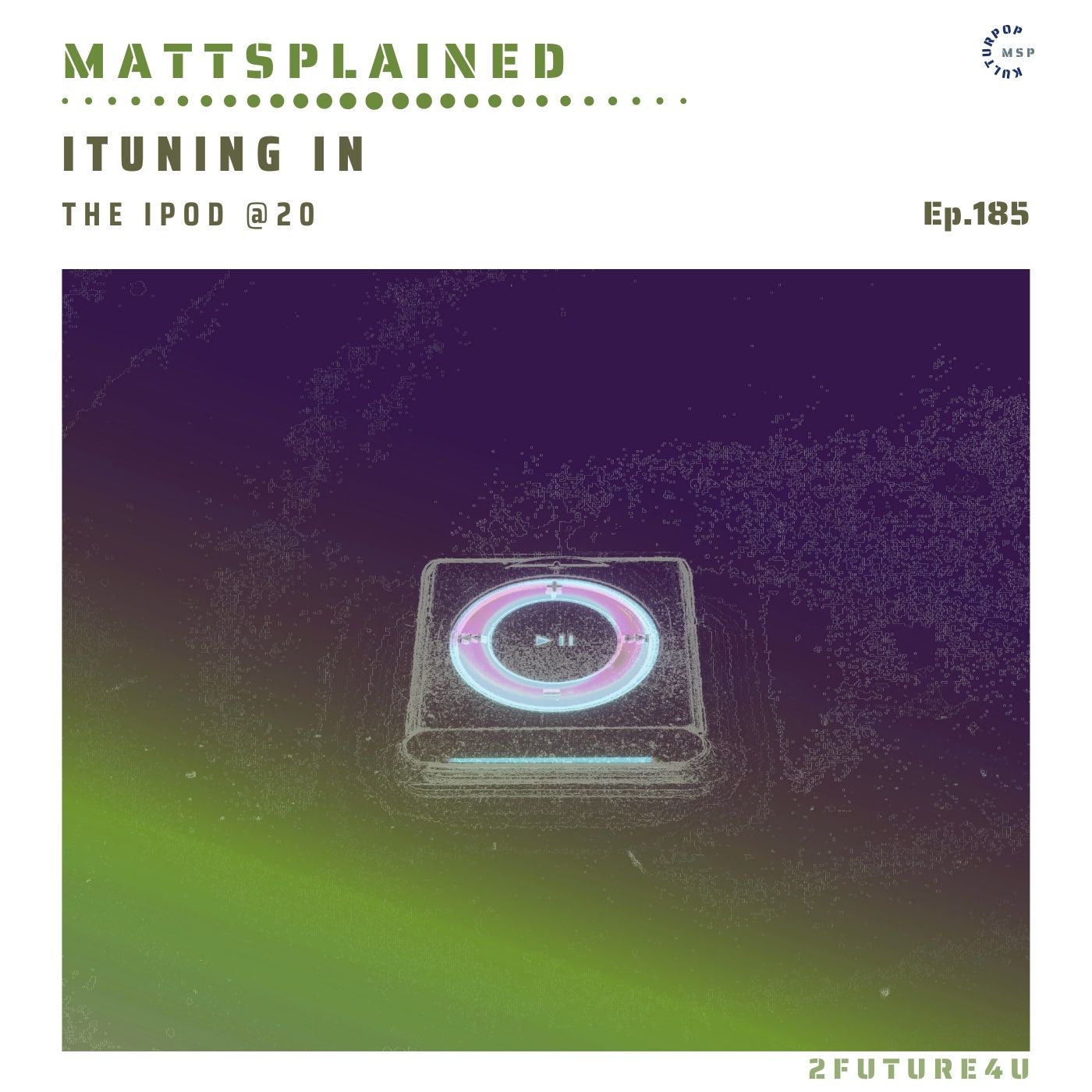
And it's not an iPod, it's the iPod. And, you know, I'm really kind of astonished by this, but the iPod is actually 20 years old. And that's probably older than some of our listeners, although, you know, probably not most of them. But we did do a show a couple of years ago when it was the Walkman's 40th birthday.
So, you know, it's only fair that we do the same with the iPod, especially given that, you know, arguably, that device has helped to groom us with the introduction of smartphones and the apps and the digital subscription services that we now buy, you know, every day with a click. And it paved the way for a lot of the music and video streaming services that have replaced the older CD and DVD buying models of the entertainment industry. Not that anyone to do age of 30 cares about that at all. But, you know, just for my own interest, what was the first digital music player that you remember having?
I remember having one of those USB things. I had a mini-displayer, and I guess if we're looking at technically a CD player, was it a portal CD player? Is it technically digital? Is it not?
Kind of. Well, I mean, stretching. I mean, people still call that kind of physical media, right? But I mean, I was the same.
I mean, I think for me, it was one of Sony's network Walkman series players, which played those awful A-track encoded files rather than M3s. I think you might be right. Yes. Yes.
Something like that. Yeah. And I think that would have been the early 2000s. Same as you, I had one of those cheap knockoff thumb drive style MP3 players that could hold, you know, a handful of songs.
And I think the first proper MP3 player I had was one of those creative Nomad Zen jukeboxes, which had a massive 60 gigabyte capacity. Yeah, I remember those. No, exactly. And I think that was one of the largest capacity players at the time.
I really regret selling it, to be honest. But, you know, even then that jukebox, then it was the size of a fable, but much thicker. You know, I was going to say it was the size of a Walkman, but that's probably not really helpful to younger listeners that don't know what a cassette is in the first place. All right.
So let's skip to October 2001. OK, so the iPod drops in October 2001. As we've mentioned, there were already a lot of competing digital audio and MP3 players out there. But most of them really weren't user friendly, you know, most of them wrestled with mysterious buttons and switches.
And they're operating systems to pretty much a PhD in electrical engineering to navigate. So, you know, that's the digital music landscape that the iPod landed in. And of course, Apple, after its heyday in the early 1980s, had basically been in the wilderness for a decade. But by, you know, the late 90s, it was staging a bit of a comeback.
Steve Jobs had rejoined the company in 1997. In 1998, they launched the iMac, which of course was designed by Johnny Ive. And it came with those distinctive, colorful and transparent cases. But Apple isn't that must have product maker that it became in the mid 2000s.
For most people, the iPod was the first introduction to that minimalist, easy to operate aesthetic that Apple continues with to this day. And it was the company's first real bid for a mainstream market, as well as, you know, that philosophy, that Apple idea, that doing things better is more important than doing them first. Let's talk about its looks. How different where it looks?
Well, like I said, there were a lot of players. They tended to be pretty plasticy. You know, they didn't feel very premium. They were usually black.
As we've said, a lot of the smaller players had that thumb drive style look. The bigger ones looked like a discman or a cassette walkman. And the iPod was probably roughly the same size and shape as the majority of the players. But it was the first one that you looked at and thought, you know, I need that.
It was all white. The front face was dominated by this massive solid state scroll wheel that you use to navigate its operating system. Other than that, there wasn't much to it. It was minimal.
It was simple. There was a small backlit grayscale screen that let you see what you're playing and get through the menus. And it came with a five gigabyte or a 10 gigabyte physical hard drive memory, not, you know, solid state storage. One of those spinning hard drives you get in a laptop.
And, you know, you imported music to it from iTunes, which of course was software that was only available on a Mac. And that exclusivity was part of the genius of its appeal. Almost no one had an Apple computer. So for the first year or so, if you wanted the coolest music player on the planet, you had to buy into that world of Apple.
Now, with that said, I don't think history will remember iTunes as fondly as they do the iPod. Probably not. I mean, it's been a horrible piece of software throughout its existence. You know, it's one of the rare things that Apple has never been able to get quite right.
But without iTunes and the retail store, it became the way digital technology unfolded might have been very different. But, you know, we'll get to that a little bit later on. I think it was over a year before Apple launched the same version of the iPod, which was Windows compatible. And it was a further year before a Windows port of the iTunes app was released.
But that couple of years helped to stir demand. You know, there were plenty of people like me who bought their first Apple laptop, partly because of that tie to the music player that they loved. But, you know, and there was the site of those all white earbuds that signified that you had an iPod. And that helped to make it such a desirable commodity that, you know, it just flew off the shelves once it became PC compatible.
And this thing, it wasn't cheap. You know, we're talking 400 US dollars 20 years ago for something that just played music. That was serious money. Now, I guess it held out for a lot of people.
The music they put on it was free. Well, yeah, that's definitely a big part of the story. I mean, you paid $400 for it and then basically the music came free of charge. Conchainous people would simply rip their own CDs and transfer them to the music players.
So they would copy in what they'd already bought known. But most people, if we're honest about it, were bootlegging and downloading. But, you know, let's go back a bit further than 2001. You know, let me paint you a picture of the late 1990s when I was thin and I had a luscious head of hair.
The golden age of the internet 1.0 is about to flower. A plucky little company called Amazon is trying to upend the monopoly that book publishers had to set prices and where their books were sold. A little chap called Mark Zuckerberg is about to enter high school, very popular. We're still wondering whether Ross and Rachel are going to get together.
And we're asking Geeves how to find our way to our Hotmail account. The first high speed broadband lines are being installed. And these, of course, are mostly in big companies, but also at university campuses. Right.
And this helped to usher in the conditions for Napster to flourish. Yeah, I mean, Napster was another revolutionary idea and a game changer in its own right. So Napster was really the first global jukebox. It was a peer to peer file sharing program that allowed you to search for music and films as well, but mostly music and download them to your own machine.
And it blew up the music industry like a box of dynamite. I mean, literally in the space of a couple of years, free music was everywhere laying waste to this multi-billion dollar global music industry. Companies like Napster, you know, Lime Wire, Kazza. You can argue they democratized music, but they did it at the expense of the people who actually made their living from music.
Thousands of college students in dorms were using the first high-speed internet connections to illegally download songs. You know, it's probably hard for some of our listeners to visualize how different this was. Apart from, you know, adult content porn, this was the first real consumer example of on-demand content entertainment. And I remember, you know, having to convert my, you know, collection of music from CDs to digital musical, music files, you know, and that process, I found that process kind of cathartics is rediscovering the music that I've already gotten and putting it into a new digital space to hear what it sounded like on these new devices.
Yeah, I actually remember, I was listening to, I think it was this American Life podcast recently, and some guy sent a playlist to a woman and the two a girl and the titles of the songs, you know, spelled out something like, I love you and the name of the woman he was giving it to, but she ripped it to her computer and the computer ripped it in the reverse order. So she never saw the message from the next tape and it was only kind of 20 years later. But you know, these things happened with that and it wasn't kind of streaming in the sense that we have it now, you know, partly because the broadband speeds didn't support that. So like you said, you had to physically rip the files or you downloaded the physical files, whatever music you wanted.
And then, you know, you had this library and access to every song that had ever been made, as long as someone had ripped and uploaded it to a peer-to-peer network that you had access to. You know, that was what was so revolutionary. When you went to a music store or a night market, you could only choose from whatever was on the shelves or the benches. If you wanted something specific, something they didn't have in stock, you had to order it, that could take weeks, it could take months.
But with this new digital kind of format, you know, there was no storekeeper, it felt like it was free. It was a crime, yes, but it didn't feel like one. And that has kind of changed the value relationship that we have with music pretty much forever. Those digital files, you know, they may have been digital, but they weren't still yet portable.
No, I mean, as we pointed out in the show about the Walkman and the Discman, having your music on the move, you know, changed the way that we interact with music the way that it sand tracks our lives. So at first, you know, to make these digital files portable, you would download them and then you would have to rip them back to CD. So you could play it on your CD player on your Discman. And it wasn't until the late 1990s that these first digital music players started to appear.
In fact, actually that the first digital audio player to come to market was about 15 years before it was sometime in the early 1980s, I think. But, you know, lack of capacity, slow transfer speeds, plus, you know, the fact that PCs back then weren't really good and not many people had them. Men back this idea never really went anywhere. So even by this point in the late 1990s, MP3 players often had a really tiny memory, you know, 32 megabytes or 64 megabytes.
I mean, things that you don't even think about now enough for 30 to 60 minutes of really low quality music. And forget about convergence devices. You know, you took a phone with you and you took an MP3 player. I think Samsung brought out the world's first music phone, which was the iconic up-raw or the SPH M100.
And again, that had just 64 megabytes of memory. And that was in the year 2000. You know, at that point, like you, I was still hoping that Mini Disc was going to be the music format of the future. Yeah, yeah.
How many music players have you owned, mate? I mean, if we discount those cassettes and CD players, I mean, dozens, a couple of Mini Disc players that Creative Xena mentioned, a bunch of those dodging over and Bluetooth streaming thumb drives. I had pretty much all of the iPods, iPods, iPod classics, minis, nano's, shuffles. I don't think I had a touch.
I don't remember owning a touch because I had an iPhone by that point. I had those Sony Walkman, Sony Ericsson, Walkman phones I had, waterproof players for swimming with. I've still got a Microsoft Zoom player on the shelf behind me and a working iPod classic that's on the desk in front of me. That must be close to a decade old.
And that's without counting all the iPhones and iPads and Android phones over the years, which, you know, is the only music player most of us need today. But, you know, I am a hardware nerd. The beauty of the iPod was that it opened the door to actually selling this content. And that's what we'll be talking about after the break.
How the iPod was Steve Jobs, Gambia. It was his way of grooming us for the world of apps and micro payments that was to come. Thanks for that, Matt. And when we come back, eating through Apple, you're tuned in to BFM.
This is Matt Spleen on BFM 8.9. Funk, Next Steps, BFM 89.9, The Business Station. BFM 8.9, the Business Station. Welcome back to Matt Spleen.
Now, we're going to be celebrating 20 years of the iPod today. And before I ask Matt this question, I just want to say that, you know, Matt, back in the day when the iPod was about to be launched, and I remember reading about it, I owned an iRiver. And the iRiver, I don't remember where it was produced. I'm assuming it was Japan, but it was one of those music devices that had all these wonderful formats.
I was a bit of a music snob, you know, played on board, basically, flack, played, all of these things. And I was thinking to myself, if you want a portable music player, you want it to play in all the formats that you can get, and you want it to sound amazing, and nobody will want to play from a device that only plays MP3s. Yeah. Well, I mean, I'm glad you were there to support Obforbus and Flack, because, you know, otherwise Neil Young would have been completely on his own.
So it was good that you have at least a little bit of the company. I think that was a problem. The lack of library was a problem back then. But yeah, anyway, not forgetting that once you put them into that format, the files were absolutely enormous.
I mean, you know, yeah, you know, and we forget computer drives weren't massive at that point either. So you put something into an Obforbus file format and you're like, oh, half of my drive is already gone. Yeah. Now back to the iPod then.
Out of all the models, which do you think was the most important? Well, I think it was probably the one that I never actually owned, that iPod Touch, which arrived in 2007. Did you have one of those? I did not know.
No, I mean, basically, it was an iPhone that you couldn't make calls with. Right. Yeah. You know, that lower price point made it possible for consumers who couldn't afford the phone to still, you know, get into that world of Apple's apps.
And a lot of people might be surprised to know that you can still buy the iPod Touch today, not that original version. I'm not sure which generation it is now, but its starting point is $200. So you're actually a lot better off buying one of Apple's entry level phones or pretty much any phone. But they are still there if you really want one.
But, you know, for this publisher, I think it's the software, the iTunes store that we really should be talking about rather than the devices, the hardware, because that really was the gateway drug for apps and the digital world we live in today. Yeah. And it's an issue that many digital and tech companies are still struggling with, you know, two decades later. That issue of how do you persuade users to pay for content?
Yeah. So, you know, as we said earlier, the music industry saw MP3 players, including the iPod, as enablers for the trend of downloading content illegally. You know, I'm not going to go into that entire story. That's a series on its own.
But for anyone who's interested, you can check out a book called How Music Got Free by Stephen Witt. And yes, there is an audio version as well. So you can find it as an audio file. But Steve Jobs essentially went to the record labels and said, look, you know, your business is in free for and I can save you.
I'll get people to pay for music on their iPods by making it easy and convenient. But just to clarify, you know, Apple wasn't the first company to try and charge music, was it? No, I mean, the early 2000s were free for all of music services, trying to get people to pay for content. Some of them were backed by the labels, but the tracks were expensive.
They cost you anything from 99 cents to $3.50. That's US dollars per track. You know, I briefly worked for a company called Sam Buzz in 2000 and 2001. That was a digital music store concentrating on the Southeast Asia market.
But the labels essentially dictated what we had to charge, which was 99 US cents per track. And that was absolutely insane because Sam Buzz was looking to India and Indonesia as its main markets. You know, even today, the average daily wage in India is about 20 ringgit. It's like four US dollars.
So imagine paying one US dollar for a single song in India in 2000. So surprise surprise, Sam Buzz was not a massive worldwide success. It didn't become Spotify. But neither did any of those other services, you know, Rhapsody, Press Play, E Music, even Napster eventually became one of the legal music services after being litigated out of the piracy game.
And in the meantime, the labels began suing individual illegal file shareers, because nothing is more likely to persuade a teenager to buy a Britney or an N-Sync CD than suing them for thousands of dollars. You know, so the battle was already lost. Free had become the preferred flavor of all of the content on the internet. And it walks Steve Jobs.
Yeah, I mean, at that point, you know, the services were really fractured as well. A lot of the labels had their own download and retail stores, others formed little blocks and their services competed head to head with others. But it overlooked the fact that music fans care about artists and songs, not the labels they belong to. So some music artists and their songs were all in one service.
Universal's were on another one. The files were all in different formats and digital watermarking limited the number of times you could download files or move them to your portable devices. With the iTunes store, Jobs put content from all the labels in one place. I mean, that really doesn't sound like a massively clever idea, but the labels haven't been able to get together and do it.
A user would register their credit card with Apple and they could buy music with a single click and download it to their iPod or a compatible device. I mean, you know, looking back, it's not rocket science, really, is it? No, but you know, it took a certain mindset because people didn't trust online transactions the way they do now. Jobs was using the fact that his customers, Apple customers, they were brand loyal.
The companies products were premium, so he knew that the customers had disposable income. And if you can find a way to make paying for things safe, cheap and convenient enough, people will find it better and easier to do it legitimately than mess around downloading stuff illegally. So it was this relationship that Jobs was banking on and that battle with the music companies was one that no one expected him to win, but he did. So in a sense, there's a direct line from there to the legal battle that Apple is fighting with Epic Games over the percentages that the company charges app makers in its app store.
Yeah, totally, because Jobs essentially dictated his own terms to the labels. As I said, you know, Sambaz, we were told what we had to charge. And this is why no one expected him to win. He walked in and said, this is what we charge, this is the percentage we're taking, take it or leave it.
And when the iTunes store expanded to movies as well, I don't know if the company played the same hardware tactics, but I imagine they did. You know, the iTunes model proved that a tech company could make its users pay for content. So that was huge in the context of making that leap from the phones we had to smartphones. And it's also why that iPod touch was so important to what Apple was to become.
Again, Apple wasn't the first company to try and launch a smartphone. No, at that point, the big phone players, of course, were Nokia, Sony, Ericsson, Motorola. I mean, nobody thought that Apple could really do it. I don't think all of them had tried various keyboard or touchscreen type smartphones.
I had a few of those surprise surprise pocket PC type phones made by Dell and other Windows manufacturers, not to mention, of course, those blackberry, which is probably the first proper smartphone that people adopted in any great numbers. But most of these things weren't great convergence devices. They were all pretty flawed. You could play music on a lot of them, but it wasn't a great experience in the same way you could browse the internet on most of them, but it wasn't a great experience.
They tended to prioritize email. The first iPhone was essentially Apple taking what it had learned from the iPod and applying it to a phone. The company understood that there would be a market for a high priced entertainment and leisure device that also made calls. And that it wasn't just about the device itself.
People wanted them to be as easy to use as they computed. Yeah. I mean, again, this is something that it's easy to forget. Those early noughties, device makers, the Nokia's and all, they were hardware companies.
The operating systems on most of them were just awful. It was like someone had drawn a probability tree during their tea break and somebody else had built a rudimentary user interface around it. Something as simple as taking someone else's phone to make a call could turn into a 10 minute lesson on what buttons to press and which menus to access. Apple and Microsoft were both in the operating system game and Apple made really nice hardware as well.
So that first iPhone in 2007 and the iPod Touch that came with it, they took the computing experience and made the mobile internet and entertainment experience fun and enjoyable for the first time. Of course, Android followed the next year and the success of those devices, both Android and iOS, convinced developers that they would be able to make money selling apps to users. Of course, Apple went the lockdown route. You had to sell, you had to buy the apps or sell the apps through the app store and frequently tried to brick and lock up the phones of users who had the to merity to try and sideload apps or customize their phones.
Oh, yes. And not forgetting to find that many of those early smartphones were terrible. Oh, undoubtedly. And I had a couple of bricked iPhones as well.
But we know we suddenly went from phones that had a battery life of weeks to these touch screen things that had to be charged twice a day. Of course, the iPod Touch was a little bit better battery wise because it didn't have those antenna for calls and stuff. But yeah, I mean, they were awful at laggy screens. The web pages loaded slowly.
Apps took forever to open. You know, the the BlackBerry had already ushered in the generation of pavement warriors that paid more attention to their screens than their surroundings. But you know, the iPhone and its Android descendants turbocharged that heads down shut off culture that we know and love today. And you think there's a direct line from the iPod to the e-wallets and the micro payment systems we use today?
Definitely. I mean, I think the situation has slightly different routes in countries like say Japan and Korea, where the phones and devices were years ahead of the rest of the world, including making payments, you know, micro payments linked to your phone account. And I'm sure you experienced the same during your time in China as well. I mean, just much more forward thinking than here.
But you know, how many of us now pay monthly subscriptions for Netflix or HBO through the phone app store? You know, we've gotten through the pandemic because we can do everything from ordering a pizza to a piano from apps on those phones apps that are largely because the iPod proved we were willing to pay for mobile content. So that gave those companies the confidence to develop their business models, their ecosystems that support all of these content delivery systems, whether it's entertainment or whether it's physical services and retail. Sure, you know, there's a whole host of other technologies and advances that have moved those developments forward.
But the introduction of the iPod cemented Apple as a must-have device maker. You know, the iPod minis and shuffles made sure there was a way for consumers at all income levels to buy into Apple's vision of the future and persuading us to pay for content at a time when digital companies were mostly, you know, resting their hopes on that advertising funded premium model helped to pave the way for the world we live in today. Good and bad. Thanks very much for that, Matt.
There was a wonderful trip back down memory lane. Thank you. Well, memory lane for us and probably a first time for some people. Yeah, of course.
You can find Matt on Instagram if you look really hard and Twitter at culture, Matt. You can also head over to culturepop.com for transcripts of V shows and information about culture pop and its consulting services. If you missed any part of the show, don't forget, you can listen back to the podcast, whatever you'd like to. I recommend you use the BFM app.
It's available on the Apple App Store or Google Play. Call BFM 89.9, I'm rich, Gregory. Thank you for listening to this podcast. To find more great interviews, go to bfm.my or find us on iTunes, BFM 89.9, the business station.