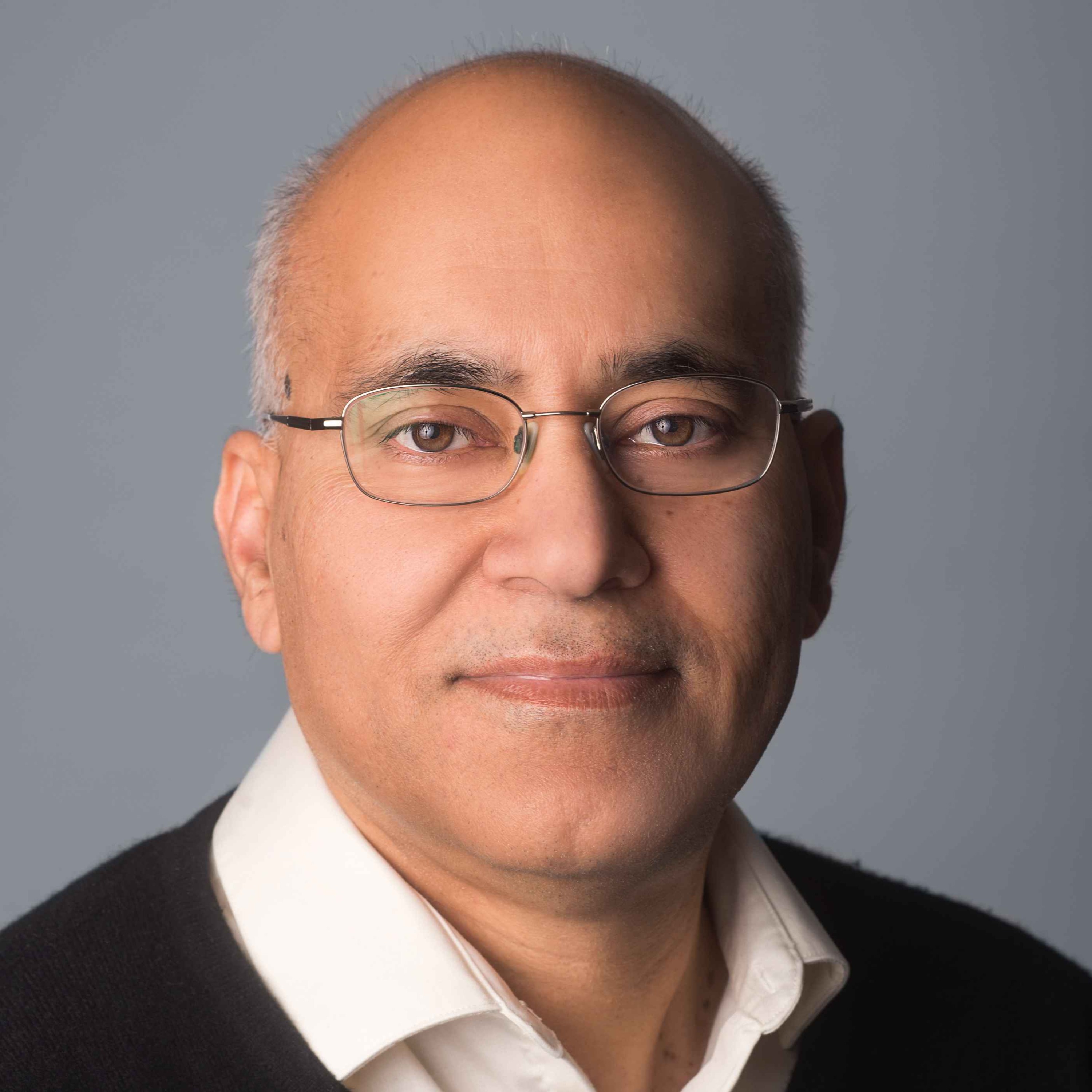
Jitendra Malik on the sensorimotor road to artificial intelligence episode artwork

EPISODE · Mar 24, 2023 · 55 MIN

Jitendra Malik on the sensorimotor road to artificial intelligence

from Berkeley Talks

Jitendra Malik, a professor of electrical engineering and computer sciences at UC Berkeley, gives the 2023 Martin Meyerson Berkeley Faculty Research Lecture called, "The sensorimotor road to artificial intelligence.""It's my pleasure to talk on this very, very hot topic today," Malik begins. "But I'm going to talk about natural intelligence first because we can't talk about artificial intelligence without knowing something about the natural variety."We could talk about intelligence as having started about 550 million years ago in the Cambrian era, when we had our first multicellular animals that could move about," he continues. "So, these were the first animals that could move, and that gave them an advantage because they could find food in different places. But if you want to move and find food in different places, you need to perceive, you need to know where to go to, which means that you need to have some kind of a vision system or a perception system. And that's why we have this slogan, which is from Gibson, "We see in order to move and we move in order to see."For a robot to have the ability to navigate specific terrain, like stepping stones or stairs, Malik says, it needs some kind of vision system."But how do we train the vision system?" he asks. "We wanted it to learn in the wild. So, here was our intuition: If you think of a robot on stairs, its proprioception, its senses, its joint angles can let it compute the depth of its left leg and right leg and so on. It has that geometry from its joint angles, from its internal state. So, can we use it for training? The idea was the proprioception predicts the depth of every leg and the vision system gets an image. What we asked the vision system to do is to predict what the depth will be 1.5 seconds later."That was the idea — that you just shift what signal it will know 1.5 seconds later and use that to do this advanced prediction. So, we have this robot, which is learning day by day. In the first day, it's clumsy. The second day, it goes up further. And then, finally, on the third day, you will see that it ... makes it all the way."Malik's lecture, which took place on March 20, was the first in a series of public lectures at Berkeley this spring by the world's leading experts on artificial intelligence. Other speakers in the series will include Berkeley Ph.D. recipient John Schulman, a co-founder of OpenAI and the primary architect of ChatGPT; a professor emeritus at MIT and a leading expert in robotics, and four other leading Berkeley AI faculty members who will discuss recent advances in the fields of computer vision, machine learning and robotics.Listen to the episode and read the transcript on Berkeley News.UC Berkeley photo. Music by Blue Dot Sessions. Hosted on Acast. See acast.com/privacy for more information.

Jitendra Malik, a professor of electrical engineering and computer sciences at UC Berkeley, gives the 2023 Martin Meyerson Berkeley Faculty Research Lecture called, "The sensorimotor road to artificial intelligence.""It's my pleasure to talk on this very, very hot topic today," Malik begins. "But I'm going to talk about natural intelligence first because we can't talk about artificial intelligence without knowing something about the natural variety."We could talk about intelligence as having started about 550 million years ago in the Cambrian era, when we had our first multicellular animals that could move about," he continues. "So, these were the first animals that could move, and that gave them an advantage because they could find food in different places. But if you want to move and find food in different places, you need to perceive, you need to know where to go to, which means that you need to have some kind of a vision system or a perception system. And that's why we have this slogan, which is from Gibson, "We see in order to move and we move in order to see."For a robot to have the ability to navigate specific terrain, like stepping stones or stairs, Malik says, it needs some kind of vision system."But how do we train the vision system?" he asks. "We wanted it to learn in the wild. So, here was our intuition: If you think of a robot on stairs, its proprioception, its senses, its joint angles can let it compute the depth of its left leg and right leg and so on. It has that geometry from its joint angles, from its internal state. So, can we use it for training? The idea was the proprioception predicts the depth of every leg and the vision system gets an image. What we asked the vision system to do is to predict what the depth will be 1.5 seconds later."That was the idea — that you just shift what signal it will know 1.5 seconds later and use that to do this advanced prediction. So, we have this robot, which is learning day by day. In the first day, it's clumsy. The second day, it goes up further. And then, finally, on the third day, you will see that it ... makes it all the way."Malik's lecture, which took place on March 20, was the first in a series of public lectures at Berkeley this spring by the world's leading experts on artificial intelligence. Other speakers in the series will include Berkeley Ph.D. recipient John Schulman, a co-founder of OpenAI and the primary architect of ChatGPT; a professor emeritus at MIT and a leading expert in robotics, and four other leading Berkeley AI faculty members who will discuss recent advances in the fields of computer vision, machine learning and robotics.Listen to the episode and read the transcript on Berkeley News.UC Berkeley photo. Music by Blue Dot Sessions. Hosted on Acast. See acast.com/privacy for more information.

NOW PLAYING

Jitendra Malik on the sensorimotor road to artificial intelligence

0:00 55:48

No transcript for this episode yet

We transcribe on demand. Request one and we'll notify you when it's ready — usually under 10 minutes.

Carnivores Don't Get Sunburn - Carnivore Diet Talks Carnivores Don't Get Sunburn - Carnivore Diet Talks Welcome to “Carnivores Don’t Get Sunburn,” where we have fun and explore the carnivore diet and its transformative power. Join us as we uncover real stories from individuals who have thrived on this diet, defying convention and embracing optimal health. Plus, stay tuned for our upcoming documentary featuring diverse carnivores overcoming health challenges. Learn more at www.carnivoredietdocumentary.com.Excitingly, we’re working on an upcoming documentary where we’ll feature carnivores from various walks of life, conquering diverse health challenges. Join us on this journey and learn more at www.carnivoredietdocumentary.com.Join us in uncovering the power of the carnivore diet. Prepare to be inspired, informed, and empowered to embrace optimal health and well-being.Welcome to “Carnivores Don’t Get Sunburn: Unveiling Real Stories of the Carnivore Diet.” Stay tuned for our upcoming documentary. Discover how this lifestyle can transform lives. Learn more at www.carnivoredietdocumentary.com IT IS WHAT IT IS with SHALLZ - SHALLY ZOMORODI Shally Zomorodi What?  "It is what it is" with ShallZ – Shally ZomorodiWhen? WeeklyHow long? 35 minutesEvery week, Mother of 4, wife, morning TV news anchor and ultimate hostess, Shally Zomorodi talks about life - its up's and downs and how to stay on track in her weekly podcast, ‘It is what it is.’  Known for her high energy, infectious smile and ability to see the cup as half full Shally talks about all things in life and how to work through its challenges. From parenting, marriage, friendships, current events to how to smile when it just seems impossible ‘It is what it is’ is the perfect podcast to help inspire you to dance through the rain. Tracking Nuclear Weapons Programs Center for Strategic and International Studies The CSIS Proliferation Prevention Program talks to experts about transparency and nuclear weapons. Cover Stories with Chess Life US Chess Chess Life Editor John Hartmann talks to the authors of each month's Chess Life cover story.

Frequently Asked Questions

How long is this episode of Berkeley Talks?

This episode is 55 minutes long.

When was this Berkeley Talks episode published?

This episode was published on March 24, 2023.

What is this episode about?

Jitendra Malik, a professor of electrical engineering and computer sciences at UC Berkeley, gives the 2023 Martin Meyerson Berkeley Faculty Research Lecture called, "The sensorimotor road to artificial intelligence.""It's my pleasure to talk on this...

Can I download this Berkeley Talks episode?

Yes, you can download this episode by clicking the download button on the episode player, or subscribe to the podcast in your preferred podcast app for automatic downloads.
URL copied to clipboard!