
EPISODE · Jun 6, 2025 · 18 MIN
John Gay (1685–1732) The Rogue's Ballad: John Gay and the Subversive Power of The Beggar's Opera
from The Cogitating Ceviché Podcast · host Conrad T Hannon
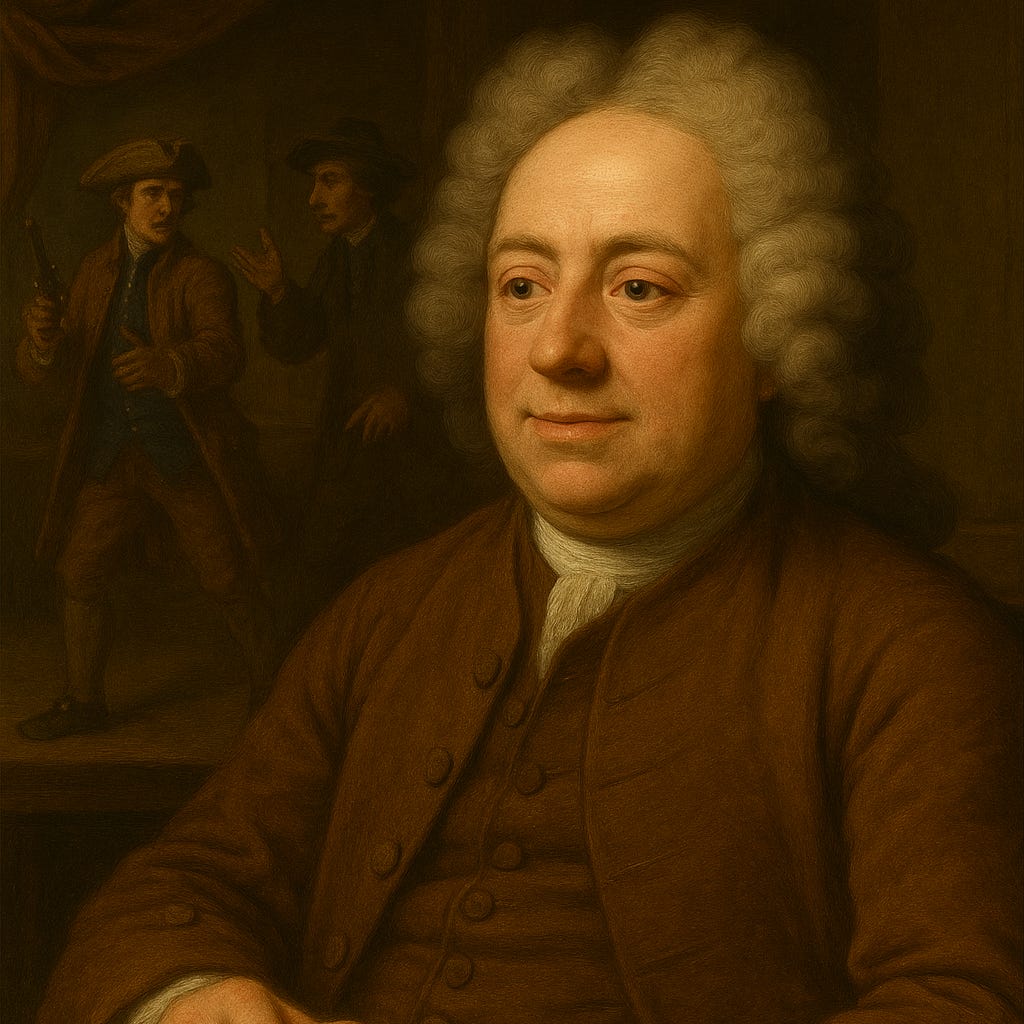
The Cogitating Ceviché PresentsJohn Gay (1685–1732) The Rogue's Ballad: John Gay and the Subversive Power of The Beggar's OperaHonoring the Satirists and Thinkers Who Altered Our Perspectives #80By Conrad HannonNarration by Amazon PollyPrefaceJohn Gay occupies a fascinating place in the history of satire: less acerbic than Swift, more theatrical than Pope, yet no less potent in his political critiques. Best remembered for The Beggar's Opera (1728), Gay transformed London's stage into a mirror of its hypocrisies. His work did not simply entertain—it disarmed, ridiculed, and laid bare the corruption of those in power by aligning them with the seediest characters of society. With wit cloaked in song and criminality, Gay subverted conventions, drew blood with laughter, and made permanent his mark on English letters. What made Gay particularly dangerous to the establishment was his ability to make subversion irresistibly entertaining, wrapping revolutionary ideas in melodies that audiences couldn't help but sing.Early Life and InfluencesJohn Gay was born in Barnstaple, Devon, in 1685, the youngest child in a modest but respectable family of drapers. Orphaned by age ten when both parents died within two years of each other, he was raised by his uncle Thomas Gay and sent to the local grammar school under the tutelage of Robert Luck, a classical scholar who introduced him to Latin poetry and the satirical traditions of Juvenal and Horace. His formal education stopped at fourteen, but the literary education that would define his career was self-driven and fueled by early exposure to classical satire and English poets like Dryden and Butler.By 1706, Gay had relocated to London with little more than his wit and ambition, joining the city's teeming world of letters as an apprentice to a silk mercer—a trade he quickly abandoned for the uncertain but more appealing world of literature. He worked as a secretary to Aaron Hill, a dramatist and entrepreneur, and served as an occasional tutor, including for the young Duke of Monmouth, which provided him entrée into elite literary circles. There, he met figures like Alexander Pope and Jonathan Swift, forming what would later be known as the Scriblerus Club—a collective that waged satirical war against pedantry, political corruption, and literary pretension. The club also included Dr. John Arbuthnot, physician to Queen Anne, whose scientific wit complemented Gay's theatrical sensibilities.The tumultuous political landscape of early 18th-century Britain—split between Whigs and Tories, scarred by the South Sea Bubble financial crisis of 1720, and riddled with systemic bribery under Sir Robert Walpole's administration—offered rich material for Gay's increasingly sharp sensibilities. Though not deeply political by temperament, Gay was a keen observer of social dynamics and eventually became a cunning participant in cultural resistance to Whig hegemony. His association with Tory-leaning satirists like Pope and Swift positioned him squarely against the dominant political establishment, though his satirical targets transcended party lines to encompass the entire corrupt system.Major Works and ThemesThough The Beggar's Opera is by far his most celebrated work, Gay's literary output was remarkably varied: pastoral poetry, verse fables, theatrical farces, and political burlesques. Across genres, however, his wit maintained a steady course—one that prized subversion, delighted in irony, and consistently critiqued vice in both high and low places. His career trajectory shows a writer growing increasingly bold in his satirical ambitions.The Shepherd's Week (1714)Originally commissioned by Pope to mock the artificial pastoral poems of Ambrose Philips (whom Pope derisively called "Namby-Pamby"), Gay's The Shepherd's Week turned out to be a clever, endearing twist on the genre. Rather than idealizing rustic life with classical shepherds spouting refined sentiments, he portrayed its grubbier, more ridiculous aspects—shepherds with names like Cuddy and Lobbin Clout who spoke in authentic rural dialects and dealt with real agricultural concerns like foot-and-mouth disease. This early work signaled Gay's fondness for flipping expectations and his ability to satirize a literary target while simultaneously creating something genuinely entertaining and even affectionate toward its ostensible victims.Trivia, or The Art of Walking the Streets of London (1716)This mock-heroic poem in three books elevated the banal act of urban walking into a subject of poetic grandeur, all while poking fun at the filth, chaos, and absurdity of London street life. Styled after Virgil's Georgics, Trivia captured Gay's ability to satirize without bitterness, offering practical advice about navigating London's hazardous streets while simultaneously mocking the very idea that such mundane matters deserved epic treatment. His London was filthy and dangerous—complete with detailed warnings about falling chamber pots, treacherous puddles, and pickpockets—yet vibrantly alive, a metaphor, perhaps, for England itself. The poem's success established Gay as a master of the mock-heroic form and demonstrated his acute eye for social observation.Fables (1727–1738)Published in two series, with the second appearing posthumously, Gay's Fables were ostensibly moral tales for the young Duke of Cumberland but contained sly digs at political corruption, class hypocrisy, and courtly intrigue. These brief narratives in verse allowed Gay to channel his critiques through animals and allegories, cloaking sharp commentary in accessible rhymes and familiar moral frameworks. The fox, the lion, and the fool became proxies for England's rulers and the dupes they governed. Tales like "The Hare and Many Friends" exposed the hollow nature of fair-weather friendship, while "The Shepherd and the Philosopher" mocked intellectual pretension. The fables' apparent simplicity masked sophisticated social criticism.But none of these works compares in impact to the cultural earthquake that was The Beggar's Opera.The Beggar's Opera (1728): A Satirical MasterstrokeConceived during conversations with Jonathan Swift and encouraged by Alexander Pope, The Beggar's Opera was a revolutionary work that fused low entertainment with high critique. Swift reportedly suggested that Gay write "a Newgate pastoral"—a work that would treat criminals with the same romantic conventions typically reserved for shepherds. Gay's stroke of genius was in using the popular form of ballad opera—set to sixty-nine recognizable tunes borrowed from folk songs, hymns, and popular airs—to tell a story that equated politicians with criminals and the aristocracy with vice. The opera ran for sixty-two consecutive nights in its first season, an unprecedented success that made Gay wealthy and famous while terrifying the government.Critique of Society and PowerAt the heart of The Beggar's Opera lies a simple but devastating thesis: the only real difference between the criminal underworld and Britain's ruling elite is in the clothing they wear and the pretense they maintain. The highwayman Captain Macheath—a rakish antihero with two wives and numerous mistresses—mirrors Sir Robert Walpole, Britain's first de facto prime minister, who was notorious for his corrupt use of patronage and his own extramarital affairs. Peachum, a fence and thief-catcher who profits from both sides of the law, is cast as a stand-in for corrupt party fixers and government informers. The character of Lockit, the prison keeper who takes bribes, represented the entire system of venal justice. The message was unmistakable and inflammatory.Lines such as:"The lawyers are bitter enemies to those in our way, and always hang us when they can catch us."and"Through all the employments of life,Each neighbor abuses his brother,W***e and rogue they call husband and wife:All professions be-rogue one another."drove home the opera's mockery of every tier of English society, from courts to clergy. The famous air "How Happy Could I Be with Either" became a popular street song, with audiences delighting in its cynical view of loyalty and commitment.Audiences—especially London's middling and lower classes—loved it with an enthusiasm that bordered on mania. They recognized the hypocrisy being exposed and relished seeing their social superiors mocked. Aristocrats came to laugh at the criminals onstage, only to realize they were laughing at themselves. The opera's democratic appeal was enhanced by its musical accessibility—everyone could hum along to familiar tunes while absorbing subversive messages.Defense of Justice and ValuesBeneath the cynicism, The Beggar's Opera harbored a genuine moral vision rooted in traditional English values of honesty and fair dealing. It was not an amoral celebration of vice, but rather an indictment of the system that rewarded corruption while punishing honesty. By exposing how easily the criminal and the politician could be mistaken for one another, Gay implicitly argued for a more transparent, accountable society. The opera's moral framework was conservative in the best sense—it called for a return to authentic virtue rather than performed respectability.While Macheath's charisma steals the show, his ultimate fate (ambiguously "pardoned" in a meta-theatrical twist that the Beggar-narrator insists upon to avoid tragic consequences) leaves the audience pondering whether justice can truly be served in a world built on deception and political favors. This ending, which Gay presents as artificially imposed, further emphasizes the artificiality of the entire social system the opera depicts.Gay's satirical targets weren't only politicians. He mocked the entire machinery of polite society: marriage as a financial transaction (exemplified in the arrangements between Peachum and Lockit), morality as social performance, law as elaborate theater designed to protect the powerful while victimizing the weak.Rhetorical Style and TechniquesGay's style is marked by a careful balance—never shrill, rarely vicious, always witty, yet capable of delivering devastating blows through accumulated irony. In The Beggar's Opera, he exploited the jarring contrast between genteel operatic form and grubby criminal content with masterful precision. Traditional operatic arias dealing with noble love and heroic sacrifice were repurposed for bawdy lyrics about prostitution and theft. Familiar tunes—folk melodies, drinking songs, and even hymns—became vehicles for scathing social commentary. This democratization of opera made it both accessible to common audiences and radically subversive of elite cultural forms.He employed irony, parody, and pastiche with remarkable finesse, never allowing any single technique to overwhelm the others. The opening prologue, spoken by a character labeled simply "The Beggar," introduces the opera as a faithful reflection of contemporary society, suggesting that its realism lies not in romantic idealization but in unflattering honesty. By embedding this commentary within the structural framework of the opera itself, Gay turned the entire production into a sophisticated satire on both dramatic genre and social reality.His use of familiar melodies was particularly subversive—audiences found themselves humming tunes associated with criminal characters, effectively internalizing the opera's moral inversions. When respectable theatergoers caught themselves singing Macheath's songs, they were forced to confront their own complicity in the corrupt system Gay was exposing.Controversies and CriticismsThe Beggar's Opera was an immediate sensation—and an immediate threat to established authority. Its success was so overwhelming and its political implications so clear that Gay planned a sequel, Polly, but Walpole and his allies intervened decisively. The sequel was banned from performance in 1729, ostensibly for indecency but clearly for its continuation of anti-government satire and its even more explicit attacks on colonial exploitation and political corruption. In response, Gay published Polly by subscription and made a fortune—over £1,000, a substantial sum—proving that his satire could be censored but not silenced.This act of censorship backfired spectacularly on the Whigs: it boosted sales of the published version, inspired widespread public sympathy for Gay, and exposed the government's insecurity about theatrical criticism. The controversy also deepened Gay's sense of marginalization from mainstream political life. Despite continued support from the Scriblerians and sympathetic aristocrats (including the influential Duchess of Queensberry, who championed Gay at court), his later years were marked by increasing disengagement from the pursuit of official preferment and growing cynicism about political reform.Contemporary critics were divided in their responses. Some saw The Beggar's Opera as vulgar, morally corrupting, and dangerous to public order—Dr. Samuel Johnson later worried that the opera made criminal life appear too attractive. Others, including many in the literary establishment, recognized its satirical sophistication and social value. The moral ambiguity was intentional: unlike many moralists of the time, Gay made his critique genuinely enjoyable—dangerously so—refusing to provide easy moral conclusions or comfortable distance from the corruption he depicted.Impact and LegacyGay died in 1732, just four years after the premiere of The Beggar's Opera, but his legacy proved astonishingly durable and far-reaching. His opera fundamentally reshaped English drama, directly inspiring a new genre—ballad opera—that dominated popular theater for decades and indirectly influencing everything from Brecht's The Threepenny Opera to modern musical satire and political commentary.Influence on Later Writers and ArtistsBertolt Brecht and Kurt Weill's Threepenny Opera (1928), a gritty reworking of Gay's original written exactly two centuries later, adapted Macheath into "Mack the Knife," shifted the setting to a Weimar-era underworld, and intensified the Marxist critique only implicit in Gay's version. Yet the satirical bones of the story remained intact—another corrupt society, another age of masked vice, another popular entertainment that made audiences complicit in their own exposure. Brecht explicitly acknowledged Gay's influence while updating the social criticism for a new era of political upheaval.Gay's innovative blend of humor and social critique anticipated later dramatists like George Bernard Shaw and Oscar Wilde, who also used theater as a means to dissect class privilege and political hypocrisy. His success in embedding radical satire into genuinely popular entertainment laid crucial groundwork for today's politically conscious musicals, satirical television, and other forms of mainstream cultural criticism that challenge power while entertaining mass audiences.Enduring Popularity and Cultural EchoesThe Beggar's Opera has never quite left the stage, appearing in major revivals in every subsequent century and inspiring countless adaptations across different media and national contexts. Its themes—institutional corruption, moral hypocrisy, the performative nature of respectability, and the relativity of moral standards—remain depressingly evergreen. Gay's portrayal of a society where criminals run the government and love is invariably entangled with financial calculation feels, in many ways, more timely now than ever, speaking to contemporary concerns about political corruption, corporate influence, and the commodification of human relationships.Modern scholars continue to debate whether Gay was a genuine revolutionary or merely a wry observer profiting from social discontent. But this ambiguity is part of his enduring brilliance. He did not preach or provide simple solutions. He staged moral complexity. He did not directly accuse specific individuals. He invited audiences to recognize themselves—their own compromises, hypocrisies, and moral ambiguities—in both rogues and judges alike.ConclusionJohn Gay was a satirist of productive paradoxes: gentle yet merciless, subversive yet wildly popular, moralistic without moralizing, revolutionary while remaining personally moderate. In The Beggar's Opera, he built an entirely new form of satirical entertainment—not as a bitter pamphlet or angry denunciation, but as a laughing melody that lingered in the mind and heart long after the curtain fell. His genius was in demonstrating that even the most respectable faces could hide criminal hearts—and that song, laughter, and theatrical spectacle could do more to expose such uncomfortable truths than a thousand earnest sermons or political speeches.In an age when satirical criticism was often confined to print media and elitist literary venues, Gay democratized it with unprecedented success. He made corruption sing in memorable melodies and made the public hum along to their own indictment. As we honor the satirists who fundamentally changed how we see the world and ourselves, John Gay stands as enduring proof that laughter, when properly deployed, can indeed be the sharpest blade of all—cutting through pretense, puncturing false dignity, and revealing the authentic human comedy that lies beneath our most solemn social performances.Thank you for your time today. Until next time, stay gruntled. This is a public episode. If you'd like to discuss this with other subscribers or get access to bonus episodes, visit thecogitatingceviche.substack.com/subscribe
Embed this episode
Ready to play
John Gay (1685–1732) The Rogue's Ballad: John Gay and the Subversive Power of The Beggar's Opera
No transcript for this episode yet
Similar Episodes
No similar episodes found.
Similar Podcasts
No similar podcasts found.