
EPISODE · Mar 28, 2025 · 11 MIN
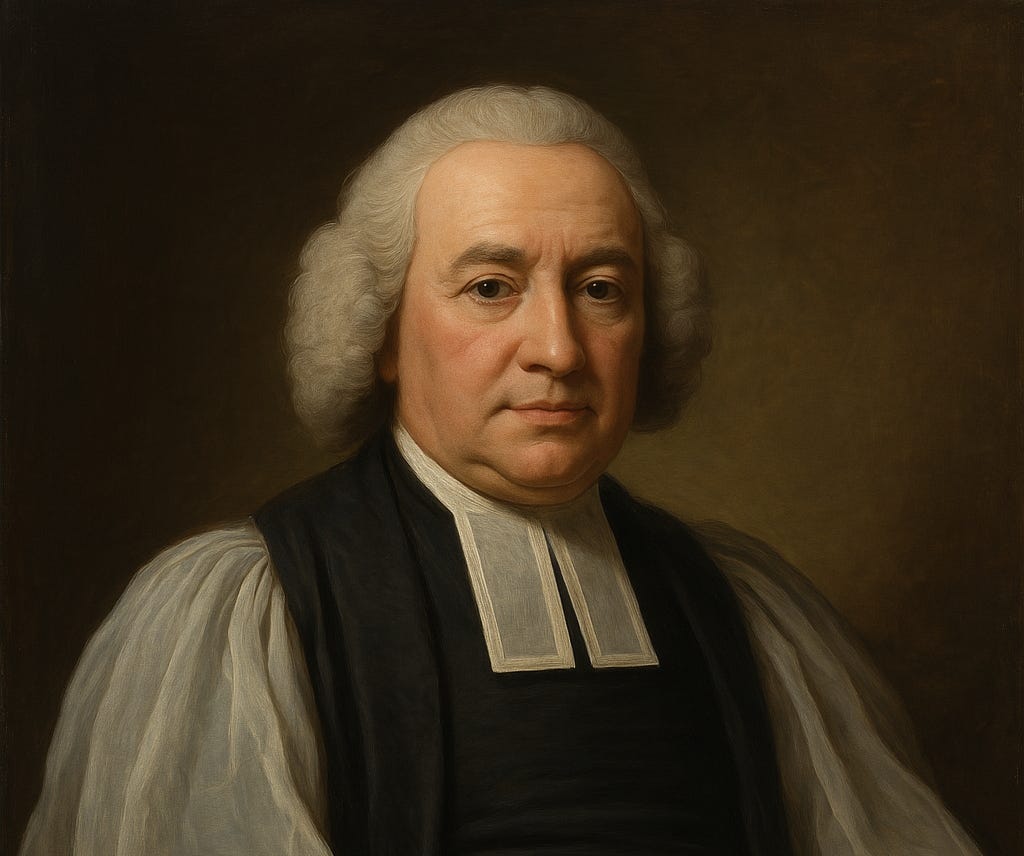
Jonathan Shipley (1714–1788): The Bishop Who Spoke Truth to Empire
from The Cogitating Ceviché Podcast · host Conrad T Hannon
The Cogitating CevichePresentsJonathan Shipley (1714–1788): The Bishop Who Spoke Truth to EmpireEntry #70 – Honoring the Satirists and Thinkers Who Altered Our Perspectives By Conrad HannonNarration by Amazon PollyPrefaceJonathan Shipley stands as a striking figure in 18th-century England: a high-ranking Anglican bishop who did not merely observe political crises from a distance but took the risky step of engaging them—publicly and pointedly. In a time when deference to authority was expected from the pulpit, Shipley used his position to challenge the moral basis of British imperial policy, particularly as it pertained to the American colonies. His advocacy was not cloaked in fiery polemic or theatrical satire. Rather, he wielded reason, scripture, and restraint like a scalpel. In doing so, he embodied a powerful and often underappreciated mode of satire—one grounded in moral gravitas and rhetorical elegance.Shipley’s legacy reminds us that satire is not always loud or mocking. It can be quiet, deliberate, and even delivered from behind a bishop’s desk. His works became essential reading on both sides of the Atlantic, especially in the years leading up to and during the American Revolution, when the need for voices of principle—particularly from within Britain—was both rare and invaluable.Early Life and InfluencesJonathan Shipley was born on March 5, 1714, in Stockbridge, Hampshire, into a clerical family steeped in education and Anglican tradition. His early education at Winchester College—a bastion of classical learning—instilled in him the values of discipline and intellectual inquiry. He later matriculated at Christ Church, Oxford, one of the university’s most prestigious colleges, where he read both theology and the classics.Shipley's upbringing coincided with the early waves of Enlightenment thinking that were spreading through British intellectual circles. He was particularly drawn to the works of John Locke, whose writings on liberty, property, and legitimate government would later echo through Shipley’s own speeches. Similarly, the legal writings of Sir Edward Coke and the parliamentary speeches of earlier constitutionalists such as Algernon Sidney provided historical ballast for Shipley's evolving ideas about political accountability.His path to clerical office was steady and respectable. After several ecclesiastical appointments, he was made Bishop of Llandaff in 1769 and, a year later, Bishop of St. Asaph. Yet what set him apart from many of his peers was not his ascent within the Church, but his willingness to challenge the political status quo in defense of moral principle.Shipley’s family life also reflects a pattern of principled dissent. His wife, Anna Maria Mordaunt, belonged to a family with its own streak of independence, and his children—particularly William Davies Shipley, Dean of St. Asaph—would go on to fight for press freedom and liberal causes. It was a household where faith and free thought were not seen as contradictory.Major Works and ThemesAlthough Shipley was not a prolific pamphleteer, his influence came through a few carefully crafted texts—sermons, speeches, and letters—that circulated widely and resonated deeply. These works were reprinted in London and across the Atlantic, where American revolutionaries eagerly republished them in colonial newspapers and pamphlets.Critique of Society and PowerShipley's Speech Intended to Have Been Spoken on the Bill for Altering the Charter of the Colony of Massachusetts Bay (1774) is his most celebrated political text. Though not a member of Parliament and thus unable to deliver it formally, he composed the speech in protest of the Massachusetts Government Act—a punitive measure imposed by the British government after the Boston Tea Party.The speech directly criticized the notion of collective punishment, expressing outrage at the Crown's decision to strip Massachusetts of its charter and self-governance:“The exercise of arbitrary power, wherever it is found, is an affront to the laws of reason and of God.”The critique was as much theological as it was political. Shipley did not merely object to British policy on pragmatic grounds; he saw it as a violation of divine justice. His speech used careful irony to underscore the hypocrisy of a nation that celebrated Magna Carta while crushing colonial assemblies. He did not accuse ministers of tyranny outright, but his rhetorical questions and scriptural allusions made it difficult to interpret his stance as anything but condemnation.In a sermon delivered in 1773 and published as On the Principles of Government, Shipley spoke plainly of the rights of subjects to resist misrule. He invoked both British constitutional tradition and biblical precedent to argue that unjust governance could not claim moral or spiritual legitimacy. By articulating a vision of authority as rooted in justice rather than force, he subtly ridiculed the imperial pretensions of his own government.Defense of Justice and ValuesAt the heart of Shipley’s satire was a belief in the dignity of the individual and the essential morality of liberty. While many in Britain viewed the American colonists as rebels, Shipley emphasized their lawful resistance and their appeal to principle. His works framed the American struggle not as a revolt, but as a defense of inherited British rights.He praised the intellectual vibrancy of the colonies and contrasted it with what he saw as growing complacency and corruption in British politics. In one letter, he wrote:“They have not fallen into that species of luxury which enfeebles the mind, corrupts the heart, and consumes a nation in its vitals.”This kind of comparative critique—delivered in the tone of moral disappointment rather than fury—lent his satire a unique force. He held up the American example not to romanticize rebellion but to shame Britain into moral reflection.Rhetorical Style and TechniquesShipley’s rhetorical style was a study in contrasts: ecclesiastical decorum meeting political provocation. His use of rhetorical questions, biblical allusions, and understated irony created a tone of calm outrage. Unlike the pamphleteers of the time, who relied heavily on mockery and exaggeration, Shipley assumed the dignity of a cleric and let facts and principle do the work of satire.He frequently used inversion and juxtaposition. For example, by quoting British laws and then pointing to the government’s actions in the colonies, he invited the reader to draw damning conclusions without ever making inflammatory statements himself.His language was also strikingly modern. Shipley avoided the florid prose common among 18th-century clergy and wrote in a clear, accessible style. This made his writings appealing across social classes and geographies, and allowed them to serve as teaching tools for political philosophy as well as religious ethics.Controversies and CriticismsThough Shipley was never formally punished for his views, his outspokenness earned him suspicion and hostility from conservative circles in both church and state. Some in Parliament viewed him as dangerously sympathetic to revolutionaries, while some within the Church worried he was undermining its apolitical stance.His son, William Davies Shipley, would later be prosecuted for publishing a political tract advocating parliamentary reform—an event known as the “Dean of St. Asaph’s Case.” Though Jonathan Shipley was not directly involved, the legal and political persecution of his family reflected the risks associated with dissenting voices, even when clothed in clerical garb.Yet Shipley’s critics often struggled to counter him directly, precisely because his arguments were so steeped in British legal and theological tradition. He did not call for rebellion; he called for consistency between Britain’s values and its policies. This made him a difficult figure to demonize—though many tried.Impact and LegacyJonathan Shipley’s reputation was far greater in America than in Britain during his lifetime. Colonists reprinted his works in newspapers, read them from pulpits, and quoted him in political debates. Thomas Jefferson referred to him with respect, and Benjamin Franklin counted him as an ally. In fact, it was Franklin who praised Shipley’s moderation, writing that his calm tone lent “greater weight to his arguments than any amount of vehemence could have.”Shipley’s writings became part of the ideological foundation of the American Revolution—not because he advocated separation, but because he articulated a moral and constitutional defense of liberty that colonists found validating.In the post-revolutionary period, Shipley’s influence waned in Britain, where radical voices often overshadowed his measured tone. But in modern historical assessments, he has come to represent a unique form of clerical resistance—deeply loyal to principle, skeptical of power, and willing to challenge orthodoxy from within its own ranks.Today, his work remains a valuable resource for students of political theology, legal history, and rhetorical ethics. His legacy is also a reminder that institutions, when inhabited by people of courage, can become tools of critique rather than merely control.ConclusionJonathan Shipley’s life and work exemplify a rare kind of courage—the quiet kind, exercised through logic, faith, and the pen rather than protest or polemic. As a bishop, he had every reason to remain within the boundaries of decorum. Instead, he chose to test those boundaries, using his platform to defend justice and oppose coercion.His satire did not look like satire. It did not provoke laughter or caricature its targets. But it revealed hypocrisy, challenged authoritarianism, and elevated the public discourse. In doing so, it achieved satire’s highest aim: to uphold truth in the face of self-serving power.In honoring Shipley, we honor the idea that even the most traditional institutions can produce voices of dissent—and that sometimes the most effective critics of empire are those who speak from within its walls.Thank you for your time today. Until next time, stay gruntled. This is a public episode. If you'd like to discuss this with other subscribers or get access to bonus episodes, visit thecogitatingceviche.substack.com/subscribe
Embed this episode
NOW PLAYING
Jonathan Shipley (1714–1788): The Bishop Who Spoke Truth to Empire
No transcript for this episode yet
Similar Episodes
No similar episodes found.
Similar Podcasts
No similar podcasts found.