
EPISODE · Mar 26, 2026 · 53 MIN
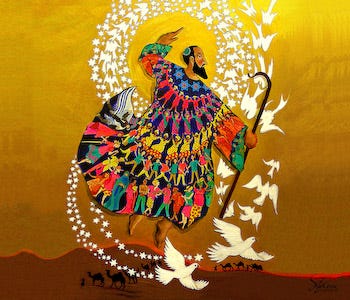
Joseph the Dreamer
from Extra Credit Podcast · host Cameron Combs
The Joseph Story Ep. 1The Jewish scholar Jon Levenson has said that the Joseph story in Genesis “is arguably the most sophisticated narrative in the Jewish or the Christian Bibles.” Chris Green writes that it is “deceptively simple” and that it becomes “more mysterious with every good re-reading.” Taking these two thoughts together we see that the sophistication of the Joseph story is the reason why it becomes more mysterious the more you read it. For many of us this will sound like an odd claim. The Joseph story, as most of us have been taught, is very simple and straightforward. It’s the story of a faithful man who is hated by his brothers, sold into slavery in Egypt, but no matter what misfortune happens to him he remains faithful and God prospers him.While this is not wholly wrong, it also betrays a very simplistic, flattened reading of this “sophisticated” and “mysterious” story. Our simplistic readings are fall into one of two types: (1) practical readings and (2) typological readings.Practical ReadingsIf something is practical you can sell it. The greatest sin of any church or teacher today is to be impractical. We are enslaved to the practical. This means that we expect that every truth should make immediate and easy sense to us and that it should improve our lives. So it is unsurprising that practical readings on the Joseph story abound today.Here are just a few examples that Green gives of popular practical readings of the Joseph story:* “If they think like Joseph, believers can survive ‘in the lean times’ and ‘advance into the season ahead.’” (Shawn Akers)* “You may feel that God is leading you further and further and further away from your dream until the moment it happens. Look at Joseph.” (Mark Rutland)* “Joseph’s faith leads to prosperity. During a worldwide famine, Joseph was in charge of all the food. Now that’s prosperity! God was able to reveal the spiritual secrets that would open the door of success for him. That’s what makes God’s method of prospering so exciting. It works anywhere and everywhere. It will work in the poorest countries on the face of this earth just like it works here in the United States. And you can be sure that it will work for you!” (Kenneth Copeland)You can see how practical readings want to package Joseph and sell the story as something you can use to your benefit. Besides the fact that this is a less than faithful way to read and preach Scripture, none of this is in the text.Typological ReadingsTypological readings of Joseph want to read him as a “type” of Christ. Many throughout church history have noticed the unmistakable likeness of Jesus’s and Joseph’s stories: he is the favored son, he is betrayed by his brothers, he is innocent when he is tempted, he is delivered from prison to a position of power, and he accomplishes a sort of salvation for his family.Joseph is often seen to be one of the “cleanest” and “purest” types of Christ in the Old Testament. Many have said that he is presented to us as “sinless/faultless.” Now, these are vastly superior readings to the practical readings, but we still have a problem. We still aren’t reading the texts of the story closely or carefully. If we think Joseph has no faults, or that he is cleanest and most perfect type of Christ we aren’t reading the actual story very closely. In fact, the New Testament never makes the connection between Jesus and Joseph. That doesn’t mean Joseph isn’t a type, but it does help to remind us to read more carefully.In our eagerness to see Jesus in the text, we fail to actually read the story of Joseph. We rush to impose a lifeless image of Christ on him. With these readings Joseph becomes a mannequin who is only there to model clothes that really belong to Jesus. To quote Green yet again, “Our typological readings often amount to us stamping dead images of Jesus” onto Old Testament texts, narratives, characters rather than discovering his “living likeness” there.A Closer Reading…In the class we tried to do a number of close readings of a few of the texts from the Joseph story. I’ll list them here, but to hear the full explanation you can listen to the podcast.* Joseph is presented at the beginning of the story as “a spoiled younger child who is a tattletale.” His reporting on his own dreams to his brothers reveals an “adolescent narcissism.”* Most surprising and easiest to miss is the fact that Joseph’s dreams are never said to come from God. “This is the first dream recorded in Genesis in which the voice of God does not speak…The absence of any specific divine speech or revelation in the dream accentuates its ambiguity.” This is a significant departure from the way that Genesis relates others who dream earlier in the story. For example: * Genesis 20:3, “God came to Abimelech in a dream and said to him…”* Genesis 28:13, “There above the ladder stood the LORD, and he said, ‘I am the LORD, the God of Abraham and Isaac…’”* Genesis 31:24, “God came to Laban the Aramean in a dream of the night.”* Joseph never prays within the narrative. Even when he interprets the dreams of the cupbearer, the baker, or Pharaoh we are not told that he speaks to God regarding the interpretations. Samuel Draper writes, “Joseph rhetorically says, ‘do not all interpretations (of dreams) belong to God?’ Yet he then proceeds to interpret them with no further reference to the divine. This same pattern occurs with Pharaoh’s dreams in chapter 41 where Joseph attributes the interpretations to God, but God is not seen to act himself in inspiring Joseph’s interpretations.”* Joseph’s plan for the 7 years of famine has the effect of centralizing all of Egypt’s wealth and power to Pharaoh and enslaving all the people to Pharaoh. But it is Joseph’s own policies that will end up being forced onto his own children generations later. Joseph’s enslaving of Egypt has the consequence of enslaving his own people generations later.* Gen. 47:21-22: “So Joseph bought all the land of Egypt for Pharaoh. All the Egyptians sold their fields, because the famine was severe upon them, and the land became Pharaoh’s. As for the people, he made slaves of them from one end of Egypt to the other.”Rabbi Arthur Waskow provides an alternative reading which points most of this out. Waskow observes that when Joseph is given the chance to interpret Pharaoh’s dreams, he does not pause to ask God for guidance. What if Joseph had asked God for wisdom? Waskow writes:“What might have happened if Joseph had asked God for guidance, and God had answered. How might God have told him to deal with the danger of famine? We have a hint: God’s command of how to prevent famine in the Land of Israel. Each year, every landholding family must let the poor gather grain from the corners of the field. In the seventh year, the land must lie fallow and all debts must be forgiven. The seventh year? How instructive! Perhaps Pharaoh’s dream should have been interpreted to say: There will be seven years of plenty. If you reap all seven years, there will follow seven years of famine. If you reset in the seventh year, you will have enough to eat. What Joseph hears and what he creates is almost precisely the reverse of the process that God later commands for the Land of Israel. Could that command have come earlier? Would God have made the Teaching available as soon as anyone asked?” This is a public episode. If you would like to discuss this with other subscribers or get access to bonus episodes, visit cameroncombs.substack.com
NOW PLAYING
Joseph the Dreamer
No transcript for this episode yet
Similar Episodes
Mar 26, 2026 ·1m
Jan 2, 2026 ·47m
Dec 21, 2025 ·46m