
EPISODE · Apr 22, 2025 · 48 MIN
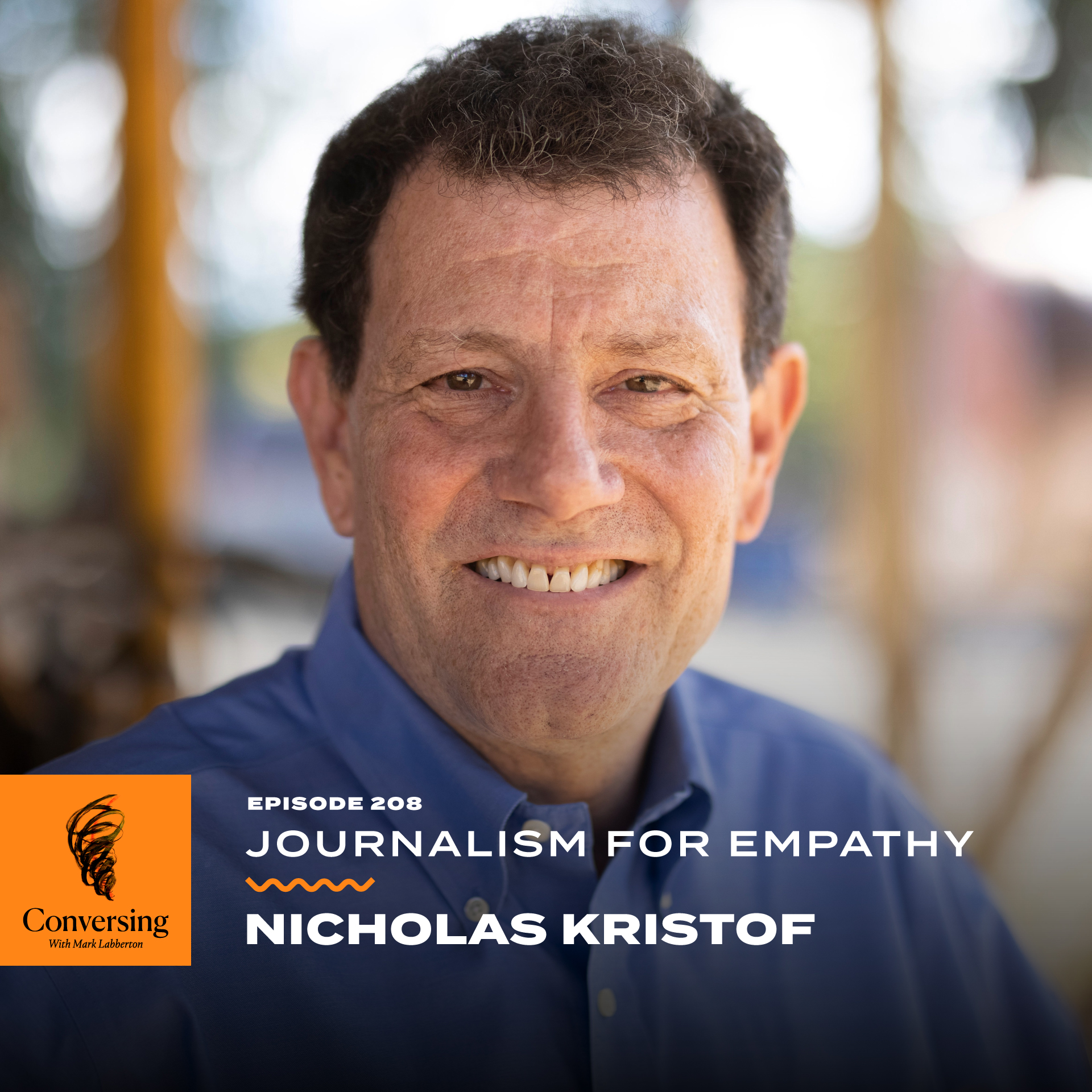
Journalism for Empathy, with Nicholas Kristof
from Conversing with Mark Labberton
Two-time Pulitzer Prize–winning journalist Nicholas Kristof (opinion columnist, the New York Times) reflects on his career of reporting from the front lines of injustice and human suffering, discussing hope, human resilience, and the urgency of responding to global injustice. An advocate for empathy-driven journalism that holds power accountable and communicates the stories of the most vulnerable, Kristof joins Mark Labberton in this episode to discuss his life's work of reporting from the world's most troubled regions—from Gaza to Congo, from rural Oregon to global centres of power. Known for his unsparing storytelling and deep empathy, Kristof shares the family roots and personal convictions that have shaped his lifelong pursuit of justice and hope. They also explore how despair and progress coexist, the role of faith and empathy in healing, and how local acts of courage can ripple globally. Grounded in gritty realism, but inspired by everyday heroes, Kristof invites us to resist numbness and embrace a hope that fights to make a difference. Stories from Gaza, Congo, Pakistan, and beyond Balancing heartbreak and hope in humanitarian reporting Why empathy must be cultivated and practiced The global impact of Christian activism and its complexities Episode Highlights "Side by side with the worst of humanity, you find the very best." "We focus so much on all that is going wrong, that we leave people feeling numb and that it's hopeless … but people don't want to get engaged in things that are hopeless." "Empathy is something that, like a muscle, can be nurtured." "The worst kinds of evil and the greatest acts of courage are often just one decision apart." "We are an amazing species—if we just get our act together." "You can be sex positive and rape negative. I don't think there's an inconsistency there." About Nicholas Kristof Nicholas Kristof is a two-time Pulitzer Prize–winning journalist, and is an opinion columnist for the New York Times, **where he was previously bureau chief in Hong Kong, Beijing, and Tokyo. Born, raised, and still working from his rural Oregon home, Yamhill, he is a graduate of Harvard and was a Rhodes Scholar at Oxford. He is the co-author, with his wife Sheryl WuDunn, of five previous books: Tightrope, A Path Appears, Half the Sky, Thunder from the East, and China Wakes. In 2024, he published a memoir, *Chasing Hope: A Reporter's Life.* Books by Nicholas Kristof Tightrope A Path Appears Half the Sky Thunder from the East China Wakes Chasing Hope: A Reporter's Life Helpful Resources International Justice Mission Dr. Denis Mukwege – Nobel Peace Prize PEPFAR: The U.S. President's Emergency Plan for AIDS Relief Tim Keller's Final Interview with Kristof (NYT) Show Notes A voice of conscience How a global orientation for journalism developed Kristof reflects on his humble roots in Yamhill, Oregon, as the son of two immigrants "My dad was a Armenian refugee from Eastern Europe. His family had spied on the Nazis during World War II. They got caught. Some were executed by the Nazis, others were executed by the Soviet communists, and my dad was very lucky to make it out alive and was sponsored by a family in the US in 1952." "I think that one fundamental mistake that bleeding hearts make, whether they're bleeding hearts in journalism or in the non-profit community or in advocacy, is that we focus so much on all that is going wrong that we leave people feeling numb and feeling that it's hopeless, so there's no point in engaging. And there's pretty good evidence from social-psychology experiments that people don't want to get engaged in things that are hopeless. They want to make a difference. And so I think that we need to both acknowledge all the challenges we face but also remind people that there can be a better outcome if they put their shoulder to the wheel." Extraordinary changes for justice and what's going right David Brooks: "A deeply flawed country that also managed to do good in the world." "It just breaks my heart that kids are dying unnecessarily." On losing PEPFAR foreign aid: "I hope that this damage can be repaired and that bleeding hearts of the left and the right can work together to try to help restore some of these initiatives." The tragedies that followed from dismantling USAID Kristof's book Chasing Hope "The fact is that I've seen some terrible things, and I think I may have a mild case of PTSD from, you know, seeing too much." Nicholas Kristof on Gaza: "I don't see Israel and Hamas as morally equivalent, but I absolutely see an Israeli child, a Palestinian child, and an American child as moral equivalents. And we don't treat them that way." "What human beings share is that when terrible things happen, some people turn into psychopaths and sociopaths, and other people turn into heroes." Cowardice and malevolent tendencies Empathy can be nurtured Children dying without anti-retroviral drugs in South Sudan Empathy Project in Canada Mass literature to inspire perspective taking Uncle Tom's Cabin Black Beauty and animal rights/well-being Kristof's run for Oregon governor Eastern Congo and UNICEF "A child is raped every thirty minutes in Eastern Congo." Dr. Denis Mukwege, Nobel Peace Prize laureate treating women brutally injured by militia rape in Bukavu, a city in eastern Democratic Republic of the Congo. Small gestures of compassion as an empathy grower for local communities "One of the lessons I think of Congo is that violence can be and inhumanity can be terribly contagious." Genocide in Rwanda in 1994 The global sex-trafficking crisis "We don't have the moral authority to tell other countries to do better unless we clean up our own act." The American sex-trafficking crisis: systemic failures such as foster care pipelines into trafficking "There are no statistics, but I think it's plausible that a girl in foster care is more likely to emerge to be trafficked than she is to graduate from a four-year college." American sex-trafficking practices by PornHub and X-Videos: "Their business model is monetizing kids." "You can be sex positive and rape negative. I don't think there's an inconsistency there, and I, I think we've just blurred that too often." Christianity's disappointing response to injustice Nicholas Kristof's engagement with the activism and theology of the Christian church William Wilberforce's anti-slavery movement in the 1780s President Bush's establishment of PEPFAR in 2003: "This incredible program to reduce the burden of AIDS that has saved 26 million lives so far. It's the most important program of any country in my adult lifetime in terms of saving lives." "Evangelicals are very good in terms of tithing and donating money to good causes, but they've often opposed government programs that would create opportunity and address these problems." "Liberals are personally stingy, but much more supportive of government programs that that make a difference." Criticizing the dismantling of global aid programs like USAID: "How can you read the Gospels and think this is good?" "I think being part of a religious community has led people to do good works together." Christian advocacy for freedom of religion Kristof on scripture and belief: "We read the Bible and develop our religious views, and I think so often just reflects our priors rather than what the text says." A closing example of hope: The Afghan war "We are an amazing species if we just get our act together." Production Credits Conversing is produced and distributed in partnership with Comment magazine and Fuller Seminary.
NOW PLAYING
Journalism for Empathy, with Nicholas Kristof
No transcript for this episode yet
Similar Episodes
Mar 26, 2026 ·1m
Jan 2, 2026 ·47m
Dec 21, 2025 ·46m