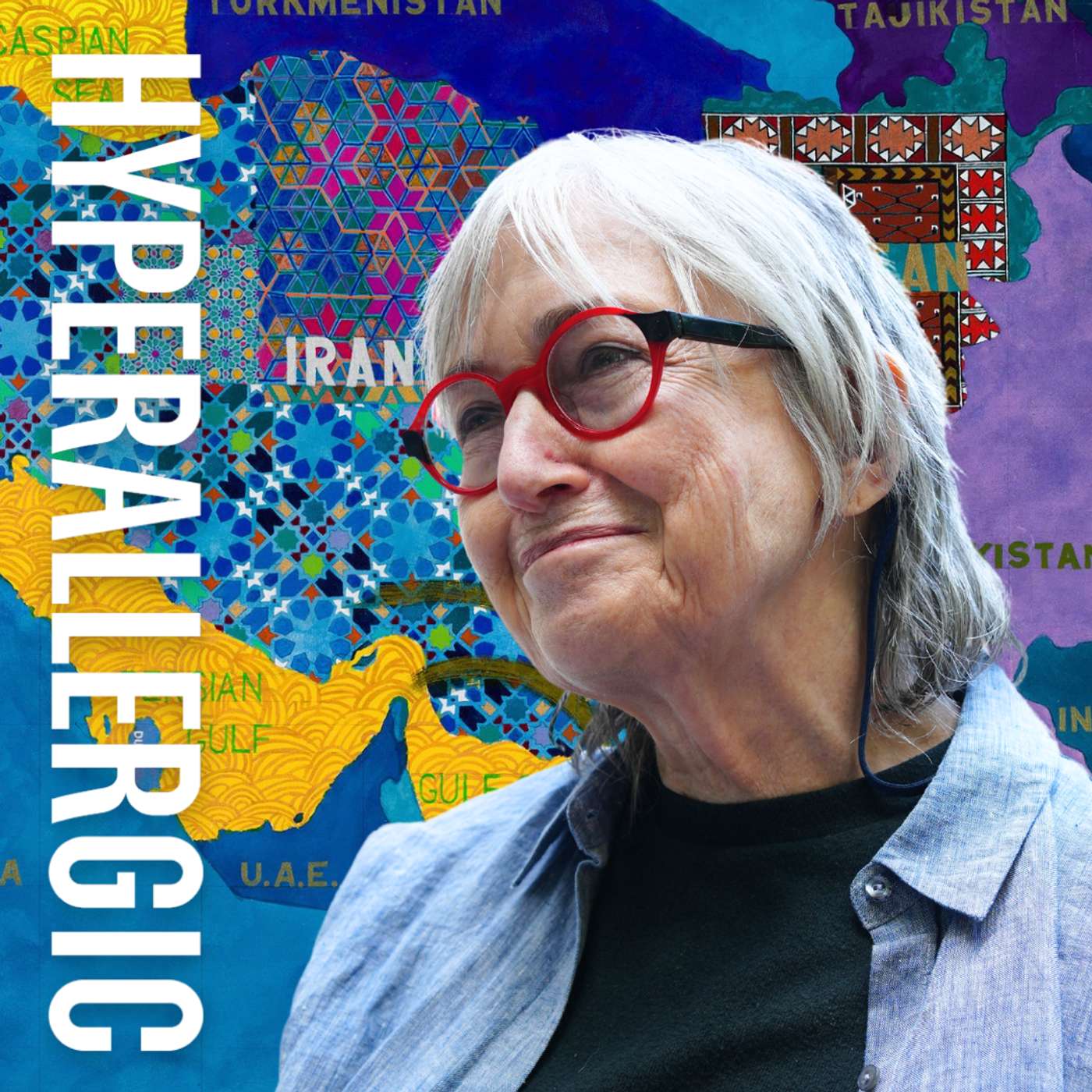
Joyce Kozloff’s Patterns of Protest
from Hyperallergic Hosted by Hyperallergic
In 1973, gallerist Tibor de Nagy gave Joyce Kozloff a call. His voice quivered as he told her that Clement Greenberg had just left the back room after giving a searing review of her latest work. Greenberg had scoffed at the artist’s “Three Facades” (1973), a painting based on the rich tapestry of interlocking bricks and tiles on Churrigueresque church facades in Mexico, and said that it “looked like ladies’ embroidery” — as if that was a bad thing. Kozloff told us that “Tibor freaked out” and asked her “to take it away.” Greenberg had unwittingly dismissed the first of the artist's paintings in a major art movement of which she was a key founding member: Pattern and Decoration, also known as “P&D,” which grew out of the flowering folk revival and feminist protest era of the 1970s. Fed up with hard-edge abstraction and minimalism favored by the White men who dominated the art world, P&D leaned into lush decorative surfaces, cultural adornment, and unapologetically crafty aesthetics. Of course, it was critics like Greenberg whom P&D was revolting against. He’s cited twice in a 1978 article Kozloff co-wrote with Valerie Jaudon, “Art Hysterical Notions of Progress and Culture.” Published in the feminist art journal Heresies (of which Kozloff was also a founding member), they wrote that in “rereading the basic texts of Modern Art … we discovered a disturbing belief system based on the moral superiority of the art of Western civilization.” They “came to realize that the prejudice against the decorative has a long history and is based on hierarchies: fine art above decorative art, Western art above non-Western art, men’s art above women’s art.” Luckily, Kozloff’s career wasn’t up to Clement Greenberg. Kozloff went on to have dozens of shows, beautify over a dozen buildings and transit systems with public artworks over the decades, and inspire new generations of artists to unabashedly lean into ornament. Once an active member of the peace protests of the 1960s, she has also continued her political activism, which in the 21st century has become more explicit in her work. Her all-over pattern paintings have morphed into detailed maps, from Civil War battle plans exploding with viruses to aeronautical charts dotted with points that the United States has bombed. In this episode of the Hyperallergic Podcast, you’ll hear the interview our Editor-in-Chief Hrag Vartanian recorded with Kozloff just after the opening of With Pleasure: Pattern and Decoration in American Art 1972–1985 at Bard College’s Hessel Museum of Art, which the institution called “first full-scale scholarly North American survey” of the P&D movement. They talk about everything from her mother’s embroidery to her travels in Turkey and Iran that inspired her art. You’ll also hear from Hyperallergic Staff Writer Maya Pontone, who reported this past year about Kozloff’s iconic public artwork in Cambridge’s Harvard Square train station that’s currently at risk of disappearing. And if you’ve been listening closely this season, you’ll recognize some recurring characters: Columbia professor Stephen Greene; the Heresies collective; Joyce’s partner, writer Max Kozoff, and; of course, Clement Greenberg. Works from three of Kozloff’s latest series, Uncivil Wars, Boys’ Art, and Social Studies, are on view in the Map Room at Argosy Book Store (116 East 59th Street, Upper East Side, Manhattan) through January 25, 2025. (00:00) - Intro (04:13) - Childhood (07:35) - Art School at Carnegie Mellon and Columbia University (22:04) - From abstraction to patterns (27:39) - Joining the feminist movement in California (41:01) - The Heresies collective (44:46) - First Pattern and Decoration painting (46:45) - Forming the Pattern and Decoration movement (55:42) - The 1980s and public art (57:03) - Maya Pontone on the deterioration of Kozloff’s Harvard Square Mural (01:05:01) - Paintings of maps (01:07:52) - Political activism in and outside the studio (01:18:11) - Civil War series (01:21:17) - Making work about war (01:28:46) - Advice for artists (01:32:01) - Outro Subscribe to Hyperallergic on Apple Podcasts, and anywhere you listen to podcasts. This episode is also available with images of the artwork on YouTube. — Subscribe to Hyperallergic Newsletters This podcast is made possible by the support of our members. Join us today at hyperallergic.com/membership.
Embed this episode
Chapters
- 0:00 Intro
- 4:13 Childhood
- 7:35 Art School at Carnegie Mellon and Columbia University
- 22:04 From abstraction to patterns
- 27:39 Joining the feminist movement in California
- 41:01 The Heresies collective
- 44:46 First Pattern and Decoration painting
- 46:45 Forming the Pattern and Decoration movement
- 55:42 The 1980s and public art
- 57:03 Maya Pontone on the deterioration of Kozloff’s Harvard Square Mural
- 1:05:01 Paintings of maps
- 1:07:52 Political activism in and outside the studio
- 1:18:11 Civil War series
- 1:21:17 Making work about war
- 1:28:46 Advice for artists
- 1:32:01 Outro
No transcript yet.