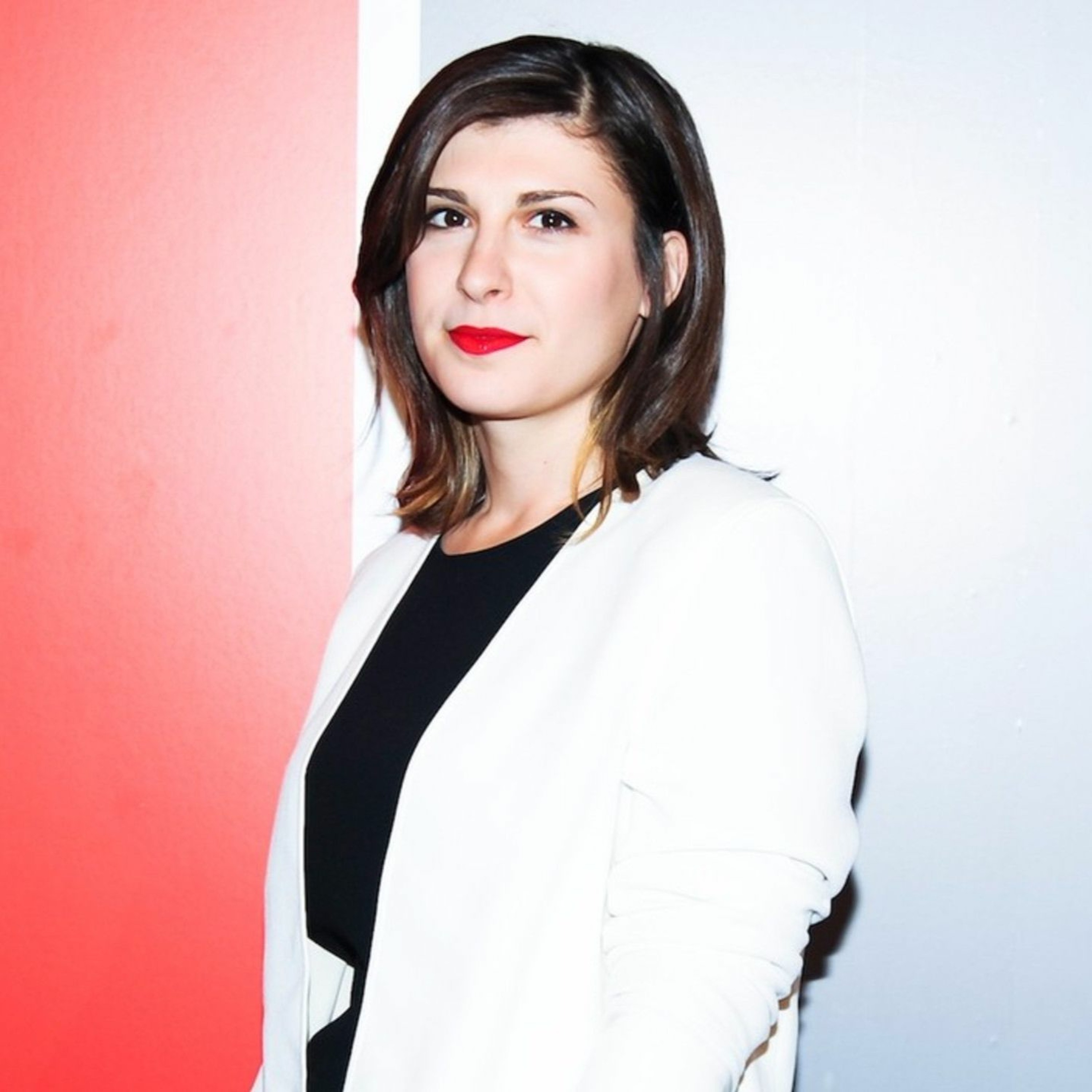
The opinions expressed in this podcast do not necessarily reflect those of ACMI. I'm Katrina Sedgwick. I'm the director here. And today's a really great opportunity to kind of have a conversation about what we're doing and in particular what Julia Kagansky is doing over at New Ink in the New Museum in New York. It's just been a wonderful piece of sort of opportunistic timing that you're on this side of the world over in New Zealand and able to pop over and visit us. But we're really excited about New Ink at the New Museum and indeed it was a bit of an inspiration for us as we started thinking.
18 months ago, really, about moving our office and establishing a co-working space at ACMI. And I had the opportunity to very quickly run through their space, I think, in May last year. I think I got to talk to you for about five seconds. But it was just fantastic to see what they did as a kind of real groundbreaker in this new kind of philosophy, I suppose, behind what a museum is in its community and what are new ways that we can leverage this incredible asset and engage with the community in different ways. So the way we're going to run today is... I'm going to introduce Julia to you a little more formally, and then Julia's going to do a bit of a presentation.
about New Museum and New Inc. So without further ado, I'll introduce Julia. So Julia's a curator and an editor and a cultural producer. And I think we're increasingly going to see that word producer appearing in the museum environment. That creative producer role is so key. And her particular focus is on the intersection of art and technology. She's currently the director of the new museum's art, technology and design incubator, New Inc. But previously, she was the global editor of the Creators Project. And I'm going to get you to talk a bit about that as well, because I think that's got a lot of relevance to the conversation today. That was an international arts initiative set up by Vice and...
Intel, and really ahead of its time, dedicated to showcasing the ways that technology can enable creativity. So how do we harness these tech tools to enable new ways of making art and interaction? Julia is also the founder of the New York Times acclaimed arts tech. was hashtag arts tech meetup. And again, I'm really interested to hear you talk a little bit about that as well. It's a monthly event series, which again explores this art and tech intersection. And she was also the co-founder and curator of Blue Box Gallery, which is a pop-up gallery dedicated to bringing new media art to a rotating host of urban alternative spaces. She's really passionate about...
the opportunities that technology brings to the arts generally and how, not only to its kind of practice, to the making of work, but also to how audiences access and interact with that work. And that's a really interesting kind of double definition of potentialism. So, Julia, please come to the podium and give us a bit of a show and tell. Thank you so much for the kind introduction, Katrina, and for hosting me. And thanks also to Seb. It's been a really warm welcome here. So I'm going to tell you a little bit about New Inc. And it's not very often that I get to talk about this project in a space that feels so familiar and resembles our program so closely in a number of different ways. So I'll try and keep it brief because I think the conversation is going to be maybe the most rewarding aspect of this afternoon. So the new museum situated here on the left, this blocky building.
was founded almost 40 years ago in 1977. It's a contemporary art institution. It is not a collecting institution, but it was founded by a curator named Marsha Tucker, who wanted to engage with contemporary art, with artists who are making and working today. And at the time, museums weren't really showing contemporary art, which is hard to believe today when everyone is just obsessed with it. But it's been a kind of radical, future-leaning, experimental institution throughout its history because it's focused on the present and the future. And because, you know, unlike many museums, it doesn't have a permanent collection to maintain, so it's always glancing.
at what's coming next as opposed to what came before. And in 2007, we moved into this beautiful building on the Bowery designed by the architect Sana. It was our first permanent building after 30 years of temporary spaces in the Soho area. And the following year, this building with the circle around it came onto the market. And the board of trustees felt that it was just very lucky that the building next door should come available. And we bought it. And then shortly after, the recession happened. So as you can imagine, we didn't do a whole lot with it after requiring it.
I think around 2010, 2011, the museum started really engaging with the city in a different way. I mean, of course, the recession really created a financial crisis. And in 2011, the museum started a festival called Idea City, which was looking at what is the future of cities? What is the role that culture can play in our cities? And I would argue that at this point, the museum started thinking of itself as a citizen and not just as a public servant institution. And I tell you all of this because I really think that these
ideas informed New Ink eventually. So we launched New Ink in September of 2014. It occupies the second floor here in this building next door, 8,000 square feet. And we'll soon be adding another 4,000 square feet, which is, I guess, you are 400 square meters, on the fourth floor of the building where we'll have a fabrication lab and production space. We currently have some basics, some 3D printers, a laser cutter, some stations for soldering and making. But for the most part, it's office space, much like it is here, but much whiter with some chrome accents.
And when we started New Ink, it was the first museum-led incubator. We chose to focus on art, design, and technology. And I want to talk a little bit about why. So New York... graduates more art and design students than any other U.S. city. And a survey that came out in 2014 saw that 88% of them who want to stay and build their businesses and careers in New York felt like they didn't have the adequate business and entrepreneurship skills in order to do so. And in the States, as you know, we have quite a different arts patronage model than you guys do here. There's just much less public funding and support of the arts. And it really does require a kind of more enterprising approach, which is why platforms like Kickstarter have been so popular.
in the States in such an important way to finance projects and enable creative work to happen. The other thing is kind of a broader shift in the nature of work today. We are seeing a move towards a freelance work culture, not always for the right reasons. Sometimes it's because permanent jobs are disappearing and there is a kind of precarious nature of work that is emerging that is being sold to us as empowerment. Quit your day job, do what you love, set up your shop on Etsy. You can be a photographer, a graphic designer, whatever, which is true to a point, but it also is kind of part of this macro trend that has many other factors.
In the creative industries, we're not always adequately prepared to take on that entrepreneurial way of working that even as a freelancer, knowing how to contract, how to protect yourself legally, financially, is not something that we necessarily learned in school. So we kind of saw this gap that existed. As a cultural institution, we were very familiar with artist residencies, of course, and the museum still runs artist residencies that are related to some of the exhibitions that we run. But, of course, this creative industry space wasn't being served by that. There were many co-working spaces proliferating around New York, as I'm sure there are here.
Again, they didn't have that kind of professional development business training aspect that an incubator does. Then there were kind of tech incubators, and I would actually argue that most of them are tech accelerators who are designed to take a company that is kind of nascent and really help them grow rapidly. And they're designed to scale, to attract investors, and provide exponential returns on those investments. So they're very much kind of venture capital oriented, whereas historically incubators have actually been nonprofit organizations that are designed to help small business communities stay alive. and afloat in these very volatile first two years of their existence.
And then there were many kind of university media labs that were increasingly cross-disciplinary. Of course, MIT's Media Lab is maybe one of the most famous examples, and they refer to themselves as being anti-disciplinary. In New York, we also have NYU's Interactive Telecommunications Program, and some new programs that were being initiated by some of the other schools, like the Parsons Transdisciplinary Design. SVA, I think, has a similar program. So these spaces were encouraging collaboration across disciplines as a way to foster new ideas, as a space that, quote-unquote, breeds innovation.
So all of this kind of informed our thinking about the kind of program that we wanted to build. I wouldn't say that we are squarely situated in any of these models, but we're kind of borrowing and adapting aspects of them to create something new that we felt was really missing from the community. So we started the space in September of 2014. We had 40 full-time members start off with us and initially 20 part-time members. They're a very versatile bunch. They span a number of different industries, all kind of under this umbrella of art and design, with technology being a connective through line among them. And they range from individual teams to teams as large as four who are pursuing everything from visual art to film, music, dance, fashion, graphic design, architecture, product design. And I'll get into a little bit more of that.
in a bit. We were able to build this space because the New Museum's Board of Trustees committed $2 million towards the capital campaign, towards renovating the building, building out the space. And then after that, it was designed to be kind of self-sustaining. We assembled a really fantastic board of advisors to help steer and guide this initiative. As a museum, of course, we didn't have much experience with incubators or running this kind of professional development program. So we called on some people like Fred Dust, who's a partner at IDEO, Andy Weissman, who is at one of the best VC firms in the City Union Square Ventures, Yancey Strickler, who's the CEO of Kickstarter, and even some folks from our own staff like Lauren Cornell, who leads art and technology initiatives at the museum, to help direct this vision that we had.
And these are some of the goals that we set for ourselves. We wanted to, first and foremost, foster this kind of vibrant interdisciplinary community, look at the way that creative practitioners were working in the city, and how can we bring them together and connect them to each other, break through some of the silos that have historically existed, but increasingly these kind of lines were becoming more porous in a way. We wanted to establish a new platform to support creative work, work that was too entrepreneurial for a typical artist residency, not necessarily work that our curators would curate into exhibitions, but that we felt was doing something interesting in the creative industries that we wanted to help support and help develop further.
front of an audience. We wanted to investigate new models for sustainable creative practice. The digital era offers not only new tools for making, but also new ways of accessing audiences, of funding your project. And some of the existing business models maybe don't work as well, but then there are new models that are emerging, like, again, crowdfunding, that are allowing... individuals and businesses to work in new ways, to explore new ideas at the intersection of culture and technology, expand our impact through collaborations with civic and industry partners. We've done a couple of smaller collaborations with, say, companies like Microsoft Connect, which is a tool from Microsoft that I'll talk about later that many of our members were already using in their installations. I'm sure you guys are familiar with some of that and see how they could support some of that work. And we're about to announce, actually, on Friday, a new partnership with Bell Labs, which is a very kind of important historic tech innovation.
Lab in New Jersey that led some of the first art and technology collaborations in the 60s with their experiments in art and technology program. And to also catalyze the growth and development of New York City's creative economy. And that creative economy piece is one that is maybe most important and most unusual for a museum to look at. What are the creative industries? This is a snapshot that I got from creative startups online. And I would say that most of these, if not all of them, are represented in New Inc.'s community of members. If not currently, at some point we have had an individual or a company that is working in all of these sectors. And why does it matter? Well, I mean...
If you're talking to money people, you can talk to them about facts and figures. But this weekend, I went to Mona in Tasmania, and everyone I talked to talked about how important that museum has been for transforming that city and Tasmania as a whole. And I think we can also see the effects that cultural institutions have towards really transforming the cities that they exist in and how it... manifests in those communities in tangible and intangible ways. And again, here in Victoria, it sounds like you guys are very progressive in terms of arts funding in order to attract creative people to cities like Melbourne. And so again, this is probably not surprising to you, but I feel like the creative sector and the arts are often seen as this very cute thing that happens over here, but really measuring the economic impact of this work I think is important. And finally, I think we also had this belief that
The innovation sector that New York, at least, was investing in attracting startups and technology companies to compete with Silicon Valley wasn't the only space that could produce innovation and new ideas. And that, in fact, as one of our advisors likes to say, that engaging with culture, with the arts, with human experiences is vital to breeding innovation. And so how do we, on the one hand, facilitate that and foster that, but on the other hand, also champion it and really make that work visible in the community? So a little bit about the program, what it is that we actually do.
New Inc. is a 12-month program. It follows the kind of academic cycle. We start in September. We end in August. We have currently 40 full-time and 40 part-time members working in the space. They apply to be there. They're selected. It is curated to be almost kind of like an ecosystem. We do think about how do these individuals and groups complement one another? What are the collaborations and the relationships that might form out of them sitting in the same space and working within proximity of one another? How might they challenge each other's way of working and expose one another to new ways of thinking that they may...
not have been exposed to in other kind of more homogenized spaces. We have two anchor tenants. One is Rhizome, which is a long-term affiliate of the museum. They've been affiliated since 2003. And they are a digital-born arts institution.
They initially focused on internet-based art, and now they do a lot of work with digital preservation and kind of looking at digital culture and the arts more broadly. And our other anchor tenant is Columbia University's Graduate School of Architecture, Planning, and Preservation, who run a kind of incubator within our incubator where they've selected 20 students, or actually post-grads, so people who have graduated from the school, who are starting studios and businesses today to be at New Inc. as well. Similar to Acme X, our members pay $600 a month for full-time or $350 a month for part-time, which is about equivalent to a fancy co-working space in... lower Manhattan, but with the added benefit of this curriculum that we've been developing. Members retain 100% of their intellectual property, and we don't function as an accelerator, obviously, because we have, on the one hand, this longer time frame, and on the other hand, because we're equally interested in non-profit projects, in artistic projects, as we are in startups and in companies that are going to reach a mass consumer audience.
What we offer, weekly professional development programs, a mentorship program where we match each of our members with a dedicated mentor, some shared equipment and resources, which we're currently in the process of expanding, office hours with new Inc. staff and new museum staff, as well as outside experts who we invite in to talk about everything from legal questions to insurance to marketing and branding and storytelling to grant writing, any kind of topic that we see a large number of the community is needing some guidance in. And we have a team of five support staff and are growing. We just started our third year in September. And this is kind of a quick snapshot of the composition of our community. We have individual artists and creative practitioners who are doing work that is not commercial but has a kind of business administrative challenge. And I'll give an example of that later. And they need to figure out how to finance it, how to market it, how to brand it, how to potentially travel it and get it out into the world. There's design studios. And these are folks who work with clients. So they do client commissions. But oftentimes, this is a way of subsidizing their own self-directed creative work that they want to be doing but hasn't really developed a full market for.
juggling and trying to figure out how to do more of the work that they want while using their very valuable skills to make a living. Then we have startups that are building digital or physical products, all kind of, again, rooted in the creative industries. And I'll show a few examples. And this year, more nonprofits than we've ever had. And we're actually seeing more and more nonprofits apply. And I would also put kind of social enterprise projects in that bucket as well.
We've been really interested in diversity. As an interdisciplinary space, I would argue that kind of cognitive diversity has been part of our focus since the beginning. We really wanted to bring all of these skills together out of this sort of hypothesis that they will breed new ideas through that kind of creative collision. have taken a long, hard look at what is the representation of women, of people of color in our community as well because both the tech sector and the arts, quite frankly, are notoriously very white and very male-dominated. So we wanted to make sure that we weren't replicating those same biases in our program. Over the past three years, we've increased the caliber of applicants and hope to continue to do so. And we've also increased the number of financial assistance that we're able to provide because although, again, our space is designed to be self-sustaining through the membership fees that I mentioned, we want to also make sure that people who have great ideas are not precluded from participating in the program.
program because of their financial situation. Here are some of the themes that, if I had to categorize, that we're seeing in New Ink. Some of these we articulated as areas of focus that we wanted to see applications from. So artificial intelligence was one that we knew was an area that we really wanted to explore and we were looking at applications. highlighting that theme specifically. Others have kind of emerged. One that I think is not listed here but is a kind of sub-theme is we have three projects that are addressing disability this year. And this was, again, something that we didn't expect but came out of the applicant pool. And I'll talk about two of them later on.
The space is designed to be very collaborative. All of the workshops really focus on small group work and peer-to-peer mentorship whenever possible because, as you can imagine, they're all kind of going through the same process. Even though their businesses and their needs and their ideas and their areas of focus are quite different, the process is very much the same. You're trying to figure out your mission and vision, what it is that you're trying to do and the communities that you're targeting, what is the financial model that enables this work to happen in the world, how do you... access the resources that you need to make that work possible? And then how do you talk about this work? How do you reach your audience? So the components, I think, really translate across sectors. And that's been one of the things that we've been focused on refining with the professional development program is how do we translate between this kind of nonprofit way of thinking and working to the sort of business school curriculum of lean startup methodology? There are things that are valuable about that methodology that do work, but are often alienating to the artists in the cohort who are like, what's an MVP? Why do I care? What does this mean to me?
And so we've been iterating on the program design, I think, more than anything else, trying to figure out how to straddle this line between creative practice and kind of good business sense in a space that is as kind of diverse as ours. And this is what a sample month might look like. These things, status sessions at the top, they're kind of monthly check-ins that we do with our community to create kind of peer accountability, but also peer mentorship. And so out of that, oftentimes collaboration occurs when people find that they have similar challenges that they're trying to circumvent. And also the staff is kind of very much in tune with what people's needs and challenges are so that we can address them through the programming in the following month or through office hours and things like that.
We do two demo days every year. These are kind of public presentations. They're not entirely public because the audience is very much curated. It's selected based on who we think our members are going to benefit by connecting with. And sometimes those are venture capitals, but other times they're curators, they're creative directors, they're other arts funders. So the mixture of all of those is typically in the room. And we do this at the midway point. So we have one coming up at the end of January and then at the end of the year as well.
We've also done showcases for some of the projects that are experiential, that are more on the art side, that are interactive, that are performative. We stage a showcase at the end of the year that presents these projects. These are some of my favorites from our first year. What was great about this first year, too, is that all of the projects were collaborations. So we developed eight new interactive installations, all of which were the result of collaborations and relationships that came about through the New Ink program. And many of them have gone on to travel and continue. And we'll be working with this artist, Sue Gwen, as part of the Bell Labs.
project as well. Virtual reality has kind of emerged as a big focus for many of our members over the past two years. I know it is here as well. So we have started a virtual reality conference and festival that we do once a year with our partners, Kill Screen, and that's coming up at the end of February. And yeah, we're kind of learning as we go. And so many of these things are responding to the things that we see happening within our community and within the broader New York City creative scene at large. A couple of examples of projects from New Ink over the past two and a half years now. First, some kind of stats.
I would say that this is not the only way that we measure success, but this is one of the things that certainly the city likes to see. How many ventures have you incubated? How many jobs have you created? How much money did they raise? I'm more interested in the intangibles, the relationships that are formed within the community, and how the network effect of new ink as a space creates greater resilience and sort of strengthens these projects moving forward because of the connections that they've forged. But this is nice to be able to show to the local economic development corporation.
This is a project called DepthKit that was part of our first year. And I really love this project because it speaks to something that I like to term like the artist as inventor. This team was a team of filmmakers and visual artists, very proficient in software and working with open source coding frameworks like Open Frameworks. And they created this tool by essentially hacking together a Microsoft Connect and a standard Canon SLR camera to create this volumetric filmmaking technique. And they did it for themselves. They shot a documentary.
in this format called Clouds, which was all about the creative coding community, and this was a really great sort of visual style to do that documentary in. But when they released this tool, open source, they found that there was a much bigger audience and demand for this than they anticipated. It was being used for everything from VR porn to M&M music videos. M&M the music artist, not the candy. And the visual effects industry, especially because of this heightened interest in virtual and augmented reality, really wanted a professional version of this tool. And so the studio, these two guys, they did creative projects and were trying to develop an artistic practice. And they were getting commissions.
emerged as a potential business that they didn't anticipate. And they were kind of exploring whether it was something that they wanted to pursue while they were at New Inc. Interestingly enough, at the end of the year, they decided that they were not going to build a business on it. And then six months later, they came back and said, actually, we've thought about it. And we really like the idea of making a tool. And we are going to raise venture capital. And can you connect us to some people? And they just finished raising a $1 million round. Another example of an artist who created a tool out of his own kind of need is
Kevin McCoy, he's a visual artist who's been working with his partner Jennifer for, I'd say, about the past 20 years. And the work is in the collections of the Guggenheim and Whitney. And at Rhizome, our partner organization, at their conference, Seven on Seven, where they pair seven artists and seven technologists and ask them to collaborate, he came up with this project called Monograph, which is essentially kind of a digital licensing tool that allows creators to dictate licensing. But it tracks this on the blockchain, which is essentially that kind of cryptocurrency back end that things like Bitcoin use. This is a fashion platform called Print All Over Me.
platform essentially where you can go and upload any image, either one that you yourself created or something that you found online, to create custom garments. They have all kinds of different silhouettes. I think last I checked, over 100 different designs. They're now experimenting with home goods and furniture as well. And you can essentially create these beautiful pieces on fabrics as diverse as silk to canvas that are of your own creation. And then I can go online and I can find your piece and I can buy it. And when I do, you get 20% of the profits. This brother and sister duo is incredibly innovative and creative. And they were with us at New Inc.
two years. And in their second year, these overachievers developed a whole new company called Cocoa, which is essentially a tool in your browser for creating 3D environments. The barriers to entry for making work in virtual reality and augmented reality are still very high. You need to be able to create 3D models to program in something like Unity or Unreal. And it just takes a very long time, and it's not incredibly accessible. So they created essentially a drag and drop interface that allows you very quickly to kind of sketch a 3D environment and then be able to look at it either in your browser or
using Google Cardboard in your phone, or even import it into an Oculus Rift. Again, VR, this is a project called Giant. It's a new content studio that launched at New Ink last year. This was from their presentation at Sundance, where they were kind of the bell of the ball at the Sundance New Frontier. And they'll be actually going back there again this year with their new project called Tree. And this was a really great story that is based on the director's personal experience growing up in war-torn Serbia.
This is a visual artist, Rachel Rawson, who is also working in VR but taking a very different approach. She is an oil painter, as you can see in the paintings behind this gentleman, but is also a coder and a gamer. She's been gaming and coding since she was 12. She's really interested in VR as well and essentially created these in-plane-air paintings by using photogrammetry to scan physical environments, manipulate those environments in the game engine Unity, and then paint from those kind of distorted environments to create the paintings back there. And so she's actually someone that...
Our curator, Lauren Cornell, has commissioned as one of a series of VR commissions that we have coming out next year. There are several also interactive design studios that were based at New Inc. This is one from our first year at Dave and Gabe. This is a sound installation. They're very much interested in 360 sound and interactive sound experiences. This was at South by Southwest last year.
They've just blown up. They literally quit their day jobs a week before joining New Inc. Dave was at Arup. Gabe was a producer working with the Criterion Collection and with local bands. And they banded together to start the studio. And they've...
They're supposed to break a million dollars in billings this year, and this summer they won two Can Lions for one of their previous projects. This is a musical instrument called Artiphon. It is a digital musical instrument that you can play as many other instruments. You can play it as a guitar, as a violin, as a piano, as a drum pad. And it raised initially $1.3 million on Kickstarter and is now at a point where it is arriving into stores and it's being currently carried at the MoMA Design Store and at the New Museum's own store, as well as sold online.
This is a new project for us this year. It's called Micro Museums. They're miniature science museums. And I am also quite tickled at the idea that we are a museum-led incubator incubating miniature museums. And essentially, they want to take these miniature science museums and bring them to outer borough schools that maybe don't have as ready access to these types of institutions. But also...
to places like the DMV or hospital waiting rooms, spaces that they've termed as dehumanized zones to really kind of enliven and enrich these spaces. And this is serious work. It has 15 exhibits. This first one is the smallest mollusk museum. And they worked with 35 different scientists to create this museum, as well as a four-week science curriculum that accompanies it that could go into schools. Education is, again, a theme for us this year. This is another project called Power Plant, which is a digital art school located in kind of an urban environment.
where the kids don't have a lot of access to arts education. And they're essentially teaching them digital art skills like after effects and coding and unity, which have a high value on the market, but can also be used for creative expression. This is a dancer at New Ink right now. Her name is Alice Shepard. She is a wheelchair-based dancer. And she's working on a project right now, which is twofold. On the one hand, she's developing this system of ramps that she wants to install in public spaces to really challenge the way that we think about the aesthetics of disability. And on the other hand, she's also working with a dance collective to develop a performance piece using these ramps.
to explore new forms of movement and mobility. And at New Inc., she's kind of developing the administrative side of this work, you know, how to tour it, how to finance it, how to get funding and support for it. And that's one of my favorite projects this year. And last but certainly not least, this is a design project that, again, is also addressing disability. They're redesigning Braille to make it more legible and easier to read.
I want to say something like 90% of people who are visually impaired actually can't read Braille. And most of them used to be able to see, and they lost their sight at a later point in time, and many of them have partial sight. But the Braille system, the abstract dots, are notoriously difficult to learn and read because when you string them together in a sentence, it becomes really difficult to differentiate letter forms. So they developed this new style that takes someone three months to learn as opposed to the 12 months plus that it might take someone to learn traditional Braille. Currently, they're working with Hewlett-Packard to develop a printer to disseminate this new braille design into schools, but also into workplaces and other environments. And so our kind of focus is on how we reimagine the incubator model, which, especially in the States, is very closely associated with venture capital, with that kind of Silicon Valley style of working, but really kind of bring it back to its original roots as being about economic vitality, supporting small businesses, and also to foster cultural value and not just capital value. And that's what we're up to.
you have been listening to an acme podcast for more recordings go to soundcloud.com slash acme online or the acme website