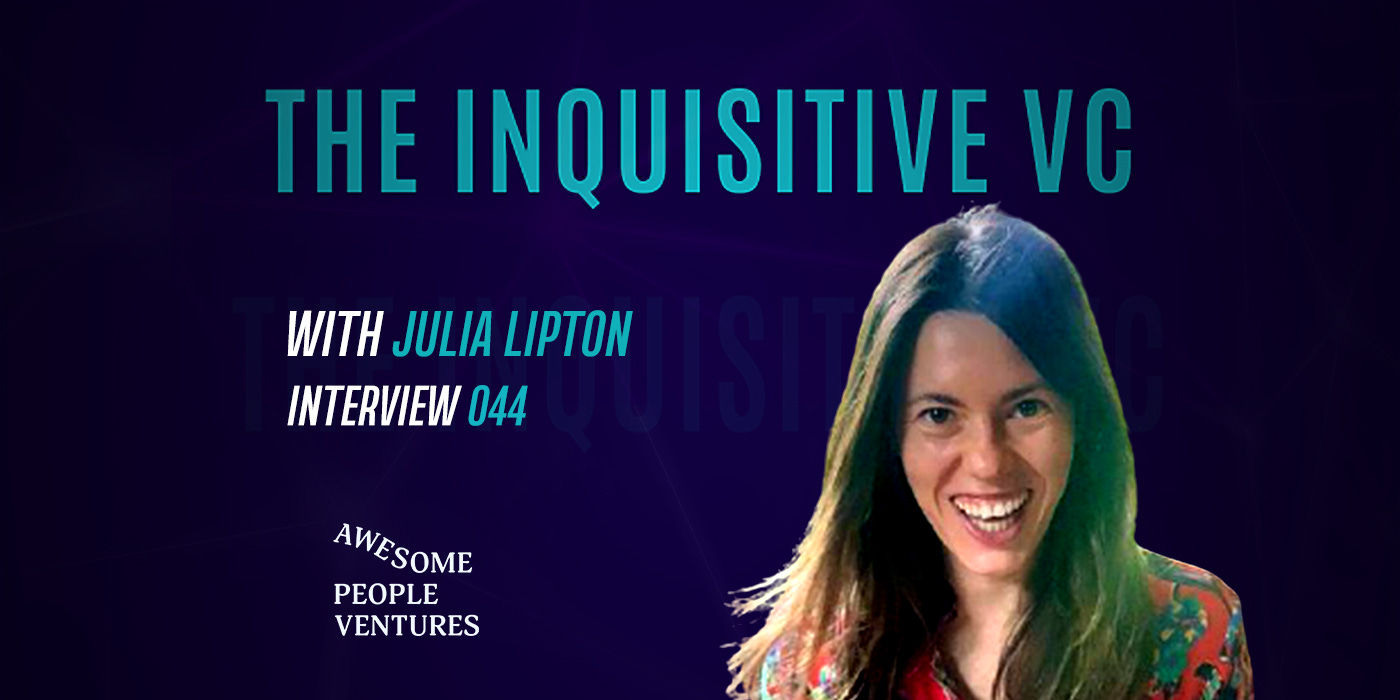
Julia Lipton - Awesome People Ventures
from The Inquisitive VC Hosted by Nawaz Ahmed
Julia Lipton is the founder and GP of Awesome People Ventures, an early-stage fund focused on world positive investments. Prior to investing Julia led product and growth teams in Silicon Valley startups.We talk about her journey to investing, investing in Web 3.0, investment DAOs, raising a fund and more!The podcast is also available on your favourite podcast sources like Spotify, Apple and Youtube! NA: I'd love to start with your background. I'm quite interested in how you got into the world of VC? JP: How I got into the world of VC. Okay. So I started on the operator side. So when I was still in college, I actually joined a startup. I was going to college at the time in LA and I joined a startup that was in the Bay Area and I'd fly every week from LA to the Bay Area to work on this company. So I'd go to school Monday, Tuesday, Wednesday, and then I'd work Thursday, Friday, Saturday, Sunday, and rinse repeat. And that was a super high flying company. That at one point it was valued at $700 million and came crashing down to zero. So I learned a lot about what product-market fit doesn't look like and the importance of going to zero to one around that time, I also got super burnt out and very sick and had, you know, a mini-crisis about what I was doing with my life and decided I only wanted to work on things that were going to make people happier, healthier, and quit that startup and joined a nutrition coaching company called Rise, where I ran growth and revenue for them. That company was then bought by One Medical, where I launched their telemedicine practice. And so I saw these three very different companies. One Medical for people in New Zealand is now a publicly traded primary care practice with a strong telemedicine arm. I saw these three really different companies, three different stages, a high flying rocket ship that never had a product-market fit, a company that was just going to zero to one, and then it got bought and then pre IPO. And I realized that across those experiences while I was running growth and eventually product revenue teams, what I really loved was helping the founders make their dreams a reality. I was always advising my friend’s companies, I was always just chatting with new founders about startups and I really loved just learning what was new and interesting. And so after One Medical, I took a bit of a sabbatical and after the sabbatical, I started consulting, consulting, turned into angel investing and angel investing turned into starting a fund. NA: That's a great journey. It's great, how you went through phases of different startups and then you got to angel investing. What was the change from going from angel investing to raising a fund? How different are the two? JP: So my first fund was very small and so I almost consider it like a friends and family fund where it wasn't like I went out and raised from big institutions. It’s something that I'm now doing with fund two, but the change wasn't so much around, oh I need to go raise a big fund, the change was really around the mindset, right? As a fiduciary, I feel different about deploying capital, when it's my capital versus someone else's capital. And when it's my capital, if I like someone, I don't totally understand the market, but I liked the person, I liked the story, liked the video, yeah, I'll take a flyer. When it's someone else's capital, I feel a responsibility and therefore am much more diligent and much more thesis-driven. I'm much more structured in my investment process than I would be with my own capital. I think that's something that people don't necessarily think about when they go from angel to fund manager, is that it is psychologically different and add fund admin on top of that, add LP relations on top of that, add the fact that you have an LPA, so you need to invest against certain things. Add that against the fact you have a deployment appointment timeline, so you have to be investing. It is quite different. NA: Yeah, no, that definitely makes sense. I'd love for you to talk about the thesis that you came to after doing your angel investing and raising your first fund. What is your current thesis now? JP: Well, I invest in a couple of different themes that I'm most passionate about. There are the web 2 themes and then the web 3 themes. And I basically invest in things that I'm passionate about and that I know. And so in web 2, that's a lot of the health care stuff, wellness stuff, tooling, remote work tools, a lot of the future of work tools that were previously built-in web 2, I think will actually be built in web 3. So most of my future of work investing and most of my creator economy investing has moved from web 2 tooling to web 3, just because I think that's where the breakout companies are in those spaces and that's where the models work best. And so we talked about a bit how in web 2 healthcare, climate, B2B, SaaS, tooling. Web 3, I'm very interested in DAOs right now. I think they hold a lot of potential to unlock new types of development, and new types of financial access, new types of frankly companies and ways of working. And so a lot of my investments in web 2 are in web 3 right now are around DAOs and community. NA: Exciting. Yeah. That, I guess that leads to your journey from going from investing in web 2 and healthcare and SaaS to web 3 and the difference that is like, do you have to have a different kind of mindset when you're looking at web 3 companies? JP: Well, I think it's really different, right? Like you can have a B2B SaaS tool that is, there's B2B SaaS tooling in both ecosystems, right? You have like payment infrastructure in web 2 and payment infrastructure and web 3. But what's interesting is in web 3, the economics are so different. So if you look at a web 2 funds returns, and you look at a web 3 funds returns, the web 3 fund is going to on average, outperform the web 2 fund, by orders of magnitude. Right? So I have friends funds in web 3 that have like 30X, 50X their funds in three to five years. I don't know anyone who has done that at the fund level in web 2, and part of that comes down to just the way that these companies are structured and the tokenomics, and the fact that right now, in a bull market, you have these projects, where if there's a token associated with the project and some path to liquidity just has a tremendous amount of upside in comparison to the web 2 companies. And so what's the difference? I think part of it's the deals and the companies are fundamentally structured differently. I was talking with some people who I'm in an investment DAO with earlier today and they just categorically don't do anything that doesn't have a token because where they're getting their returns are on these tokens. Right. And so how is it different? I think the structures of the deals and the economics from an investor standpoint are fundamentally different. And I also think the people who are successful in web 3 as founders are different because most web 3 companies require some sort of protocol or DAO or something that encourages community participation. The importance of distribution and creating something that's valuable for a community is way different than in a B2B company. When you can have a really top-down approach and just nail an enterprise sales motion. To summarize the structures of the deals are different, but the founders are different and the way that you build one of these companies is inherently different. NA: And when looking at these deals at this point, have you come to a preference yourself, like token or equity? JP: Most of the stuff I'm doing is equity with a token warrant. I personally haven't drawn a hard line. It's hard, right? Because even the B2B SaaS tools in web 3 would outperform the B2B SaaS tools in web 2. So it depends through what lens. NA: Yeah, no. Fair enough. And what, what are your further thoughts on investment DAOs? Like where do you think that they will actually disrupt VC? Or is that just a story? … This is a public episode. If you would like to discuss this with other subscribers or get access to bonus episodes, visit theinquisitivevc.substack.com
Embed this episode
No transcript yet.