
EPISODE · Dec 19, 2024 · 4 MIN
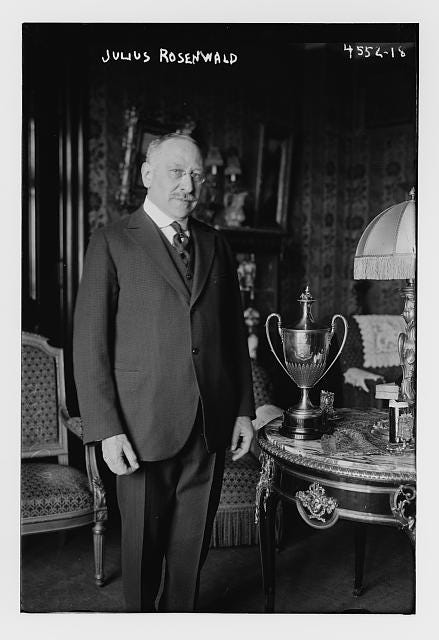
Julius Rosenwald
from Historical Snapshots · host Historical Snapshots
There is a fundamental teaching in Judaism called Tikkun Olam. It means repairing the world. For Julius Rosenwald, this idea was a way of life. Julius had become quite wealthy in his adult years, likely one of the richest men in America at the time. But becoming so had been quite the journey. His father had lived an American immigrant story, arriving from Germany with $20 but with smarts and a dedicated work ethic. From poverty, life slowly evolved into stability. And when Julius was born in 1862, the family lived a block away from Abraham Lincoln's Illinois home. Julius built from this foundation that his parents had created. He got into the clothing business, though one could say that he was born into it. His father had become a tailor in the U.S. and then ran a clothing store. Julius worked in the shop from a young age. By the middle of high school, he dropped out to work full-time. Diligent, hard-working, and a believer in the importance of quality products, Julius' career in business flourished. But it was a $37,500 investment in 1895 for 25% of Sears, Roebuck & Co., a Chicago-based mail-order company still looking to find its footing, that would bring him tremendous wealth. America at the time was amidst a rural revolution, as railroads had opened up vast territories. For these families, however, goods were often hard to come by. Mail-order was an ideal solution. And Julius, who eventually took over as President, focused on the quality of products to transform Sears into a retail giant. By the early 20th century, the company catalog was as ubiquitous in American homes as a family Bible. Yet, interestingly, Julius would attribute much of his success to luck, writing, "The big successes are largely due to opportunity. Many men with quite exceptional ability never get a chance. I never had exceptional ability and there are in Sears today many men who are much cleverer than I. To say that I had vision and foresight in going into Sears is nonsense. I went in simply because I saw a good chance. In other words, for precisely the same reason that other young men change their jobs. I had no idea that Sears would develop into five percent of its present size. It was simply a lucky chance that the business developed along such a scale. We ran it efficiently and worked hard and it made money. There is the whole story. The subsequent economic developments of the country have made it into what it is." That said, Julius was considered one of the great business leaders of his time. But, arguably, it would be his work as a philanthropist that made him particularly special. Julius established the Rosenwald Fund, focusing on education and public health. Amongst these initiatives, it was in the former that he made a uniquely meaningful and lasting impact. Having been moved by the work of Booker T. Washington and William Henry Baldwin Jr. in helping black Americans thrive, and understanding racism from seeing anti-semitism, Julius funded over 5,300 schools for black students in the South. Though he did take an interesting approach, insisting that communities contribute to the projects, fostering a sense of ownership and partnership. For a time ripe with segregation and lack of funding for education for black students, Julius' initiative and communal method made a significant impact. Over 600,000 students would attend a school. After his illustrious business career and meaningful work in philanthropy, Julius passed away in 1932. Sources: * Ascoli, Peter Max. Julius Rosenwald: The Man who Built Sears, Roebuck and Advanced the Cause of Black Education in the American South. United States, Indiana University Press, 2006. * BACHMANN, LAWRENCE P. “Julius Rosenwald.” American Jewish Historical Quarterly, vol. 66, no. 1, 1976, pp. 89–105. JSTOR, http://www.jstor.org/stable/23880425. Accessed 18 Dec. 2024. * Bain News Service, Publisher. Julius Rosenwald. [Between and Ca. 1920] Photograph. Retrieved from the Library of Congress, www.loc.gov/item/2014706782/>. * Oleshansky, Deborah. “Education is the Key to Unlocking a Better Future for All.” The Jewish Observer, https://www.jewishobservernashville.org/article/2023/12/education-is-the-key-to-unlocking-a-better-future-for-all * Solender, Michael J.. “Inside the Rosenwald Schools.” Smithsonian Magazine, March 30, 2021. https://www.smithsonianmag.com/history/how-rosenwald-schools-shaped-legacy-generation-black-leaders-180977340/ This is a public episode. If you'd like to discuss this with other subscribers or get access to bonus episodes, visit historicalsnapshots.substack.com/subscribe
Embed this episode
Ready to play
Julius Rosenwald
No transcript for this episode yet
Similar Episodes
No similar episodes found.