July 13: Saint Henry
from Catholic Saints & Feasts Hosted by Fr. Michael Black
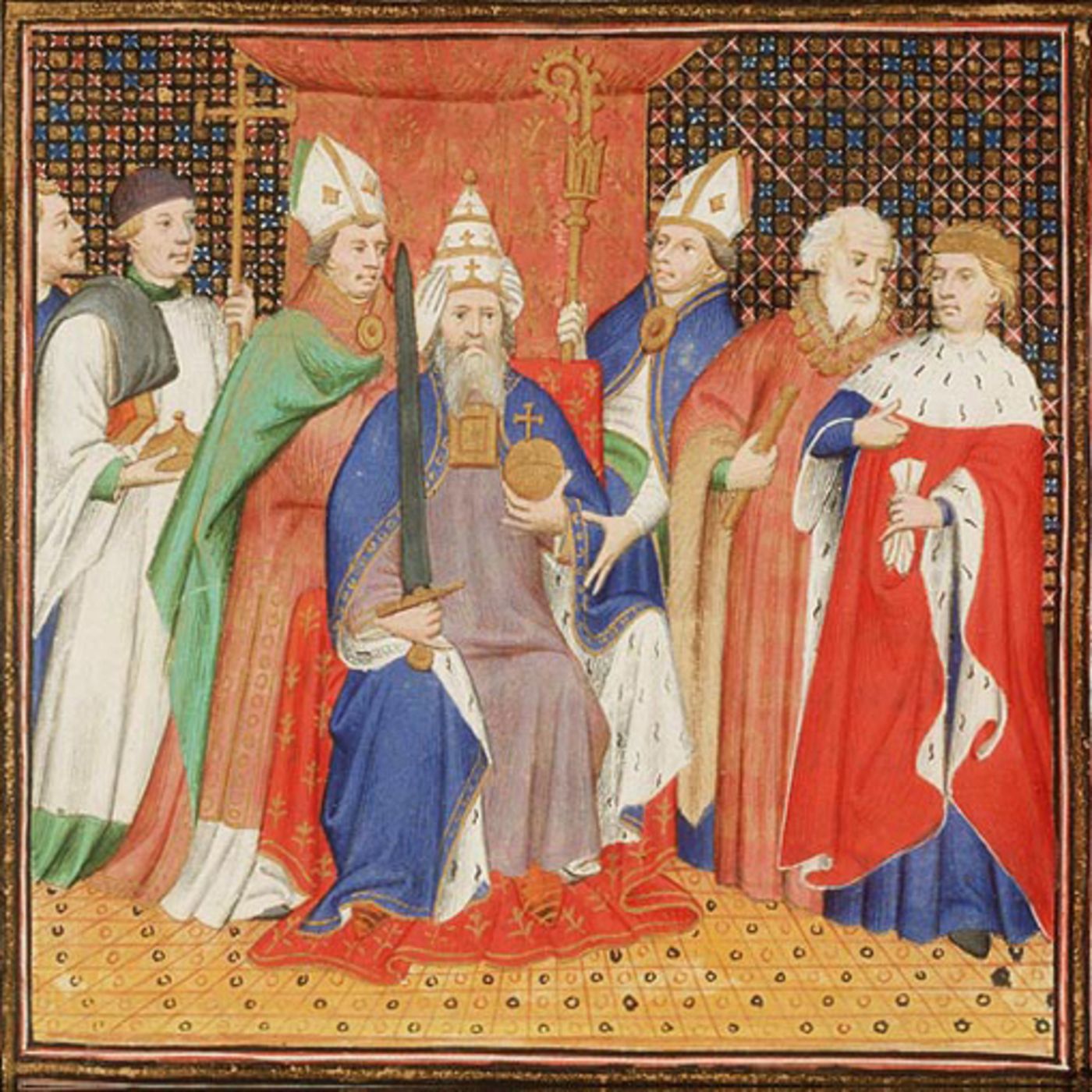
July 13: Saint Henry 973–1024 Optional Memorial; Liturgical Color: White Patron Saint of the childless and Benedictine Oblates A king walks the tight path of virtue Passing through the heroic-sized doors of St. Peter’s Basilica in Rome, the pilgrim walks into a vast interior space, his gaze slowly rising to silently absorb the sublime vaults, criss-crossed by ethereal beams of sunlight. Yet as the pilgrim meanders, head tilted upward, eyes drinking in the beauty, he is actually walking on art too. Near the end of St. Peter’s central nave, embedded in the elaborate marble floor, is a large, deep red disk. It is porphyry, a rich purple granite prized by the emperors and nobles of Rome. This disk, harvested from an Egyptian quarry, was originally placed in a Roman home or public building. But the Emperor Constantine pilfered it. He had the disk transplanted to near the main altar of the fourth-century basilica he built in honor of Saint Peter, and the disk has been preserved, in a different location, in the present sixteenth-century basilica. And on this lush granite disk numerous kings and emperors, including Charlemagne and today’s saint, Henry II, humbly knelt to be crowned by popes. Saint Henry made the long journey from Germany to Rome to be crowned Holy Roman Emperor by Pope Benedict XIII on February 14, 1014. Not just common men but kings too went on pilgrimage to Rome to seek Saint Peter’s blessing. The life of Saint Henry shows that even a king has a King. Even the powerful are under Someone who is more powerful. Good kings know that; bad ones don’t. King Henry lived a life in many ways typical of the royals of his era. He was involved in almost continuous political intrigues and military battles to protect and expand his kingdom. There were fights to attain power and fights to retain power. There were long military campaigns in Poland, Hungary, Germany, and Italy. There was court intrigue, a strategic but childless marriage, the envy of nobles, and all the other ingredients inherent to the struggle for power. But Henry is the only Holy Roman Emperor ever to be canonized a saint for a reason. He had deep faith. He loved the Church. He lived the virtues to a heroic degree. He received the Sacraments. He was devoted to Saint Mary. Saint Henry was outstanding in utilizing his wealth and position to advance the apostolates of the institutional Church. He formed a new diocese, endowed others, founded monasteries, donated land, and had close relationships with powerful bishops. Under his care, the church became an arm of the imperial government, with bishops of large dioceses even becoming princes wielding both civil and ecclesiastical power. This blurring of the lines between Church and State in Germany became problematic in later centuries when imperial officials tried to wrest church governance from the pope’s hands and flexed their secular muscle in crushing heretics. But under Saint Henry the mingling of church and state was mutually beneficial. It created a united love of fatherland and religion, of culture and liturgy, of patriotism and faith, which lasted until the early sixteenth century throughout all of Germany and until the Napoleonic era in large swaths of it. The rich and powerful are subject to temptations just like the common man, yet their wealth and influence can carve new pathways of sin not open to the common man. So when a king, queen, president, prime minister, multi-millionaire, or movie star walks the straight road and enters through the narrow gate, there is a bit more to celebrate. The sinful road not taken, the evil path that could have been trod but was not, is a cause for rejoicing for every man, but especially for the powerful man. Every soul can indulge in some legitimate Christian pride for what it has not done, for having conquered temptation and sin by strategically avoiding it. Many paths opened up before King Henry during his life. He walked the tight path of virtue and entered heaven by the narrow gate and thus exalted his royal status to one even higher, that of a saint. Saint Henry, you were an exceptional benefactor of the Church, living sacrificial generosity to advance her apostolates. May your example help us all to be generous, in every way, when our religion demands a generous response.
Embed this episode
No transcript yet.