Welcome to World War I Centennial News, episode number 79. So we're really happy that you found the podcast, and now you can find us on Twitter at TheWW1Podcast. You can ask us questions, make comments, get a link you might have missed, or ask us to drop a note to one of our guests for you. That's at TheWW1Podcast, because it's more than just a show. It's a conversation about the events 100 years ago this week, and the World War I Centennial commemoration happening now about the war that changed the world.
This week, Dr. Edward Lengel, Catherine Akey, and I sit down for our July Overview Roundtable. Mike Schuster updates us on General Pershing's view of the war in early summer 1918. Rob Laplander, the champion of Doughboy MIA, is with us. Authors Michael Collins and Martin King introduce us to their newest World War I book, The Lost Voices.
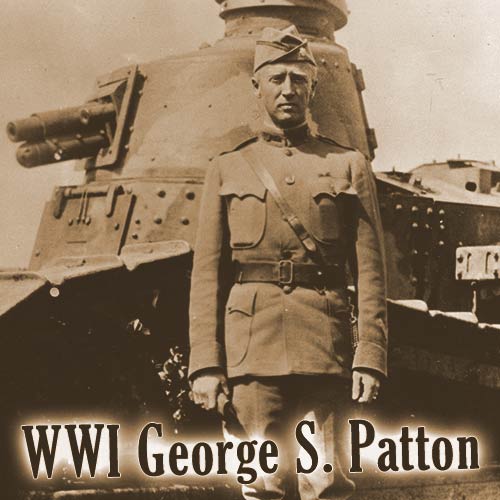
Carlin Morris and Phil Wilburn present the 100 Cities 100 Memorials Project for the Patton and U.S. Tank Corps Monument in Fort Knox, Kentucky. Yeah, you heard it right. Like many other famous names from World War II, they cut their teeth in World War I. And of course, The Buzz, where Catherine Akey highlights the commemoration of World War I in social media. World War I Centennial News is brought to you by the U.S. World War I Centennial Commission, the Pritzker Military Museum and Library, and the Starr Foundation. I'm Teo Mayer, the Chief Technologist for the Commission, and your host.
Some months ago, during a podcast editorial planning session for an upcoming month, we turned on our mics, recorded it, and played it for you. You liked it? Now we do it. So here's the conversation Dr. Edward Lengel, Catherine Aikie, and I had last week. The question on the table, so what are the big stories and themes in July 1918 in The War That Changed the World?
We keep talking about turning points. This is a major turning point on the Western Front, generally. American forces become involved on quite a large scale, first in beating back the final German offensive of the Kaiserschlag on July 15th, and then participating in what came to be called the Second Battle of the Marne on July 18th. We called it the Battle of Soissons, and we're now attacking against the German positions in France on a large scale. Through the latter half of July, we begin what's called the advance to the Valle River.
where several American divisions embedded with the French are attacking on a broad front. American forces are now really beginning to get that combat experience. We're having a tangible impact on a broad scale on the Western Front. One of the things that I know was part of Pershing's plan was to get out of the trenches and change the fundamentals of the war into being a field battle. Is that starting to happen this month? Yeah, to some degree it really works, and surprisingly so. When you think about it, his idea of getting out of the trenches was hardly a new idea. It isn't as if the British and French enjoyed being in the trenches.
Now we really are moving in the open alongside tanks in many cases and using combined arms with airplanes as well. The Germans no longer have the depth of reserves and the quantity of men on the Western Front in order to maintain large-scale entrenchments and defenses. What the Germans do at this point is they transition to a more flexible defense using machine gun posts, using kind of a broad-based defense in depth that really lends itself to more of a war of movement. The nature of the war changes. We have to loop back to these counterattacks that the Allies take on. The Battle of Soissons, Battle of Chateau-Thierry, that are part of the Second Battle of the Marne. Not only do the Allies manage to recover most of the ground that we've lost since the beginning of the German Spring Offensive way back in March, but we actually are starting to incorporate a lot of the tactics that the Germans used in 1916 and 17 that gave them a really big advantage and kind of stalled out the Allied offensives of those two years. Mainly this term that Ed's dropped, which is defense in depth. It's a very World War I specific kind of tactic.
It basically means multiple lines of different kinds of defense that allows you to pull back or get deep underground, wait out a barrage, and make it really difficult for attackers to actually get at the core of where your guns and people are. So maybe there's less fortified positions at the front that you can run in and fill after a barrage has finished and then pull back from. And as you pull back, you go deeper and deeper into more and more reinforced constructions. And it's one of the main reasons why the Germans have trouble. They only managed to really have a successful offensive for about two days from the 15th to the 17th before they start losing ground again.
You know, that's a great point, but there's an interesting footnote to that. It's quite bizarre, actually. In the French army, it's often left up to French army commanders and French corps commanders to decide whether they want to use defense in depth or not. And some of them really stick to the older style of defense, which involves packing the front line with as many troops as possible. On July 15th, when the Germans attack at zero hour, they hit two French corps side by side along the Marne River that have American troops embedded in them. One of the French corps is employing a defense in depth and really fights quite effectively. But the other French corps has packed the front lines, including with troops of the American 28th Division. And those lines break at the very beginning. And there's some pretty severe losses taken by the French and the Americans before they're able to shore it up. Even after four years of seeing how successful it is. Exactly. Well, Catherine, there's also a whole battle that takes the Austrians out in Italy. What's that about?
July is a bad time for the Austro-Hungarians. After the Battle of the Piave River, where thousands of Austro-Hungarian soldiers drowned, and it's a whole big mess. We talked about that on previous episodes. I think it's kind of looked at as like the last fatal blow to their armed forces. There's another big battle in July that the Americans are involved in. After the Battle of the Piave River, Pershing sees this as a moment, and he says, okay, we need to pick a couple divisions from France that are already here, move them over to Italy. And they end up reinforcing the Italians.
The Austro-Hungarians don't end up completely pulling out of the war officially until about October. But after this, that front calms down a lot. And the Italians have basically taken the upper hand there. And actually, there are some Italians in France as well. There's an interesting moment.
You're talking about the Italian divisions being on the Western Front. One of the American divisions that moves toward the front in July is the American 77th Division, which is heavily recruited from New York City and includes large numbers of Italian Americans. When that division arrives in the front line, the German reports suggest that an Italian division has entered in the front because they hear the Americans talking to each other in Italian. So that's a pretty funny moment there. One of the things that really sort of seems to be at play here, and it comes up in Mike's post this week as well, is that the exhaustion of the Germans isn't something that everybody is completely aware of, but they're pretty burnt out at this point, aren't they?
They're definitely burned out. The German army still has a strong fighting corps. pretty fearsome, actually, very professional, very effective, focused still on trying to prolong the war and win an honorable peace. But in terms of the quality of their infantry, more broadly speaking, it's really very poor. They've had to draw on large numbers of reservists, really children, 15, 16 years old, as well as old men who are into their 60s and beyond to try to shore up their defenses. So they don't have much staying power at this point. The same is actually true for the Allies. Everybody is just at their last breath, with the exception of the Americans.
Absolutely. And I know there's some really wonderful apocryphal stories about Allied troops and German troops seeing the Americans and sort of saying, wow, they look so healthy and they're so big and their clothes are so nice, because this part of Europe has been living in absolute terror for four years now. There are exceptions, though. Now in July, for the first time, you encounter some American divisions that are pretty badly run down. And the best example of that is the second division that had fought at Belleau Wood and particularly the Marine Brigade.
And when the Americans launched the offensive at Swasson on July 18th, the second division is one of the frontline divisions. And within a couple of days, it has to be pulled out of the line because it's so exhausted. And you were going to see that as we move on into the late summer and especially into the fall, Americans began experiencing combat fatigue in ways that were unprecedented since the Civil War. I wanted to ask, Ed, it seems to be a legend that a couple of American engineers put a briefcase with false plans for an American counterattack, handcuffed to a corpse. in a vehicle that they made look like it ran off a road, and then had the Germans basically find these and adjust their attack plans to thwart the false plan. Have you ever heard of this? You know, I have heard of that, and I believe it's true that the Americans attempted to do that. I don't think there's any proof that the Germans necessarily fell for it, but I believe that that's the case, that they had put these false plans in a suitcase handcuffed to a corpse. Stranger things happened on the Western Front, and we put it that way. Well, that leads to an interesting note. Apparently, the Allies cracked the German codes in the past month or so, and this actually came up in one of Mike's posts.
It may have been one of the reasons we were prepared and anticipated some of the German defensives. What do you know about that? I think that factors into July 15th because as the Germans are preparing their assault shortly before the assault, the French launch a counter barrage that hits the Germans just as they're massing for the attack across the river. And it not only causes severe casualties, but as you can imagine, it's terribly demoralizing. Yeah.
The Americans were taking over more and more radio stations and adding more and more radio stations and managing to tap into airplane communications and things like this. I think it's a matter of numbers, having more Americans there intercepting, listening, working on it. It's also a good moment to remind everyone that the Navajo cold talkers are quite famous from World War II, but in World War I, the Americans bring over a number of different Native American tribesmen specifically to use their language to avoid having the Germans understand what they're talking about. Notably, the Choctaw are used to keep communications safe. So what was going on in the sky about this time? July is marked by a pretty famous, notable, and sad date, July 14th. Quentin Roosevelt is shot down and killed. And he's only been flying in France for a couple of weeks, maybe. And it is huge news. It shakes all through the United States. And when he's shot down, the Germans actually bury him with high honors and in a well-marked, well-distinguished grave. But of course, we had a really wonderful interview earlier in the month of June with an author about Teddy Roosevelt. And this was one of the main points he made was he had so much.
personal loss during the war, notably his favorite son and his youngest son, Quentin. It had a huge impact. I've read hundreds of American diaries and letters from July of 1918, and just about every single one troops at the front mentioned Quentin Roosevelt being killed. So they were talking about it at the front. Everybody knew about it.
A couple more aces get shot down, notably James McCudden, who ends up being the seventh highest scoring ace of the war, having 57 victories when he dies. There's also the last attempt to bomb the British Isles by the Germans in airplanes. It's unsuccessful, but that marks the last time they fly planes over there and try to attack Britain itself. At the same time, at the very end of the month, the Royal Air Force, the British Air Service, launches a bombing raid over Germany, and they lose 10 out of their 12 planes. So it's wholly unsuccessful.
As we've been talking about, reconnaissance continues to be very important, and airplanes are starting to take on this kind of all-armed warfare role, where they're being used during attacks, as tanks are, in coordination with the infantry. What about war on the sea? Is there any news and update on what's happening on the oceans? There is one fairly important episode in July, and that is the sinking of the American troop ship Covington. On July 1st, 1918, the U.S. Navy convoy that included the Covington was sailing away from France. Fortunately, in this case, the Covington had already delivered its cargo of troops into France, and it was sailing back empty to the United States. But a German U-boat, the U-86, torpedoed it, and it sank on July 2nd. That's certainly an indication of what could have been if the Germans had been able to be more effective. There was a lot of fear that the Germans would be able to sink troop transports in large numbers and kill a lot of American soldiers. They really were not able to do that because of the convoy system.
I know in the Mediterranean, in particular, around Italy, there's a number of Allied ships that get torpedoed and sunk. I've always found it curious that the Austrians actually had a pretty potent submarine fleet, and they were sinking Allied ships. The Japanese Navy has moved into the Mediterranean and plays a big role in that period in helping to take the burden off the British Navy and the French Navy in managing patrols there so they can concentrate on the Atlantic. Okay, what else shapes July 1918? I always have my little tidbits at the end for me to bring up. Yeah, you do. Yes. Russia is still in the middle of a civil war.
But it adopts a new constitution on July 10th, declaring it a Soviet republic. Also in Africa and the Middle East, the Ottoman Empire is also starting to peel apart. And as that happens, there's a lot of national interest concerns that keeps Allied troops involved as they try to hold on to territory or keep a voice in what's happening as those old empires are sort of peeling apart and new countries are forming. And on the home front, there is what's known as the Great Trainwreck of 1918. In Tennessee, two trains crash head on.
And over 100 people are killed, an additional 170 are injured. It's big, big news on the home front, as it's a pretty major wartime disaster here at Stateside. And Ed, on the military front, Pershing asks for a lot more troops, doesn't he? He certainly does. July of 18 is the final month in which Americans have to fight entirely under French or British command.
Finally, in August, Pershing is going to be able to achieve his dream of a single American army, the first army under American command. So in order to prepare for that, in order to prepare for the large campaigns he anticipates in the fall and the winter, he's calling for greatly accelerated numbers of troops to come over from the United States. That brings us to Mike Schuster, former NPR correspondent and the curator for the Great War Project blog. Mike, in your post this week, you continue to show us the changing landscape of the war in Europe, and you echo the comments made in the roundtable about Pershing's perception that we need a whole lot more U.S. troops to win this thing. Very true, Teo. So the headline reads, Summer 1918, key battles in Italy and France, Pershing to house, the Allies are done for. But airpower now favoring the Allies. I should salute you. Special to the Great War Project.
Crucial developments in late June a century ago on the Italian front and still on the French front, where the Americans are battling for bellow wood. The Austrians gather near the battlefronts where Italy and Austria meet. The Italians on the Allied side, Austria with the Germans. Austrian leaders fully expect a grand victory. It does not come, and Austrian political leaders are shaken. One great advantage for the Allies' superiority in the skies, reports historian Martin Gilbert. More than 600 Allied aircraft caused havoc to the Austrian forces. The Allies take hundreds of prisoners. On a single day, reports Gilbert, the Italians shoot down 14 Austrian warplanes.
Only five days after they start their offensive, the Austrians begin a withdrawal. As for the Western Front in late June, the Americans are still battling the Germans at Belleau Wood, and the French are still begging General Pershing, the American commander, to share his units. After four years of war, the French and British are exhausted and need the Americans badly. Pershing recognizes the draining effect, writes historian Gilbert, of their own many previous offensives, as well as the German offensive that March. Pershing also knew that the three million troops on the Western Front were facing three and a half million Germans. Pershing is blunt. The Allies are done for, he writes to President Wilson's key advisor, Colonel Edward House.
And the only thing that will hold them, especially France, in the war will be the assurance that we have enough force to assume the initiative. America's task, Gilbert writes, is to win the war in 1919. Pershing argues that to assure an American victory then, the American army of 800,000 must be increased to 3 million. In June 1918, a century ago, Pershing asked the War Department in Washington for an increase of nearly that scale. In a telegram to Washington, he argues that this dramatic expansion of the American expeditionary forces must get to France by May 1919.
This, he wrote, was the least that should be thought of. Those American troops who were already in action, Gilbert reports, were giving a remarkable account of themselves as new as they were to fighting. On June 26th at Bella Wood, the Marines who had refused to withdraw three weeks earlier, finally gained the wood. More than half of the 10,000 of the American Marine Brigade had been killed or wounded in the action. In the war cemetery at the edge of the wood, according to Gilbert, are the graves of more than 2,200 American soldiers in the names of a further 1,000 who have no known grave. Gilbert continues, in another cemetery a few hundred yards away are more than 8,000 German graves.
After the battle, General Pershing visits a combat hospital where a gravely wounded soldier, his right arm has been amputated, struggles to salute the general. I cannot salute you, the soldier says. No, Pershing replies, it's I that should salute you. Mike Schuster is the curator for the Great War Project blog. The link to his post is in the podcast notes. That's it for 100 years ago this week and this month. It's time to fast forward into the present with World War I centennial news now. Now this part of the podcast focuses on now and how we're commemorating the centennial of World War I.
In commission news, and as a follow-up for the last two weeks, where you heard from Meredith Carr about the planned events for the Centennial of the Armistice on Veterans Day weekend this November 11th, and from Betsy Anderson, who introduced us to Bells of Peace, the national bell tolling on 1111 at 11 a.m. local. This week, we have some more interesting news for you. We're going to produce a special participation app for all those events. You'll be able to download the app on your smartphone or tablet and get news and updates about events coming up in Washington and around the country. You'll be able to send in your commemorative activity pictures, posts, and videos to share with the rest of the country. You'll be able to tune into live streams from key events.
And in case you don't have your own bell to toll, we'll give you several choices of bells to toll from your device that you can also plug into your sound system at your commemorative event. The Armistice Centennial Participation app will be coming out in late August at a smartphone near you. So join together and join us as we commemorate the Armistice of World War I. This week, our Remembering Veterans segment is very poignant for me. As the saying goes, a man is only missing if he's forgotten. And there are several thousand American doughboys who would both be missing and forgotten if it weren't for our next guest.
Robert Laplander is the author of Finding the Lost Battalion, Beyond the Rumors, Myths, and Legends of America's Famous World War I Epic. But beyond his very fine book, he's also the passionate and dedicated managing director for Doughboy MIA, an organization researching the fate and the service of World War I's MIAs. Rob, thank you for joining us. Hi, Dale. Thanks for having me on. Rob, when did the U.S. government stop looking for the MIAs from World War I? 1934. Wow, that's a lot earlier than I thought. Yeah, what they did is they sent their crews out and they scoured the landscape and they slowly whittled the list down.
The way that they felt is that they had put as much time into it as they could when they got to 1930, and they were scheduled to hand over the control of the cemeteries in 1934, and they decided what they would do is close all the cases by 1934. By that time, they had exhausted everything that they had, every resource that they had. How many MIAs are left from World War I? 4,223. A good half of them are missing at sea. Okay, so they're lost at sea and will never be found. No, they're totally unrecoverable. We know where they are, and it is what it is for those guys. At least they're remembered. Great point, Rob. But for our soldiers that died on the battlefields...
How did they get buried? Who took care of that? It was the units themselves. Usually a junior officer or chaplain of the unit who buried these bodies, and he filled out what was known as a grave registration blank, and he sent it back to Graves Registration Service. What they did is they kept track of all these and where all the graves were, and then after the war, they went out and excavated some 80,000 burials in over 5,000 temporary cemeteries to concentrate them into the big cemeteries. Then they offered the families the chance to bring their loved one home or not, and the ones that didn't go home stayed in France.
So when they went out looking for these cemeteries, they knew where the cemeteries were and they knew where the bodies were reported to a man. It doesn't necessarily mean that they were able to find all that stuff. We've got two Marines right now that we're looking for. We have statements by the man who buried them. And he went back in the 80s and even pointed out where he believed they were. They didn't have the technology that we have now. So what they did is they walked the ground. They had a man stationed every yard and a half.
and they would send these picket lines through that would look for anything that looked like it had been a grave, a temporary grave, or anything like that. Sometimes this happened five, six years after the war was over, and there wouldn't be anything left, and they just couldn't find them. Well, let me ask you this. What are some of the really hard parts of the challenges that you face in trying to resolve some of these cases? The biggest problem that we have is finding missing paperwork. There are a lot of records for the American Expeditionary Force from World War I, and you're talking about records that have been shuffled here and there for 100 years. So a lot of things have gone missing, and we're still trying to find all the records for the unknowns.
The biggest thing that we depend on for information is the burial case files. Each man who died in service at that time had a burial case file, and those are still in existence. We look at those on a regular basis. We have hundreds and hundreds of those. They tell you that man's story. There's usually a statement in there by somebody who saw the man killed or the last person to see him alive and where they were. There'll be statements in there of the searching parties that went out looking for the grave or looking for the remains. There's letters back and forth with families in there. Some of those letters are pretty hard to read. And then information on the Gold Star Mother's Tours, because even if the man was missing in action, the mother or widow was offered the chance to go over to France.
and view the cemeteries and see the name on the wall. Well, Rob, I know you've had some successes in identifying these MIAs. Tell us about it. Our first major win was Herbert Hammond Renshaw, who was a sailor who a year and a half ago we discovered had been forgotten on what they called the walls to the missing. Each cemetery has tablets in their chapel that are covered with names of the missing in action. At Brookwood Cemetery in England is where they have those who are missing at sea. Herbert Renshaw was one of the first naval casualties of the war. In May of 1917, he went missing. And this past April, that was corrected. This past April, for the first time since 1934, they carved a name in the wall.
So Rob, you've written two books about World War I and the happenings in Europe. What were they? The first book that came out was Finding the Lost Battalion. It's about the Lost Battalion of World War I, which was 700 men who were trapped behind enemy lines for five days. At the end of the siege, 194 of them were able to walk out under their own power. And then my wife and I just recently released a coffee table book, a picture book called Faces of the Lost Battalion. Rob, your passion and dedication to this project is really special. I don't know who all and how all you can be thanked, but thank you. Well, we take it seriously.
It's something that I don't think I picked. I think I was picked for, along with my team. We're going to France in September, not over. We're going to be doing some ground research for Dow Boy MIA and lay the groundwork for what we hope to be actual expeditions and attempts at recovery. What is it that our listeners or people can do to help you? The government has the Defense POW MIA Accounting Agency, the DPAA, but their mission only goes back to World War II, and that's where we pick up the ball. We don't take any government funding for what we do. It's all volunteer, and it's all non-for-profit.
We come to a unique point in history now that we have technology available to us, affordable technology at our fingertips that nobody else has ever had. And with this, we can go in there and we might be able to reclaim some of the remains and bring these boys home. The biggest thing that we need is funding. To that end, we have our own fundraiser. It's called 10 for them, 10 bucks. Just donate 10 bucks. If you can give 10 for them, then you did your part to try to help. And we appreciate it. Okay, listeners, you can go to www.cc.org slash MIA. And on the left side of the webpage, you'll find a place where you can give 10 for them. And Rob, keep up the great work.
A man is only missing if he's forgotten. We're at a unique point in history now where we can do all this and get it together. It's the same thing with the Lost Battalion. If I never do anything else in my life ever again, I've done that. And long after I'm gone, that book will be here, my research will be here, and that story will live. If you can give to history like that, then everything that you did was worth it. Rob Laplander is the author and the keeper of the flame for Doughboy MIA. Learn more at www.cc.org slash MIA. Reach out on Twitter at The WW1 Podcast or follow the links in the podcast notes.
This week, in our spotlight on the media, we're joined by two prolific authors, Michael Collins and Martin King, as they tell us about their newest collaboration, drawn together using firsthand accounts of World War I and the American experience of it. The book is called The Lost Voices, the untold stories of America's World War I veterans and their families. And it just came out. Gentlemen, welcome to the podcast. Pleasure. Thank you very much for having us. The two of you worked on several books previously. What made you decide to take on World War I and the American experience of World War I for this book?
Martin and I wanted to do something different, and of course, through Martin's family connections with World War I, and the fact that I had found a really interesting archive of World War I personnel files in Pittsfield, Massachusetts, at the Berkshire Athenaeum, where I was working at the time, we decided to try something different. Now, you guys do primarily first-person account books, don't you? Yes, absolutely. It has to come from the horse's mouth. Well, you've both worked on a number of books on World War II engagements before, specifically Battle of the Bulge. How is this different? Well, for me, it was something I wanted to do for a long time. My grandfather fought at Passchendaele with the British, and he had the unique distinction in that battle of terrifying both sides, I think. He was quite a character to me. And I wanted to write something like that, but I wanted to pay homage as well to the American contribution, which is often underplayed here in Europe, precisely how significant and how deeply profound that was to the Allied forces at the time.
I think for myself, it was very different in that you couldn't just contact someone and get a firsthand account right off the bat. This was really a lot of gumshoeing. And also even just going to the National Archives in College Park, Maryland, it was a whole different experience. Record keeping in both World War I and World War II, just like the warfare, record keeping changed. That was a big adjustment for myself to figure that out and to really know where to dig. I went to different historical societies, but also universities to try to find firsthand accounts and different writings about it.
Some of them were amazing. Some of them were full diaries. Others were typed up accounts by grandchildren of veterans. So it was a very unique experience on the research side of it. Let me ask a question to each of you. If you were to put what we should remember about World War I into a single phrase, what would it be? I think it created the America we know today. It created a superpower. Some people might think of World War II as doing that, but World War I did it. Right on the nail. It shaped the world.
Okay. What do you think you enjoyed most about doing this project? You know, of all the books I've written, I must admit I've really enjoyed reading this one. The other stuff's great too, but this one I really enjoyed. I really got onto the skin of it, you know. Yeah, and what I really enjoyed was hearing Martin's firsthand accounts from his family. We've met each other in Europe to walk the battlefields and to really see the British perspective and also just what exactly these soldiers were going through throughout the battles and how difficult the conditions were. It's one thing to read about it, but once you actually get in the field and get to step into the trenches that they were at and see the sight lines, it really brings it home.
It really does. And that's something that's unique about Belgium and Europe. It's one big battlefield, basically. And to walk in my grandfather's footsteps. And this was a guy who was promoted to corporal and then demoted back to the ranks for punching out a sergeant. Because there were a lot of daft orders given. I mean, it was very much a case of them and us. And we weren't sure who they were, whether it was the generals or whether it was the enemy. The guys who were doing the fighting were really between two fires there. Well, Catherine just sent in a question. She wants to know, are there any more World War I books like this that you're going to work on? I think she really likes what you do.
That's very kind of Catherine. Thank you so much. We uncovered the stories we wanted to cover and did give them a deeply human perspective. We did really try to cover all the bases in our own unique way. There's a lot of places, even the Berkshire Athenaeum where I was working at, I mean, they didn't really realize what was in those files. And they've been sitting in a veterans administrative office for probably decades, just gathering up dust. They were almost thrown away. I kind of wonder what other stuff is out there that may one day be uncovered. Hopefully it's uncovered now, but there might be other stories that are just hanging out in plain sight that we don't know about yet. Well, gentlemen, thank you so much for joining us today.
Thank you so much. So when it came time for an offensive, armies needed to be totally sure that everybody involved, from artillery back of the line to the foot soldier going over the top, knew exactly when to start the operation. So to help this kind of large-scale coordination, the wristwatch was developed, and we talked about that back in episode 48. But organizing with this new tool, synchronized actions to a specific moment created a new term, and this week's phrase for speaking World War I. The phrase is, zero hour.
Zero hour is the name given to the instant of action and became a commonly understood phrase during the war. The New York Times introduced it to the American public in a 1915 article about the Battle of Luce. Quote, At 5.05 a.m. September 25th, a message came to the dugout that zero hour, that is the time the gas bombardment was to be started, would be at 5.50 a.m. By the 1920s, zero hour had been applied to other non-military situations to broadly mean the time when something begins. Zero hour. The moment the countdown stops. A precise solution to a logistical nightmare and our phrase this week for Speaking World War I. We have links for you in the podcast notes.
Moving on to our 100 Cities 100 Memorial segment about the $200,000 matching grant challenge to rescue and focus on our local World War I memorials. This week, we're headed to Fort Knox, Kentucky. Now, this memorial is dedicated to someone we normally associate with World War II, but someone who really got his start in World War I. At the time, just a captain, George S. Patton. Here to tell us about the project commemorating him and the Tank Corps are Carlin Morris, retired veteran from the Kentucky National Guard and commander of the Patton Battalion, USA Bow. He's also the project manager for the new monument. Joining him is Phil Wilburn.
Sergeant First Class Retired, USA Bow, Patton Battalion Board Member and Member of the Monument Committee. Gentlemen, thank you for joining us. Thanks for having me. Thank you. Your project is really pretty unique in terms of World War I memorials I've come across on the 100 Cities 100 Memorials program. First of all, it's a new monument, and secondly, it focuses on the birth and implementation of a new technology, the tank, and the man tied closely to it. Can you tell us about the monument and how the project came about? Originally, we were talking with the Patton Museum about possibly donating a plaque to commemorate Patton's service in World War I. Well, as we kind of went through the process, we figured out that we couldn't donate a plaque, and the Patton Museum actually offered us the idea to put a monument in Memorial Park next to the museum.
So that's what began the process. And as we thought about what we would want as a monument, I had heard about the monument at Borg France, which kind of commemorates World War I and World War II. And so we developed that as our original idea, and we would replicate that monument. But on the backside, we're going to go through the history of Patton's service in World War I, the tank battles, the tank battalions that fought, and then the men that ultimately supported Patton, not only through World War I, but through World War II and beyond. So Patton actually started a tank school and sort of developed a lot of the doctrine, didn't he?
He absolutely did. Patton at the time was not in a position that he was really feeling utilized. And when this came up for him to be in the tank service later, the Tank Corps, he was instrumental in not only setting up the U.S. Tank School and training the first U.S. tankers, but he was a key player in the development of the tactics, which were integrated into the rest of modern warfare at the time. One of the great things about this project is that you're actually creating a new memorial, and you're commemorating not only the man, but the entire Tank Corps. Yes. And this is the only monument dedicated to the U.S. Tank Corps in the United States.
There's a plaque at Gettysburg where Camp Colt was originally located, and that was placed there in 1953. But other than that, there's not a monument dedicated solely to the U.S. Tank Corps in the United States. Interesting. And when do you expect to complete the project?
Our goal is to get the monument in place by November of this year. How did you hear about 100 Cities, 100 memorials? I've been following the 100th anniversary of this. We originally started in November of 2016, and I've always been kind of reaching out to find out more about how we could do this. And as soon as I heard about the World War I commission, I immediately started following it. And then as it's come about, I heard about the memorials and coerced our guys that we needed to get involved. Well, you also, because you're doing the monument modeled after the one in Borgia, France, you created ties with that city, didn't you?
Yes. As soon as we were granted permission via the Fort Knox Garrison Command to put our monument at Memorial Park in Fort Knox, I immediately reached out to the mayor of Borg, France. And that was in April of last year. And we have been in communication ever since. Well, that's pretty neat that you've got a commemorative partner city in France. I'm glad that we're able to reconnect the tankers and tank mechanics with the town of Borg, France, because it seems we've distanced ourselves over the years. And now we're coming back together for this 100th anniversary. Hopefully it's something we can remain connected.
I was a tanker for quite a few years, you know, I mean, 20 plus years in the service. And Patton, he wasn't mythical and a legend, but really it's something to tie the tank history and the tank cores, as Carmen mentioned a minute ago, with a monument here in the U.S. It's just not something that we have. So placing that World War I Patton and the tank all together kind of ties it together for tankers going forward. And I think that that brings a lot to our communities. That's a great project, gentlemen. Thank you so much. Thank you for having us.
This week in World War I War Tech, I have to open by telling you that I actually had a very hard time with the segment because it addresses such an incredibly brutal and intensely gruesome aspect of hand-to-hand combat in World War I. It's a total throwback to medieval combat as soldiers fell on each other with an improvised weapon, the Trench Club. Now, most fighting in World War I, though unimaginably devastating, was somewhat impersonal. It took place at a distance. Artillery, machine guns, torpedoes, airplanes, and of course the tank are all combat weapons aimed at a somewhat distant enemy. But during the trench raids, scouting missions, and increasingly during these current months, as the war started to, quote, move during the spring and summer of 1918, hand-to-hand combat became a brutal reality.
While World War I sort of defines the birth of modern war technology, the undeniably primitive Trench Club was a bludgeon for combat inside the trenches when rifles were too long and cumbersome, grenades too wide in their destruction, knives too limited, and men were looking for ways to destroy one another hand to hand. Well, that's the realm of the Trench Club. Many trench clubs were produced, improvised, and modified by the troops themselves. They varied from fairly simple designs, not unlike police batons with extra weight, to these incredible terror weapons, spiked logs with metal heads and chain mace. Many of these were put together using spare materials found in the trenches, including nails, metal gear cogs, barbed wire, and more. Trench clubs, literally medieval horrors, and perhaps my least favorite story on World War I war tech. We'll be posting some pretty creepy images for you on Twitter, at TheWW1Podcast, and we have some links for you in the podcast notes.
This week in articles and posts, where we highlight the stories you'll find in our weekly newsletter, The Dispatch. Headline, Fighting Father Duffy Remembered. World War I Centennial Commissioner Dr. Libby O'Connell joined Cardinal Timothy Dolan, the Archbishop of New York, and the New York National Guard's top chaplain on June 27th to salute the Army's most famous chaplain, Lieutenant Colonel Francis P. Duffy. Headline, Historic Fireboat in New York City Turned into Floating Work of World War I Inspired Art.
Well, you can't miss the John J. Harvey Fireboat. It's been painted in bright red and white patterns, hearkening back to the dazzled camouflage of World War I ships. The living art exhibition is co-commissioned by New York's Public Art Fund and England's 1418 Now. An unusual and really interesting World War I commemoration for anyone visiting New York City. Headline, Navy Cross Nurses, inspiring heroism during the influenza epidemic of 1918.
World War I Centennial Commission intern Miranda Halpin takes a look at how two Navy nurses fought against the great flu epidemic in 1918 and sadly became its victims themselves. Headline, Warriors in khaki, Wyoming Indian doughboys who served in World War I. Read more about the Wyoming Veteran Memorial Museum exhibit on Wyoming and the Great War, which includes the service of Wyoming Native Americans, particularly from the Arapaho and Shoshone nations. Headline, this week's story of service features Emmett George Hoyt. Submitted by his nephew, Joe Davis. This week's story of service tells of Emmett George Hoyt, a soldier from the Pennsylvania National Guard who spent 57 days fighting the Argonne Forest before being wounded. Finally, our selection from our official World War I centennial merchandise shop. Our featured item this week is a lavishly illustrated book of photographs and prints from the Pritzker Military Museum and Library. It's called Lest We Forget the Great War.
Links to our merchandise shop and all the articles we've highlighted here are in the weekly dispatch newsletter. Subscribe at www.cc.org slash subscribe. You can also send us a tweet at the WW1 podcast and ask us to send you the link. And that brings us to the buzz. The centennial of World War I this week in social media with Catherine Akey. Catherine, what do you have for us this week? Hi, Tao. I wanted to share two particularly popular articles that we shared on our Facebook page this week. The first comes from the Daily Beast and outlines the short-lived World War I Victory Arch Memorial in New York City. The arch was built in Madison Square Garden to mimic the Arc de Triomphe, a grand architectural feature for returning men to parade through after the war's end in 1919.
But instead of using marble, which would have taken a long time to procure, New Yorkers opted for a temporary wood and plaster version, with every intent of replacing it with a more permanent version later down the road. But down the road never came, and today no Victory Arch stands in Madison Square Park. Read more about how the arch came to be, and not to be, by following the link in the podcast notes. And last for the week, the website Syracuse.com published a piece recently about one of the largest homefront disasters of World War I, a massive fire at a munitions plant in Split Rock, New York, that killed over 50 individuals. The Semet Solvay factory in Split Rock was built at the site of an abandoned limestone quarry, and before the U.S. entered World War I, it supplied picric acid for the French, English, and Russian governments. With the American entrance into the war, it would become a vital facility for the war effort. With some 600 workers, it was considered the best equipped and most efficient munitions plant in the country. Read about how this jewel of wartime industry went up in flames by following the link in the podcast notes. That's it this week for The Buzz.
And that's a wrap for Episode 78 of the World War I Centennial News Podcast. Thank you for listening. We want to thank our guests, Dr. Edward Lengel, military historian and author. Mike Schuster, curator for the Great War Project blog. Rob Laplander from the Doughboy MIA Project. Michael Collins and Martin King, authors of the new book, The Lost Voices. Carlin Morris and Phil Wilburn from the 100 Cities 100 Memorials Project in Fort Knox, Kentucky. Catherine Akey, World War I photography specialist and line producer for the podcast. Many thanks to Mack Nelson, our wonderful sound editor, and World War I Centennial Commission intern, J.L. Michaud, for his great help.
And I'm Theo Mayer, your host. The U.S. World War I Centennial Commission was created by Congress to honor, commemorate, and educate about World War I. Our programs are to inspire a national conversation and awareness about World War I, including this podcast. We're bringing the lessons of 100 years ago to today's educators and their classrooms. We're helping to restore World War I memorials in communities of all sizes across the country. And of course, we're building America's National World War I Memorial in Washington, D.C. We want to thank the commission's founding sponsor, the Pritzker Military Museum and Library, as well as the Star Foundation for their support.
The podcast and full transcript of the show can be found on our website at www.cc.org slash cn, like Charlie Nancy. The podcast Twitter handle is at TheWW1Podcast. The Commission Twitter and Instagram handles are both at WW1CC and on Facebook at WW1Centennial. Thank you for joining us, and don't forget to share the stories that you're hearing here today about the war that changed the world. Hey Gunny, you got yourself one of them fancy wristwatches? What time is it? It's 1125 a.m., soldier.
You know, that's the darndest thing, Gunny. All morning long, I've asked five different people the same thing, and they all just keep giving me different answers. So long.