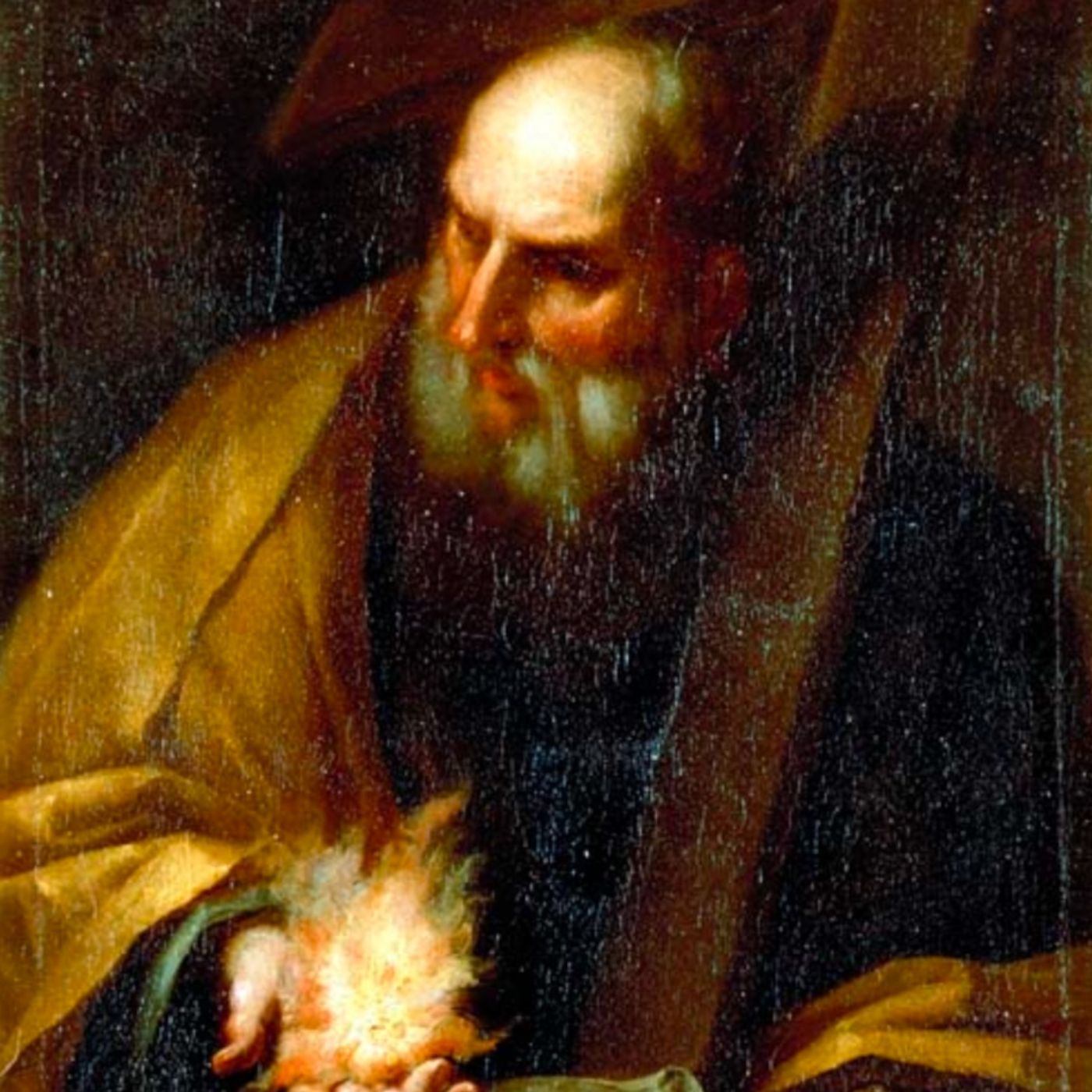
June 11: St. Barnabas, Apostle
from Catholic Saints & Feasts Hosted by Fr. Michael Black
June 11: Saint Barnabas, Apostle Early First Century–c. 62 Memorial; Liturgical Color: Red Patron Saint of Cyprus A multi-talented disciple recruits Saint Paul Today’s saint was an Apostle in the exact same sense in which St. Paul was an Apostle. Saint Barnabas was not one of the Twelve original followers of Christ nor a replacement for one of the Twelve, like Saint Matthias. But the term “The Twelve” quickly disappeared after the Gospel events, because “The Twelve” themselves propagated into dozens, hundreds, and then thousands of successor Apostles, known alternatively as Episcopoi or Prebyteroi: Overseers or Elders. Saint Barnabas is among that generation of Christian leaders whose name first surfaces immediately after the Resurrection. So although he was not in the circle of “The Twelve,” he stood in the next outer ring. The earliest name for the movement initiated by Jesus of Nazareth was “The Way.” This term is used in the Acts of the Apostles and in the ancient catechetical document known as the Didache. But “The Way” was replaced early on by another term. The Acts of the Apostles explains: “Then Barnabas went to Tarsus to look for Saul, and when he had found him, he brought him to Antioch. So it was that for an entire year they met with the church and taught a great many people, and it was in Antioch that the disciples were first called ‘Christians’” (Ac 11:25–26). We owe Saint Barnabas, then, the credit for the word “Christian” as the standard description of the followers of Jesus Christ. The persecution and martyrdom of Saint Stephen forced many Christian leaders to flee Jerusalem. The unforeseen effect of Stephen’s assassination and the subsequent persecution of Christians was the spread of the Gospel into greater Syria, the Greek Islands, and North Africa. This expansion led to contact with Greek and Roman Gentiles, or non-Jews, a growth presaging the transformation of Christianity from a localized Jewish sect into a multiethnic worldwide Church. When some converts from North Africa and Cyprus went to Antioch, the capital of the Roman province of Syria, they converted a great number of Greek speakers. And when “news of this came to the ears of the church in Jerusalem...they sent Barnabas to Antioch. When he came and saw the grace of God, he rejoiced, and he exhorted them all to remain faithful to the Lord with steadfast devotion; for he was a good man, full of the Holy Spirit and of faith” (Ac 11: 22–24a). Saint Barnabas played a crucial role in the first unfurling of the Gospel message beyond Palestine. Acting as a kind of talent scout, he lassoed Saul from his hometown of Tarsus to begin the extraordinary missionary efforts which would forever change the Church and the world. Saint Paul and Saint Barnabas are repeatedly mentioned together in the Acts of the Apostles as they traverse the port cities, the waters, and the dusty highways of the Eastern Mediterranean world. Together, they call down the Holy Spirit, commission new Apostles, confront Jews and Roman citizens alike, challenge a magician, speak to governors, and, of utmost consequence for the Church’s future, convince the other Apostles not to force new converts to become Jews first and Christians later. Saint Barnabas was a dynamic force of nature who spun like a tornado from town to town in the early Church. He was a giant of that first generation of risk-taking, manly, apostolic leaders. The citizens of Lystra in Asia Minor compared him to the Greek God Zeus. They were so impressed that they tried to crown him with garlands and to sacrifice the blood of oxen to both him and Saint Paul (Ac 14:12–18). After numerous adventures in tandem, Paul, the better preacher, writer, and organizer, ultimately sails off on his own. The last we hear of Barnabas, he is returning to the Island of Cyprus, his native land. When Saint Paul writes from his Roman prison in about 62 A.D., he mentions that Mark, the cousin of Barnabas, is with him (Col 4:10). Barnabas’ absence at Paul’s side in his hour of need is a clue that Barnabas is likely dead by the year 62. Tradition tells us that Barnabas was martyred on Cyprus, perhaps by a Jewish mob angered at his successful preaching in the synagogue of Salamis. His relics and memory are particularly honored on Cyprus to this day. Saint Barnabas, you gathered infant Christianity from its cradle and carried it into the world beyond. You poured the message of salvation into new wineskins without any guile. May all Christians be so confident, so convincing, and so successful through your intercession.
Embed this episode
No transcript yet.