Welcome to World War I Centennial News, episode number 74. It's about World War I then, what was happening 100 years ago this week, and it's about World War I now, news and updates about the centennial and the commemoration. This week, Dr. Edward L'Engle, Catherine Akey, and I sit down for our June 1918 preview roundtable. Mike Schuster updates us on the fact that it's not all quiet on the Western Front. Tanbir Kahlo tells us about American immigrants from East India and their World War I experience. Nancy Heingartner shares the story of her great-grandfather, the U.S. consul in Liège, Belgium, in World War I.
Susan Weefald tells us about the 100 Cities 100 Memorials Project in Bismarck, North Dakota. Catherine Akey with the commemoration of World War I in social media. And a whole lot more on World War I Centennial News, a weekly podcast brought to you by the U.S. World War I Centennial Commission, the Pritzker Military Museum and Library, and the Starr Foundation. I'm Tao Mayer, the Chief Technologist for the Commission, and your host. Welcome to the podcast.
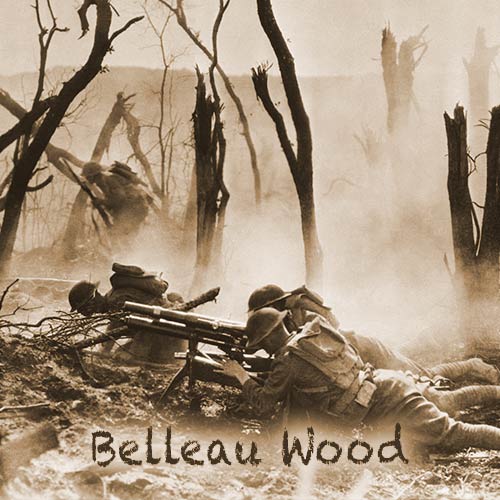
Well, the first week of every month, we invite you to our preview roundtable where Dr. Edward Lengel, Catherine Akey, and I talk about the upcoming month and the key events that are happening 100 years ago. The question on the table as we sat down was, what were the big stories and themes in June of 1918? What follows is our conversation. What's the main theme, Ed? The main theme is combat. American forces enter combat on a large scale for the first time. They come in at the end of the German offensive of May 27th along the Chimine de Damme, initially for the 2nd and 3rd Divisions to stem the German tide, which the Americans imagine is aimed at Paris. The 3rd Division rolls in along the Marne River, the 2nd Division comes in next door, and the 3rd Division is involved in the initial defense, and the 2nd Division starts hitting back at Belleau Wood.
The German offensive, thanks largely to French defensive operations with some support from the Americans, rolls to a halt. Then you begin to see through June as combat continues at Bella Wood and Hill 204, army units begin to be moved into the front lines in small pockets, sometimes in company strength, battalion strength, regiment strength, sometimes on a larger scale, not just to like occupy the trenches for a short period of time, but now actually to get involved in offensive operations and combat. And you see for the first time French officers are actually instructing the Americans in the line on how to fight. And then toward the end of June, offensive operations really begin in earnest with operations around Vaux and in other places. You'll now see American divisions moving into the field, not just by ones and twos, but by threes, fours, and fives, and eventually even in core strength. Catherine, what are some of the other themes that struck you for this month? I would just add to what Ed said. We are seeing this pattern of the German offensive continuing.
The third offensive ends on the 6th. That's the one that started at the end of May. It does get really close to Paris, like really close to Paris. They're within 35 miles of Paris. Civilians are fleeing the city. The French government is packing up and drawing up its plans to evacuate to Bordeaux. For reference, the first Battle of the Marne back in 1914, when the Germans arguably could have taken Paris, they were only 30 miles outside of Paris. So they're pushing pretty deep during this third offensive and are only really halted by French troops and U.S. troops at Chateau Thierry on the 4th.
As that third German offensive ends, just a couple days later on the 9th, the fourth German spring offensive picks up. And it goes through pretty much the same pattern we've seen all spring. The Germans take a lot of territory, don't achieve their strategic goals. Their intent is to draw more Allied reserves towards the south of the fighting front, widen the German salient, but they aren't successful. And in part, this is because the Germans are getting captured in larger and larger numbers. The French are warned by German prisoners that it's coming. And so they're able to pull out of the areas that are going to be hit by an artillery barrage, not take those casualties, and then move back into place.
place before the Germans can attack. So they're actually getting the upper hand in this fourth push that starts that second week of June. Ed, there's a term that keeps coming up, and it comes up all the time, and the word is salient. What does that mean? A salient is a piece of territory projecting into the lines. So in other words, it's a piece of German-held territory that juts out into French and American lines like a thumb.
A salient is something that potentially is very vulnerable. It can be attacked on multiple sides, preferably at the base and cut off. But also, if it's held strongly, it can be very dangerous. It can be like the thin edge of a knife sticking toward your heart. Salients are something that armies fight over. When you're looking for a place to attack from or to attack, you go to a salient. I think the most famous example for Americans would be, of course, the Battle of the Bulge, right? Right, yeah. Great example. Is that a physical geographic thing or just an enemy position thing? Often it is defined by geography and the idea that topography is fate and war.
Sometimes, for example, rivers or mountains or other points of topography can help to define what constitutes a salient. Now, for example, the Germans in 1916 launched a major attack against the French fortress of Verdun, and they were able to push the French back on either side of Verdun, but not actually to capture Verdun itself. And the result of that was that you have three salients. You have one French salient in the middle poking into the German lines of Verdun, and you have two German salients poking into the French lines on either side of Verdun. The northern one of those salients would become called the San Miguel salient, and American forces would attack that in September in a major battle. Great, great explanation. Thank you. So in the meantime, that's what's happening on the ground. Anything particular happening on the water this month? More and more transport ships and munitions vessels are being sunk by U-boats. That's just continuing at a pretty rapid pace, and that doesn't let up until the war comes to a close. There are a lot of ships that get sunk pretty consistently over the course of the summer.
And another thing that's pretty important is that the Allied blockade of Germany is really beginning to tell on German civilians. Because despite these sinkings, and you're absolutely right, Catherine, despite the high level of sinkings of transport ships, munitions, ships, and the rest, the British Royal Navy continues to maintain a stranglehold over the German coast. German civilians are really starting to feel the pinch now by the summer, and it's approaching starvation level. Are there other international fronts, not just the Western Front? Because it's been brought up by some of our guests that we tend to think of World War I as a Western Front War, but it's really happening all over. Anything happening in other areas of the world that are significant this month? Oh, goodness. So, so much. We forget that Russia is technically not in the war anymore, but Russia is having a just complete meltdown and a long, long running civil war between the Red and the White Armies and Finland's involved and the Caucasus is involved and Crimea is involved. And there's just a lot happening in Eastern Europe.
This month in June, the Ottoman Empire signs a treaty with the Caucasus region, basically ending most of the fighting there. That would be where modern Armenia, Azerbaijan, and Georgia are. Similarly, in the Middle East, fighting is continuing. And in Africa, which is a front that we don't talk about a lot, there's actually a huge uprising against the British going on in Nigeria that's drawing some of their forces away from where they've been. A lot of these countries that are part of these colonial empires, they're seeing this as an opportunity to fight for independence. So there's actually a pretty large force of German, French, and British in Africa and in the Middle East trying to hold on to all these valuable territories. One last thing I would mention is Italy. There's still fighting going on in northern Italy. And in fact, in June on the 15th, there's a huge battle that starts up, the Battle of the Piave River, where the Austro-Hungarians launch an attack that's terribly ill-timed because they're trying to fight along this river.
There's a huge spring thaw starting in June. They're pretty high up in altitude, so spring's a bit later in the year. And the troops, the Austro-Hungarian troops, some get caught on the wrong side of the river and are easy targets, and some 20,000 of them drown trying to cross the river. And it's just a complete, utter disaster for the Austro-Hungarians. This was a point when the so-called Easterners come to the fore in the Allied camp. These are people who had been arguing from the beginning that the war could not be won on the Western Front and that the proper way to defeat Germany was to drive up through the Balkans, through Bulgaria and Serbia and into the Austro-Hungarian Empire. And as the Balkan regimes, particularly Bulgaria and Austria-Hungary, begin to collapse and the Ottoman Empire is close to collapse, there are loud calls in the Allied camp.
to pull forces away from the Western Front and move them over into the Balkans and to drive up there. You can only imagine what would have happened if that had taken place. Some very, very unhappy French and British generals, I suspect. Yeah, exactly. Unhappy Americans, too. And unhappy Americans. What happens in June in the War in the Sky? Well, I know, and maybe I can speak more to Cantigny and how the planes were used, but I know that Cantigny is one of these first kind of all-arms battles where you see planes supporting infantry.
Most of what the aircraft were doing at this point is spotting for artillery and reconnaissance. Billy Mitchell really does not see a direct air-to-ground support capacity for the American Air Services, and so he tends to use them in other ways. In fact, Cantini stands out in the sense that it's basically the only major American battle of 1918. with the possible exception of San Miguel, in which aircraft really played a role over the battlefield, American manned aircraft, because usually they were all flying somewhere else. Yeah. I do know one bit of sort of fun fact from the War in the Sky is that the Germans love their sort of mega gigantic bombers, right? We've talked about those previously on the podcast. Riesenflugzeug. Yes. Well, this is the Zeppelin Staken, which is a type of Riesenflugzeug, or however you call it. It's got a wingspan of 138 feet.
It's got four engines. It's a biplane. It's humongous. And the French shoot one down in June, which is pretty cool. They shoot a lot of ammo at this thing. And I'm pretty sure they have a lucky shot where they knock out some of the engines, maybe catch it on fire, and it comes crashing down. And for the French anti-aircraft behind the lines, it's a pretty exciting moment. Did we miss anything that we haven't talked about?
We do see this extra shift in the draft at the beginning of June, on June 5th, when all the men who've turned 21 in the last year get absorbed into the draft. And that's an estimated extra 750,000 men being added to the forces. Do they actually conscript them or are they just registered for the draft? They're just registered for the draft. But as far as I know, pretty much if you're registered for the draft, you're being mobilized to training camps and cantonments.
We don't know that this war is going to end in November. I know we've said that before, but it's really important to keep in mind. We see this as, oh, we just have to make it to September, October, November, and we're done. They really think they might have to be fighting until 1921. Is this a period like when Eugene Debs gets arrested and thrown in jail? He gets jailed on June 30th. So that is a good thing to mention is we spoke in May about the Sedition Act and Eugene Debs. And on June 16th, he makes this speech urging resistance to the military draft. And on June 30th, that's when he's charged. He's arrested and charged with 10 counts of sedition.
And of course, there's another disaster in process, the flu. The flu is still happening. And in June, I think is when you can pretty confidently say it's reached pandemic levels. And it's not just a virulent flu. This is like really starting to take its toll all across the world and especially amongst the troops. We had someone come on recently who's written a new book about the flu. Yeah, Kenneth Davis. That's his name.
This was the most deadly pandemic in modern history and probably the most deadly pandemic after the Black Death of the Middle Ages. And it struck with such suddenness. That's what made it so extraordinary. And because of the war, it went around the world so quickly. And he was very, very clear that in his research, it was 100 million, 20 million in India alone. I mean, it's just batty to think about.
Let's move on to The Great War Project with Mike Schuster, former NPR correspondent and curator for The Great War Project blog. Mike, in your post this week, you talk about Pershing telling the Allies that the American forces would not really be ready until the end of the year, and maybe not until 1919, which totally freaks everybody out. The French are quite certain that they can't last until then, aren't they? They certainly are. So the headline reads, Americans not ready until 1919, Pershing tells shocked allies. Lesson for Germans, Americans not a rabble of amateurs. French government fleeing Paris. This is special to the Great War Project. On the western front of the village of Cantigny, the Americans take back lost ground. Despite significant losses and exhaustion, the Americans held Cantigny, reports historian Martin Gilbert. It gives General John Jay Pershing a further argument for an independent United States command. And it provides the first cold foreboding to the Germans that this was not as they hoped.
a rabble of amateurs. Nevertheless, according to historian Gilbert, the onward German thrust continued. These days, a century ago, are crucial to the outcome of the war. On May 29th, German troops enter Soissons. Gilbert reports that after three days of fighting there, more than 50,000 French soldiers had been taken prisoner, as well as 650 artillery pieces and 2,000 machine guns seized. The Germans press harder, reaching the River Marne. That night, General Pershing meets with the Supreme Allied Commander, French Marshal Foch. Reports historian Gilbert, they contemplated the terrible situation the Allies were in, what was probably their most serious situation of the war.
At this moment, the Germans are just 40 miles from Paris. Once again, reports Gilbert, the French government was preparing to leave Paris and move south. Tens of thousands of civilians were fleeing from the capital, as they had done in 1914. So once again, the French make urgent appeals to Pershing to transfer his now considerable force to French control in the collapsing French sector. Pershing resists Faust. As always, Pershing is loath to give up control of the American forces, which he sees growing larger at the rate of some quarter million men each month. It turns out these numbers are not true. Pershing stuns the Allied leaders when he tells them at a meeting in Versailles that the Americans have only one month's supply of soldiers to send to France.
This was far fewer rights historian Gilbert than the Allies had imagined possible, but it was the true figure. The great American contribution to Allied manpower would not be ready until the end of the year, possibly not even until 1919. The French Prime Minister, Georges Clemenceau, remarked acidly, that is a great disappointment. Clemenceau urges that new American troops be trained in France, not in the United States. Men learned quicker in France, he says. Pershing stubbornly answers, I would not surrender my prerogatives in this matter. But for the Germans, the threat of an American army gathers like a thundercloud, a German officer writes in his diary.
And every week brings that threat closer. The brief window of opportunity for a decisive German victory was starting to close. Indeed, as the Americans rushed to block the Germans at the River Marne in northern France, they are helped by the Germans' own exhaustion, reports historian Gilbert. At the end of a six-day struggle and by the great distance created by the German advance, writes one French officer, we all had the impression that we were about to see a wonderful transfusion of blood. Life was coming in floods to reanimate the dying body of France. And that's the news from the Great War Project for these days, a century ago.
Mike Schuster, curator for the Great War Project blog. The link to his post is in the podcast notes. And that's what was happening 100 years ago. But now it's time to fast forward into the present with World War I centennial news now. Now this part of the podcast focuses on now and how we're commemorating the centennial of World War I. This past weekend, we celebrated Memorial Day. And World War I commemorations were front and center in communities all across the country. Now the commission had a pretty busy weekend as well. First of all, we had a float to commemorate the centennial of World War I in the National Memorial Day Parade in Washington, D.C.
Besides being joined by a number of really cool World War I-era trucks and vehicles, General John Jay Pershing himself and a bunch of re-enactors, we also introduced America's National World War I Memorial, asking the crowds, did you know that every major war of the 20th century has a memorial in the nation's capital except World War I? The unbelieving shock at this revelation is pretty universal. Everyone assumes that there is one, but there isn't. The National Memorial Day Parade honors those who served in the Great War, World War I. More than 116,000 Americans died in service during the First World War, in what all hoped would be the war to end all wars. However, lingering resentments led to the rise of Nazi Germany and eventually World War II. Did you know that World War I is the only major war without a national memorial in our nation's capital?
I did not know that until I spent the day here Saturday touring and discovered that. But our next float is from the organization Charged to Fix That. The World War I Centennial Commission is leading America's efforts to honor the 100th anniversary of the Great War and bring a national memorial to Washington, D.C. And I am with this commission. The commission established by Congress is working to raise $40 million in private funds to build the memorial that you see depicted here on the float. This should be real. This should be something we can all go see. The memorial will be 60 feet long, 11 feet high, and set in Pershing Park near the White House. Perfect place. The float entitled They Deserve Their Own Memorial encourages every American to donate today so that future generation...
of Americans will never forget the sacrifices of the Great War. New York City always has quite a memorial day. Besides their own parade, the Navy coming to town for the much-beloved Fleet Week. This year, the commission was instrumental in sponsoring a very special event for the occasion. The musicians of the 369th Experience brought turn-of-the-century ragtime and jazz onto the decks of the USS Intrepid at the Intrepid Sea, Air, and Space Museum at Manhattan's Pier 86. Carrying on the legacy of the famous Harlem Hellfighters Regimental Band, the 369th Experience pulled together talented modern-day musicians from HBCUs, historically black colleges and universities from all around the country. The musicians competed to participate in this 369th Regimental Band tribute, and a number of amazing and amazed young men came to New York for a truly memorable experience. Here's a clip from New York's PIX11 News.
They were perhaps the best military band ever, and they were also a band of brothers, the 369th Regiment Harlem Hellfighters of World War I. Now their music is being recreated 100 years later by young jazz musicians from traditionally black colleges across the country on the Intrepid this Memorial Day. For everyone, it was a lesson in history as well as music. The Harlem Hellfighters, a New York-based regiment, went to Europe, fought for the French because the white officers didn't want to have them under their command in America. They fought heroically. They also had a regimental band led by James Reese Europe. It started out as ragtime, and it progressed into jazz. And my grandfather, James Reese Europe, was one of the men most important in that transformation. They brought jazz to France and the world.
These college musicians learned their music separately in different parts of the country and just started rehearsing together a few days ago. Quite impressive to the son and daughter of jazz great Duke Ellington. To hear these young, talented musicians is just phenomenal. It's just, it gives me goosebumps. Your father would have loved this? Oh, absolutely. I know he's looking down smiling right now. And to these young jazz musicians, they say it's just an incredible experience to be playing the music of the Harlem Hellfighters a hundred years later on the deck of the Intrepid. To aspiring professional tuba player, 20-year-old Jacob Paul Tatum of Houston, it's a dream come true. For just this opportunity to be on Memorial Day, it's truly special because we're representing something great. And the fact that we get to stand here and accept the honor for the 369th Regiment makes it that much more special. For the Turner family of Coney Island, with both veterans and musicians in the family, it was a perfect Memorial Day. This is amazing. They practice on Scott.
This is, that's great. Great. Great. What do you think of the music you're hearing? I love it. It's very exciting. From the flight deck of the intrepid McGee Hickey, Pix11 News. We collected the social media posts from the 369th Regiment, Regimental Band, and the Memorial Day concerts from everywhere and put them in a special gallery at www.cc.org slash 369th or follow the various links in the podcast notes to learn more. It was great. This week, we're remembering veterans. We want to end the month of May, which is Asian Pacific American Heritage Month, with a focus on Indian American immigrants in World War I.
Our guest for the segment has an unusual background in his World War I expertise. He's become one of the leading go-to guys when it comes to Indian participation in World War I. He just graduated as the Ronald E. McNair Scholar from St. Lawrence University. But before that, he was an intern at our own World War I Centennial Commission. His name is Tanvir Kahlo. Tanvir, thank you for joining us. Thank you for having me. So Tanvir, it's really exciting to see an intern from the commission continue what they became passionate about in their intern period. Can you tell us the story of your intern experience and how it shaped your interest in the Indian-American experience 100 years ago?
So my supervisor when I was at the commission was Chris Christopher, and he was looking for content for the commission's website. And we had a discussion, and I briefly mentioned that I knew of an Indian soldier that served in the U.S. military during World War I, Dr. Pagateng Tind. And Chris Christopher was really excited and said, we'll find more information. As I continued my research on him, I came across the South Asian American Digital Archive, which had six photographs of Indian Americans that were serving the U.S. military during World War I, and just used AncestryInstitution.com to explore their military services and their lives and created this whole original historical database for the commission.
When you interned, you helped a journalist named Surishi Mohan put together one of the publishing partner websites called Vande Mataram. And it's dedicated to the Indian American experience in World War I. How did that come about? And did she find you or did you find her? So we were connected through Chris Christopher and we exchanged conversations and we thought our research worked really well together. One talking about the military service of Indian Americans and the other talking about independent activities of the community on the West Coast for the most part. It was really well-rounded research and just focusing on Indian participation during World War I. A great experience of having the chance to meet with her and work with her.
The website's called Vande Mataram. What does that mean? It comes from a poem from, I believe, the 18th century or later, and has become a slogan for Indian independence, especially during the 20th century under people like Gandhi and so forth. It's almost like a rallying call for independence. The site features a story of the Hindu conspiracy. Can you give us an overview of that incident? That was a group of individuals called the Dutter Party. They were operating outside of California and somewhat in the East Coast. They were receiving support from the German imperial empire, mainly because the Germans saw that they can open up another front, essentially, for the British empire.
by fighting them on the Western Front and supporting the Irish revolutionaries and also the Indian revolutionaries to basically distract them. The other party on the West Coast was receiving support and arms from the German Empire. They were found by American authorities with assistance with the British and reported on trial for crimes to disrupt the war effort and potentially harm Britain. And their goal was essentially to help liberate India from the British Empire. I think a lot of people don't know that there was a fair-sized East Indian population in America at that time. How big was it? So right now we're looking at 3 million or so Indian Americans. Back then it was less than 100,000. Mainly these people were skilled laborers. Others went on to have successful professions. Very diverse backgrounds, but also a very small population during this period. You recently did a profile on Dr. Bhagat Singh Tind. Who was he and why did you choose him as the focus of your story? He's definitely one of the pioneers for the South Asian community in the United States.
immigrated here about 1912 and for higher education to become a scholar and a teacher of spirituality and religion. He was one of the first Indians and the first Sikhs in the U.S. military. He served out in St. Louis during the war, didn't serve overseas. The U.S. government at that time introduced a policy that could allow more nationals to become naturalized in the military, and Dr. Paget Singh Tind was one of the soldiers that obtained naturalization while in the military. And after the war, the U.S. government revoked many naturalizations of South Asians and other Asian communities simply because they were not white.
And he fought against this leading up to the 1923 case, U.S. versus Ben. U.S. Supreme Court ruled against him, saying people from India are not white, therefore cannot apply and obtain naturalization. He continued to fight this petition after petition. And eventually, in 1936, he obtained naturalization through the state of New York. And so definitely he's one of the pioneers for the community fighting for what he thought was right and also what he thought was his right.
I actually did not know that it was government policy to revoke the citizenship post-war. The government also introduced policies to naturalize foreign nationals because of the need for manpower. And it's really interesting, too, for the South Asian community, they could be exempt from military service because they were British subjects. But then the war started, manpower was needed. So you naturalize them to make them, quote-unquote, American or Americanize them. And then after the war, you know, the government didn't really want these individuals to be seen as Americans because of their color of their skin. Wow. Okay, Tanvir, what's next on your horizon? Next is Brad would be attending the University of Delaware, part of the Hagley Fellowship Program.
for a master's in history. Well, Tanvir, we're really proud and excited for all the work that you're doing and this expertise that you're building up and the voice that you're carrying. Thanks so much for coming in and speaking with us today. Thank you for having me. Tanvir Callow just graduated as the Ronald E. McNair Scholar from St. Lawrence University and a former World War I Centennial Commission intern. Read his articles and learn more about the Indian American service in World War I by following the links in the podcast notes.
In a special Remembering World War I segment, we're going to hear about a very touching and heartfelt tribute made by Belgian refugee children from 100 years ago. For this, we're joined by Nancy Heingartner, the Assistant Director for Outreach at the University of Wisconsin, Madison's Institute for Regional and International Studies. Nancy also happens to be the great-granddaughter of Alexander Heingartner, the U.S. Consul in Liège, Belgium in 1915. Her discoveries in a family attic has gifted her with a very special collection of letters sent to Alexander. Letters of thanks from the Belgian schoolchildren 100 years ago. Nancy, welcome to the podcast. Thanks, Theo. I'm delighted to be here. Could you start off by telling us a bit about your grandfather? Was he in Belgium when the war broke out? Yes, he was. And let me give you a little bit of background on that. Alexander Heingartner, my paternal great-grandfather, was born in 1857 in New York City, but spent most of his youth in Canton, Ohio, where his father owned a paper mill, on December 6, 1898, when he was 41 years old.
President McKinley, a friend from Canton, nominated him to be the U.S. consul to Catania, Italy. After seven years in Italy, Alexander's next two posts were in the Russian Empire. On August 19, 1911, Alexander received his commission to serve as consul in Liège, Belgium. Kind of a strange coincidence that my great-grandfather died in Liège on March 30, 1917, a week to the day before the U.S. entered the war. And he is buried in the main cemetery in Liège. Now, the children writing him letters were thanking him for the support and provision given to them by the Commission for Relief in Belgium, the CRB.
That organization was led by a young engineer and mining consultant named Herbert Hoover. What is the commission and how is your great-grandfather involved in it? That's a great question. From 1911, when my great-grandfather reported to Liège, until the early part of 1914, Belgium was considered one of the most prosperous countries in the world. That ended abruptly when Germany invaded Belgium in early August of 1914. In late August, due to a British naval blockade of all Belgian ports, the supply routes to the country were cut off, and in a country where three-quarters of the food was imported, food supplies dwindled very rapidly. Herbert Hoover became aware of the plight of the Belgians and decided to step into action. According to George Nash, a historian and Herbert Hoover biographer, and I quote,
So began an undertaking unprecedented in world history, an organized rescue of an entire nation from starvation, end quote. This organizational structure was called the Commission for Relief in Belgium. So as the highest-ranking American official in Liège at this time, Alexander Heingartner was made a member of the CRB and was put in charge of making sure that Belgian relief supplies that reached the U.S. consulate in Liège were distributed to the people who needed them. And then, if not for discovery that my father and I made in the attic of my parents' house just a few years ago, that would be the end of the story.
Yeah, you found some letters. Tell us about the letters. Yeah, so one evening while I was visiting my parents, my father and I were carrying out what I like to call an archaeological dig in the attic. On this occasion, we collected an old steamer trunk made in Liege to go through. We found a treasure hidden at the bottom. The treasure was wrapped up in handmade paper tied with pink ribbons with two small note parts attached. When we removed the ribbons and paper, we found a book roughly 24 inches tall by 12 inches wide. Its cover is of hand-painted silk with the words Glory and Gratitude to the United States written on it.
The book contains a collection of handwritten and decorated letters expressing the gratitude of Liège schoolgirls to the American people for the support they and their families received from the Belgian aid campaign. And they're all from 1915. So here's one. And I'm sorry that a podcast cannot do them justice because these are truly works of art. Okay, these are translated from the French. Dear little friends, calculation arithmetic is not our strong suit because we're only eight years old. However, we know how to add up good deeds even if we do not personally know the benefactors. It's precisely because our little hearts feel so strongly that we are so eager to thank you and your fathers and mothers for doing so much for Belgium. You are luckier than us, as every evening you can give a big hug to your beloved parents. You do not see them suffer, and your beautiful country is not miserable like ours. We are happy for you, dear little friends, and we pray that good Jesus looks after you along with all your loved ones.
And that peace reigns in the beloved America that sends us food as well as clothes, because we have benefited from the generosity that has flown from your country. Ask him, dear girlfriends, for our fathers to come back quickly so that the smile returns to our mothers' faces and to ours as well. Farewell, dear little friends from far away. We hold great affection for you in our hearts and remember you in our prayers. On behalf of all the second grade pupils, a young schoolgirl from Liège, José Leclerc, eight years old. That's delightful. That really is delightful.
Aren't they beautiful? Yeah, they're very touching. So what happens to this treasure now? That's a great question. You know, since I discovered the letters, I brought them to the attention of the Belgian embassy in the U.S. Together with their tremendous support, we actually mounted an exhibition of the letters back in Liege, where the letters came from. It went from December 2015 until early spring of 2016. And my great, great hope is to create a book based upon the letters.
I continue to be conflicted about whether to create sort of a small children's book to bring to the attention some of the great deeds that our country did, or whether to present the letters sort of in their full glory as maybe like a coffee table book, or perhaps I could do both. That's a really wonderful story, and the letters are truly touching. Thank you so much for bringing them to us. Oh, it's my great pleasure to do so. Thank you. Nancy Heingartner is the Assistant Director for Outreach at the University of Wisconsin-Madison's Institute for Regional and International Studies. Learn more about her discoveries by following the links in the podcast notes.
Moving on to our 100 Cities, 100 Memorials segment about the $200,000 matching grant challenge to rescue and focus on local World War I memorials. This week, we're profiling a project from Bismarck, North Dakota. It's the capital city of North Dakota, located on the bluffs of the Missouri River. With us to tell us more about the World War I Memorial Building Project is Susan Weefald, Vice Chair of the North Dakota World War I Centennial Committee, an active volunteer, and a retired elected state official. Susan, welcome to the show. Thank you very much, Tao. Happy to be with you today. Your project involves a World War I Memorial Building rather than a statue or a monument. What made your community decide to build a World War I Memorial Building in 1929? Well, after World War I, General John Pershing, who of course was commander of the American Expeditionary Forces, he encouraged living memorials, public facilities that could serve citizens.
and honor those who had served in the Great World War. North Dakotans embraced this idea and built 23 public buildings dedicated to World War I veterans, more than any other state except California. Money was tight in the 1920s and 1930s in North Dakota, but people approved special taxes for these World War Memorial buildings in commemoration of the people of their county who rendered services during the Great World War. Well, Susan, actually, I just realized you built this literally when the economy crashed in 29. That must have been tough.
That's exactly right. And it was amazing that the people put forward their dollars for the special purpose of building a memorial building, which cost, of course, a lot more than a monument would have. Well, now, in its early years, the building housed the state legislature for a time. How did that come about? Well, the Capitol burned down in December of 1930. The memorial building was to be dedicated in January of 1931. The legislators moved in immediately. How long did they legislate from that building?
The sessions in North Dakota only last for four months. And in that time, sessions only lasted for three months every other year. So by the time the state capitol was rebuilt, it was in 1934. Legislature occupied the World War I Memorial Building for several months every other year until 1934. Well, so you are clearly the spearhead for the restoration effort on the building. How did you get involved? I've been researching World War I Monuments Memorials in North Dakota for three years. I started in January 2015 when I saw an article in Preservation Magazine.
asking for people to start to do research on their memorials and monuments in their state. I called and I asked whether anyone was doing North Dakota. And the person I spoke to said, no, we don't have anyone doing North Dakota. So I got busy on that. I love a project where I can do some detective work. And I called small towns, read old books, talked to people, looked at old pictures and found over 40 monuments and memorials here in North Dakota. And probably most of them hiding in plain sight. I mean, that's what we've discovered from the whole Hundred Cities, Hundred Memorials project is that people have been walking by these things their whole life and going, oh, really, it's a World War I memorial.
Right. And for example, this particular building is called the World War Memorial Building. And it doesn't say World War I. So I think many people in our community may have thought that it was from World War II. But it actually was a World War I memorial. And many of those were built in North Dakota in the 1930s. And that was quite a few years after the war. But it was because there was federal assistance also available to help those communities build those buildings, along with the local community funds that were raised. Well, you bring up a good point. Until World War II happened, nobody knew that there would be a World War I and a World War II. So they called it the World War.
I was looking for monument memorials dedicated between the years 1918 and 1940. We found that in North Dakota, we have what appears to be the very first monument dedicated to local war dead in the United States. That's up in Minot, North Dakota. It was in excellent condition, so it didn't need any additional work on it. So we couldn't nominate that one for this particular recognition. But it certainly is a very special memorial to have in our state. What stage is the project at now? This particular project was a lobby restoration project. And the project now is completed. They put in a new service station in the lobby. They also repolished the floors and did some painting in the lobby so that it would be more presentable as people go into the building. There's a lot of traffic going into the building these days for the gymnasium that has been in place for years. Are you going to be rededicating it?
I'm talking to the people at the Parks and Recreation District office today about that effort, and I anticipate that'll happen this summer. Excellent. Well, Susan, thank you for coming in and telling us about the project. You're welcome. Thanks for having me. Susan Weefold is the vice chair of the North Dakota World War I Centennial Committee. Learn more about the 100 Cities, 100 Memorials program by following the link in the podcast notes. Welcome to our weekly feature, Speaking World War I, where we explore the words and phrases that are rooted in the war.
After April 6th last year, we started talking about the cantonments that the U.S. government was building all around the country to train our millions of new recruits. Everybody got the idea that cantonments were big old training camps from the context we used it in. All the historians and military experts around me were using the word like it was something I should have known. But, you know, when I started asking around, who the heck uses the word cantonment on a regular basis? Seriously, turns out that the word cantonment comes from a 16th century Middle French term for a corner or an angle, which leads to...
a definition for an area, and that leads to a section of land and then a segment of a region. By 1917, cantonment was the name for a permanent military camp or garrison, and for World War I, the U.S. built some 30 of these camps to accommodate the training of our new army. Cantonment, a pretty esoteric term for my money, and this week's word for speaking World War I. Next week, we're going to look at the word boot camp, which also shows up at this time, and unlike cantonment, it sticks around and is popular even today. Now for World War I war tech.
This week, we're looking at one of the truly, truly horrific World War I weapons, tweaked up by the Germans and called der Flammenwerfer, which quite literally translates as the flamethrower. A hundred years ago, as the Americans entered the fray at Cantini, French flamethrower troops were part of the offensive forces used against the Germans. Now, the idea of the flamethrower goes way back, back to the 5th century BC, with some of the earliest working examples dating back to the Byzantine era. Centuries later, by the 1st century AD, hand-pumped flamethrowers on board ships were being used and known as Greek fire. The more contemporary version of the weapon was developed in the early 1900s by the German inventor Richard Fiedler. Now, there's two types, the Kleinflammenwerfer and the Großflammenwerfer, which, appropriate to the very literal nature of the German language, means the small flamethrower and the big flamethrower. The small ones were one-man portable backpack devices, and the large ones were three-man, big-hose, big-pressure, long-throw monsters.
Although it was initially placed into the German arsenal in 1911, the flamethrower wasn't used extensively until the summer of 1915. The shock and the fear and the terror caused by the cascading sheets of fire led to quite a panic among the defenders. It's a genuinely horribly grisly weapon. And like so many of the other devastations of World War I, the Allies quickly began developing their own flamethrowing machines. Meanwhile...
Flamethrower operators typically don't live very long. The first threat is not from the enemy, but from the potentially fatal malfunction of the weapon. I mean, after all, with the portable ones, you're essentially carrying around an explosive backpack with a lit fuse. Now, with the big ones, it's just sort of nutty to squirt huge quantities of flammable liquid out of a nozzle and then light it on fire. Enemy gunfire is a pretty big threat, too. You know, that nicely lit up guy with the flamestick, well, he's just a natural target to shoot at first. The Flammenwerfer, another genuinely horrific World War I weapon, and this week's subject for World War I war tech. Learn more by following the link in the podcast notes.
For articles and posts, here are some of the highlights from our weekly dispatch newsletter. Headline, in D.C. Memorial Day Parade, heir to the pie man from Georgetown recalls efforts which provided dough for the doughboys. Writer Anthony Hayes in the Baltimore Post Examiner tells the amazing World War I history, behind the quaint pie truck, a black Model T box truck replete with its creamy white Connecticut Copperhike Pie Company World War I logo. Headline, Politico article offers in-depth look at current status of new national World War I memorial at Pershing Park in Washington, D.C.
Politico published a broad-ranging and insightful article on May 28th that takes a hard look at the obstacles facing the progress of the new National World War I Memorial at Pershing Park in Washington, D.C., and the opportunities which may emerge from moving forward on the project in the coming months. Headline, Loudermilk book aims to shine the light of awareness of World War I for next generation. Upon receiving the diary of his grandfather, a World War I veteran, writer and photographer Jeffrey Loudermilk was inspired to honor his grandfather's memory by taking the same journey across Europe. Learn more about his book, Honoring the Doughboys, following my grandfather's World War I diary.
Headline. There but not there. Silhouettes honor World War I fallen and support military charities. A new nationwide campaign to commemorate the centennial of World War I and raise funds for military charities was launched across the United States this week. Read the article titled There but not there. Headline. This week in the right blog, I never saw him drowning. Great Uncle Charlie and the Great War. Philippe Maître tells the story of his great uncle Charlie, his veteran father, and his own exploration of war through writing and poetry in the right blog.
Finally, our selection from the official online Centennial merchandise store. This week, we're featuring the Centennial key tag inscribed with the slogan, nothing can stop these men. Inspired by an original World War I poster, this quality key tag features the dramatic image of a bayonet advance on the enemy with the United States flag in the upper corner. I have to admit, I've been carrying one of these in my pocket for three years and it still looks awesome. It's got a great heft to it. And you can get yours in our official merchandise store by following the links in our weekly newsletter, The Dispatch. And you can subscribe to The Dispatch by going to www.cc.org slash subscribe or follow the link in the podcast notes.
And that brings us to the buzz, the centennial of World War I this week in social media with Catherine Akey. Catherine, what are this week's picks? We have so many photo albums, links, and articles to share with everyone from Memorial Day weekend. In the podcast notes, you'll find photos and reports from the American Battle Monuments Commission and the U.S. Army Center of Military History, both of whom participated in the grand opening ceremony of the New Visitors Center at the American Monument in Chateau Thierry, France on Sunday, May 27th.
You'll also find links to videos of the Memorial Day commemorations at the Lafayette Escadrille Memorial and a video of World War I Centennial Commissioner Monique Seyfried speaking from the fields of the Mozargonne. There's also an article from NPR about the temporary poppy memorial set up on the National Mall in D.C. over the weekend. 645,000 synthetic flowers, one for each American killed in an international conflict since the start of World War I, pressed against acrylic panels and backlit. Finally, the team behind the film, Sergeant Stubby and American Hero, have teamed up with the American Legion to bring the film to communities across the country. Fun Academy Motion Pictures is offering American Legion posts nationwide opportunities to screen the animated film beginning Memorial Day weekend and continuing through Veterans Day in November with the help of veterans outreach nonprofit vetflix.org. Read more about it and how to organize a screening at your local American Legion post by following the link in the podcast notes. That's it this week for The Buzz.
And that wraps up the last week of May for World War I Centennial News. Thank you so much for joining us. We also want to thank our guests, Mike Schuster, curator for the Great War Project blog, Dr. Edward Lengel, military historian and author, Tanvir Kahlo, a quickly developing expert on Indians in World War I and a former Centennial Commission intern, Nancy Heingartner, educator and custodian of a great century-old collection of thank you letters from Belgian students, Susan Weefelt, vice chair of the North Dakota World War I Centennial Committee. Catherine Akey, World War I photography specialist and line producer for the podcast. And many thanks to Mac Nelson, our hardworking sound editor, who makes us all sound like we never make mistakes. And of course, I never do. I'm Theo Mayer, your host. The U.S. World War I Centennial Commission was created by Congress to honor, commemorate, and educate about World War I. Our programs are to inspire a national conversation and awareness about World War I, including this podcast.
We're bringing the lessons of 100 years ago into today's classrooms. We're helping to restore World War I memorials in communities of all sizes around the country. And of course, we're building America's national World War I memorial in Washington, D.C. We want to thank the commission's founding sponsor, the Pritzker Military Museum and Library, as well as the Starr Foundation for their great support. The podcast can be found on our website at www.cc.org.cn, now with our new interactive transcript feature for students, teachers, bloggers, reporters, and writers. You can also access the World War I Centennial News podcast on iTunes, Google Play, TuneIn, Podbean, Stitcher Radio On Demand, Spotify, using your smart speaker by saying, play WWI Centennial News podcast, and it's also now available on YouTube. Just search for our WWI Centennial YouTube channel. Our Twitter and Instagram handles are both at WWI CC, and we're on Facebook at WWI Centennial.
We want to thank you for joining us. And don't forget to share the stories that you're hearing here today about the war that changed the world. In closing, we have discovered a fact that is very, very strange but true. Did you know that there are over 26,000 people in the United States that tend to use the word cantonment multiple times a week and have for decades? Yep, they all live near Pensacola, Florida in, you guessed it, the only town in the U.S. called cantonment. So long.