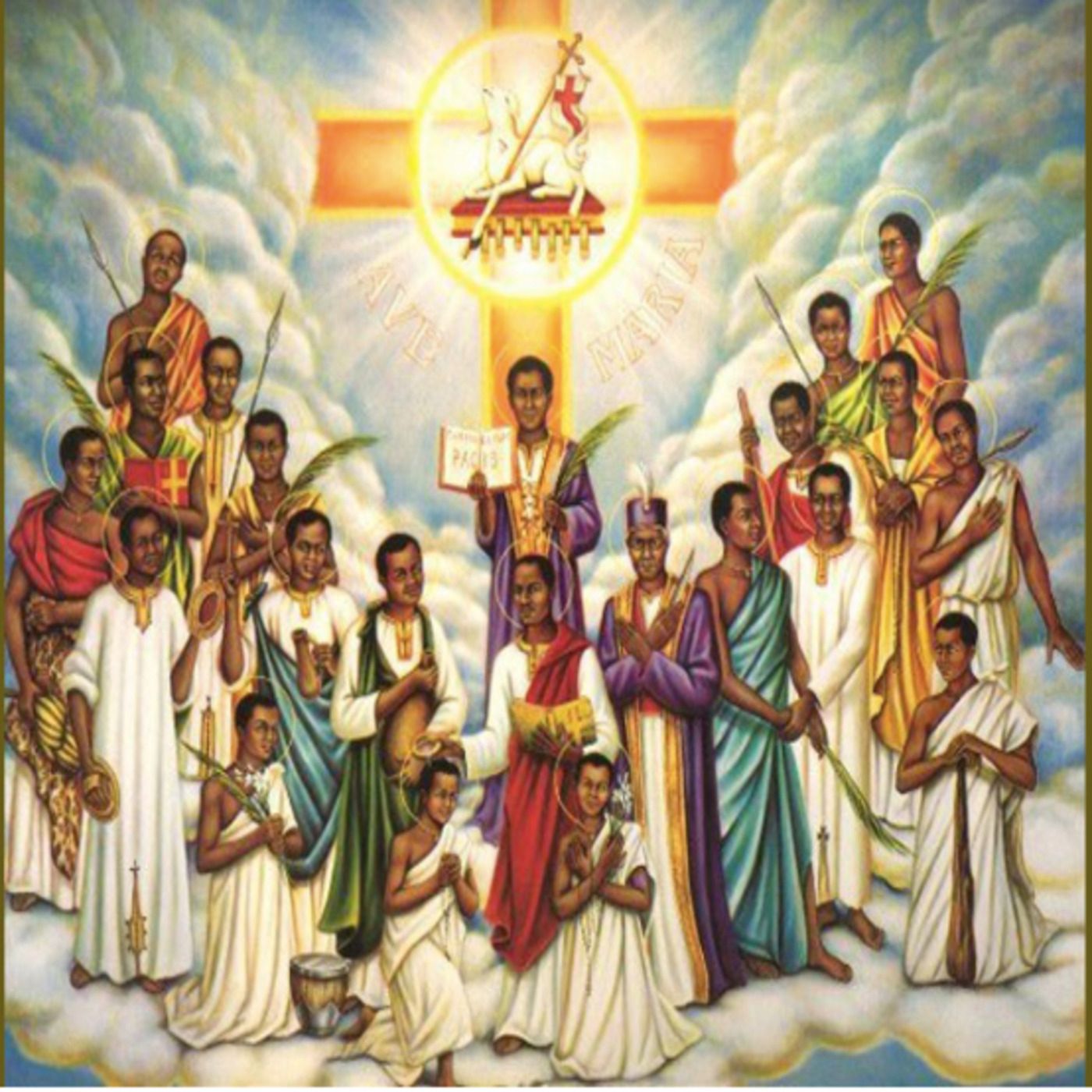
June 3: Saint Charles Lwanga and Companions, Martyrs episode artwork

EPISODE · Jun 3, 2026 · 5 MIN

June 3: Saint Charles Lwanga and Companions, Martyrs

from Catholic Saints & Feasts · host Fr. Michael Black

June 3: Saint Charles Lwanga and Companions, Martyrs 1860–1886 Memorial; Liturgical Color: Red Patron Saint of African youth Young African Christians die like the martyrs of old Many of the faces of the saints in heaven that shine with the light of God are dark faces. North Africa was one of the first regions to be evangelized and was home to a vibrant, diverse, and orthodox Church for over six hundred years. North Africa had over four hundred bishoprics and enriched the universal Church with a wealth of theologians, martyrs, and saints. That Catholic culture drowned under the crushing waves of Arab Muslim armies that inundated North Africa in the seventh century, altering its cultural and religious landscape. Small pockets of Christianity continued to exist in isolation for a few centuries more. But by 1830, when French colonists and missionaries settled in Tunisia and Algeria, local Christianity had totally disappeared. The Christian light had gone out in North Africa centuries before. Yet today’s saints are nineteenth-century African martyrs. While North Africa has remained in the tight grip of Islam, sub-Saharan Africa has lived a contrary reality. It has embraced Christianity. Throughout the nineteenth century, daring missionary priests and religious from various European countries penetrated deep into the towns, savannas, jungles, and river deltas of the “dark continent,” carrying the light of Christ. For the most part, they were well received and initiated the long and complex process of evangelization, inculturation, and education that has turned today’s sub-Saharan Africa into a largely Christian region.Charles Lwanga and his companions were all very young men, in their teens and twenties, when they were martyred. They ran afoul of their local ruler for one reason and one reason only—they were Christians and adhered to Christian morality. The ruler did not otherwise question their loyalty, devotion, or service to him. He was suspicious of the European priests who had brought the faith, wary of outside interference in his kingdom, and also eager to impress his subjects with a display of ruthlessness and power. He was also a sodomite who wanted these young men to engage in unholy sexual acts with him. For refusing to satisfy his disordered and abusive lust, they became victims of homsexual violence. The ruler and his court questioned the young males who served as their pages and assistants to discover if they were catechumens, had been baptized, or knew how to pray. Those who answered “Yes” were killed for it. One was stabbed through the neck with a spear and another’s arm was cut off before he was beheaded. But most were marched miles to an execution site, cruelly treated for a week, then wrapped in reed matts and placed over a fire until their feet were singed. They were then given one last chance to abjure their faith. None did. These tightly wrapped human candles were then thrown onto a huge pyre and reverted to the dust from whence they came. One of the executioners even killed his own son. The executioners and onlookers knew their victims had succumbed to the flames when they no longer heard them praying. The site where these Ugandan martyrs died is now a popular shrine and a source of pride dear to the heart of African Catholics. Charles Lwanga and his companions, though new to the faith, acted with the maturity of the wise and the aged, choosing to sacrifice lives full of promise rather than surrender the pearl of greatest price—their Catholic faith. Saint Charles Lwanga and companions, help us to be courageous in the face of threats, to stand tall for our beliefs, and to suffer ridicule and hatred rather than renounce or minimize our relationship with Christ and His truth.

June 3: Saint Charles Lwanga and Companions, Martyrs 1860–1886 Memorial; Liturgical Color: Red Patron Saint of African youth Young African Christians die like the martyrs of old Many of the faces of the saints in heaven that shine with the light of God are dark faces. North Africa was one of the first regions to be evangelized and was home to a vibrant, diverse, and orthodox Church for over six hundred years. North Africa had over four hundred bishoprics and enriched the universal Church with a wealth of theologians, martyrs, and saints. That Catholic culture drowned under the crushing waves of Arab Muslim armies that inundated North Africa in the seventh century, altering its cultural and religious landscape. Small pockets of Christianity continued to exist in isolation for a few centuries more. But by 1830, when French colonists and missionaries settled in Tunisia and Algeria, local Christianity had totally disappeared. The Christian light had gone out in North Africa centuries before. Yet today’s saints are nineteenth-century African martyrs. While North Africa has remained in the tight grip of Islam, sub-Saharan Africa has lived a contrary reality. It has embraced Christianity. Throughout the nineteenth century, daring missionary priests and religious from various European countries penetrated deep into the towns, savannas, jungles, and river deltas of the “dark continent,” carrying the light of Christ. For the most part, they were well received and initiated the long and complex process of evangelization, inculturation, and education that has turned today’s sub-Saharan Africa into a largely Christian region.Charles Lwanga and his companions were all very young men, in their teens and twenties, when they were martyred. They ran afoul of their local ruler for one reason and one reason only—they were Christians and adhered to Christian morality. The ruler did not otherwise question their loyalty, devotion, or service to him. He was suspicious of the European priests who had brought the faith, wary of outside interference in his kingdom, and also eager to impress his subjects with a display of ruthlessness and power. He was also a sodomite who wanted these young men to engage in unholy sexual acts with him. For refusing to satisfy his disordered and abusive lust, they became victims of homsexual violence. The ruler and his court questioned the young males who served as their pages and assistants to discover if they were catechumens, had been baptized, or knew how to pray. Those who answered “Yes” were killed for it. One was stabbed through the neck with a spear and another’s arm was cut off before he was beheaded. But most were marched miles to an execution site, cruelly treated for a week, then wrapped in reed matts and placed over a fire until their feet were singed. They were then given one last chance to abjure their faith. None did. These tightly wrapped human candles were then thrown onto a huge pyre and reverted to the dust from whence they came. One of the executioners even killed his own son. The executioners and onlookers knew their victims had succumbed to the flames when they no longer heard them praying. The site where these Ugandan martyrs died is now a popular shrine and a source of pride dear to the heart of African Catholics. Charles Lwanga and his companions, though new to the faith, acted with the maturity of the wise and the aged, choosing to sacrifice lives full of promise rather than surrender the pearl of greatest price—their Catholic faith. Saint Charles Lwanga and companions, help us to be courageous in the face of threats, to stand tall for our beliefs, and to suffer ridicule and hatred rather than renounce or minimize our relationship with Christ and His truth.

NOW PLAYING

June 3: Saint Charles Lwanga and Companions, Martyrs

0:00 5:11

No transcript for this episode yet

We transcribe on demand. Request one and we'll notify you when it's ready — usually under 10 minutes.

PDF feed of Interpreter: A Journal of Latter-day Saint Faith and Scholarship PDF feed of Interpreter: A Journal of Latter-day Saint Faith and Scholarship The Interpreter Foundation is a nonprofit educational organization focused on the scriptures of The Church of Jesus Christ of Latter-day Saints (the Book of Mormon, the Pearl of Great Price, the Bible, and the Doctrine and Covenants), early LDS history, and related subjects. All publications in its journal, Interpreter: A Journal of Latter-day Saint Faith and Scholarship, are peer-reviewed and made available as free internet downloads or through at-cost print-on-demand services. Other posts on the website are not necessarily peer-reviewed, but are approved by Interpreter’s Executive Board.Our goal is to increase understanding of scripture through careful scholarly investigation and analysis of the insights provided by a wide range of ancillary disciplines, including language, history, archaeology, literature, culture, ethnohistory, art, geography, law, politics, philosophy, statistics, etc. Interpreter will also publish articles advocating the authenticity and historicity Verax Patria Verax Patria Restoring The Contemplative Soul & Cultivating Catholic Land Holy and Healthy Saints Laura Pickard The Holy and Healthy Saints podcast is to help Latter-day Saints embrace the power of Jesus Christ as they strive for better health and body image. We explore how and why this faith-filled approach may be the answer to peace and freedom around food. Wild Olive Jeanne Petrolle and Jennifer Bird The Wild Olive Podcast brings you game-changing conversations about literature, culture, and the Bible. With co-hosts Jeanne Petrolle and Jennifer Bird, Wild Olive serves up idea-feasts: tasty insights about biblical texts and contemporary (or classic!) literature, with generous side-portions of cultural commentary and hearty laughter. One literature professor + one biblical studies professor = uncontrolled, out-of-bounds, untamed conversation: ideal listening for the post-evangelical, the spiritual-but-not-religious, the Bible-curious secularist, the free-thinking religionist, and the literary-but-not-stodgy! New episodes every other Friday!

Frequently Asked Questions

How long is this episode of Catholic Saints & Feasts?

This episode is 5 minutes long.

When was this Catholic Saints & Feasts episode published?

This episode was published on June 3, 2026.

What is this episode about?

June 3: Saint Charles Lwanga and Companions, Martyrs 1860–1886 Memorial; Liturgical Color: Red Patron Saint of African youth Young African Christians die like the martyrs of old Many of the faces of the saints in heaven that shine with the light of...

Can I download this Catholic Saints & Feasts episode?

Yes, you can download this episode by clicking the download button on the episode player, or subscribe to the podcast in your preferred podcast app for automatic downloads.
URL copied to clipboard!