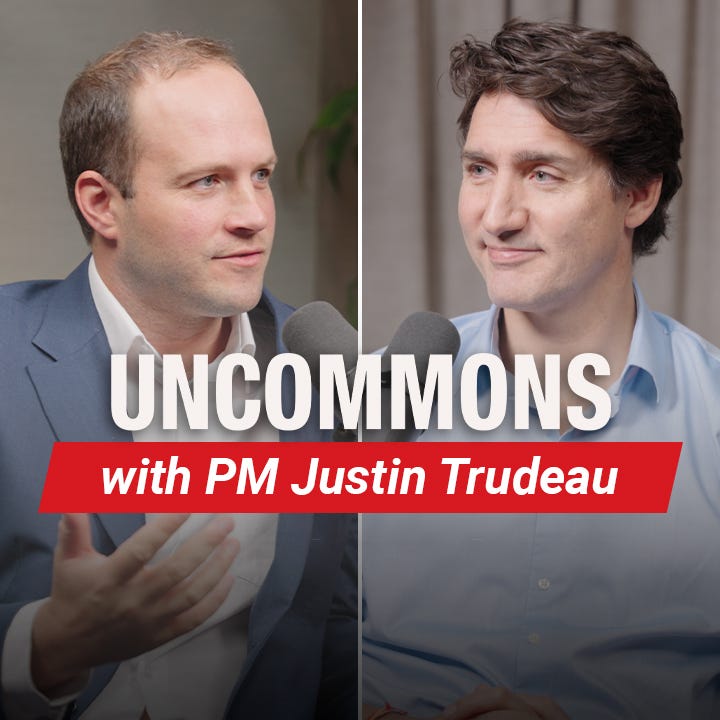
Justin Trudeau on Uncommons
from Uncommons with Nate Erskine-Smith Hosted by Nate Erskine-Smith
On this episode Prime Minister Justin Trudeau joins Nate to discuss the next election, successes and failures in governing, and what comes next. Watch the full podcast on YouTube: — Transcript: Nate: Welcome to Uncommons. I'm Nate Erskine-Smith, and on this episode I'm joined by Prime Minister Justin Trudeau, and you should know at the outset there were no pre-approved questions. Now, before we get to that conversation, two quick public service announcements. We've started these weekly update videos of the week that was in Parliament. We of course call it Uncommons Weekly, and you can check it out on our social media @beynate. The second thing is, do me a favor. If you like what we're doing, go to your platform of choice and leave us a positive review because it does help us reach a wider, greater audience. And I could do a big preamble, but you know who the Prime Minister is. So let's jump to the conversation. The Importance of Conversations in Politics Nate: Justin, thanks for joining me. Justin: Oh, so good to be here Nate. Nate: I was laughing. So, you, in the same week, you're looking at your itinerary and you're doing the Colbert show, and then you're looking, you're going “Oh, and I'm doing Uncommons with Nate. What is – what is happening? How did these two end up on my schedule the same week?” Justin: Yeah. You know, it's actually, it's actually just right, because a big part of what I've been trying to do is have as many different conversations in different places about, about the challenges we're all facing, because one of the things we learn and we've learned over the past years is, if we don't go to where people are, then people aren't listening. It's not like I can give a speech on the steps of Parliament and know that most Canadians will have tuned in to the speech, through the nightly news or through – no. Nate: Five people are really fantastic. Justin: Well, and it's great that they're then, I'm happy to give speeches for them. But if I don't start, if we don't start making, you know, space for real conversations that actually do filter through everything that people are either bombarded with or just busy doing in their lives, then we're not doing right in terms of either representing or serving people. Nate: So for those who are regular listeners, they know a bit of my background. But for those who may be tuning in the first time, because we've got you joining us, this is a Liberal MP’s podcast, but, you and I have not always seen eye to eye. And I get asked all the time, well, what's your relationship like with the Prime Minister, thinking that there's some, you know, animosity that’s between us. How would you describe our relationship to sort of set the stage for this? Justin: Well, when people ask me “So, how do you put up with Nate?” I actually laugh because you're actually one of the MPs that I have a better type of conversation with than many others. And we have all, and we've had some, some pretty important conversations over the years or at least crunchy conversations over the years. But I've always thoroughly enjoyed it. And for me, it's a feature, not a bug, that I have thoughtful MPs who come at this with, you know, ways of challenging me with strongly felt beliefs, with points where we will diverge on things. And as long as I can have, as we have always had, and perhaps better than many others who are sometimes more divergent in their perspectives, as long as we can have really good conversations where you understand where I'm coming from and I understand where you're coming from, then there is, I mean, that's almost the way democracy writ large is supposed to work. As you know, people come together to vote on, you know, what direction the country's going to take. If we can't have these conversations, then, then nothing else is working in democracy. Reflections on Leadership and Governance Nate: Yeah. And a reasonable disagreement is, I think, central to not only our politics writ large, but also to the Liberal Party as, as I hope many of us see it. But when you think of, the Liberal Party, when you think of, you know, you've got, I will never be an anonymous MP in the media, I think it's cowardly, but you've got any number of colleagues who are now speaking out in, less than helpful ways, if I'm putting it more politely. You've got others who are going on record and raising concerns, and the concerns are mixed. Sometimes it's about direction, sometimes it is about you and, and they try to cast it as it's not about, you know, fair or unfair criticism, but you know how people feel. When you look at it, you know, you're in this for nine years. And I want to start with a bigger sort of question of why. You articulated the need for serious change heading into 2015. Many people like me left this, got off the sidelines to participate, because of that call to do things differently, when you think of what's to come next, you've got anonymous MPs raising complaints. You've got people who are, who are, frustrated for this reason or that reason. Governing wears on governments. Why do you want to do this again? Justin: It's interesting that you go back to 2015, right. And that, the why we did this, because first of all, there were a lot of people, you know, telling us that we were wrong, that I was doing things the wrong way, that I wasn't, I wasn't, you know, tackling the right things the right way. There was a lot of skepticism about what that was. And it was an opportunity to actually give Canadians a choice that I think was absolutely necessary for the country to say, okay, we've got to double down on fighting climate change and growing the economy at the same time. We got to step up in supporting the most vulnerable. We got to move forward on reconciliation. We got to, we got to figure out how we navigate through a much more challenging world that has impacts on us. Those are all things that the Harper government wasn't doing, and those were all the things that drove me to saying, “Yeah, Canadians need that choice to be able to make,” well, that's sort of the same choice they're going to make in the next election. Choice whether you’re moving forward on the fight against climate change or whether we just basically throw up our hands and go back to leaning heavily on fossil fuels with the kind of short term thinking that is going to end up being so costly for Canadians just a few years down the road, not just with, with the, the, the costs of climate impacts and wildfires, but also, with the missed opportunities to participate in where the global economy is going. That question of, okay, at this time of backlash against progressive policies of inclusion and diversity, you know, are we going to double down on making sure that everyone gets to participate, or are we going to continue to drive wedges into people and, and, you know, group Canadians into, into subgroups that are angry at each other? I think all those questions are just as important now, if not even more important, because back in the run up to 2015, I think everyone got a sense of, okay, yeah, we just need to find an alternative to Stephen Harper and whether it's Mulcair or whether it's Trudeau, the winds were turning in that sense. Yeah, this is going to be harder on a lot of levels, because it's, it's, a time where people are frustrated. But the choice to make a deliberate choice to say, no, we're going to continue and even double down on the things we know are going to get us better, which is more protection of the environment, more inclusion of people, more understanding how you have to build the economy from the bottom up, from the center out, instead of from the top down, which Poilievre is still proposing. Like, this is going to be a much harder election in 2015. It always was going to be. Nate: Set up, but set up that choice. So I agree, I want to protect the progress. Right. So we, leading into 2015, there were over 100 communities without clean water, Indigenous communities. An… This is a public episode. If you would like to discuss this with other subscribers or get access to bonus episodes, visit www.uncommons.ca
Embed this episode
No transcript yet.