
EPISODE · Sep 20, 2026 · 5 MIN
Kavanaugh left a clever trap that changes everything
from Systemic Error Podcast · host Paulo Santos
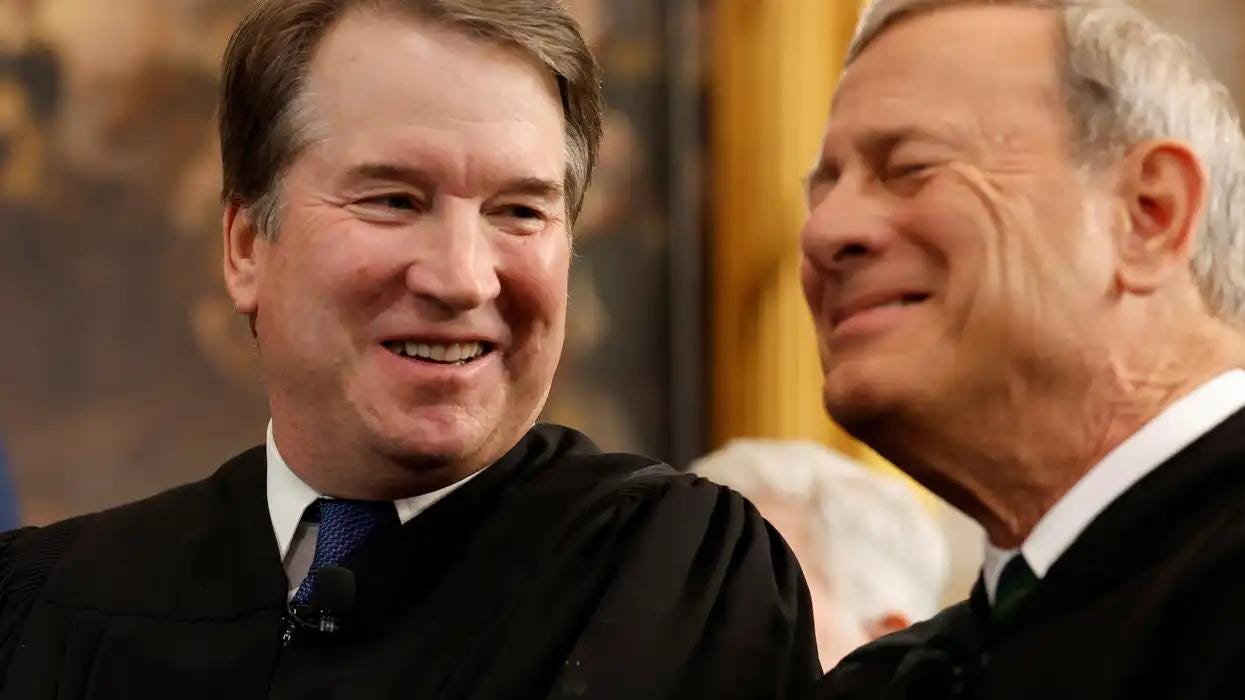
Chip Somodevilla/Pool via REUTERS The Court Blocked the Order. Trump Still Damaged the Vote. A Ruling Against the Clock The Supreme Court’s 7–2 decision blocked the administration’s attempted restrictions on mail voting before the 2026 elections. That is the necessary context. The political substance is that state and local officials must now rebuild confidence in a voting method that federal power was used to destabilize. The Sabotage Was the Policy Donald Trump and his administration held the power here. Election officials did not create the uncertainty; they inherited it. Voters did not spontaneously lose faith in mail ballots; federal action gave them a reason to wonder whether the rules, access, or counting process might be disrupted. Help fuel the work. Independent analysis doesn’t fund itself:☕ Buy us a coffee That distinction matters because coverage can turn deliberate institutional pressure into an unfortunate public-relations problem. Nevada Secretary of State Francisco Aguilar described officials preparing to reassure voters that their ballots would count. His office is being asked to repair trust after the administration attacked the conditions that made trust possible. The confusion is not collateral damage. It is politically useful. Democrats use mail voting at a higher rate than Republicans—37 percent compared with 24 percent, according to the figures cited in the source. Restricting that method therefore carries a foreseeable partisan advantage. Even when courts stop the immediate rule, uncertainty can still change behavior. Republicans Built the Squeeze Mail voting is only one point of pressure. The source also describes Republican efforts to restrict polling locations and drop boxes while threatening election workers. The structure is straightforward: discredit one voting method, narrow the alternatives, then blame administrative disorder or public mistrust for the resulting obstacles. This is voter suppression presented as election management. The weaker actors—local administrators, poll workers, and individual voters—are left to absorb the cost. They must explain shifting rules, defend routine procedures, locate remaining access points, and decide whether a lawful ballot method is still safe to use. The officials creating the instability retain the power; everyone below them receives the burden. Kavanaugh Left the Door Open Justice Brett Kavanaugh’s concurrence is more consequential than the headline victory. As quoted in the source, he objected that applying the rule in the 2026 elections would be “arbitrary and capricious” because officials lacked sufficient implementation time. That reasoning does not necessarily reject the restriction itself. It rejects its timing. The inference is unavoidable, though not yet a confirmed outcome: an administration that begins earlier could return with the same objective and a cleaner procedural record. The Court therefore provided immediate relief without firmly removing the underlying weapon. Calling that a decisive defense of mail voting would mistake postponement for principle. Trump Attacked the Court That Empowered Him Trump responded by denouncing the Court in sweeping terms. Yet, as the source notes, this is also the Court that overturned federal abortion protections, enabled vast political spending, and granted him broad presidential immunity. The contradiction is only superficial. Institutions are legitimate in Trump’s rhetoric when they deliver what he wants and corrupt when they impose even a temporary limit. That is not a legal philosophy. It is the logic of personal rule: power deserves obedience, while restraint becomes betrayal. The Court’s history makes its narrow intervention less reassuring, not more. A tribunal willing to enlarge presidential power can still reject one late or badly structured maneuver. Institutional complicity does not require perfect coordination. The System Rewards Damage Without Victory The larger pattern is governance through degradation. An administration attacks a functioning process. Courts address the narrow legal defect. Local officials scramble to restore confidence. News coverage shifts toward the mechanics of reassurance. The political actor who caused the crisis benefits from the lingering suspicion even after losing the case. That is how institutional sabotage survives judicial defeat. The order can be blocked while the doubt remains; access can stay formally available while voters are frightened away from using it. A system that measures only whether the final rule took effect misses the more durable exercise of power: making ordinary democratic participation feel provisional, dangerous, and dependent on one faction’s permission. Thanks to Alter Net Source: Kavanaugh left a clever trap that changes everything Systemic Error is a reader-supported publication. To receive new posts and support my work, consider becoming a free or paid subscriber. We warned them.We told them.We shouted from the rooftops.We plead.We begged.They didn’t listen.Now, we all will suffer.Y’all know what to do, right?VOTE BLUE! 💙Vote as if your life — nay, our country — depend on it.Because, this time, and every time, it does. This is a public episode. If you'd like to discuss this with other subscribers or get access to bonus episodes, visit paulstsmith.substack.com/subscribe
Embed this episode
Ready to play
Kavanaugh left a clever trap that changes everything
No transcript for this episode yet
Similar Episodes
No similar episodes found.
Similar Podcasts
No similar podcasts found.