
EPISODE · Sep 4, 2026 · 59 MIN
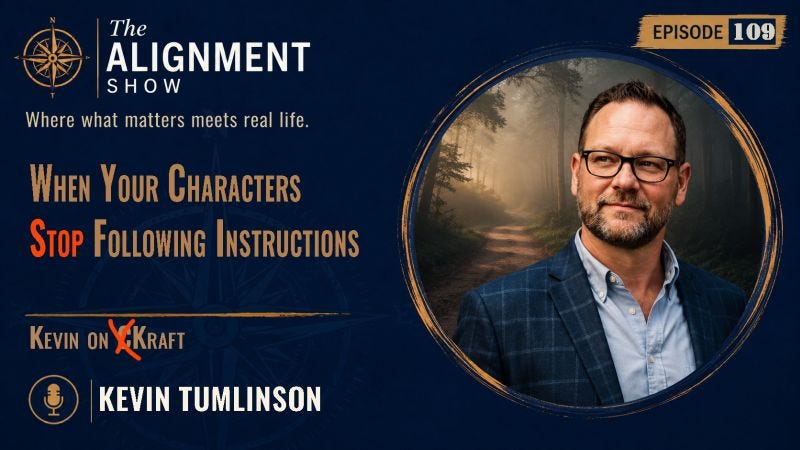
Kevin on Kraft: When Your Characters Stop Following Instructions
from The Alignment Show · host Donn King
I missed an episode last week. I could offer excuses, but the truth is more interesting: I’ve been writing. A lot. For the past couple of weeks, I’ve been almost embarrassingly absorbed in The Chemistry Between Us, the first romance novel I’ll publish as Devon Marin. Riley and Leo, the two people at the center of the story, have been carrying on conversations in my head while I’m trying to do other things. I’ve forgotten to eat. I’ve awakened early because I needed to capture something they were saying. I’ve even found myself mildly annoyed that the human body insists on bathroom breaks. Before Kevin and I got into our conversation, I talked a little about that experience and why I think it belongs on The Alignment Show. This isn’t primarily a show about writing. It’s about pursuing what matters to you. Writing happens to be one of the things that matter deeply to me. Whatever your thing is, I think there’s something worth noticing about those moments when you become so engaged with meaningful work that you’re no longer merely being productive. You’re curious. Engaged. Alive. Speaking of curious, if you happen to be curious about The Chemistry Between Us, you can read an excerpt and sign up for a chance to receive an early copy before publication at DonnKing.com/Chemistry. It costs you nothing to check it out. And all of that turned out to be a pretty good setup for this week’s conversation with Kevin Tumlinson, another entry in the “Kevin on Kraft” series. Big Takeaway Characters become interesting when we stop treating them as collections of information and start understanding how they behave. Kevin and I talked about the strange experience writers sometimes have when characters begin making choices we hadn’t planned. But we also got very practical about what creates that illusion of life on the page: consistency, meaningful details, leaving room for the reader’s imagination, and being willing to discover things during the writing process, and then go back and plant what the story needs. Maybe the larger creative lesson is that discovery and craft aren’t opposites. Sometimes discovery gives us the raw material, and craft lets us go back and make it look as though we knew what we were doing all along. In This Conversation * Kevin talks about writing Dan Kotler, the main character in one of his series, and how quickly the character began directing choices and taking stories in unexpected directions. * We compare discovery writing with more structured approaches and talk about what happens when an outline meets characters who have other ideas. * We explore the peculiar experience of “hearing” or experiencing fictional characters as distinct people while still knowing perfectly well where they came from. * Kevin explains why he often avoids detailed physical descriptions and instead lets readers supply much of the picture themselves. * We talk about using a few meaningful details to reveal character rather than stopping the story for a physical inventory. * Kevin reveals one of discovery writing’s useful secrets: when something becomes important in Chapter 19, you’re allowed to go back to Chapter 3 and make it look as though you planned it all along. * We talk about maintaining character continuity across a long series, including the reader who caught Kevin contradicting Dan Kotler’s middle-name history. * And just as we were trying to wrap up, Kevin opened two questions we couldn’t possibly squeeze into the remaining minutes: How do you write someone smarter than you are? And how do you write convincingly characteristics and experiences that differ from your own? Those will help launch our next conversation about character arcs. Practical Tips Give readers the details that matter. A character’s eye color may not matter. A pair of glasses that come off whenever things get serious may tell us something. Let the reader participate. Kevin makes a strong case that readers have enormously powerful imaginations. You don’t necessarily need to describe everything you can see in your own head. Use revision as part of creation. Discovery writers don’t have to foresee every setup and payoff. If the story discovers something important later, go back and “prepare” for it earlier. Track continuity, especially across a series. Small facts become surprisingly difficult to remember after multiple novels, novellas, short stories, and crossovers. And don’t confuse consistency with stagnation. That question became important enough that we deliberately stopped before tackling it. How does a character remain recognizably the same person while still changing? That’s where we’re headed next. Quote to Ponder “You don’t want the plotting to get in the way of the storytelling.” — Kevin Tumlinson I like that because Kevin isn’t arguing that plot doesn’t matter. Quite the opposite. He’s saying that the reader should eventually experience a coherent story, even if the writer discovered that story in a much messier order. Resources Sample of The Chemistry Between Us: DonnKing.com/Chemistry The current BookFunnel promotion (September 2026): Diversity is Mainstream, by Las Olas Press, where their mission is to make diversity mainstream through strong, beautiful main characters and inclusive stories. Check it out for dozens of free books and excerpts! Kevin Tumlinson / Wordslinger Podcast: kevintumlinson.substack.com/s/the-wordslinger-podcast Writers, Ink Podcast: WritersInkPodcast.com Kevin’s Dan Kotler books: Dan Kotler Reading Order Mentioned in the conversation: * On Writing by Stephen King; * The concept of Chekhov’s gun; * Jaws as an example of letting the audience’s imagination do some of the work; * Jack Reacher; * Indiana Jones; * and the storytelling possibilities of a disturbingly old toothbrush. If you get value from the show, consider supporting us in one of the following ways. You can make a one-time contribution or sign up for regular support through Buy Me a Coffee. You can also subscribe on Substack for free OR upgrade to a paid subscription. Your support helps me continue helping you and others, and thank you in advance! All subscribers now receive the following: * The “Big Takeaway” * A bulleted summary of the episode * Practical tips from the episode * A quote to ponder * Prefer text? We turn each podcast into an article. Plus, Founding Members receive ebook copies of all my books as well as a sponsorship message on the podcast at least once a month. That’s our way for saying “thanks for the support!” This is a public episode. If you'd like to discuss this with other subscribers or get access to bonus episodes, visit kingschronicles.substack.com/subscribe
Embed this episode
Ready to play
Kevin on Kraft: When Your Characters Stop Following Instructions
No transcript for this episode yet
Similar Episodes
No similar episodes found.