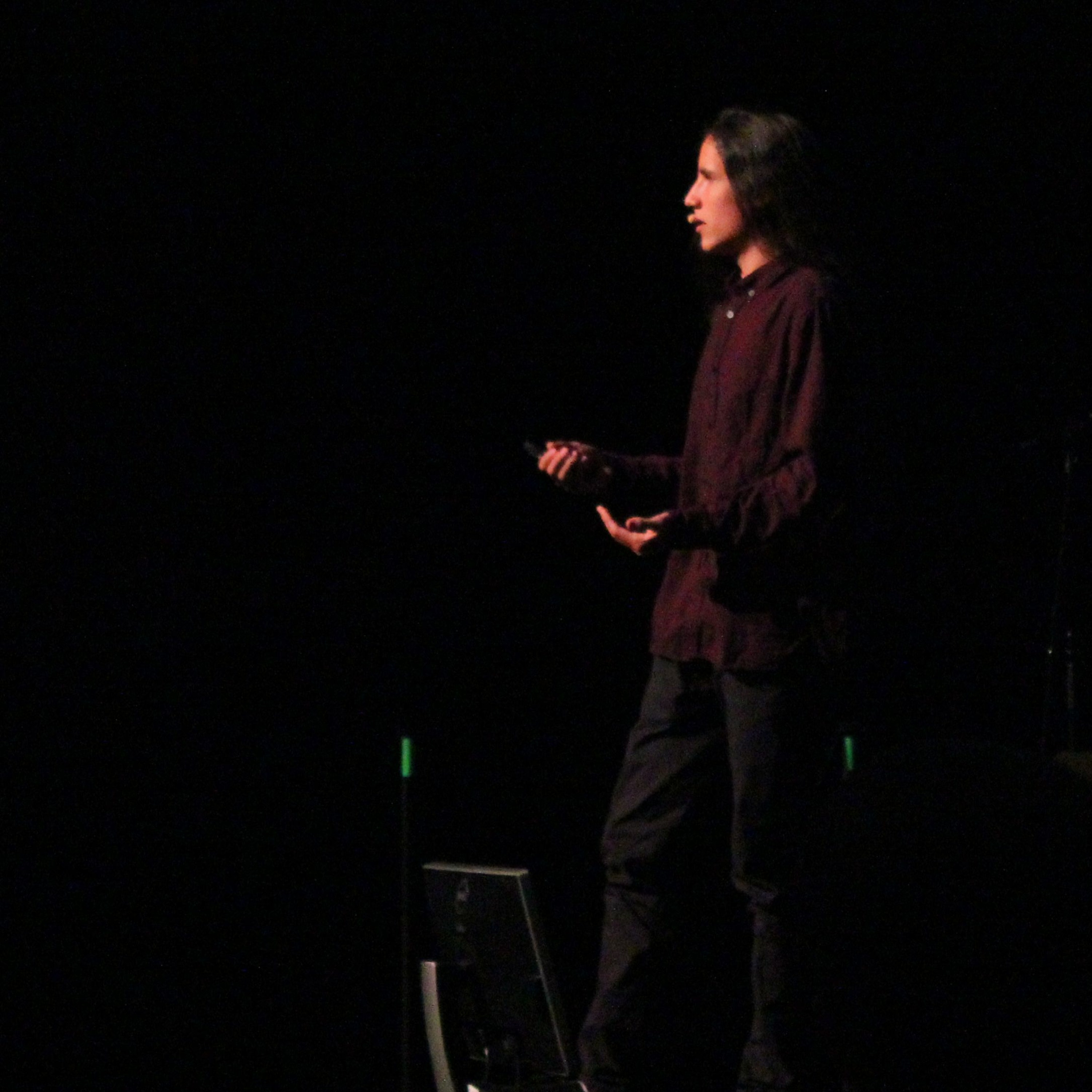
The opinions expressed in this podcast do not necessarily reflect those of ACMI. I'd now like to introduce our very special guest who's come here all the way from the United States. 16-year-old Indigenous climate change activist and youth director of the global network Earth Guardians. Now, before I introduce him to the stage, Chatezcat has come all the way from New Zealand this morning. He's had a pretty epic week travelling around the tree and so I want you all to really put your hands together really loud for Chatezcat Martinez. Louder! Yeah, what's up everybody? How are you guys feeling?
I guarantee you are not as tired as I am. Well, I'm super happy to be here. Super stoked to be here today. I want to thank each and every one of you guys for showing up. Welcome. As you may have seen or read or heard, my name is not easy to say. It's Shutez Scott, which is actually not that hard to say. I don't know. It'll take a second for you to get it. But my name is Shutez Scott. Shutez Scott. The spelling of it, though, will not help you at all. So I'm 16. I'm a climate activist. I'm a spokesperson representing youth. I'm a hip-hop artist. I've been on quite the journey for, like, the last 10 years.
doing everything that I can to fight for climate justice, to talk about these issues in a way that young people can actually listen. I believe that as youth, we are one of the most powerful voices on the planet. that young people have an incredible responsibility and opportunity to be a part of creating something really beautiful and creating change. So I'm going to start off just by telling a little bit of my story. I really want to thank the people that helped welcome this event and hold space for the indigenous peoples of this land, the Aboriginal peoples of this land, to ask permission to walk here in a good way. My roots are Mexica, the indigenous peoples of Mexico City. And I got involved when I was like six in all this work.
And then I see six-year-old kids running around now, and I'm like, how did I get up on the stage and talk to people at that age? Even for me, to think back, it's kind of crazy to think that I was so young when I first got involved. And so I was this kid that was raised a little bit differently. I spent most of my childhood just outside playing in the bush and in the mountains, in the forest. And I was super excited about being alive in life. And I was very innocent, I'd say, to a lot of the problems in the world. And my whole life I grew up in ceremony, learning the languages and the songs and the dance of my traditional people.
And that was a really important thing, because with that came a lot of teachings. And my dad told me from a really young age, at the same time that I was learning how to say and write my name, I was learning that all life is sacred. That as indigenous peoples, we have a responsibility to protect and defend this planet, this earth. When you walk outside and you go and you put your hands in the river, or if you walk along a mountain, that is sacred space, that that land is beautiful. And we have a responsibility to defend that in honor of those that came before us and defended the land for us, and in honor of those to come for future generations. So I saw a documentary called The 11th Hour, and I was like, wow.
It showed the destruction of the planet. It showed that human beings were creating the hugest crisis that the planet has ever seen, that we were causing massive imbalance in our climate, that species were disappearing. For me, the concept of extinction when I first heard about it was unbelievable, that the human race could actually drive an entire species off of the face of the planet, and it was happening every single day. We were losing hundreds and hundreds of species in the world. So I was this little kid, and I was like, what am I going to do? It was really, really overwhelming, and I had no idea how to respond. And I was like, Mom, why don't we teach? Why aren't people being taught?
to do something about this? Why aren't youth being taught to actively partake in creating change? And I felt like I had a voice that needed to be heard. I was like, I'm just a kid, but I need to talk about this. The way that I saw it is knowing about climate change in our environmental crisis, I was like, how could I live my life every day and just go to school and go to work or whatever and not think about this problem? For me, it was very important to do something about it immediately. So I began to speak to people everywhere.
And the lens in which I've seen the world has been this perspective from a regular 16-year-old kid going to high school, trying to live life and do his thing while also super passionate about protecting the earth. So just so you guys know, I turn in my homework assignments late. I sneak out of my house sometimes and I break the rules and I don't do my laundry. I'm coming from a place where everything that I'm doing today is so that young people in the future will never have to fight the way that we do today. Because it's been really hard. And I've been traveling all over the place. I've been in like six airplanes since I got here to Australia in the last week and a half.
and all trying to share this message, trying to tell this story. And it's going to unfold a little bit more as we go through this, but I'm very, very passionate about leaving something behind that I'll be proud to be remembered by as a generation and as an individual. So a lot of what I'm talking about, the first slide was an image of the People's Climate March, which happened in New York City where a few hundred thousand people came together and marched through the streets demanding climate justice. And that was a pretty power... Oh, this is working now. Cool. Wait, yeah. We good. So what is shown in this image is massive mobilizations of people.
where if we look at an issue like climate change which is caused by energy consumption transportation the way that we live our lives um you know the way that we consume and produce food you know that has caused a lot of disruption and it's not just about the environment but it's about people that's me right there that's my little bro my homie sakaya we were all up there at the front of like hundreds of thousands of people it took like six hours for the march to finish from beginning and to end because there were so many people it was very very powerful and it's all because of this like amount of co2 in our atmosphere where if you look at the science of it, we have way surpassed a safe level of greenhouse gases in our atmosphere. Greenhouse gases exist to keep the world warm, pretty much, to keep it balanced and to keep energy systems and climate systems revolving in a good way. And the problem is we have exhausted our resources in a way that is creating massive climate catastrophe. For me, it's been a very personal thing. For me, climate change has affected my community, my home, my family. And we've had massive wildfires from like 2012 to 2015. Every single summer, we were breaking more records for the worst wildfires along my mountain. You can drive along different parts of where I'm from and you just see,
forests of dead trees because of the fires. And you can see we had massive floods too that were just submerging houses everywhere. There are still communities to this day, two and a half, three years later, that have still not recovered from this flood that happened. So climate change is a very personal issue. It's not just about, I guess, an existential problem that's affecting people out there. It's not just about polar bears or ice caps. It's about how things are beginning to shift everywhere. And Australia, if you look at the bleaching of the coral reef and the disappearing of the coral reef, it's going to have a huge impact on the climate because our oceans have a really important role in actually creating oxygen for the world.
And coral reefs particularly. And so I guess what I began to discover as I continued to research and learn is that this is like a human rights issue. Climate change is not just about politics or energy. This is about people. This is about people in islands like Kiribati or the Marshall Islands that are losing their home and their communities. And I was on a Skype call with the president of Kiribati, which is one of these little island nations. And he said, for my people, it's too late. They're having to evacuate the population of their country. And he's like, so for my people, it's too late. The change in the climate and the rising of the sea levels has affected us to the point where it's too late for our communities. And that hit me.
Because being hopeless and disconnected and not taking action is turning your back on every single person that has lost their lives already. For them, they didn't have a choice but to continue to fight so that no community in the world would be affected the way that they have. And if you look at climate change, it's created millions of climate refugees everywhere because of the impacts that we are seeing from bushfires to droughts to hurricanes and typhoons all over the place. If you look at what happened in the Philippines, you look at what happened in Haiti with these massive storms that just devastated the country. That is, I think, one of the most serious issues that we have ever faced. And if you look at the driver of all of it, largely, is the fossil fuel industry.
And if you live in today's society, we consume fossil fuels. The systems that we live in are largely based around fossil fuels in countries like Australia and countries like the United States. Whereas other people in Europe, they have it all figured out already, or largely to a greater extent than we do, having massive amounts of their energy production and consumption coming from renewable energies. And so if you look at who's being impacted by climate change and if you look at who's being impacted by the extraction of fossil fuels, it's largely poor, brown people of color, indigenous nations. In the United States, if you see a coal-fired power plant or if you see fracking rigs, that's largely put near people's houses that don't have high economic status. And what we're continuing to see is as fossil fuels continue to run out, we're having to get more creative with how we extract fossil fuels. So more and more communities are being impacted and it's becoming less about energy and more about people's health. This isn't just an environmental play. This is about...
the way that people live and you know a huge cause i think of all of this is is disconnection right and and we live our lives and um i see that the roots of a lot of problems are because we are disconnected and we're disconnected from from ourselves and from another one another and from the earth from the food that we eat like if you look at racism and hatred towards other people in wars like a lot of that is fuel because i believe that we've lost a sense of connection between one another as human beings If you look at young people, like growing up in high school and seeing kind of the state of youth these days, if you look at apathy, you know, not caring about anything, not having love for ourselves, being depressed, suicidal, among young people and teens in particular, I feel like a lot of the way that the world works right now is training people to be disconnected from ourselves. Young people don't know who they are. And that's me speaking from, you know, a perspective of friends of mine, of people that I know. It's really difficult to grow up in the world today and be okay because of everything that's happening externally now. We're not really taught how to deal with it or do anything about it.
where all the problems we see are like headlines in the news, but we don't actually have the tools or resources to connect with them. So I think that it's because of this that we're in this mess. And I think that we protect what we love and we love what we understand. And I think people have actually done a really good job of falling out of love with the world. Where, you know, kind of looking back...
You look at indigenous tribes and indigenous cultures as an example. And you look at the way that they have lived in harmony and in balance with nature. My people, everything that our culture was based upon was honoring the fact that we cannot exist without the planet, without the rain, without the sun. Everything that we have comes from the earth, and therefore we have a responsibility to give back, to protect and preserve the land and nature. And I think we have lost sight of that greatly. We have lost sight of our love for the world. Raise your hand if you've heard of what's happening in Standing Rock, North Dakota. And if not, it's totally cool because I'm going to go over it right now.
So North Dakota is a state in the United States. And what happened is that an oil company proposed to put a pipeline underneath sacred indigenous land, underneath a river that is a water source to this tribe of indigenous people as well as millions of people downstream underneath the sacred lake named Lake Oahe. And when this tribe called Standing Rock, that's the name of the reservation there. In the United States, we put indigenous people on a reservation. And...
What happened is these youth decided, what are we going to do about it? And this group of 20 young people decided, we have to take up this fight. The other people aren't going to do it, so we have to take it up. So they actually ran from North Dakota all the way to Washington, D.C. I don't really know the scale of Australia to the United States, but it's a really long distance. It's like half the country's width. And they ran. And they ran with a message that we are not going to allow this pipeline to be built because it's going to threaten our water. It's going to threaten and go against the treaties we have signed to protect us as indigenous people. And they weren't going to have it. These young people took up that challenge and they brought thousands of signatures with them to Washington, D.C., to the White House where the president's chilling. And they were like...
We're going to deliver this to you and tell you that we don't want to build this pipeline, and we're expecting you as our leaders to take action. When they got to D.C., they started drilling and putting infrastructure in place for this pipeline. How tall is that? That was so devastating for these youth to hear that. So then they went back to North Dakota, and they put out a call to the world to come and defend this land. And millions of people worldwide saw it. Millions of people began to see that these people were standing up to protect their water. It wasn't about economics or politics or about energy. This was about people's rights to life, to protect the sacredness of their own water.
And tens of thousands of people mobilized. And they set up camp in North Dakota and they began to resist this pipeline. They would go out, they would peacefully pray. you know, and come out with songs. And it was grandmothers and grandfathers and children and people that were out there that were standing in resistance to pray for the other people that are building this pipeline to ask them to not do it. And there were massive amounts of violence where, you know, they brought out armed police forces and they were shooting rubber bullets and tear gassing people, you know, below zero Celsius temperature. They were spraying people with water cannons. It was freezing. It was freezing cold outside. And the injustice that happened there was seen by the world. You know, many, many people all over the world saw what was happening at Standing Rock. And it was an example of one of the greatest mobilizations of people that has happened in a very, very long time.
Where, you know, a lot of times environmental issues can get really segregated and really divided. Where it's like, you know, environmental issues are for politicians and activists. But what happened here is that they put out a call to the world that said this isn't just about being an activist, it's about being a human being. This isn't about being indigenous to a certain culture, but about being indigenous to the earth, which we all are. This is about water. You know, it's the basis of what connects all of us. And that call was heard, and it was met, and they resisted, and they fought, and they're still there. There are still many people in San Diego, North Dakota, that are camped out.
So what happened is that Obama was like, okay, we're going to grant you guys, we're going to deny easement and we're going to have an environmental impact study done. It should have taken a long amount of time. So it's pretty much delaying the building of the pipeline. Regardless of that, the industry continued to build and they paid a fine every day, but it's a multi-billion dollar project. And what you have to understand is that a fossil fuel company is going to do whatever it takes to make money. That if you look at energy, it's not about helping the economy or stability or energy independence. A lot of times these companies are just going to do it for the profit in their pockets. So what happened is Trump came to office and he was like, okay, I'm going to illegally override what Obama said.
and we're going to allow this pipeline to drill. Like right away. And yesterday they started. They started putting through the infrastructure to continue to build a pipeline. And don't get me wrong, the entire time they were building the pipeline, but now it's illegally been made legal. And they are beginning to build on the Standing Rock Reservation, on tribal land, which is breaking treaties, which is violating human rights. And then it's one of the, it has a lot of tension right now. And we're doing a lot everywhere to try to fight for justice. There's going to be huge demonstrations and rallies all over the place. But the point of this is, is what we saw is once we changed the narrative and the conversation that was being had, people came together in a way that we had never seen before.
It was incredibly powerful and it was incredibly inspiring for me to witness that. And I've been in this moment forever since I was like, that's all. And to see people come together in a way to really innocently pray for clean water and to fight to protect that, it's incredible. Raise your hand if you know what fracking is. Fracking is a process where they take millions of gallons of fresh, clean drinking water and shoot it down into the ground mixed with chemicals at high pressures to extract natural gas and oil. In my community, in my state, in the state of Colorado, we have 130,000 fracking wells. And the industry wants to drill another 100,000.
In Australia, you guys have been faced with the same problem of coal seam gas extraction. You guys call it CSG here. And we've seen massive pushes also to resist it here. And I was just in Byron Bay the other day, and they had a whole movement called Lock the Gate, where they actually said, we're just flat out not going to allow this industry into our communities, and they fought it off. And that's what is another powerful story of how these companies are going to come into your community and try to take away our rights, and we're going to fight for justice. And if we look at solutions, and we look at people coming together all over the world to fight to protect the sacred, it's amazing what mobilizing and coming together as a community can do, what that can accomplish. And one thing that I've learned, too, is it's really important to...
change the way that we're talking about fighting for what we believe in. Because a lot of people don't want to be activists because it's not cool. And I don't blame you guys. What I've learned is that we can change the conversation and open it up to young people doing what it is that you are passionate about, what it is that you are good at and what you care about, and using that to create change in your community and in the world. And that's the lens and the avenue that we can take. I've met hundreds of youth all over the world, from Brazil to Sweden to Australia to New Zealand, that are so excited about doing something about the world and making the world a better place because we know that regardless of all the crisis that we see around us, there's just as much potential to make a difference.
And it begins with one person and one idea. And it can spread to create massive movements. If you see the day after Donald Trump was elected, there were three million people that came together all over the world in solidarity and peace and love and unity to say that we are not going to stand for the leadership of a tyrant in the United States. And that was people standing in solidarity to create change. And a lot of the huge movements that we've seen throughout history have come from youth, from people just like me, from people just like you, that have decided that there is a better way and we have a right to fight for that.
You know, if you look at the Earth Guardians movement, that's the organization that I represent. And we are doing stuff in communities everywhere. We have tens of thousands of individuals, families, Earth Guardian crews, and people that are really pushing to make things happen in a really huge way. And it's incredibly exciting. You know, so far, I guess one example to look at things is if you look at a computer then and a computer now, how much has changed? And energy then and energy now. We're drilling for energy in the same way. So there are solutions that need to be built that come from people, but also from a place of infrastructure. We do not need fossil fuels, and the future of energy is not down a hole.
If you look at Australia, this is an image of exactly what Australia needs to do and which energy alternatives need to turn towards to be 100% renewable energy, how many jobs you guys are going to create, and how this is such a viable, real solution for change. $23.4 billion saved annually on healthcare costs. If you guys are talking economics, then this is a safer way to go. If you want to look at how much money is going to be made off of fossil fuels versus off of renewable energy, in the future, renewable energy is a long-term solution that needs to be implemented. And that's...
Such an important thing to look at as far as creating solutions. So another thing that for me, I had been on the front lines. I've been in marches and protests and rallies for a really long time. And not enough was changing. And it was great and it was powerful, but not enough was changing. So I was like, how can we do this different? How can we do it bigger? And I partnered with an organization called Our Children's Trust. I began to work with them. And what we decided to do was like, we're going to sue the government for violating our rights to a healthy atmosphere. We said we're going to hold them accountable. Myself and 20 other youth plaintiffs, we said that we are going to hold the U.S. federal government accountable for violating our constitutional rights to life, liberty, and property by failing to take action on climate change. And what happened is that the...
US government in a conglomerate some of the most powerful fossil companies the United States came together and they said that we are going to file this motion to dismiss this lawsuit that these young people don't actually have a right to take this to the courts, that you don't have grounds, that you don't have anything to base it off of. So after they took that to the court and said that we don't have a right, they filed this motion to dismiss. It was denied twice by two different judges. The statement of one of the judges I thought was super powerful. They said that governmental action is affirmatively and substantially damaging the climate system in the way that will cause human deaths, shorten human lifespans, result in widespread damage to property, threaten human food sources, and dramatically alter the planet's ecosystem. Plaintiffs have adequately alleged infringement of a fundamental right.
And that was the U.S. judicial system, the U.S. courts, saying that the young people have the power and the right to hold their government accountable for failing to do what's right. And that's huge. That was such a huge moment of celebration for the movement. And a lot of people have asked, what's happening now that Trump is president? Because originally we actually filed a lawsuit against the Obama administration. And all that happens now is I think it's a little bit more satisfaction on our end because we can say that we're suing Trump, which I think makes all 21 of us a lot happier. And in all honesty, Trump doesn't believe in climate change.
He doesn't believe in a lot of things that people should believe in. I'm not sure if he believes in science. But one thing that's certain is he does not believe in climate change. And it's going to be really funny because if we win this lawsuit, the courts are going to force him. They're going to actually force him and the US federal government to reduce our greenhouse gas emissions massively every single year. We're not suing for money. We're not suing for recognition and publicity. We're suing to actually have climate solutions put into place.
I think that's so exciting to see. It's going to be really exciting to see that Trump doesn't believe in climate change is going to actually have to do really, really a lot of work to stand on our side and reduce our greenhouse gas emissions. That is what young people are doing in the U.S. That's a huge project that I've been a part of. And we are working with countries all over the world to help implement and bring this to other youth everywhere to give you guys that opportunity and give you guys that voice to connect the youth plaintiffs with lawyers to show you guys that actually it is democratic and it is constitutional and it is our right. When our politicians fail to represent our voice, the young people stand up and do that.
in a way that is holding them accountable for their failure to act. I think it's really exciting, and I think this is a really freaking amazing time to be alive. I think despite the crisis and despite the problems that we see everywhere, there are so many youth that are woke and are ready to make a change. And I've seen it personally, but I've also seen that there are youth that don't really know how to be involved or how to connect with this movement that are really excited to find those opportunities and those places to engage. And the Earth Guardians movement is one where you guys can connect. Go to earthguardians.org. Hit us up on social media. Check out what it is that we're doing. All we're trying to do is give youth a voice. Each and every one of you in this audience has a voice that matters. In a society, we don't really tell young people that very often. But it's true. The young people are one of the most powerful generations on the planet today. Yeah, we're the future, but we're here now also. Yes, we're going to be inheriting the planet, but we're also citizens today. And maybe we can't vote. No, I can't. Maybe we can't vote.
but we can take action to inspire change, to inspire revolution. And when people ask me what it is that we fight for, it's not just about the environment or about a specific cause or about a political party. This is about our future, about your future. This is about me and my little brother, my little sister in the world that they're going to grow up in. It's about every young person I've ever met in my life and fighting for them and fighting for you. And it doesn't have to be this big, heavy, like dramatic thing. I think this is one of the most beautiful times to be alive because we can come together and using art to celebrate, to bring people together and to do something incredible to change the face of the planet. And there's a verse that I wrote.
and i'm running out of time there's a verse that goes it goes like this it goes The power to change the world is in each of our hands. Not the president or government. They still don't understand because we fight for the people, for the planet. We stand. As the government and industries walk hand in hand, we will fight for our rights against the tar sands. We will attack back our streets. And this is our land. This is the only home we got. We must protect it, not neglect it. We see no to these pipelines. We get Obama to reject it. And the power to change the world is in each of our hands. The power to change the world is in each of our hands. And that's true. It really is. And I've seen it everywhere. And I really hope that each and every one who takes a little piece of what you heard, maybe inspiration or hope, and take that with you and keep that alive.
Because it's really easy to get drowned in the media and the negativity of everything that's happening. But I also think that there's just as much hope and things to hold on to. You know, what better time to be alive than now? Because our generation gets to write the legacy that we will be remembered by. Our generation gets to be the ones that determines the future. Not the president's in power. Those people do not represent people. They do not represent youth.
And we have a really beautiful chance now more than ever to create change in a really huge way. Look at movements throughout history. Look at movements now. Look at what's happening in your community and look at the power that you have to do something about that, whether you're an author or an activist or a poet or a rapper, whatever it is that you are passionate about, that that can be used to change the world by starting simple and changing yourself, changing your lifestyle and your community. And small steps lead to massive amounts of change, and I've seen it everywhere. And it's incredibly exciting to see that at this tipping point that we're at in the world right now, youth are going to play an incredibly important role in tipping us in one way or the other. And we're so excited to see.
the engagement from our generation and making one of the biggest changes in the world so i'm at this time and i thank you guys for this opportunity for all coming out here and representing and showing up so thank you guys thank you so much to test cat i think we're now both going to take a seat um and opening up to a little bit of q a so my mind is racing who else's mind is racing yeah there's so much going on up there um i think Yeah, just listening to you and even, you know, thinking back to when I first heard about this event and heard that you were coming to Australia, I started to think about how amazing it was to have the opportunity to meet another young Indigenous person that was taking action on climate change. And I saw, you know, first of all, the photo of the People's Climate March where you guys were leading it and thought back to around November.
Not last year, the year before, I believe, in Melbourne, where we had about 60,000 people marching in the streets and a whole heap of rallies right around the country as well. That for the first time in, you know, as far as we know, it was being led by a lot of Indigenous people around the country. And I know that there were a lot of Indigenous people leading the march in New York as well. And then what else did I see? We heard about the, you know, fight that's going on over Standing Rock at the moment. And we recently, our Seed Indigenous Youth Climate Network connected with Joseph Wide Eyes, a young man. Do you know him?
No, no. So he's a part of the One Mind Youth movement and who I think you were talking about. And then, yeah, again, when you mentioned fracking, and that's a huge issue that we are taking action on here in Australia, I was constantly reminded of the connection that we have as Indigenous people. We're so connected as a huge family of Indigenous people here in Australia, but that extends over the seas and over the kind of borders that have been put in place. And so I wanted to kind of hear your perspective on what it's like being here in Australia and fighting as a young Indigenous man who is connected to other Indigenous people.
Right. I think that all of us have a really beautiful path. And regardless of whether we believe in climate change or not, or whether we care about the environment or not, we're all going to play a really important role, each in our own, to do something about leaving this world behind for future generations. We're all going to be inheriting the world together. And I just think that one thing that I've seen, particularly around indigenous communities, is that because of everything that happened with colonization and everything that happened in the past, youth aren't proud to say that they're indigenous.
And I've seen that in my own communities. And my great-grandma on my father's side, she's full Mexica, Aztec. And she spoke the native language that was her first language, was Nahuatl. That's where my name comes from. And she never taught that language to her kids because there was so much racial segregation and hatred towards indigenous peoples. So she never passed that on. I think that, I guess, it's just a message for indigenous uses that there's so much power when we can connect with our culture and our heritage, and that's who we are. That is our identity, and we have to be proud that we come from something as beautiful as our lineage.
you know looking at that and then for non-indigenous young people too i see a struggle with a lot of um you know youth that have european roots is that you know they don't know how to connect to to their ancestors and i think one really important thing you know regardless of who we are or the god that we believe in or you know the color of our skin that we are all indigenous to this earth i think that's incredibly important to remember because you know no matter where we are or who we are that our roots go back to the planet that is something that connects each and every one of us um and that's really important thing to remember as well though you know no matter what we all have an indigenous connection to this earth because we're human that's yeah definitely yeah and I think the values that my family brought me up on were always about looking after the land and looking after each other. And I think that's core to us, you know, solving the huge challenges that we're facing right now. Yeah, it can be really heavy. It can be really difficult.
I'm not a super serious person. I'm often in situations where I have to be, but in honesty, I think all of this work in the end has to be a celebration. I just played an epic concert in Byron Bay. I'm down. Where I was just all kinds of youth coming out to share their music and share their art, and I did a hip-hop set, and it was so fun. We organized it in four days. There was like 350 people there. The venue was full, and it was people coming together to talk about these really serious and important issues, but through music, through hip-hop, through...
different medium there was just celebration people come together to celebrate to this this dance this rhythm this movement everybody was dancing everybody is so hype and it was like that's what this movement is about you know it's not about um about necessarily you know activism or taking these topics too seriously or changing your entire lifestyle and becoming an activist and suing your government it's about protecting what we love it's about fighting for what it is that we believe in and using what it is that we're passionate and doing what it is that makes us feel alive. Definitely. And all of you guys can be a part of that. So now I'm going to hand it over to you for any questions that we have. Who and he has a question? What's the biggest change you've made, like you've seen happen? Right. That's a really important thing that I didn't have a whole lot of time to talk about. One really cool thing that I did in my community is we went to this meeting, to a county commissioner's meeting, which they're local governors of a county. And they were talking about fracking and they were talking about whether they were going to allow fracking or not.
And the people wouldn't have it. I mean, we were the same as the people in Byron, in that shire, in that whole area. They came up to resist. But we came to listen to this hearing. And our governors were totally taking the side of the industry. And we essentially started a mic check.
So a mic check is when I say mic check and you guys repeat it. So mic check. Mic check. Yeah. But like we got the whole room of people to do that over our governors talking and they couldn't shut us up. But it wasn't just repeating the word mic check. It was like we stand for renewable energy solutions and then the whole room would repeat it. And then so it was like this really powerful thing where they actually couldn't shut us up. They had the gavel and they were like bang bang bang shut up. And they left. They had to least like escort them out of the room and their seats were empty. They were like these like high seats that they could look out over the people and like we are your leaders. But then we were like.
Someone's got to take leadership. So I was like 12 maybe and me and all my friends like you know, let's let's storm the seats and we did it and it was like six or seven of us that just got up and took their chairs and We got a unanimous vote from our community unofficially to ban fracking in the state of Colorado and then The following months they banned fracking for five years in our community And we successfully got bans in moratoriums, which are temporary bans, in five different communities across our state, where our actual governor, Governor Hickenlooper, we call him Governor Frackenlooper, because he is very tied to the oil and gas industry, where that was actually a really huge change that we made in our community to fight off the industry. They have just lifted the ban this next year. They're going to be in to drill again in my community. And I've seen how sick people get, how contaminated the water gets, and how unhealthy it is for everyone. And so we're going to continue to do massive demonstrations to protest that. That's a fun story. And that is an example of a cool change that I made in my community, just me and my mates going up and taking over government. So cool. Can we do a quick mic check?
Do you have an idea for something to say and practice it with this group? Okay. Mic check. Mic check. Mic check. Mic check. We the youth of Australia. We the youth of Australia. Stand in solidarity. Stand in solidarity. With all people. With all people. To fight for justice. To fight for justice. For climate justice. For climate justice. To protect this land. To protect this land. To protect our water. To protect our water. For our generation. For our generation. And those to come. And those to come. Woo!
We're going to go to another question. But who just then, when we said water, said water? Because that's what I did. Oh, my bad. Another question? Okay. I didn't know that the planet was in that much danger. And now that I look back, when I actually hear the news in my dad's car before he shuts it off, I always hear a tiny bit of how the world is changing. And I'm really worried about it. Yeah. You know, can I ask all you?
11. 11. Cool. Well, thank you for asking that question, for making that comment. It can be really scary to think about how big the world is and how many problems are. That can be really challenging to deal with and to think about. And I guess just a little piece of advice I have for you is that acknowledge and know, and if you read articles or ever watch TV or listen to the radio, as you said, you can continue to hear about these big problems. I think that one of the best things we can do about that is understand that the solutions to these really huge problems, to fix these really big problems, begin.
Locally, begin in small communities everywhere. They're actually just growing a garden without using chemicals is helping to reverse climate change. It's actually pulling greenhouse gases out of the atmosphere. You know, and if you look at your own community, every community has different challenges, whether it's mad amounts of rubbish or, you know, being affected by climate change or they're cutting down the forests or local species are going extinct. Like there's problems in every community. And the most important thing to remember about that is that the solutions and the way to fix these problems begin with one person and begin with you and telling your friends about it and having that conversation. Yo, we're worried about the world.
And what are we going to do about it? That is the biggest disconnect that I see in the world today is people worry about the world without understanding how they can do anything about it. But what's really cool is there are lots of people everywhere doing stuff about it. If you go to earthguardians.org, you can connect with those people everywhere and get involved in your community as well. Even if it just starts with a small thing, planting one tree in a park. That is a really huge thing you can do. And you all have the power to do that.
And I think the biggest world crisis that I know of is all the plastic bags in the Pacific Ocean. And that's like one of the main things. And I was actually like around 10 years old when I found out and I made this poster drawing that said, what worlds would you prefer? And I drew one side with clean water and I made like a whale that was really happy. And there was this like floating sign that had a plastic bag and it had an X around it. And on the other side, I put plastic.
I put the water, loads of plastic bags all over the top, and I made the whale sad. And at the top, I did which whale did you prefer? Yeah. That's beautiful. Thank you. Yeah. Round of applause.
Thanks so much. I think we have another question up here. So one thing y'all can go home and do is try to use less plastic, less plastic bottle, less plastic bags. That's a really easy one. How did you start to make a difference? Like how did you become noticed and how did your voice grow to be something bigger? Everybody hear the question okay? Yeah. So how I began getting involved with all of this is I was doing some stuff on my own, you know, speaking at different rallies and protests, but how I really got involved in my community was
I saw that they were proposing in my city to add more chemicals to the list of chemicals that they already spray all in our parks. And I did a little bit of research and I saw that there was really negative impacts to our water health, to the health of young people. And I decided that, you know, we don't want this in our community. And I saw that there was going to be a public hearing. So I gathered a bunch of my friends and we were like, yo, let's go talk to these people. Let's tell them that we don't want this in our community. And that's exactly what we did. My little brother, who was like seven at the time, he got up in front of the mic, a podium like that, and he couldn't reach. So they had to like drag a bucket out and just like sit it there so he could like step up on that and reach the microphone. He was like.
You guys are not doing your job. I should not be here. I should be playing the parks, but because you guys are not doing a job of keeping us safe, we have to be here telling you how to do your job. He was like seven years old and you should have seen that face and were like, whoa. And we actually got them to ban pesticides in all of our local parks. And that was just a super small thing that we did that was really impactful. And then we saw like, wow, when we use our voice and when we are heard, we can have a really huge impact.
So we continue to do stuff like that at the Earth Guardians in Boulder around different issues like actually banning plastic bags and getting fees on plastic bags in different stores, on fracking. And then people all over the world began to see through social media, through Facebook and Twitter, wow, these kids are just, all they're doing is using their voice and talking about what they care about and doing little local actions and they're making change. We can be a part of that too. And so people all over the world from Indonesia to the Philippines to Brazil, Australia, Togo, Africa, and Ghana, people began to take notice and get involved. So I mean, we have crews in different parts of Australia and where each and every one of you can go back to your school or your community and actually...
start up an Earth Guardian crew there to identify, look, and have a conversation about some small issues and begin to make that change. I think a huge thing is starting within your own life and then understanding how you can do a little bit better every day and then having a conversation with other people, taking it to your community, and the change gets bigger and bigger. And I think it can be something really beautiful, really fun, and exciting that we can all do a little bit better for. Thank you. Great.
We have another question at the back, I believe. Do you think it would be hard to make a change now that Trump is president? Good question. That's a really good question. I think that political leaders have less power than they think they do. I think that, you know, if you look at Obama, people are going to say, oh, he did all these great things for the environment. But at the same time, he put in, you know, more power plants to produce coaxing gas and fracked gas than any other president in history. And I think a lot of people didn't really pay attention to that because he was sneaky about it. And if you look at Clinton, she would have been sneaky about it too. And I feel like if she would have become our president, people would remain complacent.
people would remain kind of you know oh yeah we have a democratic president in the united states it's all good this thing's gonna stay the same maybe not everyone will be happy but things i feel like would stay the same with trump the day after he was inaugurated the day after he became president as i said there were three million people worldwide that marched on our streets and still for solidarity if you look at what happened when you try to put the muslim ban in place in the united states that riots broke out all over the country the thousands of people mobilized and said we're not going to allow this so And now his order to actually allow easement of the pipeline for them to build a pipeline across Standing Rock is going to spark more revolution and more change, more rebellion in a peaceful, good way where people are going to demand for what they believe in, demand that our leaders do what they say they will do and hold them accountable for protecting and representing people. I think with Trump and power, we're going to have to work harder. But I think with Trump and power, people worldwide are going to be a little bit more woken up to the fact that change comes from people, not from presidents. And we really have a lot of power. I think it's going to bring people together in a really beautiful way. Another question at the back.
How do you balance school and being 16 with making such a change? Yo, it's really hard. Yeah, I mean, graduating from high school is something I definitely want to do. It's... it's something that is difficult because I travel a lot. So I'm doing some credits and some classes online. And I think more than anything is just, you know, being focused. And I'm, I guess, like a very extreme example of activism or of someone that's doing stuff in the world. And obviously, you don't have to go home and do the same level of change. But I think school takes up a lot of time. And the reality of it is that I think these issues are just as important as getting an education. Because in the future, like, what are we going to do if we know about, you know, the history of our countries and we know about, you know, how to do algebra and geometry. But our sea levels are rising. We don't know how to do anything about that.
So I think balancing school and the work that I do has been really important. And more than anything, just, I guess, staying really focused and everywhere that I go, trying to make time for both. And one thing that I've realized is that doing this work, I've learned more than I will ever learn in any classroom, ever. From just talking to other youths, from just talking to other thought leaders and other incredible people and other artists. I learn a lot from what it is that I do.
We have time for another question. Yeah, at the back. Hi. I thought a really interesting point you made was about the issue of social disconnectedness between youths and also with ourselves. Can you just talk a bit more about that and also what impact do you think social media has on that issue? I see that a lot of my friends and a lot of my peers and a lot of young people are very apathetic, very disconnected. I think teenagers are pretty notorious for not really caring about much. Not to say that that's always true, but in my personal experience, when you try to get young people excited about stuff like this, it can sometimes be challenging.
And I think it's because a lot of young people are going through life trying to figure themselves out. We've got a lot of time to try to figure out school and do all these things, but I feel like young people are, in a lot of ways, very disconnected. And I think social media opens up a platform for either mad amounts of connection to the world or unplugging and allowing yourself to kind of not really pay attention to anything other than memes on your Instagram feed and stuff like that. And social media, I think, is a really important and powerful tool towards inspiring change. If you look at revolutions and dictators that have been overthrown in the Middle East, that happened because of Twitter, because of young people tweeting about it and gathering in millions and gathering spaces. But at the same time, I think we have to really realize that...
You know, using social media to change things is really important and really powerful. But at the same time, it can serve as a tool of kind of disconnecting people at the same time. Take a second and go outside and breathe and realize that you're alive, that this world is spinning and that life is a miracle. I don't think people do that ever. Many people don't do that. And I think that if we change a little bit, some of the things that we taught youth, then it would change, I think, the way that the world is going right now. Thank you. One more question up here. What Aboriginal community are you from?
Me? Yeah. I'm from a community named, well, I guess it's not quite a community anymore. It's become a city. But my people are called the Mexica people. Mexica. And if you've heard of the Aztec people, those are my people's ancestors. So that's from Mexico City in Central America. Two more questions, I think.
Hi, I'm Delaney. Yeah, so I was like born in Africa, so I made in Africa. And I can relate to having a name that no one can say, spell, so I feel you. But this is a two-parter. The first part is how can we make a difference like today, like now, you know? Right. So there's a lot of places you can look up online that will give you like a 101 on how to save the planet or like, you know, climate action for dummies or like whatever. And I guess my role has never been to tell people what to do. But I think one lens that we can look at the world in that is really impactful is just look at your lifestyle and realize that everything you do affects the world.
The way you eat, the products you buy, the clothes that you wear, it affects the world. It affects people around you. I think if we begin to open and see the connection between our lives and everything, it's not going to, you know, don't look at it in a way like, oh man, I feel bad. Like these shoes were made by sweatshop laborers. But like in a way that it'll show you, wow, I actually have the power to choose.
um and i have the power with my actions every single day to influence um the things that i'm supporting and even just you know looking at where it goes afterwards too like looking at the rubbish looking at where your food comes from um one thing about climate change that is really easy is the way we eat affects climate change a lot you know and obviously if i come into a room and i'm telling everyone to be vegan no one's gonna listen i'm not vegan but if we are a little bit more aware about our choices with food and try to eat meat um instead of three times a day like take one meal off or like every monday have that be like you know don't eat me on mondays whatever i think that awareness in the way we act in the way we live is huge Plastic is a really huge issue that we can all do something about. Our food is a really huge thing that we can do something about. And from there, if you're inspired to continue to make change other than just in your lifestyle, talk to other people that have that similar interest. And if you don't necessarily find those people immediately around you, you can reach out to the network of people that we have everywhere that are connected to these same kind of things, are super passionate and excited about it.
And there's so many questions. I wish I would have taken less time to talk and just heard you guys. I think, unfortunately, we're going to have to wrap up the questions for now and bring the event to a close. But it's been so amazing to hear from you, Chatezka. I do have a really small gift that I'd like to present to you on behalf of our Seed Indigenous Youth Climate Network. So it's a t-shirt that we've put together. It says, ban fracking, protect country, and don't frack our land rights. So thank you so much. Put your hands together for Chatezka. You have been listening to an ACMI podcast. For more recordings, go to soundcloud.com slash ACMI online or the ACMI website.