I'm Erin Breen and this is Erin's Isle. It's a look at life in Ireland through the eyes of a broad abroad. That's me. I'm constantly on the lookout for stories of Irish adventure, living history, Celtic culture, and the true ingenuity of the people who live here. So, welcome to My View from Erin's Isle.
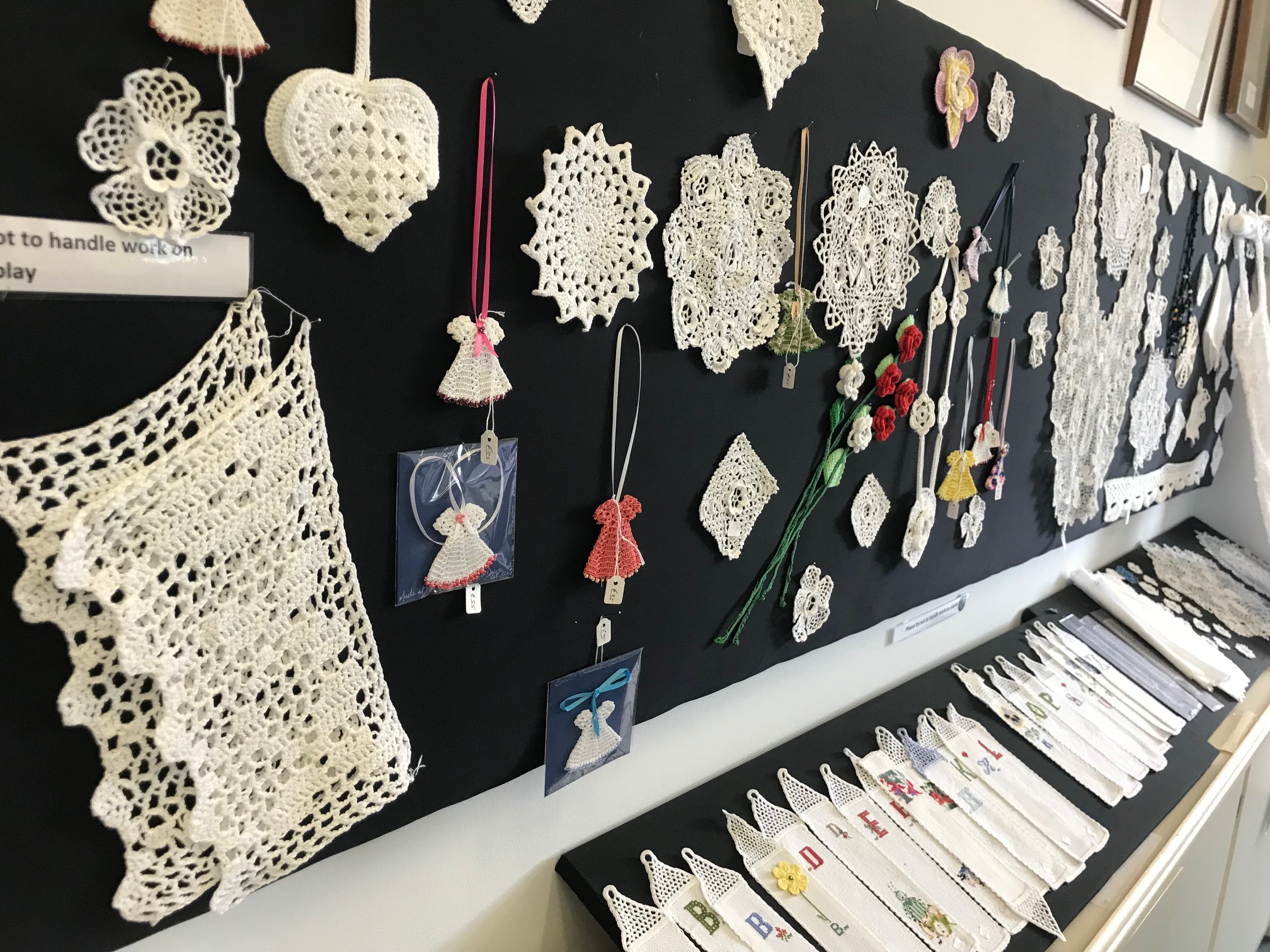
The village of Kenmare is in South County Kerry. They have a stone circle there in the center of town, and they say that if you walk through it barefoot, you can feel magic vibrations. It's also known for its lace, Kenmare lace. When I stopped in the Kenmare Lace Center, Nora Finnegan was busy demonstrating and educating. She knows her lace. This is Kenmare lace, and it's a needlepoint lace. It's made with a needle and thread. The making of Kenmare lace here dates back more than 160 years. Bernice came here in 1861. They were brought here to teach to open a school. They did that, and they soon realized that the girls had no way of our new living. So they thought they would give them a skill, and they gave them the skill of lacemaking. It was the Victorian era. Queen Victoria wore a lot of lace, so it was high fashion, so it was a good commercial thing to be in.
Nora loves lace-making, but she admits it's not for everyone. I reckon if you have 100 people, 25% will absolutely hate the sight of it and not want to touch it. Another 25% will put up at it and will manage to do it tolerably. Then, if you go up to 75%, they'll be good at it. They'll be, you know, quite good and with practice, they'll get very good. And you'll have a top 25% who will excel and who will be high honors.
You see each type from Kenmare Lace to Carrick McCross Lace to Limerick Lace to Irish Crochet Lace and Bobbin Lace. It all has its own characteristics and process and a lot of different stitches. You start off with two pieces of cloth at the back. Over that is your pattern. Over that, a mat contact. Oh, I see. Okay. You clout around the outline of your design. That is, you lay down a double thread on top. Got it. And you come out from underneath. This is called bridging. Bridging stitch. So you come up. It does what a bridge does. It comes up over the top and down the other side. And you do that all around.
And yes, it's as technical and tedious as you think it would be. When that's all done, then fill it in inside. And to do that, you use a detached buttonhole stitch. So I'm going to do one, two, three stitches here. It's based on the buttonhole stitch, which is a very tiny stitch, all the same size, but we vary the size of the stitches, and that's how we get our designs. It's so intricate. If you want an open stitch like this one, you just pull it so far and leave it like that. But then the trick is to get all your stitches in the row the same size. Now I'm going to cut it down a little bit here, and I'm going to work back here.
How could you ever sell something that's just tedious to make? Yeah, well, that's why a lot of the stuff we have here is not for sale. Exactly, exactly, right? Depending on your thread, the size of your thread, the stitches you're doing, and your whole design, it can take an hour between 15 and 25 hours to make a square inch of chicken mayonnaise. It used to be said that it was worth its weight in gold. Which really was valuable to this area, but you wouldn't know it from the history books.
You see, it was women's work. And a very important thing to remember, we were just speaking about it earlier, in the 1800s, 12,000 women in the county of Cork were making their living for making crochet days. But do you see it written in the history books anywhere? No, we don't. Could you imagine an industry that you had men involved in, people earning so much from and making a living and saving themselves from starvation or whatever, that that wouldn't be mentioned in the history books, you know? Just looking around, you see a grand display of such fine work, from vestments and dresses to doilies and veils. And it's all part of the fabric of this area's history.
And that tapestry was marked by a nun who died in 1884, so it's older than that. The veil in the middle is the veil the nuns used for reception into the order. Now that's limerick lace. It's a different technique because it was much quicker, so they couldn't afford to be using the canvair lace on themselves. And the vestment, that's the best vestment beside it, and the one down here in the corner is bobbin lace, which is also a priest vestment in alve. So you have the canvair, the limerick, carried my cross. Now this is the technique that was used on Princess Diana's wedding veil. Not made here, but that's the technique.
Now, for Kate Middleton's dress, everybody said it was Clary McCrosley's, but actually they had a further shortcut. Instead of doing all this stitching here and so on, they had motifs that were pre-made in a factory in Le Puy in France and they were stitched on. But they did make a bedspread in 1886, and it was commissioned by an American lady, she paid £300 for it. At the time you could buy a substantial house for £100. So it was £300 for the bedspread. Five nines worked on it, we think it took them about three years to make it. We don't know where it is, but we do have the pattern hanging down the back there, folded over. It's straight in front of you there. Yeah, that one. But the map of Ireland there, now that was another one of the girls did that, Sinead Hennessy, and she designed that herself. So that's actually a print, and it's a great print. Now we sell those for €30, but the actual piece, if she was going to sell it, which she isn't, would be about €6,000, considering all the time, you know?
You can buy machine-made lace these days, but there is a difference. But the thing about machine lace is that while you don't have the variety, it's just all repeated. The way you can tell the difference is that if you rip it, machine-made lace rips in a straight line, whereas handmade lace doesn't. How about that? Yeah. And if it weren't for Nora Finnegan and the other ladies in Kenmare, this is an art that could easily fade away. We teach it in the wintertime. It could easily become a lost art if you don't. Well, I mean, that is what has almost happened a couple of times, you know? That's right. They teach lace making at the Design Center in Kenmare in the wintertime.
But, you know, all the different types of laces are on display all year round. Remember the stone circle I mentioned at the top of this episode? It's an example of living Irish mythology. And people come from all over the world for its fabled magic. Martin works at the front gate of the park where the standing stones live. He knows all about them. Hey, let me just apologize now for the wind in this recording. It's 3,000 years old, so the archaeologists dated back today. This area in Kilmer is all a limestone area. There's these stones or greenstone and sandstone.
Nobody knows for sure what the purpose of them was. It had to have some importance, because why would they go to the trouble of using different stones rather than the ones for the locality? It would have been easier to go over the field and roll a couple of the limestone ones and make a circle, but they went to the trouble of gathering these sandstone and greenstone. Now the question is, where did they come from? Well, some say they got here by glacier. But still, someone had to move them to get them into place. The middle stone is over 7 tons weight, which is 7,000 kg. There was a bit of moving in that stone. There's a lot of people find that there's energy running through the site. Energy veins. Did you hear that? Energy veins. Do you feel magical when you're here? When you go in there, you will feel that there is something there. Lots of interesting things have happened there. We had one lady from America. Her hand was up in the center stone, and her walking stick started to move in her hand. I said, who's with you? She said, my husband. And I said, where is he?
She said he's inside my handbag. She brought him from America. He's ashes. So I dismiss nothing that goes on there because there's several instances of things like that. A lot of people come here every year. Some people take their shoes off and walk around because they feel more connected to the ground. Okay, all right, I might do that. No, a lot of people said you have to open yourself up like hypnosis and let it happen. I was there another day with a woman there and she got worn out. It was like she was taken over, possessed. Now, I did go barefoot myself, but got nothing. Sense of relaxation and wonder. Perhaps I'm not open enough.
But you know, I'm always open to a fairy tree, and there's a beautiful one there in Kenmare. It's covered with notes and ribbons that rustle with every bit of breeze. You see, it's believed that fairies live under a hawthorn, and that a hawthorn serves as a portal between the mortal world and the fairies. So no one ever disturbs one. I mean, seriously, roads have been diverted to avoid disturbing a hawthorn tree. But you can adorn them, and politely leave notes asking for blessings and ribbons to be remembered by the fairies. And you know what? My wish was answered, and that I've now found a way to share stories like this with people like you.
You can find pictures of the beautiful lace in Kenmare, the stone circle, and the fairy tree on my website, aaronsisle.org. You can find a lot of other stories you can listen to as well. And I hope to see you back here for the next edition of Aaron's Isle, an international venture looking out for adventures you don't want to miss. Hi, I'm Ema from Kader, home of the sheep. Hi, everyone. My name's James. I'm from Scaries in Ireland, a place you may not have heard of. Hi, I'm Barbara from Reno, Nevada, which is the biggest little city in the world. Hi, I'm Mike Rekia from Pismo Beach, California, the jewel of the Central Coast.
Hi, I'm Rachel from Dalky, home of Bono, reminding you that Aaron's Isle is an aaronsisle.org production. All rights reserved. Cheers! Cheers! Cheers! Cheers, everybody! Cheers! Cheers!