
EPISODE · Aug 6, 2025 · 7 MIN
Land of the Free? Far from it.
from American Inequality · host Jeremy Ney and Michael Tiede
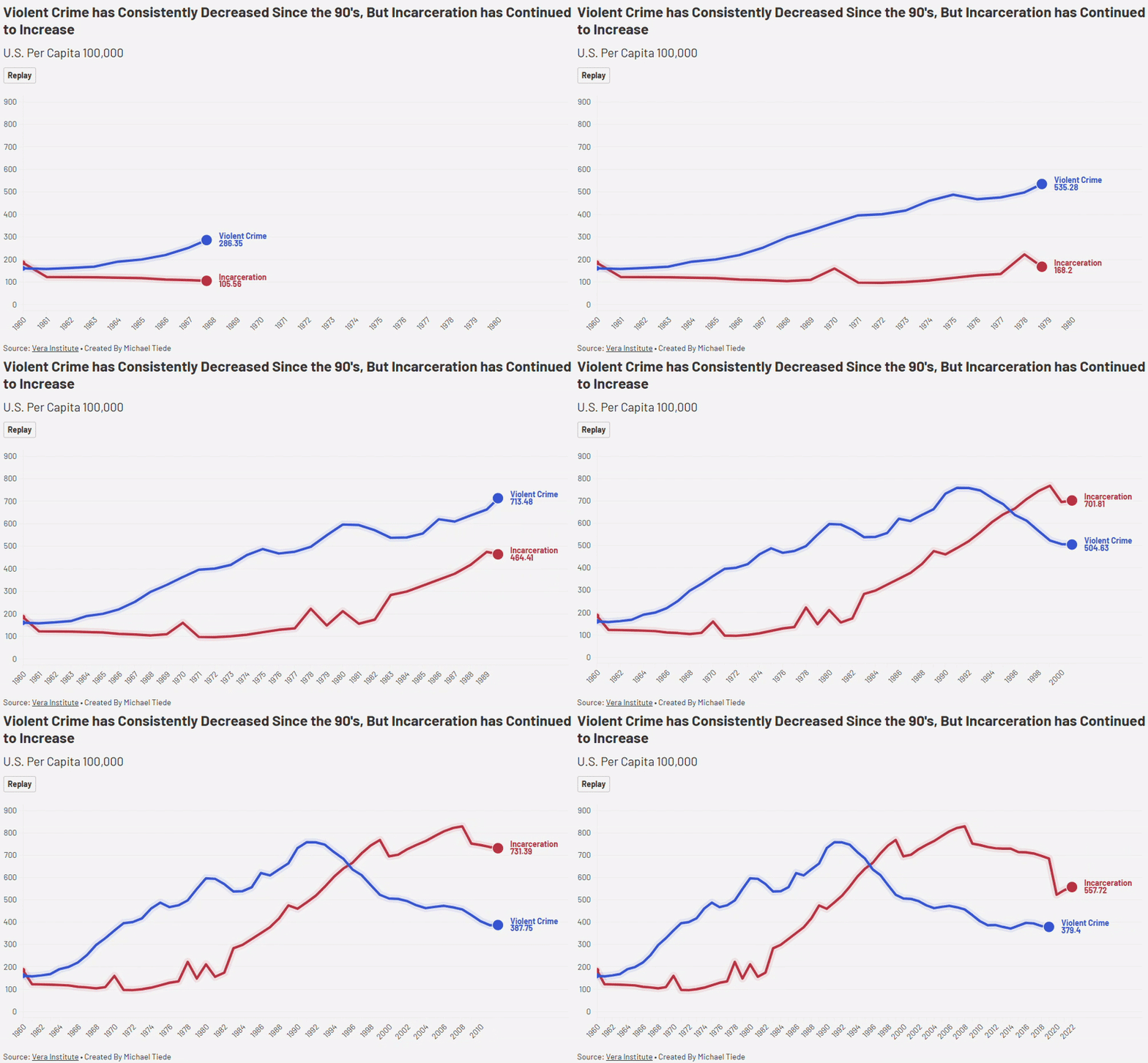
If all the people incarcerated in the United States lived in one city, it would be the 5th largest city in the nation. As of 2022, there are 1.8 million people incarcerated in the United States, or slightly larger than Phoenix, Arizona (1.6M). While mass incarceration is often justified as a strategy to improve public safety, its impact in many cases has been deeply harmful. Long prison sentences, limited rehabilitative services, and inefficient crime reporting systems show how mass incarceration often undermines its stated goal of reducing harm.These visuals are all interactive and available with more information at this link here.The increase in incarceration began in the late 1970s when the Nixon administration declared a ‘war on drugs’ and promised to be ‘tough on crime’. In 1980 the incarcerated population exploded, with a huge increase for the next 30 years. Mandatory minimums, three strike laws, and low-level drug offenses put far more behind bars than ever. Across the country, in all states, from large cities to small towns, incarceration grew. But even with these punitive measures, the violent crime rate also continued to increase.The US has a higher incarceration rate than El Salvador or Rwanda. Several countries experienced a similar increase in crime between 1972 and 1991, but very few expanded incarceration in the same way as the US. Even as crime rates fell between 1991 and 2009, incarceration continued to expand. Compared to other countries, the US has a significantly higher incarceration rate when controlling for the nation’s violent crime rate. The US has a higher incarceration rate than El Salvador or Rwanda. Even in places like Botswana or Ecuador that have far higher violent crime rates that are triple and quadruple what they are in America, their incarceration rates are one-third lower.Mississippi, Arkansas, and Louisiana have the highest incarceration rates in the United States. 17 states have a higher incarceration rate than any other country in the world.Black and Latino individuals are incarcerated more than 5 times the rate of people who are White. This reflects long standing issues of racial bias in our policies and policing. Punitive policies often involve targeting minority groups. While the US has a long history of incarcerating Black Americans, law enforcement agencies have recently turned their gaze onto immigrant communities. However, research shows that immigrants, many of whom are people of color, have a lower crime rate than native born Americans.Closing ThoughtsMass Incarceration has not been shown to improve public safety. Increasing punitive measures often deepens challenges faced by individuals and communities, while doing little to prevent future crime. Having more research-based policies with proven results and investments in rehabilitation is the only way we can move forward. While incarceration rates have been falling, the US is still struggling with a multi-decade long legacy of mass incarceration. Mike Wessler at the Prison Policy Initiative has the final word on America’s choice for the future:“America's forty-year experiment with mass incarceration has been an abysmal failure. Punitive and racist policies have destroyed lives and communities, wasted taxpayer dollars, and not made communities safer. The country has a choice: it can double down on the misguided so-called "tough-on-crime" policies that created this crisis, or it can choose a new path forward By investing in communities, expanding access to treatment, and increasing economic opportunities, America has the chance to close the books on the era of mass incarceration once and for all. The question is, will the country take advantage of this opportunity?”5 Great Organizations to Connect With and Support:* Prison Policy Initiative: Non-profit that produces cutting edge research to expose the broader harm of mass criminalization, and sparks advocacy campaigns to create a more just society.* The Sentencing Project: The Sentencing Project advocates for effective and humane responses to crime that minimize imprisonment and criminalization of youth and adults by promoting racial, ethnic, economic, and gender justice.* Vera Institute of Justice: A national organization that partners with impacted communities and government leaders for change. Their goal is to end the criminalization and mass incarceration of people of color, immigrants, and people experiencing poverty.* Equal Justice Initiative: The Equal Justice Initiative is committed to ending mass incarceration and excessive punishment in the United States, to challenging racial and economic injustice, and to protecting basic human rights for the most vulnerable people in American society.* Chain-Gang All-Stars by Nana Kwame Adjei-Brenyah (WISLY ): Finalist for the 2023 National Book Award for Fiction and A New York Times Top Ten Book of the Year, Chain-Gang All-Stars is a dystopian novel that delivers a searing critique of the U.S. prison-industrial complex with footnotes and real incarceration statistics. This is a public episode. If you'd like to discuss this with other subscribers or get access to bonus episodes, visit americaninequality.substack.com/subscribe
Embed this episode
Ready to play
Land of the Free? Far from it.
No transcript for this episode yet
Similar Episodes
No similar episodes found.