
EPISODE · Jul 1, 2026 · 20 MIN
Language Generation with Feedback: Queries and Mistakes
from Best AI papers explained · host Enoch H. Kang
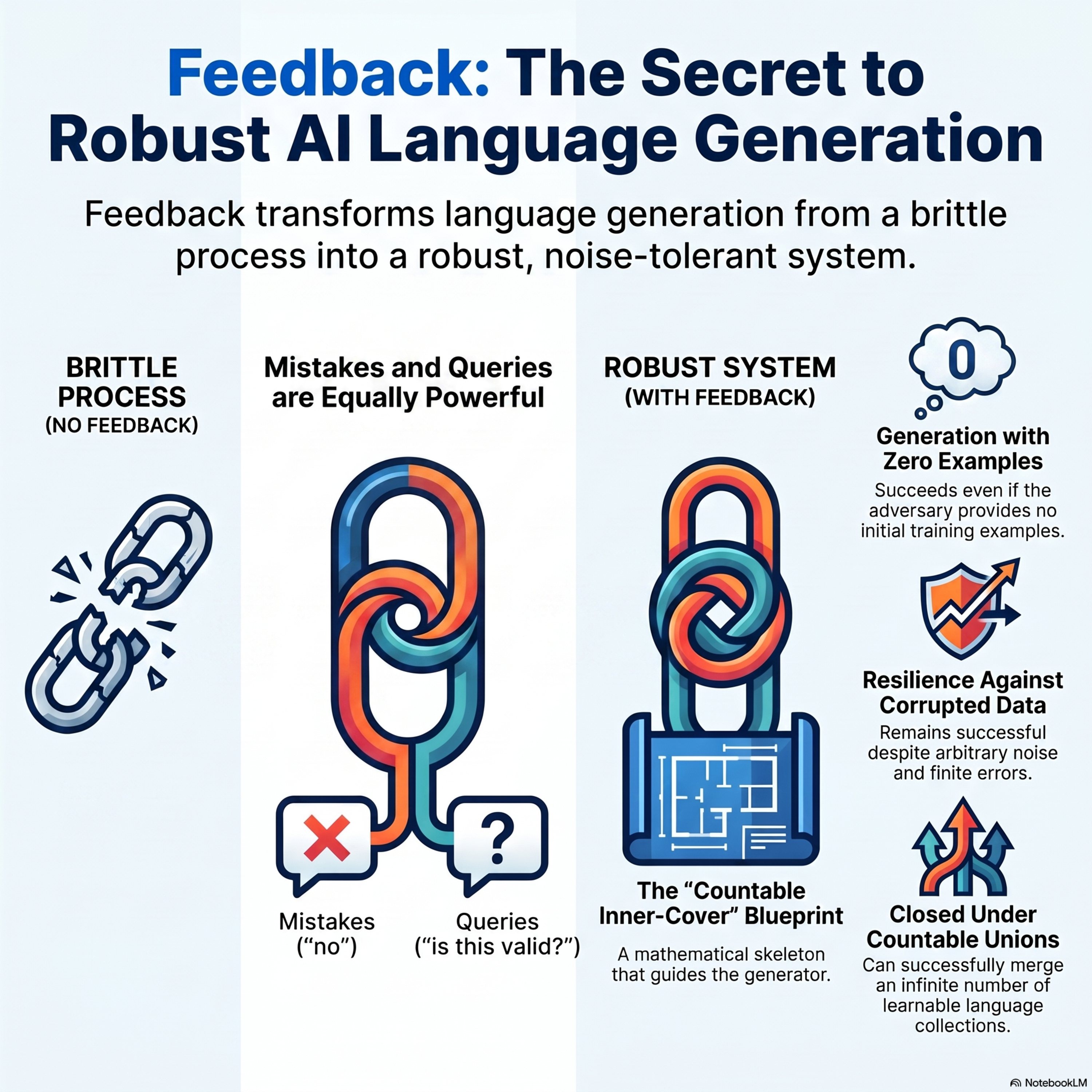
This paper introduces a theoretical framework for language generation in the limit, exploring how machines can learn to produce valid, unseen strings from a target language through various forms of feedback. The authors specifically investigate two models: mistake feedback, where a generator learns if its prior output was incorrect, and query feedback, where the generator can actively ask if specific strings belong to the target language. A central contribution of the research is the identification of countable inner-covers as the definitive combinatorial property that determines whether a collection of languages can be successfully generated under these feedback conditions. The study proves that while access to feedback makes generation more robust to noise and contamination, it also reveals a structural divergence between element-based and set-based generators in certain query scenarios. Furthermore, the findings demonstrate that with feedback, a generator can succeed even without receiving positive examples from an adversary, relying solely on the feedback channel. These results offer new insights into the closure properties of language collections and provide a clearer mathematical foundation for understanding the mechanisms behind large language models and human learning.
What this episode covers
This paper introduces a theoretical framework for language generation in the limit, exploring how machines can learn to produce valid, unseen strings from a target language through various forms of feedback. The authors specifically investigate two models: mistake feedback, where a generator learns if its prior output was incorrect, and query feedback, where the generator can actively ask if specific strings belong to the target language. A central contribution of the research is the identification of countable inner-covers as the definitive combinatorial property that determines whether a collection of languages can be successfully generated under these feedback conditions. The study proves that while access to feedback makes generation more robust to noise and contamination, it also reveals a structural divergence between element-based and set-based generators in certain query scenarios. Furthermore, the findings demonstrate that with feedback, a generator can succeed even without receiving positive examples from an adversary, relying solely on the feedback channel. These results offer new insights into the closure properties of language collections and provide a clearer mathematical foundation for understanding the mechanisms behind large language models and human learning.
NOW PLAYING
Language Generation with Feedback: Queries and Mistakes
No transcript for this episode yet
Similar Episodes
Mar 31, 2026 ·54m
Mar 27, 2026 ·14m
Mar 24, 2026 ·42m
Mar 20, 2026 ·42m
Mar 17, 2026 ·41m
Mar 13, 2026 ·44m