This is an Ant Podcast Management production. Hello and welcome to What The Foe Travel Podcast with Nick and Amy. This is a documentary about oil, tribes and the Amazon rainforest. The danger of climate change. Sea levels have risen at an alarming rate. An area of Amazon rainforest roughly the size of a football pitch is now being cleared every minute. Biodiversity is reportedly declining faster than that of any time in human history. How dare you? You have stolen my dreams and my childhood.
Forests still cover about 30% of the world's land area, but they're disappearing at an alarming rate. Between 1990 and 2016, the world lost an area larger than South Africa. Since humans started deforesting, 46% of all trees have been cut down. About 20% of the Amazon rainforest has been destroyed over the past 50 years. This is a big deal because the Amazon produces 20% of the world's oxygen.
Farming, logging to provide the world with wood and paper, mining and drilling are the reasons for deforestation. In Malaysia and Indonesia, forests are cut down to make way for producing palm oil, which can be found in everything from shampoo to peanut butter. In the Amazon, cattle ranching and farms, particularly soy plantations, are the key culprits. In this podcast, we'll be looking specifically at oil exploration in the Amazon rainforest and a recent groundbreaking court case which could be a game changer for indigenous people around the world. We'll be speaking to people who are trying to save the rainforest and those that call it home.
Jens not only owns a hostel on the edge of the Amazon rainforest in Tenna, Ecuador, but he also owns a plot of the forest itself, where he conducts his own conservation work.
I don't know if you ever heard about the Walker Cell, I think it was an English guy, who discovered that. And this is encircled over all this area where the Amazon is, over these seven million square kilometers. And when the rainforest is gone, so there is no sort of anymore. You can see it already in Brazil, for example, in the state of Rondonia. They deforest a lot there, so there is a, yeah, it's changing the climate, you know, and the forest is drying out, so it starts to burn. That's it.
Very huge problem. The other thing is, what is very important for us, all for humanity, is that the rainforest is a hotspot of biodiversity. We have so many millions of species we didn't know yet. For example, just tree species. We have over 50,000 tree species. In Middle Europe or in Great Britain, we have perhaps 25 natives.
Three species. So in one forest, here we have 50,000. We wondered what Jens thought the world would look like without the Amazon rainforest. Well, OK, the Amazon is, I think it has fifth of the sweet water reserve of the world. And then I think also the people, they live inside the Amazon or close to the Amazon, they have to move to other parts. So it could be possible that when this forest will be done, and so the people, they have to move and there will be overcrowded places.
And it will be a little bit sad then because we will lose a lot of species now. He also explains that there will be a lot of missed opportunities when it comes to biomedicine. It's a huge pharmacy and I believe there are a lot of secrets still there that we can discover. Jens took us into the Ecuadorian rainforest for the day and gave us the privilege of doing something very special. We were able to plant our own baby tree. Pick one. Okay. We're choosing a tree plant, which is a really cool opportunity that we've been given. It's a bit like going to a pound, looking for a puppy. Which one? We're trying to look the cutest.
It's not very nice when you cut like this because you can cut here or you can always cut away from your body. Okay. And try to cut like this. So I started to clear the area for my new tree. Put some muscle into it. What muscle? So it's like some plastic casing around the little baby tree which I'm ripping off.
and I'm putting the tree into a hole that we've dug. I say we. It wasn't me that dug the hole. So yeah, we're just filling in the gaps of the hole, chucking loads of earth in it. If we come back in 20 years. Yeah. So how do you feel about planting your tree, Nick? I feel very good. Yeah, I feel like I've done my very small part for the rainforest, for the world, yeah.
Trees absorb and store greenhouse gases such as carbon. They provide homes to wildlife and maintain the constant cycle of rainwater turning into condensation, which turns into rainwater and so on. Generally speaking, in its lifetime, the tree that we planted today can absorb all the carbon emitted from our flight to South America from the UK. Of course, reducing pollution and deforestation is the real solution here, but planting new trees is a start and a vital piece of the puzzle when it comes to saving the Amazon rainforest and restoring the balance of the global ecosystem. After planting our tree, Jens took us for a trek around his plot of the jungle, followed by a boat ride. We saw more birds, fish and insects than we could count, and we were even lucky enough to see some spider monkeys from our boat, high above in the trees, effortlessly swinging from one branch to the other with their long tail as a fifth limb.
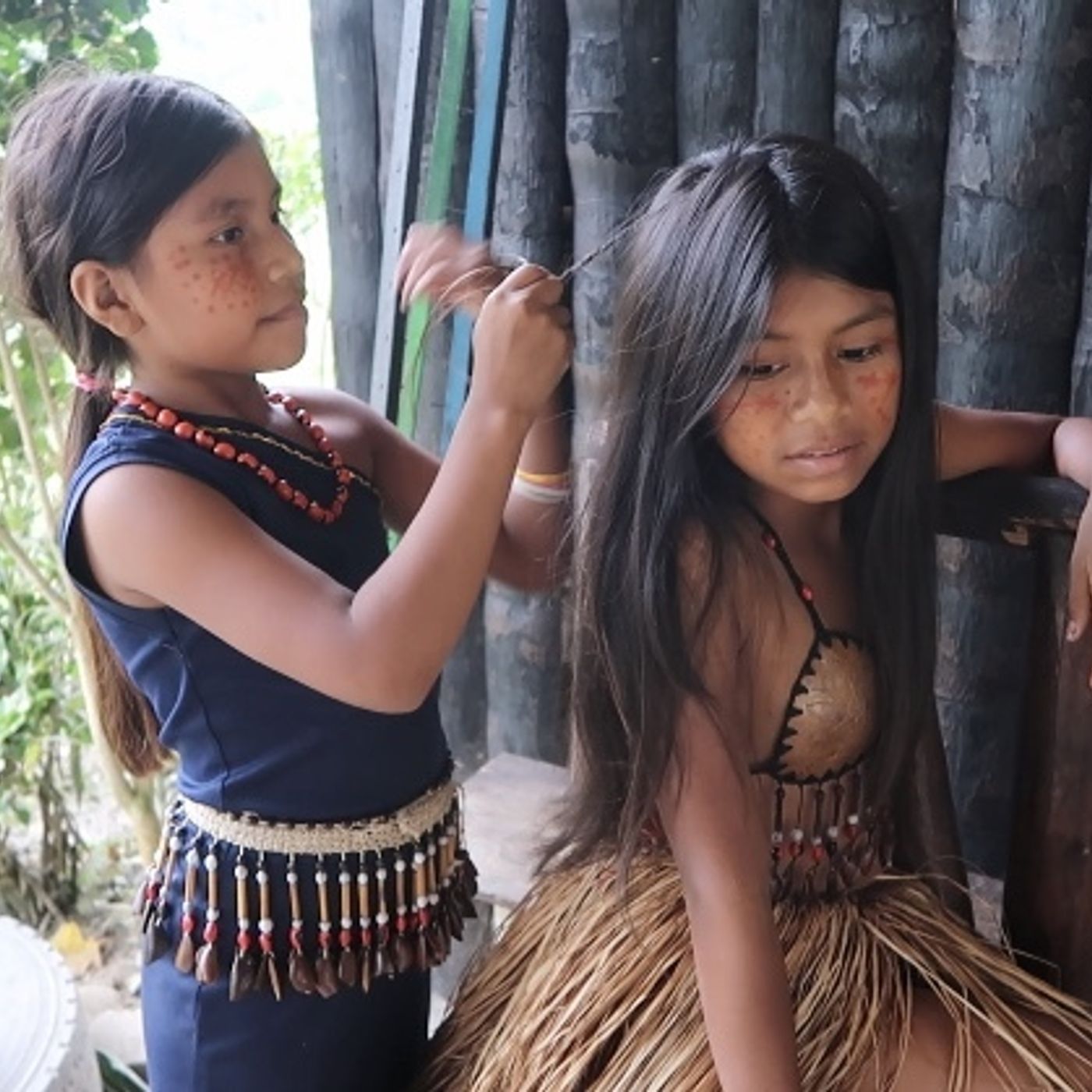
Finally, the part that we were most excited about. Jens took us to visit a traditional Quichua tribe village to learn about their way of life, food and language. This tribe are open and friendly towards tourists. Their way of life has changed so much in the past few centuries and for many, these tours are the only way to keep their traditions alive whilst earning an income. The Quichua indigenous community is the most populous ethnic group in the Ecuadorian Amazon. They tend to be farmers and supplement their diet with traditional hunting practices and food purchases from outside markets.
They are knowledgeable in the use of medicinal plants, along with the planting and harvesting of yucca, banana, coffee, and cocoa. Most working-age men and youth speak Spanish fluently, in addition to their mother tongue, quichua, the language of the mighty Inca Empire. A gradual erosion of traditional quichua culture has occurred over generations. Much of this has been caused by the expansion of the petroleum industry, forces of modernization, and due to the quichua's position on the lower end of the socioeconomic ladder in Ecuador. My name is Isabel Cordova. I am an experience manager here in Selena, Mazantana. We were able to sit down with Isabel and her colleague Darwin at the Selena hostel in Misahuaí to learn more about the native Amazonian people. We have two kinds of Quechua people. The highland Quechua people and Amazon Quechua people.
And Guarani people is living in two different territories, here in Napa province and in Pastaza province as well. This Gareno community, Guaranis from this community, they are more social Guaranis. They don't kill you. Isabel goes on to explain the similarities and differences between native Kichwa and Guarani people. They are different, but they have the same roots.
Guarani people, they decided forever to stay away from people from the big cities. And Quichua people, it's different. They like to stay in the cities, but Guarani people, they are always, they prefer to stay with a jungle lifestyle. So if the Quichua people like big cities, are there any Quichua people living traditionally? Not like, but they are...
OK with the big cities, but they are always fighting for the rights of nature and for the rivers. We wanted Isabel to tell us about the traditional jungle life. Yeah, for me it's amazing because I think in the jungle you don't need a supermarket, never. And the food is so delicious. They have like 20 different kind of palm trees and these are like...
Superfoods you can eat like sweet or salt as a dessert or with a salad. It's amazing. You can stay vegan in the jungle. The lifestyle are more free lifestyle because they don't have a schedule to stay eight hours in an office working. It's so different. And as well with the education, it's so different. They have this kind of ritual. It's called Guayu Saupina. Guayu Saupina is the name in Quichua. In English, maybe like early.
tea ritual because they drink this tea is called wayusa so wayusa is so energetic tea and they drink this tea at maybe 3 a.m 4 a.m in the morning all the families are up and they start to tell jungle stories about how hunting and fishing how to build your house and they are sharing all this knowledge with the children with the kids and this is a kind of homeschooling It's so different. It's so nice for me. Yes, because they are growing up with this different and it's so lovely. It's better this kind of education because it's direct from your parents and grandparents. And when you have maybe, I don't know, 15, you are ready to survive in the jungle.
Isabel may have more Spanish-European roots, but Darwin is a member of the indigenous Quechua community. In this modern world, is it important for Darwin to keep his Quechua traditions alive? For me, it's very important because anywhere I go, I will always remember that I am Quechua, that I am native, and I will tell that to anyone. I will always try to find the opportunity to speak in Quechua, expressing at least some words in that language. Everywhere I go, I will show that I am Quechua. This is very important considering that our past reminds us what we can achieve and what our traditions are.
Let's talk gender roles. In Quechua people, they have three statements different. On the top are the women. They are the parteras, is the name. So they are always taking care about the other women when they are pregnant and they are taking care through all their pregnancy and after with the baby. They are the grandmas, the Quechua grandmas, and they are the top on the families. On the second statement are the shamans.
The shamans, they are these kind of jungle doctors, all of this knowledge about medicinal plants and psychedelic plants as well, because they are working a lot with ayahuasca and chacruna. And the third are the biologists. Isabel then goes on to explain that this gender equality is actually starting to disappear because of the more European influences that are taken over, not the other way around. This makes me think that modern Western life has a lot to learn from these native people, not just when it comes to living in harmony with nature, but also gender equality.
We finished our chat with Isabel by asking her what is the biggest threat to Quechua and all the native people of the Amazon. The biggest problem for me is the big companies, because they are taking all the lands and the river. They have a crazy lifestyle, but it's always sustainable. They know how to keep and protect some special wild species or in the river, whatever. But the big companies, they don't have any idea about how to do this. And they are coming. And all the Quechua people are in danger right now. So Ecuadorian statement.
I know that they sell a lot of Amazon lands and it's possible since here in 10 years more. I don't know how we will be because this is a big problem. Oil companies and hydroelectric because they are polluting all the rivers and all the fishes are dying and people take this water to cook and to drink as well. On April 26th, 2019, a parade of hundreds of indigenous Warani men and women marched triumphantly through the streets of Puyol, an Ecuadorian town on the outskirts of the rainforest. Many had come from villages that have no roads, journeying by canoe and small planes. They were celebrating a new court ruling, which held that the Ecuadorian government could not auction off their land for oil exploration without their consent. The court recognised that the government violated their right to live free and to make their own decisions about their territory. Here's how CNN reported on it. One tribe is fighting back. We came here for our right to live.
we haven't come here to negotiate with the government we came here to get the government to respect our jungle our land it's our home is a leader of the warani one of a number of indigenous tribes that still call the rainforest home the ecuadorian government has sought to expand oil production in the region to boost an ailing economy a move that threatens the tribal way of life in response the irani people have taken to the streets and courts of ecuador to prevent the government selling their ancestral lands to oil companies This was an unexpected victory for the indigenous group. All too often there is a sad outcome for indigenous people in these scenarios. But this court case should go a long way to changing things and give native people around the world hope.
I'm Eric. I'm from Amazon Rainforest of Ecuador. That's Eric, who lives in Misahuaí, a Quechua village which is the gateway to the Amazon Rainforest. He provides real immersive tours into the jungle, sometimes a week long. He tells us why the rainforest is so important to him. The Amazon Rainforest is part of our territory's culture. It's our habitat, our home. It's a place where we eat, where we survive with our family, where we learn from generation to generation how to move forward. Misahuaí is a very small town surrounded by two beautiful rivers, Napo,
the most important one, and Misahili. Misahili has 22 communities working on community tourism, which give them the opportunity to show their culture, traditions, food, and craft. In the jungle, it's possible to walk around the village, see waterfalls, caves. You can find all the animals that live in the jungle. Jaguar, tapir, peccary, deer, and anaconda. Especially monkeys. Capuchin monkeys represent Miss Wahili. Monkeys are really friendly, but their attitude also depends on how people treat them. When people interact with them, they could defend themselves and make sure people know it's their territory. And finally, we asked Eric how people can stay with him. He actually hosts people for free on the Couchsurfing app.
Yes, I have been using couchsurfing already for a year and I like it because it allows you to learn how local people live and get to know their culture. Since I use it, I like to teach people about my culture, food and the way we experience life here. This is a difficult subject. It's easy for us to say that oil is bad and renewable energy is good. But the world is still dependent on fossil fuels. Do you put petrol in your car? Have you ever flown in a plane? Do you use gas to heat your home? Even the device that you're listening to this podcast on requires oil. Oil can be found in cosmetics, fertiliser, clothes and shoes. And then what about the economic benefit? Countries like Ecuador are not rich. They need money to pay for schools and hospitals.
Our modern, overpopulated, energy-hungry world is not sustainable. Every individual can change their behaviour and make wiser choices, which will make a difference. But big, tough changes need to be made by governments to decrease the demand for fossil fuels so that we can protect the only home that we have. Don't forget, you can get in touch with the show. You can email us at whatthefowpodcast at gmail.com. We are also on all the social medias, Facebook, Instagram and Twitter. And we are also on Patreon. For more information on all those things, you can go to our website at www.whatthefowtravelpodcast.com.
This podcast was sponsored by Ant Podcast Management. For help getting your professional