
EPISODE · Jun 9, 2026 · 49 MIN
Learning to herd the goat parade of development
from The New School for City Builders · host Seth Zeren
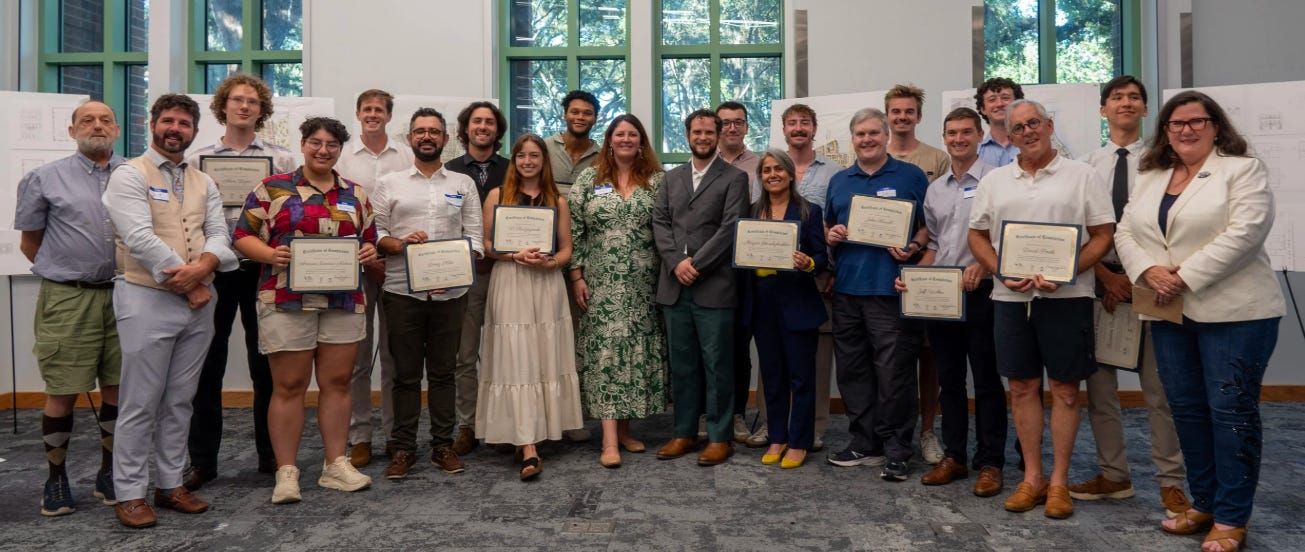
Thank you for joining me for the second installment of The New School for City Builders as I interview Sara Bega and Jack Duncan on Las Catalinas, studio education, building new architecture schools, and more. Please like and subscribe! Build the Next Right Thing is a reader-supported publication. To receive new posts and support my work, consider becoming a free or paid subscriber.The following transcript has been edited for clarity:Seth Zeren (00:02) Hello and welcome to the New School for City Builders. I’m your host, Seth Zeren, a recovering city planner turned neighborhood developer in Providence, Rhode Island. This is a podcast about how we can transform the education of city builders. If we want to change how our cities and towns work, we need to change the people who run them. We need a new generation of city builders — architects, engineers, planners, developers, city managers, and civic leaders. We need a new school for city builders.Joining me today is Sarah Bega, an architect, professor at Notre Dame Architecture School, and former town architect for Las Catalinas, Costa Rica. And for our first dual-guest podcast, Jack Duncan, also a Notre Dame architect, who helped launch an architecture program at the American College of Building Arts and is now at the College of Charleston. Together they are part of the founding team behind CityMakers Collective, a summer studio in Charleston, South Carolina, which is having its second summer starting this Sunday.So it’s very exciting — you’re both about to get right back into the thick of it. In our conversation today, Jack, Sarah, and I are going to talk about building new towns, building new schools, and the ins and outs of the studio education experience. Sarah and Jack, welcome to the New School for City Builders.Sara Bega (01:18) Thanks for having us.Seth Zeren (01:21) Great. Sarah, I saw you about a week or two ago in Northwest Arkansas at CNU, which was a ton of fun. You had just gotten back from teaching a semester in Rome — which sounds like a pretty sweet deal. Now you’re teaching at Notre Dame, the same school where you studied architecture. Can you tell us what the architecture program is like there, and how it differs from other architecture schools?Sara Bega (01:48) Sure. Notre Dame’s pedagogy in architecture and urbanism is founded on a classical philosophy and design process. That doesn’t necessarily mean it’s always expressed in the classical language, but it’s a design process based on analysis and the study of precedent — essentially learning from the successes of the past so you can do even better in the future. We treat architecture and urbanism as a living tradition. We should always be working to improve it, bringing it into the next generation, and thinking far beyond the moment so that we’re not pursuing trends that put an inherent expiration date on a project. Instead, we participate in a larger culture — multiple cultures — and understand how context-based design really matters, both as a process and as a character.I studied at Notre Dame and was drawn to it because during my tour, I was told: “We teach you the rules so you can intelligently break them.” For someone who’s incapable of being obedient, that felt great. That philosophy has remained while the program constantly folds in new successes — it’s not stagnant. In Rome this past year, for example, we had even more emphasis on landscape than ever before. I just appreciate working with people who really care about the built environment, about contributing wonderful additions to our societies, and about always learning and doing better.Seth Zeren (03:35) That’s fantastic. What’s the semester like in Rome as a teacher?Sara Bega (03:41) Dreamlike. It’s a big ask for the students — it sounds cushy, but honestly, they have to balance a lot of travel, which is a good problem to have, along with the experience of simply being there. We all know how important it is to actually be in a place to understand it. They’re traveling all around Italy and constantly shifting in and out of their design headspace. It’s challenging — most of them are in an environment very different from where they grew up, learning as human beings to adapt, and simultaneously extracting design lessons. Not all of them are going to be doing work in Europe; it’s the precedent behind the precedent, so to speak. If you’re trying to engage American tradition and American classicism, you’re going to look at what those architects were looking at, which — given the history of the Grand Tour and the development of architectural language — has often been rooted in that region.As a professor, it’s a joy because students are engaging more sophisticated ideas than ever before. They’re not just picking Corinthian because it’s their favorite — they understand when it’s appropriate to articulate a column at all, or simply use the proportional system, and if you are going to use a columnar order, what character is appropriate and where it fits within the broader culture of that expression. I had mostly taught second years before, which is the boot camp and the engine room of Notre Dame’s pedagogy. Getting to teach third years and expand on those conversations in a different context was a real joy. And outside of studio, you’re just kind of floating around in heaven.Seth Zeren (05:48) Just hanging out in Italy. So Jack — you also attended Notre Dame. Sarah, you were an undergrad there, and Jack, you came as a graduate student. What was your arc? How did you end up there?Jack Duncan (06:08) That’s a good question. I actually didn’t go to college right after high school. I ended up working for Procter & Gamble for almost five years. I wasn’t a great high school student, if I’m being honest. So it was definitely a transition.When I was ready, I wanted to stay in-state and had always been interested in architecture, but in South Carolina we really only have Clemson, and the program didn’t quite fit my perspective on the built environment. I knew I wanted to come to Charleston — it’s a beautiful place, and a lot of us from the upstate, near the North Carolina line, would come south to the beaches. So I came here originally to study classics, and somewhat ironically realized after the first year that I didn’t want to teach. I couldn’t see another career path, so I started taking coursework that interested me: studio art, historic preservation, art history. A year later, my advisor Robert Russell said, “It looks like you could double-major in art history and historic preservation, and if you want to triple major or minor in studio art, you can do that.” So I said okay — I was a bit aimless, if I’m being real.I fell in love with architecture through historic preservation, partly because of where I was. I’m sitting right now at 12 Wool Street, and you just walk out the door into a beautiful environment. Come senior year, I interned for two architects here — Christopher Liberatus and Jenny Bedden — for about a year. They asked if I was going to pursue architecture, and I said I honestly didn’t know. I took another year off and went to the ICAA Summer Studio — I think it was one of the first after they revamped it. I met great people there, came back, and thought: yes, I want to be a classical architect. So I applied to the master’s program at Notre Dame — the only program I applied to. I said, if I get in, great; if not, I’ll go join a fishing boat or something. I got in, finished the program, and it was honestly the most life-changing experience of my life.Seth Zeren (09:36) This podcast is basically just an advertisement for Notre Dame — they should really be sponsoring us. So Sarah, after graduating you went back to Italy, and then someone told you to get on a plane?Sara Bega (09:54) Yes. It was actually my last summer before my final year of school. I did a research project — mostly as an excuse to be back in Rome. I finished it too quickly, in two or three weeks, and meanwhile the internship feelers I had out weren’t panning out. I thought, if I’m going to be a waitress in Marietta, Georgia, I might as well try being a waitress in Rome. I was trying to make that work.But it became moot when someone told me to get on a plane. I had a conversation with Charles Brewer, the founder of Las Catalinas — maybe eight minutes long. We said, let’s send you down there for eight weeks as an intern. When I got there, it was less of an internship and more of an interim situation. I had to quickly overcome panic and paralysis and just get the job done. They were kind about it: “You don’t have to be extraordinary, just duct-tape this thing together until we find the long-term person.” Then I went back and finished school — and it turned out I was the long-term person. So I graduated and flew down there two weeks later.Seth Zeren (11:28) So what is Las Catalinas?Sara Bega (11:30) So many things. Las Catalinas is a village with aspirations to become a town, on a hillside above the Pacific Ocean in northwest Guanacaste, Costa Rica. The core is car-free. That design choice stems from the pursuit of a built environment where, as Clay Chapman puts it, free-range children are possible — what we call “kid freedom.” The idea is that children can have a completely independent discovery of both nature and their community, without the need for constant parental supervision. Charles grew up deciding to be home when it got dark, and that was the experience he wanted to recreate.He first tested it at Glenwood Park, learned a lot, and then doubled down at Las Catalinas. The car-free core has been a resounding success.Seth Zeren (12:41) What is it like to be a town architect?Sara Bega (12:44) Fascinating is a good word for it. You learn so much about people and their egos. I had to do a lot of work to separate my identity from the success of the vision. I understood my role as vision keeper and guardian — so anything that felt like a threat to that vision felt like a personal threat. You put a lot of heart into it, and sometimes that’s necessary.I went down there thinking I’d stay three years at most and ended up staying a decade, because it was so satisfying to watch the vision come together and know the world was better for it.The job requires being a jack of all trades. I wore the hat of architect, urbanist, bureaucrat, entitlement manager, marketer, infrastructure overseer, engineer, and construction manager. You do a little of everything — figuring out where you need to apply pressure and when, to herd what I’d call the goat parade of development.Seth Zeren (14:17) I love that expression — the goat parade. I’m going to start using that. Because it is exactly like herding goats: less cuddly than cats, and they will occasionally headbutt you.What you’re highlighting is the gap between what a lot of education does — teaching technical proficiency in a narrow specialty — and what’s actually needed to lead the whole enterprise of city building. We’ve somewhat artificially created silos over the decades, and to lead that work, you need to be a generalist who can deal with humans. A city without humans is a ruin — that’s the fundamental dynamic. And most technical education doesn’t prepare you for that.So Sarah, you’ve left Las Catalinas and are now teaching at Notre Dame. And Jack, you also graduated from Notre Dame and, despite your best intentions, ended up back in teaching — at the American College of Building Arts, helping create an architecture program. Is that right?Jack Duncan (15:51) Yes. I had known about the American College of Building Arts when I was a student at the College of Charleston — it used to be housed in the old jail on Magazine Street. And honestly, given the kind of wonderfully eccentric students who go there, it was aptly fitting.I had a great friend named Patrick Will, the plaster professor there, who heard about a program I had started at the College of Charleston called Students Interested in Traditional Architecture — C² for short. Through mutual connections, he wanted to meet me, and we became fast friends. We started holding symposia on Saturdays, inviting students from historic preservation, ACBA, and across the crafts — timber framers, blacksmiths, stone carvers. We’d be doing sacred geometry one week, working through the orders the next, or Patrick would be running plaster. Word got out, and people started showing up from the Citadel, MUSC, the College of Charleston, and even just neighbors who’d hear the sound of iron and peer over the gate.My thesis became the integration of a traditional architecture program into a school. I chose Cannon Park as the site — it has four Corinthian columns from the old Charleston Museum and a nice relationship to the surrounding residential neighborhood. About three weeks before I graduated, I got a call from the provost, which I was convinced meant I was in trouble. Instead, he said they had heard through William Bates, who was teaching drawing at the college, that I had written a curriculum, drawn the building, and worked out the spatial requirements. He asked if I’d consider teaching. I said absolutely not — I had taken a long time to get to school, and now you want to pull me back in?He offered to fly me down and make his pitch over a drink. I came home and told my wife. She’s from Charleston, and as soon as the words “job in Charleston” left my mouth — well, I do what she says. Long story short, I came on board, and for the next six years worked with my great friend and now business partner Philip Smith to build the program. Last year I moved over to the College of Charleston, but I still love those students at ACBA and see them all the time.Seth Zeren (21:10) What is it like to build an architectural program inside an existing institution — essentially from scratch? There’s a real tension between what a traditional contemporary architecture program looks like and what you were trying to do.Jack Duncan (21:39) To be quite honest, I stole everything great from Notre Dame. Not just the ideas about architecture and urbanism, but what I’d observed about great teaching. The kindness and patience of Richard Economakis. The stern expectation of Samir Younes. The eccentricity and creativity of Lucien Steil. All of those experiences shaped what I became as a teacher, and it took me two or three years before I’d consider myself even mediocre.It was the same thing Sarah described about Las Catalinas — I was terrified. It had been sold to me as “everything’s set up, we just need you to come teach,” and I showed up to find no syllabus, no curriculum, no schedule. But I work well under pressure, which I think any good architectural designer does. And I think teaching comes to me naturally — it’s something I genuinely love.The main thing I wanted to focus on was the integration of architects and craftsmen in education. When I was at Notre Dame, we had brought some craftsmen in for an exhibition. That experience made me realize that in a place like ACBA — and I hope others like it emerge around the country — when you educate architects and urbanists alongside craftsmen and they grow up together, it’ll be fascinating to see what kinds of cities they build.Seth Zeren (23:41) There’s a strange disembodied quality to a lot of contemporary architectural education. You hear stories of architects who come out of school not knowing that the real dimensions of nominal lumber don’t match what’s on the label — because they’ve never held a two-by-four, never thought about how parts actually go together in the real world.It’s like what you get from being in Italy, Sarah — you’re walking around inside your textbook. I had a similar experience in undergraduate geology during field camp. By the end of the week you realize: I’m inside one of these. And you have to figure it out by hand, developing observational skills and the ability to synthesize complex information from being on the ground.So you were both brought in to be part of CityMakers Collective, which is now in its second year. Can you tell us what it is and what you’re doing this summer? Sarah, why don’t you go first?Sara Bega (25:16) I can speak mostly to the studio component, which is where my participation has been. Jack is a better source on the overall program, but briefly: CityMakers Collective is a wonderful partnership between CityMakers Collective and InBAU USA, coming together to create a classic, intensive summer program uniquely focused on urbanism. The intensive that Jack did with the ICAA is incredible from an architectural standpoint; what Michael Mesko does there is completely admirable. CityMakers created a program they wish they’d had when entering the field — after going through educational systems where tradition felt like a bad word and anything grounded in both ideas and reality wasn’t allowed. They had to figure it out on their own, and I think the best programs come from a need, not just a desire.The overall approach is creating and encouraging built environments that are human-scaled and support human flourishing, very much aligned with New Urbanism. In the studio specifically, last year more than half of the sixteen participants had never done design work — they weren’t designers. So the challenge was: how do we teach these principles through a design project, knowing that design is the best training for understanding the built environment, even if you’re going to end up in development, policy, public health, or town council rather than design practice? The participants tackled projects at neighborhood, block, and architectural scales. This year we’ve doubled the number of participants, which is kudos to everyone, and as a result we now need two studios — so Jack is teaming up with me.Seth Zeren (27:53) Are you actually doing the scales in that order, macro to micro?Sara Bega (27:59) Last year, yes. This year we’re going to focus much more on an iterative design process across all scales simultaneously, since we have many more designers in the group. Higher expectations — why not raise the bar every year?Seth Zeren (28:21) Absolutely. You’re going to learn something every year and try to accelerate. It’s fantastic to see that kind of growth. This is a challenge for a lot of these programs — you’re starting something from nothing, and nobody knows what it is. Sometimes people find their way here after getting “radicalized” by a trip to Europe or a YouTube video, and they come back thinking: wait, what is going on? They end up in a traditional architecture school expecting one thing and finding another. CityMakers Collective is valuable for those people.Jack, you’ve taught studios at ACBA and now at CityMakers. For someone who’s never been in a design program — what does a studio class actually mean?Jack Duncan (29:47) Sarah and I have been talking about this recently. Studio is an environment of exploration and creativity — everything’s on the table. It’s an iterative process, and what I see most with early students is frustration. I think we’re conditioned, maybe culturally, to pursue a linear path: here’s the goal, it’s a straight line, let’s go. My freshmen work for three or four weeks on a pavilion — the hardest work of their lives, learning classical grammar, staying up late, putting everything into it. And then I tell them: this doesn’t quite work. The entry is in the wrong place. The proportions are off. You just watch them sink.So the first hurdle is helping them understand it’s an iterative process. That’s true in practice too — you submit to an ARB after two months of work, and they ask why you sited it that way. Getting patience and humility, making them understand the critique isn’t personal — that’s the essential lesson. Because like Sarah with Las Catalinas, or me starting a program, you tie yourself to the work. Detachment is the first thing you have to learn in any arts program, and it can be the hardest thing in studio. But we can teach it.Being in Charleston helps, because the built work is right outside the door. If a student says that detail doesn’t go together that way, we can say: let’s walk down the street and look at it.Sara Bega (32:19) And it’s worth saying — studio is not a lecture course. It’s typically four hours, meeting several times a week, where students are actively working and the professor goes around giving desk critiques. Different professors have different styles. Mine tends to be: I’m here to join you in your design process, call out obstacles, and help you figure out your options for navigating them. I try to put the responsibility for decisions on the student, because that’s what the professional world demands.That’s uncomfortable for students who got where they are by being obedient, by checking boxes. Now we’re saying: you decide what the list should be, let alone the order. That’s an entirely different relationship to your own responsibility. And sometimes the conversation is less about vernacular character or foundation details and more about helping a student who lacks confidence find the tools and resources to feel sure of their decisions.Seth Zeren (34:00) When an architectural studio is really humming, what does that look like?Sara Bega (34:07) It usually smells pretty bad, actually. COVID masks were a blessing in that regard. But in all seriousness — it’s the energy of people in the same space working through problems together. COVID proved how important that creative energy is. The projects are often individual, which runs counter to professional life, but that’s appropriate for developing design thinking. At the same time, everyone is learning from and supporting each other. It’s not quiet. For people who work best in isolation, that can be a real challenge.Jack Duncan (34:51) This connects to something Harbison writes about in The Built, the Unbuilt, and the Unbuildable — the idea of the atelier. From my very first year of freshmen, I told them: by the time you’re a sophomore, junior, senior, you are the professor. I can’t be there at midnight — I already did my time. But when you’re suffering at midnight and you see a freshman crumpled in the corner, you go help them. And they do the same as they become upperclassmen. It only takes a couple of years for that culture to take hold, and it’s a beautiful thing.I graduated from Notre Dame with eight people. I talk to all of them constantly. You spend more time together than you do with your own family. That creates an incredible bond I’m not sure exists anywhere else outside of an architectural design studio.Seth Zeren (36:03) And at the end of a studio, you typically have a crit — everyone’s work goes up on the wall, outside reviewers come in, and there are lots of comments. Traditionally, the joke is it’s not a successful crit until someone cries. What does that look like when you’re pulling it all together?Sara Bega (36:37) We’re more focused on constructive criticism at Notre Dame. Making someone cry isn’t the goal. That said, it does happen — usually from exhaustion more than anything else. It can absolutely feel like a firing line. I often tell students to have a review buddy who takes notes on what the critics are saying, because you’ll go blank or only absorb the negative. You’re so focused on appearing professional that you don’t actually retain the information.What’s important to recognize is that the review isn’t just about making a beautiful drawing or even a successful design — it’s about being able to verbally communicate your work and be persuasive. That’s how things go from paper to physical reality. You have to persuade people.The outside perspective is also very valuable. As design professors, we’re close to the project — we’ve been in the process with the student and may not catch everything. Outside critics bring fresh eyes that round out the critique.Seth Zeren (38:02) Absolutely. When I teach real estate development, I have outside reviewers for the final project and put some stakes on it — usually a gift card or something symbolic — so students are competing for the best review. And I balance the reviewers: nonprofit, for-profit, large, small, public sector. It’s really helpful for students to encounter the reality that their project will have to exist in a world where people come from very different perspectives and values.Where do you see opportunities to improve studio education — where could it be better?Sara Bega (38:57) The opportunities are infinite — that’s our job. Jack mentioned that Notre Dame has a relationship with the physical reality of how things get built: there’s a focus on structure and how things go together. But it’s not quite the same as the side-by-side experience with craftsmen that ACBA offers. That’s a different and valuable flavor.There are also studios that close the gap with reality in other ways. John Miller runs a Habitat for Humanity studio at Notre Dame — they do full construction documents, budgeting, the whole thing. It’s fantastic. But in the academic context, the fundamental job is to teach you how to think and how to learn, which often keeps things in the world of ideas rather than the world of reality. Getting that balance right is a persistent challenge, especially as students advance and get to choose their own studios.What we don’t do enough — outside of programs like that Habitat studio or Mary Ann Casado’s charrette lab — is prepare students for the messy reality they’re about to enter. I can teach you to defend your work to a room of architects, but not to a NIMBY with very emotional, non-technical arguments. That can be a cold bucket of water a few years out of school.Seth Zeren (41:17) A typical architecture degree requires a lot of studio time, and undergraduate programs often take five years or more. Is that necessary? Could we do it faster?Jack Duncan (41:35) I’ll say something slightly controversial. There was a lot of discussion recently about whether architecture should even be a licensed profession. While teaching at ACBA, I was confronted with craftsmen doing something very practical that doesn’t require a license or an exam — they’re just inhabiting the real world directly. Meanwhile, everything in architecture requires bureaucratic steps, exams, internships. And all of that is relatively new — I believe Illinois enacted the first architectural licensing law around 1897.I say this partly as devil’s advocate, but I wonder if understanding architecture more through a practical lens, and loosening some of those educational constraints, might serve us better. Maybe you keep the exams, where you can test competence in health, safety, and welfare. But a degree at Notre Dame — what does that cost now, a quarter million dollars or more? I think we’re limiting who can enter the profession.Seth Zeren (43:01) That’s exactly where I was heading — these programs become very expensive, very long.Jack Duncan (43:08) Even in law, I think you could argue for keeping the bar exam while reconsidering the education requirement. That would allow traditional architectural designers and urbanists to create something new. I wrote about this — the idea of establishing regional building arts colleges that would combine architecture, urbanism, and the building trades, rooted in each region’s living tradition. Students could be educated together: architects, craftsmen, people who make the city, at a much lower cost. At ACBA, tuition was twenty thousand a year, in an incredible city. We weren’t competing with Notre Dame — we were filling a different need.And from seven years of experience in universities: do not underestimate the glacially paced bureaucratic environment when you want to make a change. If you walk into a well-established institution and say you want to start a traditional architecture program, they will laugh you out of the building. Every decision has to pass through seventeen layers of approval. That’s an argument for building something new rather than trying to reform from within.Sara Bega (44:25) Yes. And in urbanism, the answer is always “yes, and.” Fill the whole ecosystem, don’t create competition within a very niche interest.I’ll add a slight asterisk on Notre Dame: the sticker price is obscene, but the need-based financial aid is excellent — I believe families under around $100,000 annual income pay little to no tuition. The barrier to entry isn’t purely financial; it’s the entire support ecosystem coming up that either gets you there or doesn’t. But the broader point stands.Cities are not made by architects alone. A great city is maybe eighty percent background fabric and twenty percent capital-A Architecture — civic buildings, institutions, landmark houses. So you need the full range of programs. A developer or engineer with knowledge of urbanism and context-based design is as important as a trained architect. We need the fire marshal who understands what makes a great street, and the street designer who understands health and safety. Everyone knowing a little bit about everyone else’s world will make our cities better. Whether that’s a two-week intensive like CityMakers, the ICAA summer studio, or a craftsman learning about architecture and urbanism — it’s all of the above, and the more of it that exists, the better.Seth Zeren (46:31) I like the analogy of a missing middle here too — between the YouTube video that’s inspiring and accessible, and the quarter-million-dollar five-year degree, there’s a lot of missing rungs that have withered because they didn’t fit any accredited box. Reopening that terrain would be really valuable.Sara Bega (47:01) And it should be collaborative, not competitive. What if Notre Dame published its pedagogy so that year-long programs could draw from it? What are the fundamentals of design thinking that a one-year program could build on? What is InkDev teaching developers that could inform the Auburns and Clemsons of the world? The goal should be: let’s work within existing systems to improve them, and identify where new systems are genuinely needed to fill the gaps. When the critique becomes “your program is worthless, we need to start from scratch,” that’s just creating a new silo instead of connecting them.Seth Zeren (48:10) Part of the challenge in reforming city-builder education is creating enough additional competition — even if it’s just drawing students to a summer school — that existing institutions notice and start asking questions. At some point they’ll see someone doing really great work and realize they should learn from it.Sara Bega (49:01) There are examples of crossover already. Andrews University has an incredible program, very rooted in reality. Yale has at least one classical studio. The crossover with sustainability efforts, with affordability focus — schools that are genuinely wrestling with the disposability of the built environment — is more than we realize. Identifying where we have common ground is where a lot of the dial-moving can happen. Saying “your program is not worthy so we’re starting from scratch” isn’t sustainable — it just creates another silo.Seth Zeren (50:35) Right. And the other thing you said I find really interesting: if we understand that eighty to ninety percent of the city is background buildings, then maybe we want some reflection of that in the educational programs. I went to graduate school at Yale — not in architecture, but I took several classes there. The architects I later worked alongside as a city planner were designing kitchen remodels and small apartment buildings. Nothing like what was being taught at Yale — very theoretical, very monumental. Then in practice you meet people who have to make payroll and pick tile. There’s a lot of that kind of work, and it might call for a different kind of person and a different kind of preparation: the design-build-developer type. You don’t have to be the world’s greatest designer to produce good background buildings, but you need to know enough about building and construction and development to manage the process — whether you’re stamping your own plans or hiring someone else. That’s just a different job from designing a beautiful church. But we don’t really have that distinction in our educational system today.Sara Bega (52:20) Absolutely.Jack Duncan (52:28) That was a big part of what I was trying to address in the ACBA curriculum. If you want to build a house, give me five craftsmen — a timber framer, a carpenter, a mason, someone to handle MEP. The way craftsmen work is inherently collaborative. If I’m framing a house as a timber framer, I’m in constant conversation with the mason about how we’re tying in and sheathing, and with mechanical, electrical, and plumbing about how we’re running things through the walls. That’s what I wanted the architecture program to be part of.That’s why I called the sequence “traditional architecture,” not classical architecture — we had a classical studio, but the broader program was vernacular and regional. Third-year students had a vernacular design studio covering traditional architecture from around the world, from earthen construction in Chad to the way Vietnamese buildings are oriented based on climate and social life. That context-based thinking is what I’d want any regional building arts college to be rooted in — picking a city that has a living tradition as its base, whether that’s Natchez, Charleston, or somewhere else.The tuition was twenty thousand a year, in an amazing city. We weren’t competing with Notre Dame. We were filling a completely different need. And from experience: never underestimate the bureaucratic inertia inside universities. If you try to introduce traditional architecture or an integrated real estate program into an established institution, you’ll be laughed out the door — not for any nefarious reason, just because every decision has to pass through seventeen people. That’s a genuine argument for building something new.Seth Zeren (55:51) Right. CityMakers Collective is affiliated with some schools but isn’t credit-bearing — you’re just teaching people useful skills.Sara Bega (56:02) Exactly. I heard someone say recently that the future is local. I think that’s true through every lens — how we design, build, regulate, and finance the built environment should all run through a local context. Yes, you’ll have programs educating people to work anywhere, operating at a more general level. But the more local programs there are, the better. Or programs that train you to recognize what resources and options are available so you can apply them to your particular context — whether that’s the financing structures that work in Indiana versus Florida, or the material supply chains and networks that make sense in a given region.One of the things CityMakers does really well is connect people to the broader ecosystem. The speakers who come in for symposia represent all of these different organizations — CNU for town building, NTBA for new traditional architecture, ICAA for classical design, the Urban Guild for the intersection of architecture and urbanism, InkDev for incremental development, Strong Towns for community-based work. You leave knowing people in those worlds. That handshake is what lets you follow up and go deeper. Making that map broadly available is definitely a need.Seth Zeren (58:26) I think to the extent we can create something like an ecosystem map — because there are a lot of individual people and programs out there doing great work, but it’s hard to find them if you’re new — that would be enormously valuable. There are a lot of pieces, and we loosely know of them, but there isn’t really a guide that a newcomer could use to navigate the network.Sara Bega (58:49) That’s one of the major strengths of what Will and the crew at CityMakers have done — they’ve mapped it, at least in practice. And this is a very human profession. It’s about the comfort of knowing someone who’s doing the thing you’re interested in, having that introduction so you can follow it up. Making it more generally available is a real need.Seth Zeren (59:26) This has been fantastic. I really appreciate both of you coming on — you’re doing such great work, and I come away genuinely inspired. Before we close, I’d like each of you to recommend either a place worth visiting and learning from, or a book. Either of you can go first.Sara Bega (01:00:09) A book that just arrived in the mail for me: the second edition of Street Design by Victor Dover and John Massengale. It’s even better than the first — the photos are more legible, the case studies are stronger. If you’re in the design world, the street is the heart and soul of the urban realm, and this book captures that. I got it yesterday and it felt like Christmas. Highly recommended.Seth Zeren (01:00:41) Nice. Jack?Jack Duncan (01:00:47) There’s a wonderful book by a local author named Wilson — I’m afraid I’m blanking on the full title — but it paints a picture of daily life in Charleston in the mid-twentieth century through her own words and is complemented by beautiful etchings. The way she describes street life, the flower sellers, the sounds, the rhythms of the city — it’s a remarkable window into what Charleston was and, in many ways, still is.Seth Zeren (01:01:40) Wonderful. Thank you both so much.The New School for City Builders is a production of the Educational Collaborative for Building Places People Love and Build the Next Right Thing. If you appreciate what we’re doing and want to support us in bringing this school to fruition, please become a paid subscriber at buildthenextrighthing.com.Build the Next Right Thing is a reader-supported publication. To receive new posts and support my work, consider becoming a free or paid subscriber. Get full access to Build the Next Right Thing at buildthenextrightthing.substack.com/subscribe
Embed this episode
NOW PLAYING
Learning to herd the goat parade of development
No transcript for this episode yet
Similar Episodes
No similar episodes found.
Similar Podcasts
No similar podcasts found.