
EPISODE · May 3, 2026 · 36 MIN
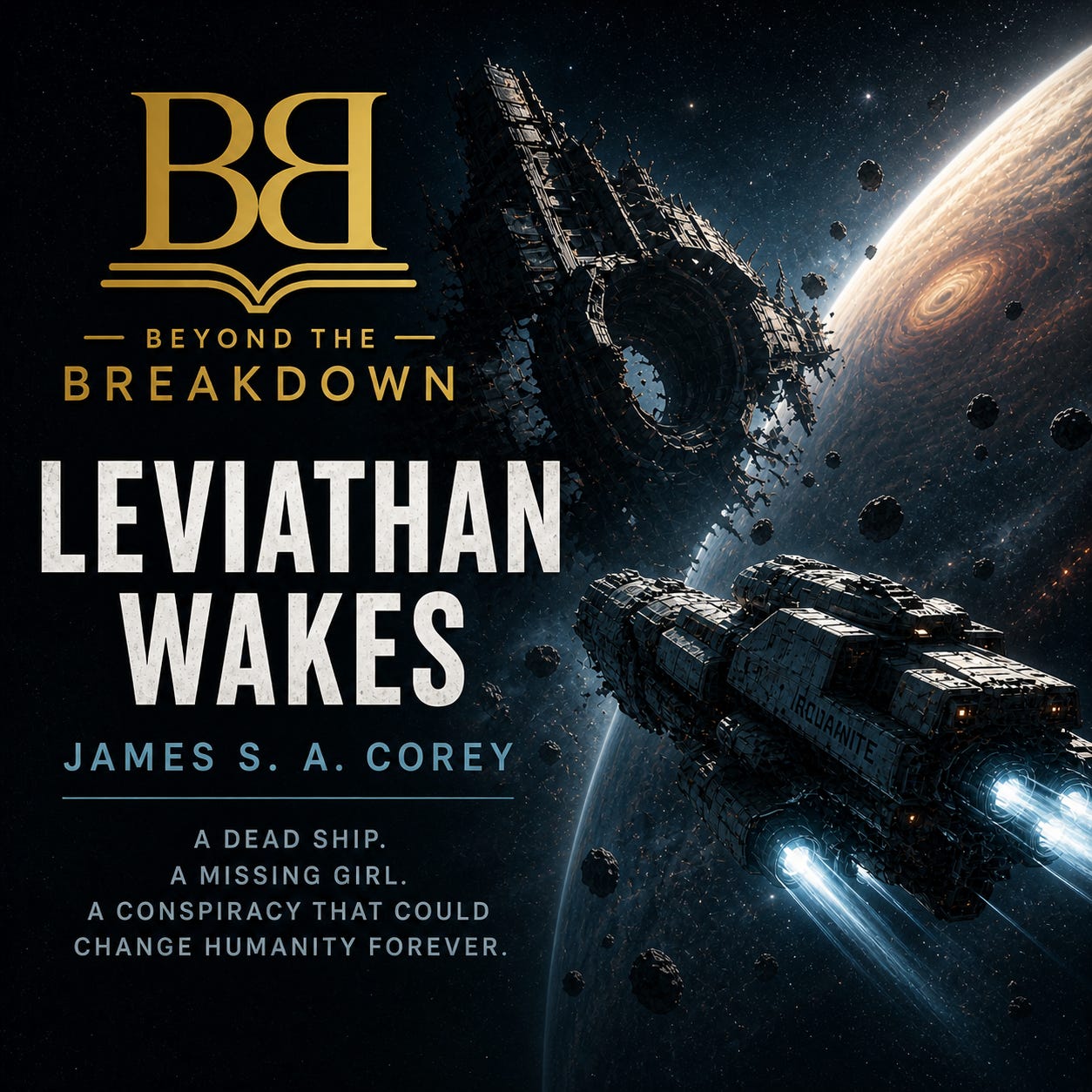
Levianthan Wakes | Transmission 01: Two Men, One Mystery
from Beyond the Breakdown · host Yvan Blanchette
FULL SPOILERS. YOU’VE BEEN WARNED.Imagine you are trapped in a pitch black metal box.You have no food. You are drinking warm, loamy water from the reservoir of a 20-year-old environment suit that tastes like algae and degraded plastic. You are doing mental calculus in your head to determine exactly how many hours of breathable air you have left.And through the metal bulkhead, you hear your friends being thrown out of an airlock into the hard vacuum of space.That is how Leviathan Wakes begins.What We DiscussedLeviathan Wakes is lying to you about what kind of book it is. Before anything else, we established the central thesis of the entire series: this book wears the costume of a grimy noir detective story and simultaneously wears the costume of a grand sweeping space opera. But it is totally lying to you. It takes until the very end to fully comprehend that it was always, from the very first sentence, a horror novel. The architecture of these opening chapters is deliberately deceptive. You cannot appreciate the structural integrity of the foundation unless you already know the crushing weight of the skyscraper it eventually has to support. Every seemingly throwaway line about fluid dynamics or a minor character’s past is a loaded gun waiting to go off.Julie Mao and biological obsolescence. The Prologue subjects the reader to sensory details that are viscerally repulsive by design. Julie has been trapped for eight days. She has urinated in her jumpsuit. She doesn’t care about the indignity because caring about the smell or the chafing would require movement, and movement makes noise, and noise gets her shot. For the first two days she attempts to maintain physical readiness, standing against the G-forces until her legs cramp and force her into a fetal position. By day three, biological imperative overrides discipline. Thirst takes over. She waits for the subsonic rumble of the reactor to change pitch, listens for the pneumatic hiss of the pressure doors, waits until the heavy magnetic boots of the crew sound sufficiently distant, and only then, in absolute pitch blackness, does she carefully disassemble a decrepit old environment suit to access its internal water reservoir. She drinks slowly because she knows if she drinks too fast on an empty stomach she will vomit, losing the hydration and making a noise.The crucial variable Corey introduces to heighten the terror: Julie Mao is not a helpless victim. She has five years of intensive low-gravity jujitsu training. When her captors initially boarded the Scopuli, she went completely feral in the zero-gravity confined space, shattering a man’s knee and doing massive structural damage to her attackers. She actually believed she was going to win the fight, right up until an armored gauntleted fist ended it. She is a highly trained apex predator.And she is sitting in her own urine hoping to be shot.The horror here isn’t existential dread. It’s biological obsolescence. By starting with a character of Julie’s caliber, wealthy, trained, ideologically driven, lethal, and reducing her to a shivering creature where a bullet to the head feels like profound mercy, Corey establishes what the book is actually about. Whatever force is out there cannot be fought with martial arts or willpower. Human agency means absolutely nothing against the vacuum of space. And it means even less against the anomaly that eventually takes the Scopuli.Day four and the severed head. By day four, the sensory deprivation fractures Julie’s mind. She hears Dave, the ship’s mechanic, a man who collected obscure antique cartoon clips and knew a million jokes. Through the dense metal door she hears him begging. A small, broken, fundamentally terrified voice. No, please, no, please don’t. Then the unmistakable mechanical sequence of the airlock. The hydraulics engaging. A meaty physical thud as his body is thrown inside. The heavy inner door sealing. And the hiss of evacuating air. Explosive decompression in space is not a gentle fading away. The fluids in his eyes and lungs are literally boiling in the vacuum while he suffocates. You are trapped in a box, listening to a man die a profoundly agonizing death, entirely impotent to stop it.When the ship finally loses power and goes dead, Julie forces the engineering hatch open. She steps into the corridor, heavy steel wrench in hand, ready to fight. She expects a torture chamber. What she finds is a slaughterhouse that is somehow still alive. The fusion reactor, the mechanical heart of the ship, is coated in pulsing structured mud. Tubes running through it like biological veins. Flesh integrated with silicon and steel. And out of this grotesque biomechanical nightmare, a tiny piece of the mass shifts toward her. It is Captain Darren’s severed head. It looks at her, fully conscious of its own horrific state, and says: help me.This single image is a perfectly engineered fractal of the entire series. What Julie is looking at is the nascent early-stage incubation of the alien protomolecule. The vomit zombies, the black filaments hijacking human nervous systems, the complete weaponization of human biomass. It’s the exact same grotesque biological framework that Dresden and his Protogen scientists will study on Thoth Station. And the exact same horror that will eventually consume the entire 1.5 million population of Eros Station. Every single bit of it starts right here in the dark with a severed head begging for death.It’s as if you sat down to watch a tense geopolitical submarine thriller like The Hunt for Red October and 20 minutes in, it abruptly mutates into John Carpenter’s The Thing.The Canterbury as a metaphor for everything. Chapter 1 pulls a whiplash-inducing tonal contrast: from the claustrophobic sensory-deprived nightmare of Julie’s locker, we are unceremoniously dropped into the sprawling, mundane, brilliantly lit, achingly boring expanse of the ice hauler Canterbury. Corey refuses to provide a textbook historical dump. He constructs the world entirely through texture and implication. You learn that 20 million people live on the moons of Saturn not through a census report but through a casual observation about the Canterbury’s architecture. It’s a retooled colony transport, three quarters of a kilometer long, mostly empty space. A hundred years ago it was the pinnacle of human ambition, hauling million-person payloads to settle the outer planets. Now it’s a glorified dump truck hauling massive dirty chunks of glacier ice to be melted into drinking water and reaction mass.The Canterbury is the physical manifestation of the human condition in the outer planets. It communicates that the romantic heroic age of exploration is dead and buried. Frontiers are closed, borders are drawn. What remains is a highly industrialized, deeply exploitative blue-collar economy. Humanity did not transcend its greed or its class divisions when it conquered the vacuum. We simply exported those exact same struggles to a vastly more lethal environment.Holden’s Kantian compulsion for transparency. When we first meet James Holden, he describes his current state in one word: comfortable. He’s the executive officer of a ship where every crew member is either wildly underqualified for their job or actively running from some catastrophic past mistake. He was court-martialed and dishonorably discharged from the Earth Navy for assaulting a superior officer, and has spent five years on this floating icebox actively dodging real responsibility. His navigator Ade confronts him about his latent capability directly. But his avoidance is entirely performative. Beneath the slacker exterior is a rigidly inflexible, almost pathological moral compass. A Kantian compulsion for absolute transparency that he literally cannot suppress. The instant he is confronted with a genuine moral dilemma he abandons his sanctuary. This psychological profile is the engine of the entire plot.The game theory of the distress beacon. When the Canterbury picks up an automated distress beacon from the Scopuli, the game theory is explicit. Altering vector and decelerating thousands of tons of ice costs massive amounts of reaction mass and time. It virtually guarantees the crew loses their on-time delivery bonuses. On a ship where the crew is barely scraping by, sending money home to families in the belt, that economic hit is devastating. Captain McDowell explicitly orders the comms officer to purge the log and pretend they never heard it. But Holden secretly logs the beacon’s cryptographic signature into the ship’s primary computer. Once a distress beacon is logged into the primary mainframe it becomes an immutable matter of official record. The Earth-UN Navy and the Martian Congressional Republic Navy will eventually see that data. If the Canterbury ignores a logged beacon, the captain loses his license and the ship is impounded. Holden practically puts a gun to McDowell’s head. His empathy is also a form of coercion.Tea kettle propulsion and the ambush. The shuttle flies to investigate using tea kettle maneuvering thrusters, superheated steam, because firing the primary fusion torch in close proximity to the Canterbury would melt through its hull. It’s slow, vulnerable, and agonizingly tense. They board the Scopuli in zero-G, find the ship devoid of crew, discover a breached hull, and locate a planted distress beacon actively broadcasting. It’s a textbook ambush. A stealth ship coated in radar-absorbent metamaterials and running entirely dark appears out of the void. It doesn’t target the shuttle. It targets the massive lumbering Canterbury. It fires a spread of nuclear torpedoes. A nuclear detonation in space is not a Hollywood fireball. Without an atmosphere to create a concussive blast wave, it is a pure blinding flash of hard radiation and thermal energy that flash-vaporizes metal and ice. Utterly silently devastating. From the cramped cockpit of the shuttle, Holden and his crew watch their home and 50 of their friends and colleagues converted into a rapidly expanding cloud of radioactive vapor.Holden’s broadcast and the cosmic trolley problem. Holden’s immediate reaction is pure, unadulterated Holden. He aims a tight-beam array at the fleeing stealth ship and transmits the personnel files, names, medical histories, photographs of every single one of the 50 people on the Canterbury. He wants to weaponize their guilt. He wants to force these faceless murderers to perceive the human cost of their strike. But then he doesn’t stop there. On the Scopuli they found beacon equipment stamped with Martian Congressional Republic Navy serial numbers. Consumed by grief and rage and his absolute conviction in transparency, he packages those serial numbers with the telemetry of the attack and broadcasts the data packet in the clear to the entire solar system.This is not a moral act. It is a catastrophic tantrum. Corey’s central thesis throughout The Expanse is that isolated individual moral choices generate uncontrollable asymmetric systemic consequences. Holden made a fundamentally decent deontological choice initially: he answered a cry for help. He couldn’t abide the thought of someone suffocating in the dark. The direct mathematical result of that empathy is the atomic vaporization of 50 innocent people. Then in his overwhelming grief he makes a second choice: he broadcasts raw, unverified data. The direct result of that tantrum is the immediate destabilization of the solar system, race riots on Ceres, and the initiation of a shooting war between Earth, Mars, and the Belt. It is the most brutal iteration of the cosmic trolley problem imaginable. Except Holden is entirely unaware he is standing in the rail yard, let alone that his hand is resting on the lever. He thought he was turning on a flashlight to help people see in the dark. He didn’t realize the room was filled with vaporized gasoline.Miller and the sociology of Ceres. Chapter 2 drops us into the hyper-local, claustrophobic, grimy streets of Ceres Station and announces a complete genre switch. We are no longer reading a space opera. We are reading a Raymond Chandler novel set on an asteroid. Miller’s methodology is pure noir: he reads the suspect not through the evidence but through the microscopic kinematics of how she waves her hand. He effortlessly code-switches into thick Belter creole to establish dominance and rapport while his newly assigned Earther partner Havelock stands by the door completely alienated, unable to parse the syntax or the cultural context of the exchange at all.Ceres has 6 million permanent residents swelling to 7 million with passing ship crews. The immense wealth of the solar system, platinum, iron, titanium mined from the belt, massive ice hauls from Saturn, complex organics from Earth, all flows through Ceres. None of it stays. Ceres is the ultimate company town, functioning exactly like the Pullman Railway towns of the 1890s: the corporation owns the housing, the stores, the air you breathe, and the police force that beats you if you strike. The people living in the deep dig near the center of the asteroid, where the simulated gravity is weakest and the Coriolis effect is physically nauseating, sleep on broken pull-down beds and smell of recycled protein yeast and fungal blooms.This is also where Corey introduces the book’s most disturbing piece of worldbuilding: Belters are physically imprisoned in the vacuum. Because they gestate and mature in low-gravity environments, their bone density and muscle mass are fundamentally compromised. They grow significantly taller, their torsos elongate, and critically, a third-generation Belter cannot simply buy a ticket to Earth. The 1G gravity well would crush their internal organs and snap their brittle femurs. The class divide is not just economic. It is written into their biology.Miller, a native Belter wearing the uniform of an Earth corporation, is the focal point of that systemic friction. A class traitor in the eyes of his own people.The four survivors and what they tell us. In the shuttle’s cockpit, four people are experiencing the destruction of the Canterbury in completely different ways. Naomi Nagata’s face is locked down, articulating the cold hard mathematics of their survival. Alex Kamal, the Martian pilot, is completely dissociated, staring at sensor ghosts in clinical shock. Shed Garvey, the medic, collapses to his knees and violently shakes. And Amos Burton stands there clenching his fists, the capillaries in his face mottled with rage, lamenting that their crewmate Cameron will never get that arm. Cameron had been saving his hazard pay for a high-end prosthetic limb. In the face of nuclear annihilation, Amos’s brain entirely rejects the macro scale. He focuses exclusively on the immediate, tangible, deeply unfair loss of a friend’s practical goal. It instantly establishes his grounded, intensely loyal, hyper-focused operational nature. And then Naomi looks at Holden, paralyzed by a feedback loop of rage and guilt, and says: what now, Captain? You’re in charge now. Act like it. That single line is the genesis of their entire dynamic. She provides the pragmatic titanium spine of that crew from the very first minute.The Thucydides Trap. To understand why the destruction of one aging ice hauler threatens to burn down human civilization, you have to understand what Holden’s broadcast lands in. The solar system is locked in a textbook Thucydides Trap. Earth is the entrenched aging hegemon, 30 billion people, a massive percentage on basic universal assistance because automation has eradicated human labor. Mars is the rising power, a highly militaristic culturally unified society dedicated to the multi-generational project of terraforming their planet, technologically superior, possessing a naval fleet that genuinely threatens Earth’s supremacy. And caught in the gravitational crush between these two massive bodies is the Belt, not just a geographic location but a distinct socioeconomic underclass. Holden carelessly threw a wrench into this system. The room was already full of gas.The Question We Left HangingWe spent this episode analyzing Julie Mao trapped in that hazard locker.Put yourself back in that pitch black room.When you are completely isolated, stripped of all your options, and you suddenly realize that every system you trusted to protect you has fundamentally failed, what kind of distress beacon do you send out to the world?And more importantly, who is actually brave enough, or foolish enough, to answer it, knowing that doing so might completely destroy them?Next TransmissionEpisode 02 covers what happens when Holden’s broadcast reaches every ship in the solar system simultaneously. Miller gets the Julie Mao file and calls it a bullshit case. And the delicate political balance of the solar system begins a rapid, terrifying, and irreversible descent toward total systemic war.Beyond the Breakdown | Leviathan Wakes Series | Available wherever you get your podcasts.Thanks for listening to Beyond The Breakdown. You want more stories decoded, subscribe for free and never miss what’s beneath the surface. This is a public episode. If you would like to discuss this with other subscribers or get access to bonus episodes, visit beyondthebreakdown.substack.com
Embed this episode
NOW PLAYING
Levianthan Wakes | Transmission 01: Two Men, One Mystery
No transcript for this episode yet
Similar Episodes
No similar episodes found.
Similar Podcasts
No similar podcasts found.