
EPISODE · May 3, 2026 · 36 MIN
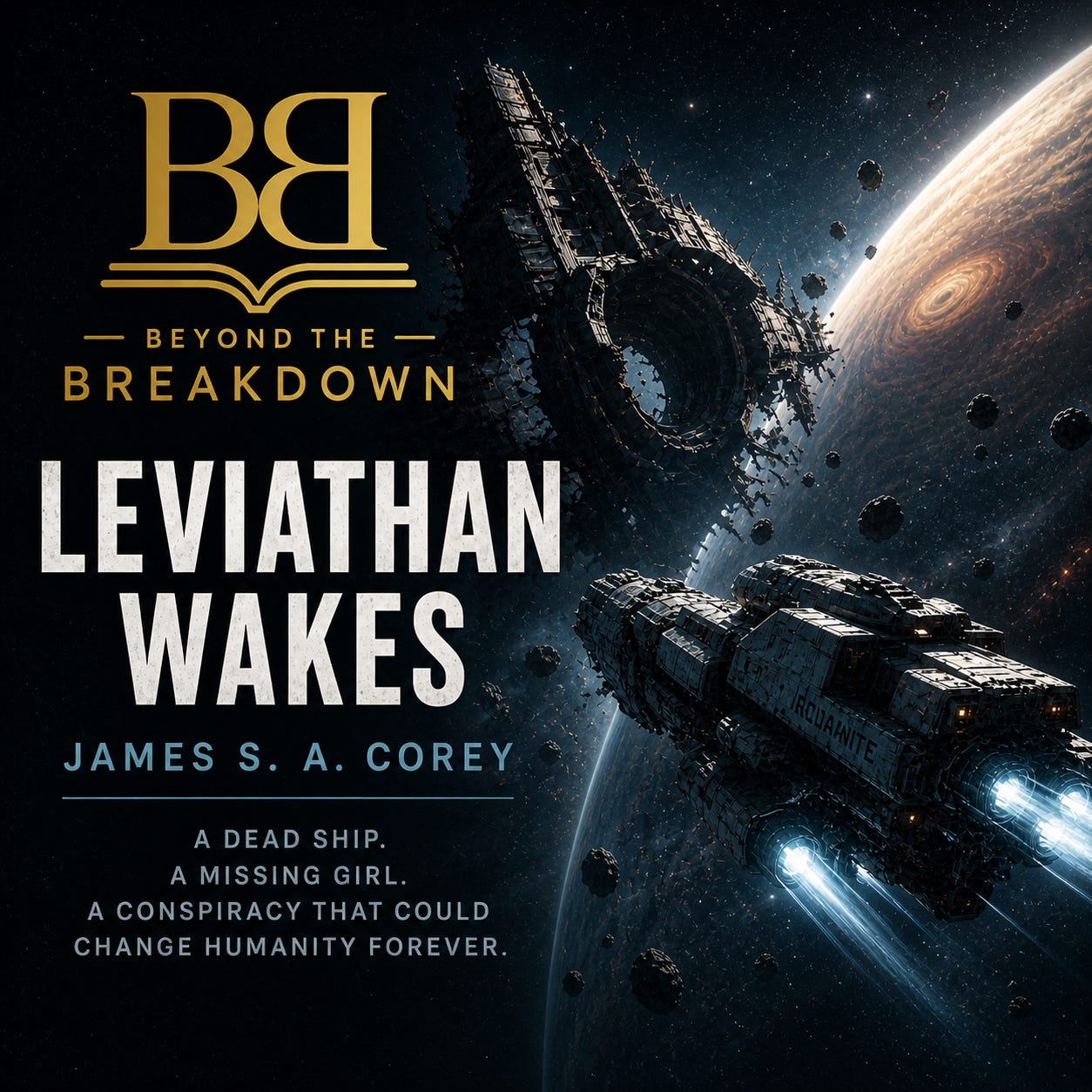
Levianthan Wakes | Transmission 04: The Blue Goo and the End of Everything We Understood
from Beyond the Breakdown · host Yvan Blanchette
FULL SPOILERS. YOU’VE BEEN WARNED | Miller finds the Anubis. And the Anubis changes what kind of book this is.We came in for a noir detective story set in space. Something else is waiting for us.What We DiscussedSubmarine psychology and the galley as sanctuary. Before the narrative drops the floor out from under you with alien horror, there's a necessary structural choice: emotional grounding. The horror simply won't matter if you don't care about the people facing it. These chapters give us tight, domestic, quiet scenes aboard the newly christened Rocinante that do enormous work. The Rocinante is a Martian military corvette. It is not built for comfort. It's built for combat lethality. Space is at such a premium that the galley and the cargo bay are the only places Holden can spread his arms without touching two walls. Standard psychological framework says that putting highly stressed, traumatized individuals into a confined space where they physically cannot escape each other usually leads to intense friction, aggression, paranoia. But the claustrophobia inverts here. The confinement acts as a pressure cooker that forces intimacy rather than explosion. The galley becomes a localized sanctuary against the terrifying infinite vacuum outside. They are building a hearth rather than just surviving the cold.But the most important dynamic in the galley isn't the drinking or the cooking. It's what Naomi is doing while the others process. She is at a terminal, completely sober, scrubbing the Martian military's tracking software from the ship's memory cores. She describes it as scrubbing with steel wool. In high-level cybersecurity, especially with military-grade hardware, simply deleting a file just removes the directory pointer. The data is still physically residing on the drive. To truly erase it you have to actively overwrite the physical sectors. And a Martian stealth corvette almost certainly has highly redundant, possibly quantum-entangled memory arrays designed specifically to survive battle damage and retain black box telemetry. She has to hunt down every redundant backup, every shadow partition, and actively overwrite those sectors with randomized zero-state data over and over again. She is performing emergency neurosurgery on the ship's brain. She is systematically blinding a warship while she is trapped inside it. This establishes her as the quiet functional protector of the group, and Amos recognizes it instantly. His loyalty to her functions like a bodyguard's oath. She is the anchor, period.The physics of impossible stealth. When they board the Anubis, the first horror precedes any biological discovery. This ship should not mathematically or physically exist. It breaks the rules of their universe. In space there is no horizon to hide behind. And space is extraordinarily cold: 3 Kelvin above absolute zero, literally as cold as physics allows. Any human ship is therefore a massive heat source. Life support keeping humans at 20 degrees Celsius. Electrical systems generating friction. And most critically, a fusion reactor producing miniature suns for thrust. Against a backdrop of 3 Kelvin, a spaceship should shine like a lighthouse in infrared. Anyone with even a basic passive thermal sensor can see you coming from millions of miles away. To build a stealth ship you cannot just paint it black. You have to capture and hide your own thermodynamic output, building internal heat sinks that literally swallow the ship's own heat. But there is a physical limit: eventually the heat sinks fill up. If you don't vent that heat into space, which makes you instantly visible, you will cook your own crew alive inside the hull. A stealth ship is a ticking thermodynamic time bomb. This technology is usually reserved for tiny fast reconnaissance drones. To build a stealth ship massive enough to house twelve capital ship-buster torpedo tubes, and then fill those tubes with weapons built to kill whatever you aim at with the first shot, defies the economics of the physics of the known solar system. It means whoever built this has resources that rival entire planetary governments. And they're using it to hide an aggressive first-strike weapon. Even before they open a door to the interior, the structural reality of the Anubis is screaming at them that the world is broken.Zombie vomit and the narrative rotting at the edges. Then they go inside. The physical environment of the Anubis shatters the rules of engagement entirely. They find signs of a struggle, a bent chair leg, bullet holes. But it's not the violence of a typical pirate boarding party. Miller sweeps his flashlight across the reactor room and finds a biological anomaly. A dark spill the color of amber, flaky and shining like glass. A biological residue that doesn't match any known human trauma. Blood freezes in a vacuum, certainly, but it doesn't turn into a golden glassy resin. And then a wadded uniform, frozen in the cold of space, soaked in this glassy substance with strange black filaments growing out of it. For the first dozen chapters we were firmly anchored in a hard sci-fi geopolitical thriller. We were calculating thrust gravity, debating water rights, worrying about corporate sabotage. The horrors were entirely human: greed, political maneuvering, terrorism. We knew how to diagnose those problems. We understand human malice. But now you are staring at a biological residue that disobeys the laws of terrestrial biology. The narrative isn't just taking a turn. It is rotting at the edges. It feels like you sat down to read a Tom Clancy novel expecting submarine tactics and Cold War espionage, and right in the middle of Chapter 15, you are dropped directly into John Carpenter's The Thing.Human bureaucracy middle-managing an alien apocalypse. Naomi decrypts the tight-beam log from Captain Higgins. The message reads: Thoth station crew degenerating, projecting 100% casualties, materials secured, extreme contamination hazard. Consider what Higgins is actually experiencing as he writes this. He is watching his own crew literally melt, degenerating into a biological glassy soup inside a vacuum-sealed tin can millions of miles from the nearest hospital. It is an unfathomable visceral nightmare. But the framing of his final message is a sterile corporate status update. Materials secured. Extreme contamination hazard. He is talking about a pathogen that is turning his friends into glass and black filaments, and he categorizes it as materials. The terror lies entirely in that contrast. The horror is bureaucratic. The genre shift works precisely because the alien threat is trapped inside the framework of the hard sci-fi corporate universe we've come to trust. It's the realization that human bureaucracy is so deeply resilient that it will try to middle-manage an alien apocalypse. They will put it on a spreadsheet.The protomolecule and the 2.3 billion year problem. The Dresden video pitch lays the concept of the protomolecule bare and fundamentally alters the existential reality of the universe. Dresden is standing there giving a slick polished corporate presentation with graphics and animations as if he's selling a new smartphone. He explains that the protomolecule was found on Phoebe, a small ice moon of Saturn. But Phoebe isn't a moon. It's an extra-ecliptical object captured by Saturn's gravity well. It is a package, a weapon, designed 2.3 billion years ago. Internalize that time frame. 2.3 billion years ago, Earth was barely a planet. It was the era of the Great Oxidation Event. The only life on our planet consisted of rudimentary single-celled organisms, mostly cyanobacteria, floating in primordial oceans. Complex multicellular life didn't even exist yet. And this package was fired from some unknown point in the galaxy, aimed squarely at Earth. It was supposed to hit our planet back then and hijack that early cellular life, reprogramming the biology of our entire world along alien lines. But it missed. It got caught in Saturn's mass of gravity and froze on Phoebe. Every single thing we are, every blade of grass, every human being, every thought we've ever had, only exists because of a blind cosmic accident of orbital mechanics. We aren't the pinnacle of evolution. We are a delayed construction project.But what the protomolecule actually does as a mechanism forces us to redefine what biology even means. A virus is parasitic. It hijacks your cellular machinery and repurposes it to make copies of itself. It uses your factory to build its product. The protomolecule is completely different. It is not a living thing. It is a set of free-floating instructions operating at a sub-cellular, possibly quantum level. If a virus uses the factory, the protomolecule dismantles the factory down to its atomic components and builds a completely different structure that obeys a physics we don't understand. It doesn't want to kill you. Killing you is a waste of energy. It wants to use you as raw biomass, absorbing your energy, your mass, and your genetic complexity and actively repurposing it. Think of it as a highly advanced hostile architectural software program. Not a wrecking ball, which is what a plague does. This software hacks into the building's central mainframe, rewrites the fundamental blueprints, starts tearing down the load-bearing walls, and constructs a completely bizarre non-Euclidean structure while all the tenants are still living inside, screaming and being absorbed into the drywall. The distinction between random horror and directed horror: an Ebola outbreak is random horror, chaotic, unthinking destruction. The protomolecule is directed horror. It has an agenda. It has a 2.3-billion-year-old set of instructions. But here is the chaotic variable: it was designed to hit single-celled cyanobacteria. Instead it was unleashed on highly complex multicellular aerobic humans with massive electrically complex brains. So it's improvising. It's laying its ancient programming over millions of years of our own complex evolution. It doesn't know what to do with a human consciousness, so it's experimenting. Which results in the visceral body horror nightmares on the Anubis.And Protogen's reaction to finding this godlike apocalyptic super-weapon that can rewrite biology at the atomic level? They slap their corporate logo on it. First, fastest, furthest. They found an alien mechanism that manipulates living systems and their first thought wasn't to warn humanity. It was to patent it. They view a civilization-ending alien threat not as a danger but as a proprietary asset. They think they can put a saddle on a hurricane.The ethics of the blast radius. Holden wants to broadcast everything: the existence of the alien pathogen, the stealth ship data, the Protogen connection, all of it immediately. The pushback he gets is intense. Miller looks at him and says: you're going to have to shoot me. Miller's argument is a deeply uncomfortable sociological truth. If you broadcast this data right now, when tensions are already at a breaking point, people won't magically unite against the alien threat. They will simply use the terrifying new information as an excuse to shoot the people they already hate. Earth will blame Mars, Mars will blame the Belt, and the alien threat will be the spark that ignites the powder keg. You can't just throw information at people. You have to know what it means first. The narrative proves Miller right in real time: Holden watches a Martian news feed showing Earth forces firing on and completely destroying the Deimos deep radar station, a massive piece of Martian infrastructure. A direct catastrophic escalation to open war. Miller looks at Holden and says: you're telling me that I did this, because Holden's first broadcast claiming Mars destroyed the Canterbury lit the fuse for the entire systemic conflict.The core question this forces: is radical transparency wisdom, or is it a refusal to take responsibility for the blast radius? If you dump highly volatile information onto the public and say you kept your hands clean because you told the truth, are you being a moral paragon or a coward who doesn't want to make the hard choices of managing that information responsibly? Holden believes truth is an absolute virtue devoid of context. Miller believes truth is a weapon, and firing a weapon blindly into a crowded room is an act of supreme negligence. Holden pushing the button and walking away isn't heroism. It's abandoning the duty to protect the people who will be crushed by the resulting panic.Miller: the data miner in the landfill. While Holden is focused on the macro-level survival of the solar system, Miller is entirely obsessively consumed by the micro-level tragedy of one missing girl. His storyline in these chapters is a masterpiece of psychological breakdown masked as noir detective narrative. He's been fired from Star Helix. He's spending his nights in his cheap apartment in the half-sleep of severe alcohol abuse and physical exhaustion. His mind starts to fracture. He begins hallucinating full conversations with a younger version of Julie Mao, and the text notes explicitly that her answers in his mind carry the power of revelation. Through these imagined dialogues his subconscious is connecting the disparate data points of a system-wide conspiracy. Earlier we used the archaeologist analogy for Miller. But it's wrong. Archaeologists deal with the dead past. Miller isn't an archaeologist. He's a data miner standing in a massive rotting landfill of human corruption. He has spent his entire life sorting through the corrupted, filthy, compromised data of Ceres' criminal underworld. And in the middle of all that garbage he found this one single uncorrupted file: Julie Mao. And in his desperate cataloging of her, he is trying to download her entire operating system into his own broken, virus-riddled hardware. And it's crashing his system. He is downloading an idealized operating system onto corrupted hardware, and the resulting crash is what we are witnessing. Tragic empathy. He is solving the case because he can empathize with her so deeply, but that same empathy is tearing his mind apart.The crucial question: is he actually in love with Julie Mao the real flawed human being, or desperately in love with the idea of his own redemption? Almost entirely the latter. Julie represents the pure uncompromising ideal that Miller completely failed to be. She was born into unimaginable wealth, gave it all up, joined the OPA, and fought for marginalized Belters simply because she believed it was right. She is his moral mirror and he hates the reflection of himself. He is seeking absolution through her. And the terrifying part is that Miller can no longer differentiate between the real historical Julie Mao and his idealized hallucinatory phantom of her. He is entirely unmoored from reality. Which makes him incredibly dangerous, but also incredibly effective: while Protogen and Earth and Mars are playing high-level 3D chess with massive fleets of warships and system-wide politics, Miller is just a guy in a cheap hat walking a straight line in the dark, completely ignoring the geopolitical noise, following a ghost directly toward the center of the maze.The Question We Left HangingWe talked a lot about the physical terror of the protomolecule. But consider the sociological terror.The ultimate tragedy of the Anubis isn't the alien goo itself. It's the realization that Protogen relied entirely on the fact that the inner planets viewed Belters as less than human. They knew nobody would come looking for missing rockhoppers. Nobody would notice a crew of Belters going dark on a stealth ship. The institutional indifference to Belt lives created the operational cover Protogen needed.The alien threat didn't break humanity. It merely exploited the cracks of prejudice that were already structurally built into the society.The true monster isn't the alien rewriting our DNA. The true monster is the bureaucratic system that allows a man in a crisp suit to watch a crew melt and think only of quarterly profits.The disease just found the weakened immune system.Next TransmissionEpisode 05: Holden and Miller's storylines are on an absolute unavoidable collision course. When they finally meet, neither man is exactly what the other expected. The ultimate collision of naive macro-idealism and cynical micro-obsession.Beyond the Breakdown | Leviathan Wakes Series | Available wherever you get your podcasts.Thanks for listening to Beyond The Breakdown. You want more stories decoded, subscribe for free and never miss what’s beneath the surface. This is a public episode. If you would like to discuss this with other subscribers or get access to bonus episodes, visit beyondthebreakdown.substack.com
Embed this episode
NOW PLAYING
Levianthan Wakes | Transmission 04: The Blue Goo and the End of Everything We Understood
No transcript for this episode yet
Similar Episodes
No similar episodes found.
Similar Podcasts
No similar podcasts found.