
EPISODE · May 3, 2026 · 29 MIN
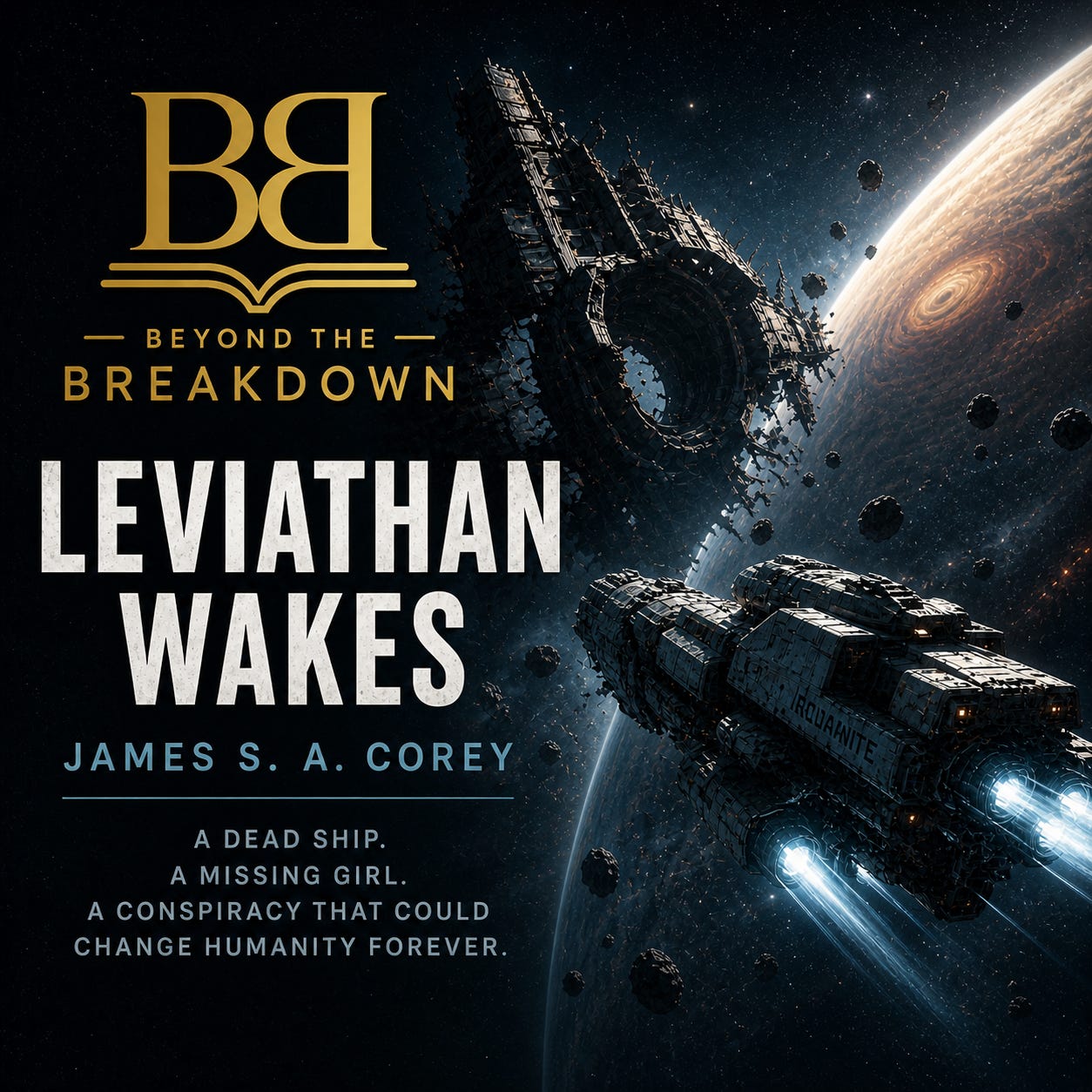
Leviathan Wakes | Transmission 06: Eros, The Horror Underneath Everything
from Beyond the Breakdown · host Yvan Blanchette
FULL SPOILERS. YOU’VE BEEN WARNED | Eros Station. A million and a half people.And something has been done to them that has no name yet.Today the book stops pretending it's a political thriller.What We DiscussedThe horror of subtraction. Horror is traditionally constructed by adding a terrifying element to a normal environment. A monster in the closet. A ghost in the hallway. Jump scares. But Corey creates terror on Eros by taking things away. The station that should be bustling with a million and a half people is instead defined by a thickening absence. The public address system, described as muddy with a false echo, loops a single message: proceed immediately to the casino level for radiological safety confinement. In belter culture, a radiation alarm is the equivalent of a fire in a submarine. You don't question it. You move. You trust the emergency protocols because you have to. So the residents of Eros file compliantly into the casino level. Not because they were forced. Because they were trained by their entire lives to obey survival protocols without hesitation. The terror isn't the cruelty of the lie. It's the efficiency of it. Protogen didn't engineer this to be scary. They engineered it to be mathematically optimal. They needed the biomass concentrated in one location, and a radiation alarm was the most effective mechanism to achieve that concentration. The cruelty is a byproduct of the optimization. And somehow that makes it worse.When Miller and Holden finally reach the casino level, the pachinko machines are melted into slag. The card tables are covered in a clear glutinous gel. But what's really missing are the bodies. A million and a half people were marched down here. And the reader, alongside Miller and Holden, frantically tries to rationalize their absence. Did they escape? Were they evacuated? But the hard physics established over 28 chapters of this series says no. You physically cannot secretly evacuate 1.5 million people. There simply aren't enough ships. The orbital mechanics wouldn't allow that mass movement to go unnoticed. If they aren't gone, they must still be here. And that leads to the slow, sickening realization of what the architecture of the casino has actually become. The black crust. Millions of dark glowing formations on the cathedral-high ceilings. The bodies aren't missing. They have been recreated into the architecture itself. The biomass wasn't removed. It was repurposed. Human flesh remade into something structural, something that glows with a soft oceanic blue light. It is an image that violates every single boundary of human sanctity. Think about the most effective horror cinema: Jaws, Alien. In those films, the horror isn't the shark or the xenomorph. It's the empty ocean surface where you know the shark could be. The dark silent corridors where you know something is waiting. Corey uses the silent casino on Eros in exactly the same way.Dresden's math and the Genghis Khan problem. Who looks at a population of 1.5 million human beings and sees structural biomass? The architect of the strategy is Anthony Dresden, and he is one of the most chilling antagonists in modern science fiction precisely because he is completely unburdened by malice. When Holden, Miller, and Fred Johnson corner him at Thoth Station, he isn't a cackling villain. He's a scientist and corporate executive presenting a business case. He literally calls a million and a half dead human beings small potatoes. When Holden asks him why, Dresden brings up Genghis Khan. Historians estimate Genghis Khan killed or displaced roughly a quarter of the human population at the time to build an empire that fell apart almost the moment he died. Dresden argues that if you scale that up to the current solar system population, that would be killing 10 billion people for a fleeting generational political entity. By comparison, he argues, sacrificing 1.5 million people on Eros isn't even a rounding error. Because he isn't trying to build a political empire. He genuinely believes he is trying to save the human race. Two billion years ago, an alien civilization fired a biological weapon at Earth. Dresden genuinely believes humanity is on a ticking clock to extinction, and that the only way to survive the inevitable return of these builders is to harness the protomolecule, rewrite human evolution, and ascend beyond the frailty of oxygen and water requirements. Belters who can work outside without suits. Humans who can sleep for hundreds of years in colony ships. To him, Eros was a beta test. He literally says: we don't know how this machine works. It doesn't come with a user's manual. We needed significant mass to see what it does.His math holds up only if you completely remove human empathy from the equation. Which is exactly what Protogen did on a systemic level.Naomi's question and the banality of evil. Naomi asks the most important logistical question in that room: how did you convince your scientists to do this? How do you find highly educated professionals willing to design radioactive murder chambers and sit in front of monitors watching video feeds of children dying? Dresden's answer: we modified our science team to remove ethical restraints. He calls them high-functioning sociopaths, and he sounds proud of it. Like it's a feature, not a bug. In a corporate structure, you compartmentalize the horror. You give a brilliant physicist a fascinating problem about radiation shielding. You give a biologist an unlimited budget to study cellular mutation. You remove the oversight. You remove the ethical review boards. You reward them strictly for data acquisition. Just focus on the puzzle. Hannah Arendt coined the term "banality of evil" to describe how normal people could participate in atrocities simply by doing their jobs within a bureaucratic system. Dresden optimized that concept for the corporate world. Protogen's motto, which Miller sees on the presentation video, is: first, fastest, furthest. They didn't see an apocalyptic threat to humanity. They saw an unpatented technology. Dresden crossed an ethical line he could no longer even see, because he had optimized his worldview entirely for progress and profit.The biology of what the protomolecule is actually doing. The body horror Corey describes on Eros is not gore for the sake of gore. Something highly technical is happening to the human tissue. The protomolecule was originally fired at primordial Earth, designed to hijack single-celled anaerobic life: the earliest, simplest forms of bacteria on a primordial planet. It was a software patch designed to interface with a very specific, very simple operating system. But it missed, got caught in Saturn's gravity well, sat on Phoebe for a couple of billion years, and when Protogen woke it up and threw it at humans, it found complex multicellular aerobic primates with incredibly complex nervous systems. The protomolecule is improvising. It's trying to run a two-billion-year-old software patch on a modern supercomputer. It isn't eating people. It's repurposing them. It's a set of blind instructions trying to build a bridge without a blueprint, taking human tissue and using it as raw material, like Lego bricks, to figure out how to achieve its programmed objective. When Miller goes back into Eros, the things he sees are grotesque but undeniably functional: softball-sized severed hands scuttling through corridors like spiders, leaving trails of glowing slime. Black ribs rippling with hair-like threads. And then the auditory horror. The station itself starts speaking. The protomolecule has hijacked the physical matter of human brains and is echoing the fragmented consciousness of a million and a half people. Miller hears the station repeating phrases in a chorus of voices: gone and gone and gone. It's like listening to an old man with dementia, but the old man is an entire space station.Miller reduces an alien apocalypse to a crime scene. How does a human mind process walking through a cathedral of remade human flesh that is actively talking to you? Miller's body panics. His suit telemetry tells him he's hyperventilating, his vision starts to go dark. But he forces his mind to reject the cosmic scale of it entirely. He falls back on the one identity that provides structure to chaos. He acts like a cop. He looks at the nightmare around him and actively refuses to engage with it as an alien apocalypse. He forces himself to view the remade human flesh as just another slab of recycled meat. He compares it to the murdered victims he used to see in cheap Ceres hotels or the suicides who threw themselves out of airlocks. It is a hyper-pragmatic defense mechanism. By reducing a civilization-ending alien threat to just another homicide case, Miller retains his sanity and his agency. If it's a cosmic horror beyond human comprehension, he is powerless. But if it's a crime scene, the largest and weirdest crime scene in history, then he knows exactly what to do. He looks for clues. He finds the culprits. He meets out justice.Violence as blue-collar labor. That same detachment carries directly into the assault on Thoth Station, and it's executed with the same refusal of cinematic heroism. Anyone expecting a glorious swashbuckling space battle where the heroes swoop in with a witty one-liner is reading the wrong book. The approach alone: the Rocinante powers down entirely, flying blind, mimicking a piece of debris. When they finally fire the reactor to brake, they execute a 10G deceleration maneuver. At 10Gs, a 180-pound person suddenly weighs 1,800 pounds. Your heart cannot pump blood to your brain against that gravity. Your organs are crushed against your spine. Without chemical intervention, you pass out almost instantly and your blood vessels begin rupturing under hydrostatic pressure. The crash couches stab them with needles and pump them full of the juice: massive doses of vasoconstrictors to force blood vessels narrow enough to maintain brain pressure, powerful stimulants to keep the central nervous system firing, likely oxygenating agents to keep the lungs from collapsing. It is a violent chemical assault on the body designed to keep you conscious just long enough to survive the physical assault of the maneuver. That is what they put themselves through just to reach the battlefield. The space combat itself is stripped of all romance. Each pearl of light in the point defense cannon streams is a chunk of Teflon-coated tungsten with a depleted uranium heart moving at thousands of meters per second. Imagine sliding on a frictionless sheet of ice at Mach 10 while someone a hundred miles away fires a bullet at you, and your only defense is to try and shoot their bullet out of the air with your own bullet while both of you are still accelerating. That is what Alex is doing in the pilot seat. And Amos is down in the crawl spaces between the halls trying to fix a broken water pressure line while the ship pulls violent evasive maneuvers. Violence as work. Dangerous, ugly, unglamorous work that has to be done to clear a path to the objective. You shoot, you move, you survive. No room for sweeping heroism when you are clearing corridors with assault rifles in low gravity.Dresden hands Fred Johnson a business card. They fight their way through a meat grinder, kick in doors, lose people, bleed on the carpet. They finally blow the doors to the command center. And they find Anthony Dresden unfolding from his chair in a raw silk suit, without a single scratch on him, handing Fred Johnson a matte black business card. He looks at their guns and says: let's dispense with the moral finger pointing and negotiate terms. The banality of his reaction completely strips the OPA's violent assault of its righteous glory. They came in ready to slay the dragon that burned Eros. But the dragon is just a middle manager who thinks he can buy them off with a severance package. Dresden doesn't respect their violence. He operates on a scale where their violence is practically meaningless. He calculates death in millions and billions. A few dead security guards in the hallway is just an HR problem. He is entirely insulated from the physical reality of the pain he causes. While Fred and Holden are caught in the gravity of Dresden's twisted logic, paralyzed by his sociopathic argument about the alien threat, Miller isn't paralyzed at all. Because Miller isn't fighting a war of ideologies. He's working a murder case. He saw the recycled meat on Eros. He smelled the antiseptic. He knows exactly what Dresden is.The radiation sentence and "a little less wrong." The quietest and perhaps most devastating consequence of Eros is the invisible lingering toll it takes on the survivors' biology. When Holden and Miller escaped, they took a massive lethal dose of radiation. Ionizing radiation acts like microscopic shrapnel tearing through the body. It shears DNA. When DNA is shattered, cells can no longer replicate. The first cells to die are the ones that divide fastest: stomach lining, intestines, bone marrow. The immune system collapses. The gastrointestinal tract literally sloughs off inside you. You die of massive internal bleeding and infection. It is an agonizing, horrific way to go. Corey handles this with a masterful avoidance of melodrama. Holden lying on his back in sickbay for five days, the room smelling like antiseptic and diarrhea, a deliberate dark callback to the smells of the Eros casino. His internal monologue isn't filled with weeping or existential dread. He drily notes that the massive radiation exposure failed to give him superpowers. He thinks about his sperm banked in Montana and on Europa, notes it makes his groin itch. When faced with incomprehensible biological trauma, the human mind doesn't stay in a state of high tragedy. It focuses on the mundane, the uncomfortable, the absurd. But they aren't miraculously cured. The technology of the Expanse cannot rebuild shredded DNA. Instead, they receive a death sentence that is indefinitely stayed by pharmacology. For the rest of their natural lives, they take a cocktail of anti-cancer pills. A constant pharmacological stay of execution. If they miss a dose or lose access to the medications, the cancers seeded throughout their bodies will bloom all at once. Before Eros, Holden's default setting was absolute transparency: I have information, I will broadcast it to the solar system, and people will naturally do the right thing. After Eros, he understands what Miller has been telling him all along. Throwing information at people without context just gives them an excuse to shoot whoever they already didn't like. He can't be the paladin broadcasting truth and washing his hands of the consequences. He has a physical manifestation of his own mortality chiming at him every time his hand terminal reminds him to take a pill. He has to make hard, imperfect choices. He has to trust Fred Johnson, a man with his own bloody history. He has to pick a side and get his hands dirty. The only choices available are a whole plateful of what he comes to call a little less wrong.The Question We Left HangingThink about the protomolecule itself. Biologically speaking, it is innocent. It has no meaning. It has no malice. It is a set of instructions trying to execute a program it was written for two billion years ago, improvising wildly on biological architecture it was never designed to encounter.The protomolecule is just a hammer.Dresden is the one who looked at a hammer and realized he could use it to build a slaughterhouse.The greatest threat to humanity in this universe isn't alien malice. It's human efficiency. The aliens provide the physics. Humans provide the cruelty. The true monster is the purely human instinct to look at an incomprehensible mechanism of creation and destruction and immediately figure out how to monetize it, patent it, and use it to kill the neighbors.No matter what wonders or terrors we find out in the stars, the most dangerous thing in the universe will always be what we bring with us.Next TransmissionEpisode 07: Dresden explains himself fully. Miller makes a decision that Holden will never fully forgive. And Eros starts moving.Beyond the Breakdown | Leviathan Wakes Series | Available wherever you get your podcasts.Thanks for listening to Beyond The Breakdown. You want more stories decoded, subscribe for free and never miss what’s beneath the surface. This is a public episode. If you would like to discuss this with other subscribers or get access to bonus episodes, visit beyondthebreakdown.substack.com
Embed this episode
NOW PLAYING
Leviathan Wakes | Transmission 06: Eros, The Horror Underneath Everything
No transcript for this episode yet
Similar Episodes
No similar episodes found.
Similar Podcasts
No similar podcasts found.