
EPISODE · Jul 7, 2026 · 2 MIN
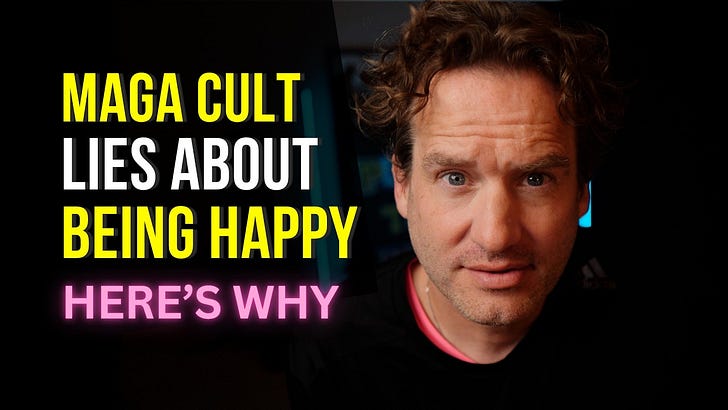
Liberals are Happier Than Conservatives
from The Lucas Bean Show · host Lucas Bean
For over a decade, one finding has come up again and again in American political psychology research.Conservatives report being happier than liberals. They report better mental health. They report higher life satisfaction. The data shows up in survey after survey and gets repeated in headlines, think pieces, and conservative media as proof that the right wing has figured something out about how to live well.There is just one problem.When researchers stop asking conservatives how they feel and start measuring how they actually behave, the finding collapses entirely.The Study That Changed EverythingIn 2015, a team of researchers at UC Irvine published a peer reviewed study in the journal Science. Lead researcher Sean Wojcik and his colleagues set out to settle the question once and for all. Are conservatives actually happier than liberals or are they just saying they are?They studied 4,936 people across multiple data sets. Online survey takers. American politicians. Twitter users. LinkedIn users. And they measured two things simultaneously. First, what people reported about their own happiness. Second, how those same people actually behaved in real life.On self-report surveys, conservatives claimed to be happier than liberals. That part confirmed what decades of previous research had found.But when the researchers analyzed actual behavior, emotional language used in Congressional speeches, genuine smiling in photographs of politicians, positive language in tens of thousands of tweets and LinkedIn posts, the results flipped completely. Liberals displayed significantly more happiness than conservatives across every single data set.Conservatives said they were happier. Their behavior said otherwise.The researchers concluded that the entire body of research claiming conservatives are happier than liberals had relied exclusively on self-report measures. And self-report measures, it turns out, are not measuring happiness. They are measuring something else entirely.The Mechanism: Social Desirability BiasPsychologist Allen Edwards identified the mechanism in 1957 and called it social desirability bias. The tendency of people to answer survey questions in whatever way will be viewed most favorably by others in their community.It is not lying exactly. It is performing. When a survey asks you how happy you are, you are not reaching inward and reporting an objective internal state. You are asking yourself a different question first. What is the right answer for someone like me to give?In conservative culture, that question has one acceptable answer. Strong. Certain. Fine. Asking for help is weakness. Admitting you are struggling is failure. Showing vulnerability is something to be ashamed of.So that is what they report. That they are fine.This is not a fringe observation. In 2023, only 17 percent of American men saw a mental health professional, compared to 28.5 percent of women. In 2021, only 40 percent of men with a diagnosable mental illness received any treatment at all, compared to 52 percent of women. The gap between need and help-seeking is enormous. And research consistently points to the same cause. The stigma attached to admitting you need help.Alexis Mostoller and Kristin Mickelson at Arizona State University studied 326 men across the United States in 2024 and found that the stronger a man’s endorsement of traditional masculine norms, the greater his self-stigma around seeking mental health help. Men who most strongly believed in toughness, self-reliance, and emotional stoicism were the least likely to admit they were struggling and the most likely to avoid professional help entirely.Conservative culture does not just discourage admitting weakness. It punishes it. Family, peers, church, and community all deliver the same message from childhood onward. Toughness is identity. Vulnerability is failure. And the survey question lands inside that cultural context every single time.The Mental Health Study That Confirmed ItThe social desirability explanation got additional support from a separate line of research that tested it directly.Researchers designed an experiment where they randomly assigned whether participants were asked about their mental health or their overall mood. The two questions are asking about essentially the same thing. But the words are different. Mental health carries cultural weight in conservative communities in a way that mood simply does not.When conservatives were asked about their mental health, the familiar pattern appeared. They reported significantly better scores than liberals.When the exact same conservatives were asked about their overall mood instead, the advantage disappeared completely. Conservatives and liberals reported equal levels.The term mental health was making conservatives lie on the survey. Not because they are dishonest people. Because the words themselves triggered the cultural reflex. Mental health is weakness. So they said they were fine. Mood is neutral. So they told the truth.The survey was never measuring how mentally healthy conservatives actually are. It was measuring how afraid they are to admit they are not.What the Distress Actually Looks LikeWhen people cannot express distress directly, it does not disappear. It comes out sideways.Research consistently shows that men who adhere strongly to traditional masculine norms and avoid help-seeking do not experience less psychological pain. They experience the same pain but redirect it into anger, withdrawal, alcohol use, overwork, and other behaviors that are culturally acceptable in ways that admitting you need help is not.The distress is there. It is just wearing a different costume.This is why the political behavior of conservative communities makes sense when you understand the underlying psychology. Communities under chronic psychological stress that cannot name or address that stress directly are communities primed for outrage, for scapegoating, for the emotional release of finding an enemy to blame. The anger is real. The cause of the anger is misidentified. And the cycle continues.The Conclusion the Data ForcesConservative culture has built a system that produces people who cannot tell the truth about how they feel, not even to themselves on an anonymous survey.The researchers who have studied this most carefully are not claiming conservatives are miserable. They are making a narrower and more important point. Self-report surveys measure willingness to disclose, not actual internal states. And when one culture systematically teaches its members that disclosing psychological distress is shameful and dangerous, the surveys will systematically underestimate the distress in that group.The happiness gap between conservatives and liberals is not evidence that conservative culture produces happier people.It is evidence that conservative culture produces people who are more afraid to say they are not okay.And a culture that teaches people to be afraid of their own emotional reality is not a culture that is thriving.It is a culture that is hiding.Sources:Wojcik, S.P. et al. Science, 2015.Edwards, A. The Social Desirability Variable in Personality Assessment and Research, 1957.Mostoller, A.M. and Mickelson, K.D. Arizona State University, 2024.National Center for Health Statistics, 2025.VeryWellMind, 2024. This is a public episode. If you'd like to discuss this with other subscribers or get access to bonus episodes, visit lucasbean.substack.com/subscribe
Embed this episode
Ready to play
Liberals are Happier Than Conservatives
No transcript for this episode yet
Similar Episodes
No similar episodes found.
Similar Podcasts
No similar podcasts found.