Listen to this Article: "Reading Proust in War"
from The Chris Hedges Report Podcast Hosted by Chris Hedges
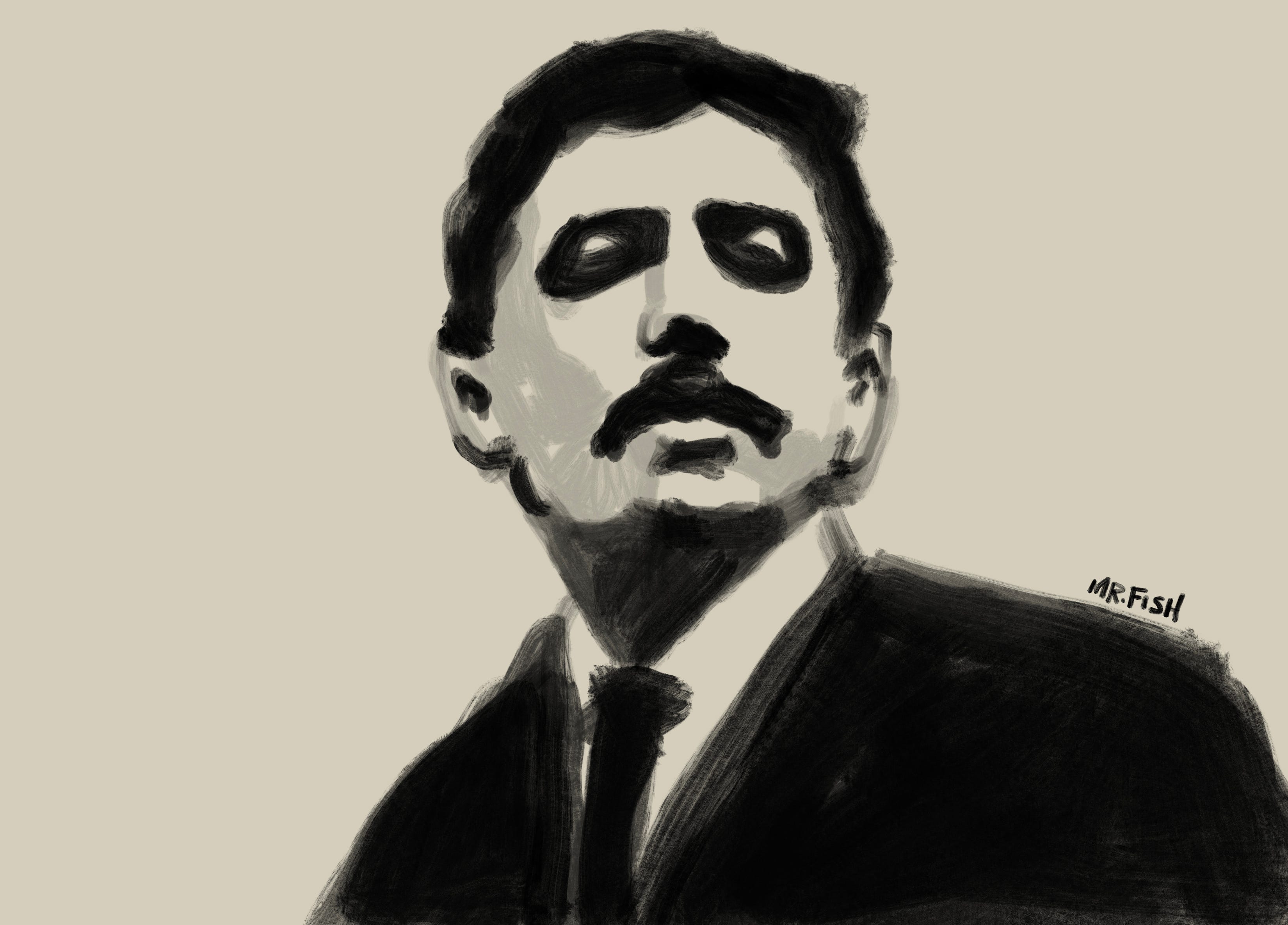
Narrated by Eunice Wong Text originally published Nov. 20, 2022 Marcel Proust - by Mr. Fish During the war in Bosnia, I worked my way through the seven volumes of Marcel Proust’s “In Search of Lost Time.” The novel, populated with 400 characters, was not an escape from the war. The specter of death and the expiring world of La Belle Époque haunts Proust’s work. He wrote it as he was dying; in fact, Proust was making corrections to the manuscript the night before his death in his hermetically sealed, cork-lined bedroom in Paris. The novel was a lens that allowed me to reflect on the disintegration, delusions and mortality around me. Proust gave me the words to describe aspects of the human condition I knew instinctively, but had trouble articulating. He elucidates the conflicting ways we perceive reality, exacerbated in war, and how each of us comes to our own peculiar and self-serving truths. He explores the fragility of human goodness, the seduction and hollowness of power and social status, the inconstancy of the human heart and racism, especially antisemitism. Those who see in his work a retreat from the world are poor readers of Proust. His power is his Freudian understanding of the subterranean forces that shape human existence. The novel is grounded in the bitter wisdom of Ecclesiastes: The beauty of youth, the allure of fame, wealth, success, power, along with literary and artistic brilliance, reap a horrendous toll on those beguiled by them, for they are transitory, and perish. I was in Croatia as Serb villages were being ethnically cleansed by the Croatian army. I watched an elderly veteran of the partisan war being pushed out of his home, which he would never again inhabit, in a wheelchair, bedecked with his World War II medals on his chest. The rise of ethnic nationalism had extinguished the old Yugoslavia and with it his status and place in society. The last volume of “In Search of Lost Time” is populated with the aged shells of once-great actors, writers and aristocrats, forgotten as the crowd flocked to new luminaries. The celebrated actor La Berma, a thinly disguised Sarah Bernhardt, too infirm to take to the stage, is ignored. The courtesan Odette de Crécy, the passion of Charles Swann, one of the central characters in the novel, was once a great beauty who entranced Paris but in senility is relegated to a corner of her daughter’s fashionable salon where she is a figure of ridicule. She had become “infinitely pathetic; she, who had been unfaithful to Swann and to everybody, found now that the entire universe was unfaithful to her,” Proust writes of Odette. The pedestals the powerful and the famous stand upon — and believe are immovable — disintegrate, leaving them like King Lear, naked on the heath. When Swann denounces the persecution of the Jewish army Captain Alfred Dreyfus, wrongly accused of treason, he becomes a nonperson and, along with other “Dreyfusards,” is blacklisted. Émile Zola, France’s most famous novelist at the time, was forced into exile because he defended Dreyfus. “For the instinct of imitation and absence of courage govern society and the mob alike,” Proust notes. “And we all of us laugh at a person whom we see being made fun of, though it does not prevent us from venerating him ten years later in a circle where he is admired.” War elucidates these Proustian truths. Death, as in the novel, permeated my existence in Sarajevo, a besieged city being hit with hundreds of shells a day and under constant sniper fire. Four to five people were dying daily, and perhaps another dozen or so were wounded. But even with death all around us, those desperately clinging to life sought to obscure its reality. Death was something that happened to someone else. This denial of death, and our impending mortality, is captured by Proust when Swann informs the Duke and Duchesse de Guermantes that he is ill and has only three or four months to live. On their way to a dinner party and not wanting to cope with the finality of death, the Duke and Duchesse dismiss the prognosis as fiction. Swann warily accepts that “their own social obligations took precedence over the death of a friend.” “You, now, don’t let yourself be alarmed by the nonsense of those damned doctors,” the Duke tells him. “They’re fools. You’re as sound as a bell. You’ll bury us all!” The death of the narrator’s grandmother, as well as the death of his lover Albertine, a version of Proust’s lover and chauffeur Alfred Agostinelli, who was killed in a plane crash in 1914, exposes the mutations of the self. Marcel, the narrator, does not lament grief, for it retains the connections to those we have lost. He laments the day he no longer grieves, the day the self that was in love no longer exists. He writes: I too still wept when I became once again for a moment the former friend of Albertine. But it was into a new personality that I was tending to change altogether. It is not because other people are dead that our affection for them fades; it is because we ourselves are dying. Albertine had no cause to reproach her friend. The man who was usurping his name was merely his heir. We can only be faithful to what we remember, and we remember only what we have known. My new self, while it grew up in the shadow of the old, had often heard the other speak of Albertine; through that other self, through the stories it gathered from it, it thought that it knew her, it found her lovable, it loved her; but it was only a love at second hand. Inanimate objects carry within them a mystical force that can awaken these lost feelings of grief, joy and love. They return not by an act of will, but through involuntary memory. A smell, sight or a sound suddenly ignites what is buried and otherwise inaccessible, the most famous example being the dipping of the petite madeleine into the tea that evokes a sudden memory of Marcel’s childhood at Combray. “I find the Celtic belief very reasonable, that the souls of those we have lost are held captive in some inferior creature, in an animal, in a plant, in some inanimate thing, effectively lost to us until the day, which for many never comes, when we happen to pass close to the tree, come into possession of the object that is their prison,” Proust writes. “Then they quiver, they call out to us, and as soon as we have recognized them, the spell is broken. Delivered by us, they have overcome death and they return to live with us.” Art – literature, poetry, dance, theater, music, architecture, painting, sculpture – give the fragments of our lives coherence. Art gives expression to the intangible, nonrational forces of love, beauty, grief, mortality and the search for meaning. Without art, without imagination, our collective and individual pasts are disparate, devoid of context. Art opens us to awe and mystery. Art is not, as the painter Elstir says in the novel, a reproduction of nature. It is the impression nature has on the artist. It wrestles with the transcendent. Imagination, however, is a blessing and a curse. It can be self-destructive when we mistake what we imagine for reality. Swann’s infatuation with Odette, for example, is driven by her resemblance to the women painted in the Florentine Renaissance by Sandro Botticelli. It is the painting, the image, not Odette that Swann worships, a fact he eventually faces, amazed that he has courted a woman “who was not my type.” Marcel will come to a similar conclusion at the end of the novel, seeing the aristocratic elites who dazzled him in his youth as mediocrities, elevated to the status of demigods by his imagination. At the same time, imagination is the fuel of art. Art, Proust reminds us, takes work — as in the fictional piece of music, the “Vinteuil Sonata,” which Swann associates with Odette. “Often one hears nothing when one listens for the first time to a piece of music that is at all complicated,” he writes. “For our memory, relatively to the complexity of the impressions which it has to face while we are lis… This is a public episode. If you'd like to discuss this with other subscribers or get access to bonus episodes, visit chrishedges.substack.com/subscribe
Embed this episode
No transcript yet.