Listen to this Article: "Sammy Goes to School"
from The Chris Hedges Report Podcast Hosted by Chris Hedges
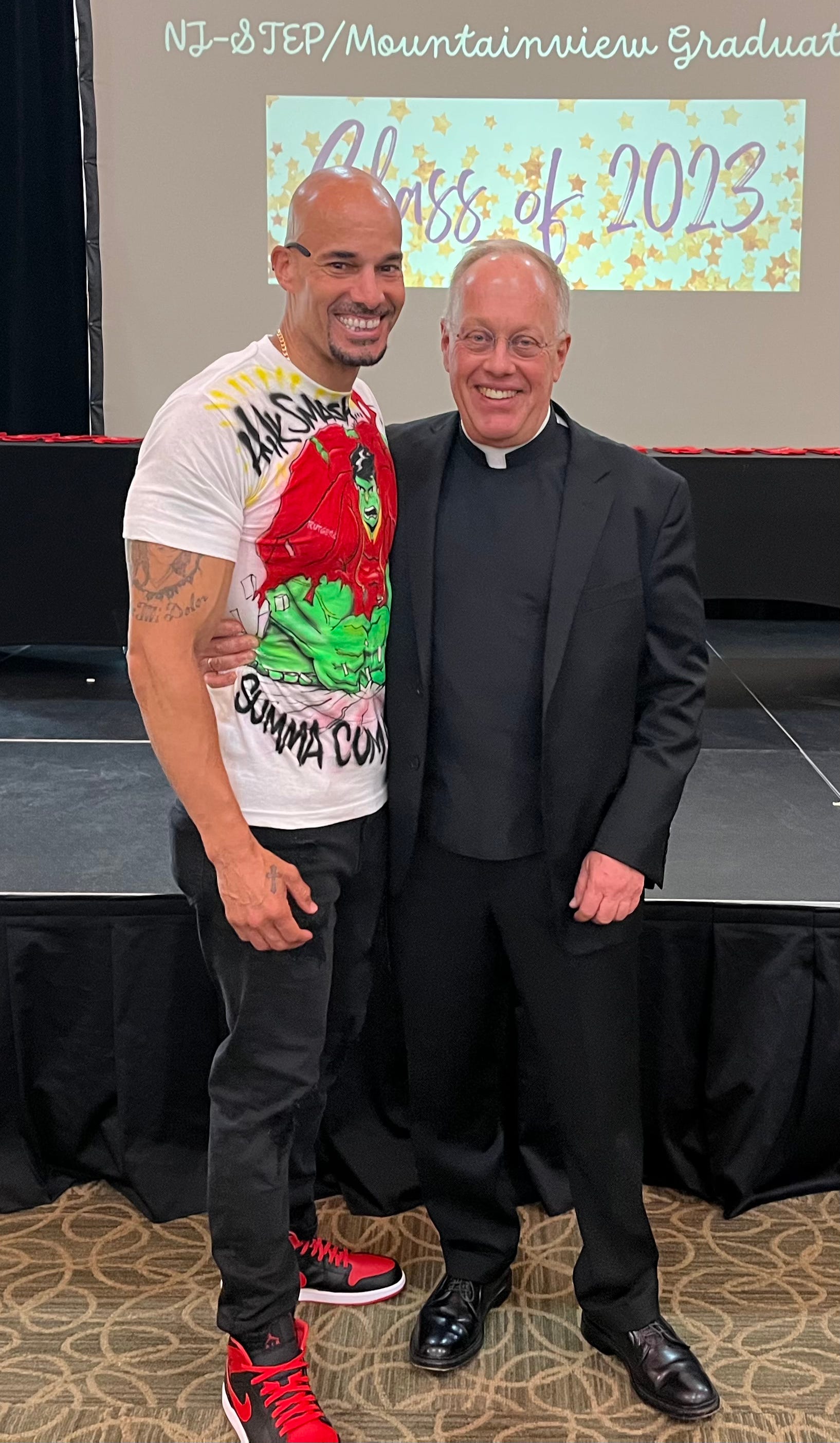
Narrated by Eunice Wong Text originally published May 12, 2023 With Sammy at the graduation ceremony for formerly incarcerated students at Rutgers University in Newark on Friday Newark, N.J. — We know the story. The absent father who leaves when his son is five-years-old and moves back to Puerto Rico. The single mother, rarely at home because she works long hours to keep her three children fed and pay the rent. The poverty. The crime. The instability. Later, the stepfather who drinks, uses drugs and beats his stepchildren. The child acting up. Dropping out of school. Joining a gang. The robberies. The one that went wrong and left a man dead. Prison. The students I teach in prison have variations of the same story. They are funneled into the maw of the prison-industrial-complex, the largest in the world, and spat out decades later, even more lost and traumatized, to wander the streets like ghosts until most, unequipped to survive on the outside and without support, find themselves back in the old familiar cages. But I tell this story because it needs to be told. I tell it because this time the end will be different. This time the system will not win. I tell it because neglected and abused children, no matter what crime they commit, should not be imprisoned as if they were adults. I tell it because we are complicit. I tell it because until we stop investing in systems of control and start investing in people, especially children, nothing will change. It will only get worse. “I come from a very violent childhood,” says Sammy Quiles, who was released from prison after serving a 30-year sentence a few weeks ago. “My mother — once my father was out of the picture — worked and partied. Me and my sisters were relegated to making it on our own or with babysitters. And then when she met my stepfather that was only exacerbated. He was a drunk, drug-abuser and very violent. I was hit with fists, bats, hangers, you name it. It was physical, emotional and verbal abuse.” I taught Sammy in East Jersey State Prison in Rahway, New Jersey, in the Rutgers college degree program. I did not know his story until he was released. I never know the stories of my students. They are not their crime. And years, often decades later, they are not who they were. Sammy, in my classroom, was reserved, determined, hardworking, brilliant and unfailingly courteous. That is who Sammy is. Who he was, to me, is irrelevant. That is not how Sammy was seen as a child, a troubled boy coping with abandonment and terrible abuse. He threw temper tantrums. He could not sit still. He was disruptive. The school system labeled him “emotionally disturbed.” He was placed in special education classes in the second grade. “Decisions were made early on in my life that I would serve the service sector of society,” he says. “I wasn’t taught innovative curriculums. They sent me to woodshop or auto mechanic schools.” He dropped out of school in the 10th grade. At 15 he left home “because the streets seemed safer for me.” “I tried to get fast-food jobs, but I didn’t last long,” he says. “My behavior was erratic, problematic. I didn’t do well with authority and structured environments. I robbed and stole. I became a car thief, a stick-up kid. That’s how I ate.” He found the Latin Kings. “Every government institution abandoned me or punished me for my behavior, but it was a gang member that helped me with homelessness, with putting clothes on my back, putting a few dollars in my pocket, fed me — his family fed me,” he recalls. “I understand today that they exploited my aggressive behavior, but they’re the ones that helped me when I left home. It felt like I had a community. They taught me about my culture. They instilled this pride in me. There was protection.” He was initiated into the Latin Kings in a schoolyard in Lakewood, New Jersey. He had to recite from memory 10 small paragraphs, or lessons, in front of a circle of some 30 gang members. Then each member embraced him. They shot a hand gesture they called “crowns,” their gang greeting. “I felt empowered, I felt accepted, I felt like I had a family,” he says. He swiftly ascended within the ranks of the gang. “I had a knack for learning the lessons, the materials they gave,” he says. “I was very interested in the literature. It was all based on culture and a lot of Puerto Rican history and about revolutionaries and where I come from. And then the aggressive nature — I was very aggressive.” The gang sold cocaine and crack. But he continued working as a “stick up kid” who robbed drug dealers and members in rival gangs. A robbery usually brought in a few hundred dollars that was divided up with other gang members. He often used his portion to buy gifts, such as sneakers, for his two younger sisters. He looked up to older gang members who became surrogate fathers. One of them recruited him to rob a Kentucky Fried Chicken restaurant when he was 17. “My loyalty to this individual warped my judgment,” he says. The manager of the Kentucky Fried Chicken was killed in the robbery, which netted about $3,000. Sammy was arrested and sent to a youth house until he was waived up to an adult court. He was evaluated by a court psychologist who determined he could not be rehabilitated by the age of 19. He was given a 30-year mandatory minimum sentence. Going to jail and prison, he says laughing, was “very easy.” “It’s unbelievable to say that today, as a 47-year-old, but I never felt uncomfortable in prison,” he says.“I was conditioned for that environment. I was rejected by my father. I was not completely loved by my mother. I had a stepfather who physically abused me. I was seen as a criminal before I even committed a criminal act. The school system sent me to special ed, to expulsion, to an alternative school. It was a lifetime of perpetual punishment. When I got to prison, I was like ‘Okay, this is just a normal day for me.’ I wasn’t the elite child who made a mistake. I wasn’t this superstar academic or athlete or any of that.” He was housed in Trenton State Prison’s Vroom wing for those with mental and behavioral issues. Prisoners called it “the terror dome.” “It had the biggest overzealous guards,” he says. “Twenty-three and one lockdown,” meaning he was only out of his cell for one hour each day. “They came around with a little book cart,” he says. “You could get a book if you wanted. You’d be let out into the yard every few days. You’d get a shower every few days, other than that you’re in your cell.” “I read as much as I could get my hands on, a lot of Puerto Rican revolutionary books,” he remembers. “I still read a lot about Albizu Campos and Lolita Lebron and Prisoners of Colonialism. Any time they let us outside, I went outside. I watched a lot of TV.” The prison authorities accused him of being the head of The Latin Kings in the New Jersey prison system, although he says, “I don’t think anyone was really in charge.” He was in his late twenties when he got married in prison to a high school friend. She had a two-year-old daughter. They visited every weekend. “I saw that it’s not just about me anymore,” he says. “I began to change.” His wife and her daughter were his only consistent support on the outside. The marriage lasted until 2015 when she moved to North Carolina. “I had people who would dust me off the shelf and remember me every birthday or a special event,” he says, “but nothing constant.” He decided to leave the Latin Kings when he was in his late twenties. He met fellow gang members in the yard at East Jersey State Prison to announce his decision. “Yo, man this is what it is, my life trajectory is taking me on a different path,” he told them. “I invited them, if they needed to discipline me or something like that, in any way, to bring it on. That was it.” The other gang members let him walk away. He gravitated towards the serious students in the prison, the ones working doggedly in their cramped and claustrophobic cells to get an education, the ones who had turned their cells into li… This is a public episode. If you'd like to discuss this with other subscribers or get access to bonus episodes, visit chrishedges.substack.com/subscribe
Embed this episode
No transcript yet.