Listen to this Article: "The Donald Trump Problem"
from The Chris Hedges Report Podcast Hosted by Chris Hedges
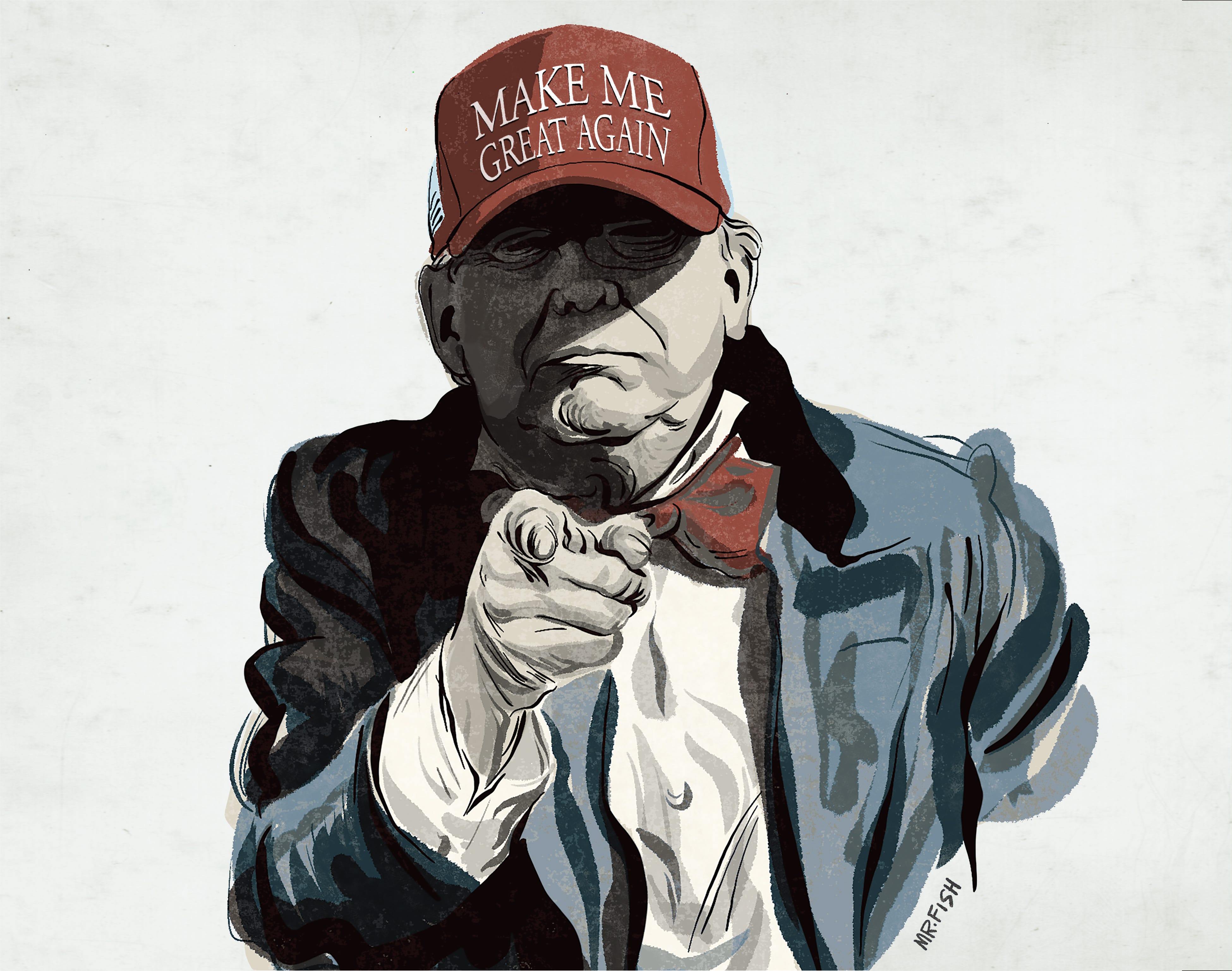
Narrated by Eunice Wong Text originally published March 26, 2023 Make Me Great Again - by Mr. Fish Donald Trump — facing four government-run investigations, three criminal and one civil, targeting himself and his business — is not being targeted because of his crimes. Nearly every serious crime he is accused of carrying out has been committed by his political rivals. He is being targeted because he is deemed dangerous for his willingness, at least rhetorically, to reject the Washington Consensus regarding neoliberal free-market and free-trade policies, as well as the idea that the U.S. should oversee a global empire. He has not only belittled the ruling ideology, but urged his supporters to attack the apparatus that maintains the duopoly by declaring the 2020 election illegitimate. The Donald Trump problem is the same as the Richard Nixon problem. When Nixon was forced to resign under the threat of impeachment, it wasn’t for his involvement in war crimes and crimes against humanity, nor was it for his illegal use of the CIA and other federal agencies to spy upon, intimidate, harass and destroy radicals, dissidents and activists. Nixon was brought down because he targeted other members of the ruling political and economic establishment. Once Nixon, like Trump, attacked the centers of power, the media was unleashed to expose abuses and illegalities it had previously minimized or ignored. Members of Nixon’s re-election campaign illegally bugged the headquarters of the Democratic National Committee in the Watergate office building. They were caught after they broke back into the offices to fix the listening devices. Nixon was implicated in both the pre-election illegality, including spying on political opponents, as well as attempting to use federal agencies to cover up the crime. His administration maintained an “enemies list” that included well known academics, actors, union leaders, journalists, businessmen and politicians. One 1971 internal White House memo entitled, “Dealing with our Political Enemies” — drafted by White House Counsel John Dean, whose job it was to advise the president on the law — described a project designed to “use the available federal machinery to screw our political enemies.” Nixon’s conduct, and that of his closest aides, was clearly illegal and deserving of prosecution. There were 36 guilty verdicts or guilty pleas associated with the Watergate scandal two years after the break-in. But it was not the crimes Nixon committed abroad or against dissidents that secured his political execution but the crimes he carried out against the Democratic Party and its allies, including in the establishment press. “The political center was subjected to an attack with techniques that are usually reserved for those who depart from the norms of acceptable political belief,” Noam Chomsky wrote in The New York Review of Books in 1973, a year before Nixon’s resignation. As Edward Herman and Chomsky point out in their book, “Manufacturing Consent: The Political Economy of the Mass Media:” The answer is clear and concise: powerful groups are capable of defending themselves, not surprisingly; and by media standards, it is a scandal when their position and rights are threatened. By contrast, as long as illegalities and violations of democratic substance are confined to marginal groups or dissident victims of U.S. military attack, or result in a diffused cost imposed on the general population, media opposition is muted and absent altogether. This is why Nixon could go so far, lulled into a false sense of security precisely because the watchdog only barked when he began to threaten the privileged.” What led to the unraveling of Nixon’s government, and what lies at the core of the attacks against Trump, is the fact that, like Nixon, Trump’s targets included “the rich and respectable, spokesmen for official ideology, men who are expected to share power, to design social policy, and to mold popular opinion,” as Chomsky noted about Nixon at the time. “Such people are not fair game for persecution at the hands of the state.” This is not to minimize Trump’s crimes. Trump — nearly even in the polls with President Joe Biden in the 2024 presidential race — appears to have committed several misdemeanors and serious felonies. In November 2022, the Department of Justice appointed a special prosecutor to investigate Trump’s retention of classified documents at his Mar-a-Lago home in Florida and any potential criminal liability resulting from that act, as well as any unlawful interference with the transfer of power after the 2020 presidential election. Separately, a district attorney in Georgia is working with a special purpose grand jury in relation to Trump’s attempts to overturn the 2020 election result. A key piece of evidence is the notorious phone call between Trump and Georgia’s Secretary of State, Brad Raffensperger, in which the president kept insisting he needed more votes to be found. Charges in this case could include conspiracy to commit election fraud, racketeering and pressuring and/or threatening public officials. The Manhattan district attorney has been investigating the $130,000 Trump used to pay off the porn star Stormy Daniels, with whom Trump allegedly had a sexual relationship. This payment was misreported in the Trump Organization’s records as a legal retainer in violation of campaign finance laws. Finally, New York Attorney General Letitia James is bringing a civil lawsuit alleging the Trump Organization lied about its assets in order to secure bank loans. If the attorney general’s lawsuit is successful, Trump and other members of his family may be barred from doing business in New York, including buying property there for five years. Trump’s alleged offenses should be investigated. Though, the cases involving Daniels and the retention of classified documents seem relatively minor and similar to those committed by Trump’s political opponents. Last year, Hillary Clinton’s 2016 campaign and the DNC agreed to pay a fine of $8,000 and $105,000 respectively, for mislabelling a $175,000 expenditure on opposition research, namely the long-discredited “Steele Dossier,” as “legal expenses.” The improper retention of classified documents has typically resulted in a slap on the wrist when other powerful politicians have been investigated. Clinton, for example, used private email servers instead of a government email account when she was secretary of state. The FBI concluded that she sent and received materials classified as top secret on her private server. Ultimately, FBI director James Comey declined to prosecute her. Trump’s former vice president Mike Pence and Biden also had classified documents at their homes, though we are told this may have been “inadvertent.” The discovery of these classified documents, rather than triggering outrage in most of the media, initiated a conversation about “overclassification.” Former CIA director David Petraeus was given two years probation and a $100,000 fine after he admitted to providing highly classified “black books” that contained handwritten classified notes about official meetings, war strategy, intelligence capabilities and the names of covert officers to his lover, Paula Broadwell, who was also writing a fawning biography of Petraeus. As was the case with Nixon, the most serious charges Trump may face involve his attack on the foundations of the two-party duopoly, especially undermining the peaceable transfer of power from one branch of the duopoly to the other. In Georgia, Trump could face very serious criminal charges with potentially lengthy sentences if convicted, likewise if the federal special prosecutor indicts Trump for unlawful interference in the 2020 election. We won’t know until any indictments are made public. Yet, the most egregious of Trump’s actions while in office either received minimal media coverage, were downplayed or lauded as acts carried out in defense of democracy and the U.S.-led international o… This is a public episode. If you'd like to discuss this with other subscribers or get access to bonus episodes, visit chrishedges.substack.com/subscribe
Embed this episode
No transcript yet.