Listen to This Article: "War with Iran"
from The Chris Hedges Report Podcast Hosted by Chris Hedges
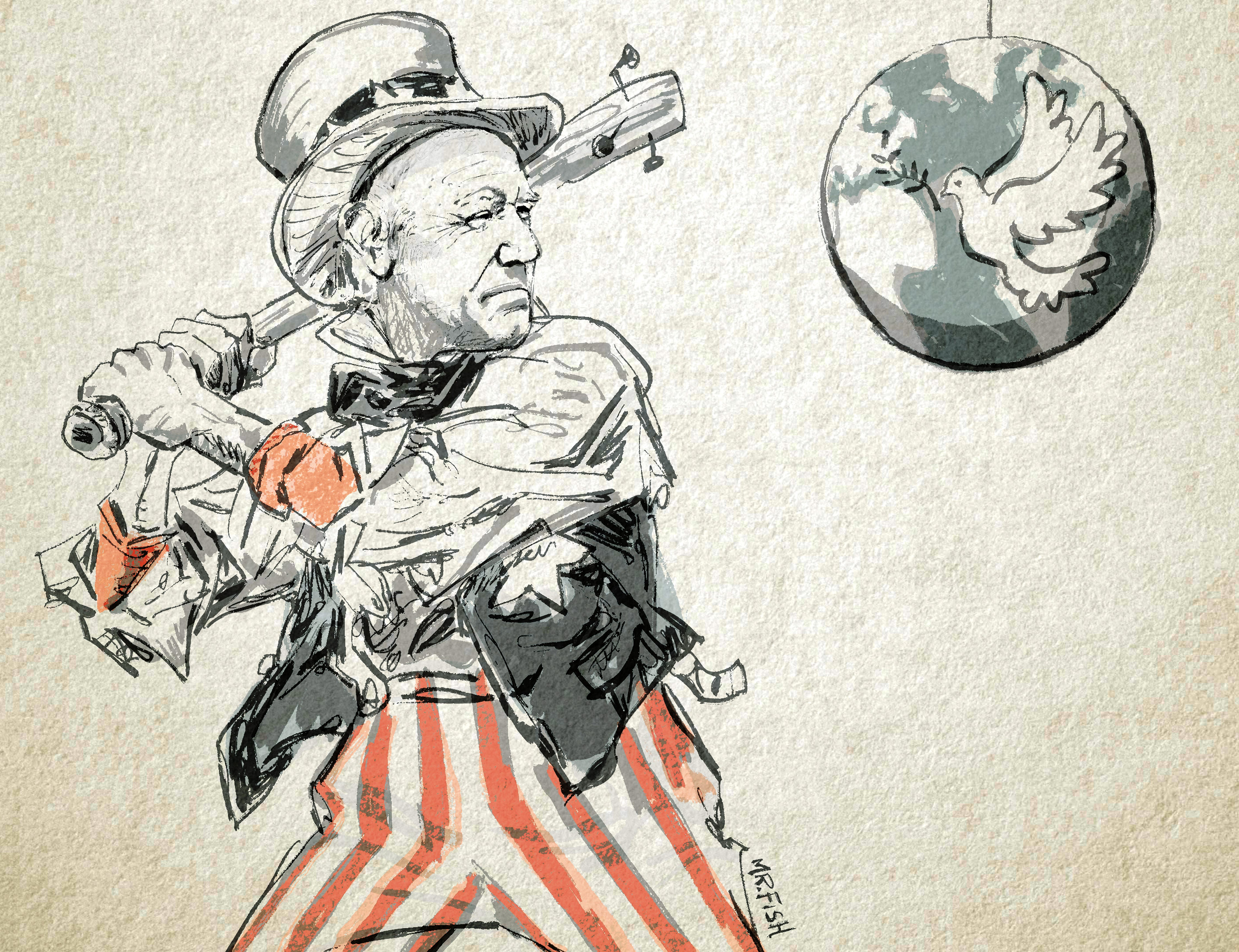
Narrated by Eunice Wong The United States, Israel and Saudi Arabia are plotting a war with Iran. The 2015 Iranian nuclear arms accord, or Joint Comprehensive Plan of Action (JCPOA), which Donald Trump sabotaged, does not look like it will be revived. U.S. Central Command (CENTCOM) is reviewing options to attack if Teheran looks poised to obtain a nuclear weapon and Israel, which opposes U.S.-Iran nuclear negotiations, carries out military strikes. During his visit to Israel, Biden assured Prime Minister Yair Lapid that the U.S. is “prepared to use all elements of its national power,” including military force, to stop Iran from building a nuclear weapon. Saudi Arabia, Israel and the U.S. function as a troika in the Middle East. The Israeli government has built a close alliance with Saudi Arabia, which produced 15 of the 19 hijackers in the September 11 attacks and has been a prolific sponsor of international terrorism, supporting Salafi jihadism, the basis of al-Qaeda, and such groups as the Afghanistan Taliban, Lashkar-e-Taiba (LeT) and the Al-Nusra Front. The three countries worked in tandem to back the 2013 military coup in Egypt, led by General Abdel Fattah al-Sisi, who overthrew its first democratically elected government. He has imprisoned tens of thousands of government critics, including journalists and human rights defenders, on politically motivated charges. The Sisi regime collaborates with Israel by keeping its common border with Gaza closed to Palestinians, trapping them in the Gaza strip, one of the most densely populated and impoverished places on earth. Israel, the only nuclear power in the Middle East, has conducted an ongoing campaign of covert attacks on Iranian nuclear sites and nuclear scientists. Four Iranian nuclear scientists were assassinated, presumably by Israel, between 2010 and 2012. In July 2020, a fire, attributed to an Israeli bomb, damaged Iran’s Natanz nuclear site. In November 2020, Israel used remote control machine guns to assassinate Iran’s top nuclear scientist. In January 2020, the United States assassinated Gen. Qassem Soleimani, the head of Iran’s elite Quds Force, along with nine other people including a key figure in the anti-ISIS coalition, Abu Mahdi al-Muhandis. It used an MQ-9 Reaper to fire missiles into his convoy, near Baghdad’s airport. If similar attacks had been carried out by Iranian operatives inside Israel, it would have triggered a war. Only Iran’s decision not to retaliate, beyond lobbing about a dozen ballistic missiles at two military bases in Iraq, prevented a conflagration. On July 7, Iran informed The International Atomic Energy Agency (IAEA) that it is using IR-6 centrifuges with "modified subheaders.” The declared purpose of the enrichment process at its underground facility at Fordow is to create uranium isotope enriched up to 20 percent—far below the 90 percent enrichment levels necessary to create weapons-grade uranium. Under the JCPOA agreement, enrichment levels were capped at 3.67 percent. Israel has allocated $1.5 billion for a potential strike against Iran and, during the first week of June, held large-scale military exercises, including one over the Mediterranean and in the Red Sea, in preparation to attack Iranian nuclear sites using dozens of fighter aircraft, including Lockheed Martin F-35 fighter jets. The 2016 Memorandum of Understanding signed by President Barack Obama provides a 10-year, $38 billion military package for Israel. Israel and its lobby in the U.S. are working to scuttle negotiations with Iran to monitor its nuclear program. The preparation for war mirrors the Israeli pressure on the U.S. to invade Iraq, one of the worst strategic decisions in U.S. history. Former British Prime Minister Tony Blair, in testimony before the British Iraq war commission, offered this account of his discussions with George W. Bush in Crawford, Texas in April 2002: As I recall that discussion, it was less to do with specifics about what we were going to do on Iraq or, indeed, the Middle East, because the Israel issue was a big, big issue at the time. I think, in fact, I remember, actually, there may have been conversations that we had even with Israelis, the two of us, whilst we were there. So that was a major part of all this. Saudi Arabia, which seeks to dominate the Arab world, severed ties with Iran in 2016 after its embassy in Tehran was stormed by protesters following Riyadh’s execution of Shia cleric Sheikh Nimr al-Nimr. Saudi Arabia, with Chinese help, has built a plant to process uranium ore and acquired ballistic missiles. Saudi Arabia signed a series of letters in 2017 with the U.S. to purchase weapons totaling $110 billion immediately, and $ 350 billion over the next decade. A war with Iran would be a catastrophe of unimaginable proportions. It would spread swiftly throughout the region. The Shiites across the Middle East would see an attack on Iran as a religious war against Shiism. The two million Shiites in Saudi Arabia, concentrated in the oil-rich Eastern province; the Shiite majority in Iraq; and the Shiite communities in Bahrain, Pakistan and Turkey would join the fight against the U.S. and Israel. Iran would use its Chinese-supplied anti-ship missiles, rocket and bomb-equipped speedboats and submarines, mines, drones and coastal artillery to shut down the Strait of Hormuz, the corridor for 20 percent of the world’s oil and liquified gas supply. Oil production facilities in the Persian Gulf would be sabotaged. Iranian oil, which makes up 13 percent of the world’s energy supply, would be taken off the market. Oil would jump to over $500 a barrel and perhaps, as the conflict drags on, to over $750 a barrel. Our petroleum-based economy, already reeling under rising prices because of the sanctions on Russia, would grind to a halt. Israel would be hit by Iranian Shahab-3 ballistic missiles. Hezbollah’s store of Iranian-supplied rockets that allegedly can reach any part of Israel, including Israel’s nuclear plant at Dimona, would also be deployed. Strikes by Iran and its allies on Israel, as well as on American military installations in the region, would leave hundreds, maybe thousands, dead. In 2002, the U.S. military conducted its “most elaborate war game” ever, costing over $ 250 million. Known as the Millennium Challenge, the exercise was between a Blue Force (the U.S.) and the Red Force (widely considered as a stand-in for Iran). It was meant to validate America’s “modern, joint-service war-fighting concepts.” It did the opposite. The Red Force, led by retired Marine lieutenant general Paul Van Riper, conducted a swarm of kamikaze suicide boat attacks and destroyed 16 U.S. warships in under 20 minutes. When the war game was reset, it was rigged in favor of the Blue Force. The Blue Force was given access to experimental technology – including that which doesn’t exist such as airborne laser weapons. Meanwhile, the Red Force was told they weren’t allowed to shoot down the Blue Team’s aircraft, had to keep their offensive weapons in the open and could not use chemical weapons. Even then, the Blue Force could not achieve all of its objectives as Riper unleashed a guerrilla insurgency on the occupying forces. Why shouldn’t Joe Biden be feted by the murderous regime of Saudi Arabia and the apartheid state of Israel? He and the U.S. have as much blood on their hands as they do. Yes, in 2018 the de facto ruler of Saudi Arabia, Mohammed bin Salman, ordered the assassination and dismemberment of my friend and colleague Jamal Khashoggi. Yes, Israel assassinated Palestinian journalist Shireen Abu Akleh. But Washington has more than matched the crimes carried out by Israel and the Saudis, including against journalists. The imprisonment of Julian Assange – who released the collateral murder videoshowing U.S. helicopter pilots laughing as they shot to death two Reuters journalists and a group of civilians in Iraq in 2007 – is designed to destroy Assa… This is a public episode. If you'd like to discuss this with other subscribers or get access to bonus episodes, visit chrishedges.substack.com/subscribe
Embed this episode
No transcript yet.