Listen to this Article: "Why Our Popular Mass Movements Fail"
from The Chris Hedges Report Podcast Hosted by Chris Hedges
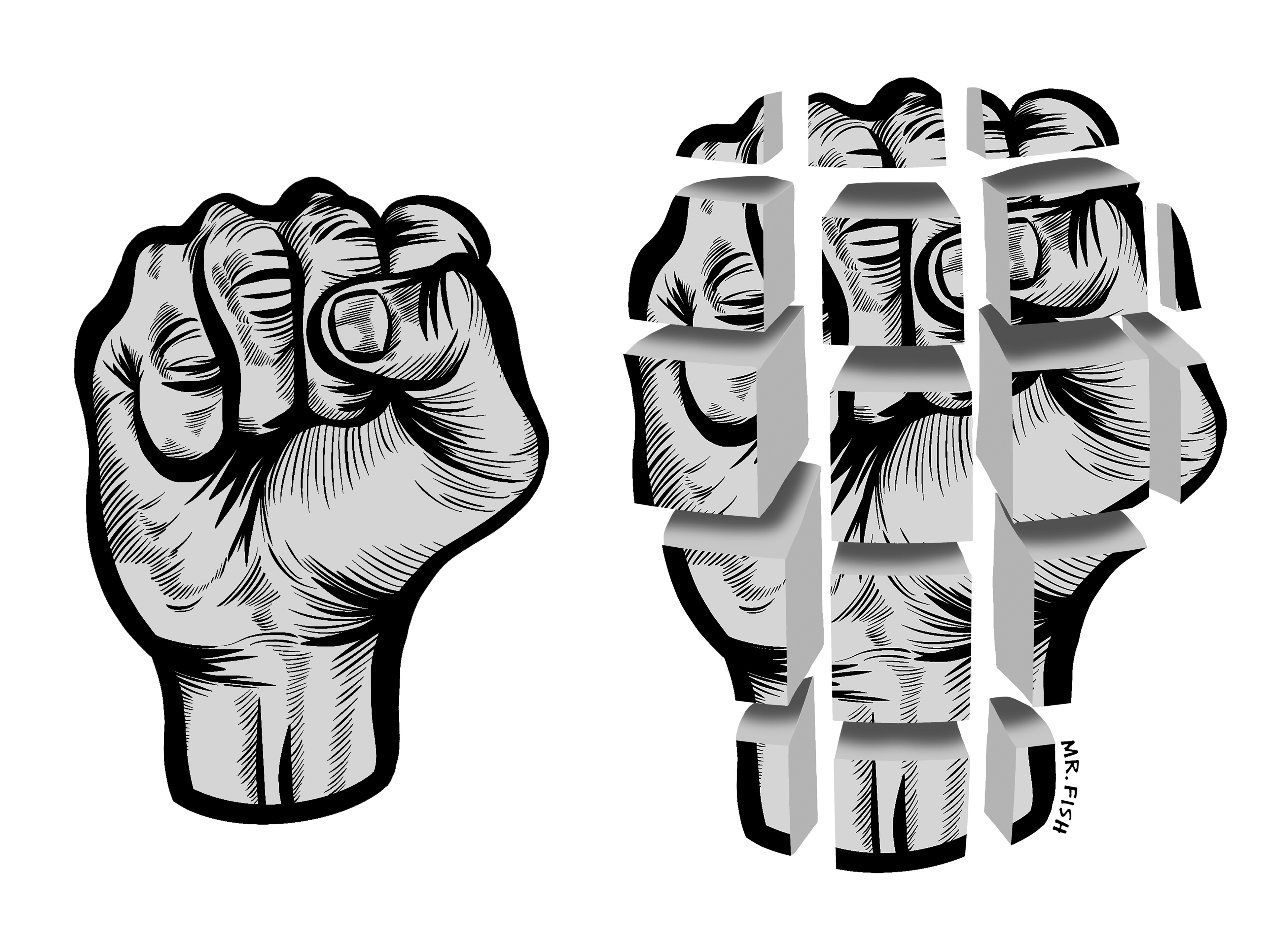
Narrated by Eunice Wong Text Originally published Oct. 1, 2023 Protest (Assemby Required) - by Mr. Fish There was a decade of popular uprisings from 2010 until the global pandemic in 2020. These uprisings shook the foundations of the global order. They denounced corporate domination, austerity cuts and demanded economic justice and civil rights. There were nationwide protests in the United States centered around the 59-day Occupy encampments. There were popular eruptions in Greece, Spain, Tunisia, Egypt, Bahrain, Yemen, Syria, Libya, Turkey, Brazil, Ukraine, Hong Kong, Chile and during South Korea’s Candlelight Light Revolution. Discredited politicians were driven from office in Greece, Spain, Ukraine, South Korea, Egypt, Chile and Tunisia. Reform, or at least the promise of it, dominated public discourse. It seemed to herald a new era. Then the backlash. The aspirations of the popular movements were crushed. State control and social inequality expanded. There was no significant change. In most cases, things got worse. The far-right emerged triumphant. What happened? How did a decade of mass protests that seemed to herald democratic openness, an end to state repression, a weakening of the domination of global corporations and financial institutions and an era of freedom sputter to an ignominious failure? What went wrong? How did the hated bankers and politicians maintain or regain control? What are the effective tools to rid ourselves of corporate domination? Vincent Bevins in his new book“If We Burn: The Mass Protest Decade and the Missing Revolution” chronicles how we failed on several fronts. The “techno-optimists” who preached that new digital media was a revolutionary and democratizing force did not foresee that authoritarian governments, corporations and internal security services could harness these digital platforms and turn them into engines of wholesale surveillance, censorship and vehicles for propaganda and disinformation. The social media platforms that made popular protests possible were turned against us. Many mass movements, because they failed to implement hierarchical, disciplined, and coherent organizational structures, were unable to defend themselves. In the few cases when organized movements achieved power, as in Greece and Honduras, the international financiers and corporations conspired to ruthlessly wrest power back. In most cases, the ruling class swiftly filled the power vacuums created by these protests. They offered new brands to repackage the old system. This is the reason the 2008 Obama campaign was named Advertising Age’s Marketer of the Year. It won the vote of hundreds of marketers, agency heads and marketing-services vendors gathered at the Association of National Advertisers’ annual conference. It beat out runners-up Apple and Zappos.com. The professionals knew. Brand Obama was a marketer’s dream. Too often the protests resembled flash mobs, with people pouring into public spaces and creating a media spectacle, rather than engaging in a sustained, organized and prolonged disruption of power. Guy Debord captures the futility of these spectacles/protests in his book “Society of the Spectacle,” noting that the age of the spectacle means those entranced by its images are “molded to its laws.” Anarchists and antifascists, such as those in the black bloc, often smashed windows, threw rocks at police and overturned or burned cars. Random acts of violence, looting and vandalism were justified in the jargon of the movement, as components of “feral” or “spontaneous insurrection.” This “riot porn” delighted the media, many of those who engaged in it and, not coincidentally, the ruling class which used it to justify further repression and demonize protest movements. An absence of political theory led activists to use popular culture, such as the film “V for Vendetta,” as reference points. The far more effective and crippling tools of grassroots educational campaigns, strikes and boycotts were often ignored or sidelined. As Karl Marx understood, “Those who cannot represent themselves will be represented.” “If We Burn: The Mass Protest Decade and the Missing Revolution,” is a brilliant and masterfully reported dissection of the rise of global popular movements, the self-defeating mistakes they made, the strategies the corporate and ruling elites employed to retain power and crush the aspirations of a frustrated population, as well as an exploration of the tactics popular movements must employ to successfully fight back. “In the mass protest decade, street explosions created revolutionary situations, often on accident,” Bevins writes. “But a protest is very poorly equipped to take advantage of a revolutionary situation, and that particular kind of protest is especially bad at it.” The seasoned activists who Bevins interviews echo this point. “Organize,” Hossam Bahgat, the Egyptian human rights campaigner, tells Bevin in the book. “Create an organized movement. And don’t be afraid of representation. We thought representation was elitism, but actually it is the essence of democracy.” Ukrainian leftist Artem Tidva agrees. “I used to be more anarchist,” Tidva says in the book. “Back then everyone wanted to do an assembly; whenever there was a protest, always an assembly. But I think any revolution with no organized labor party will just give more power to economic elites, who are already very well-organized.” The historian, Crane Brinton, in his book “The Anatomy of Revolution” writes that revolutions have discernable preconditions. He cites discontent that affects nearly all social classes, widespread feelings of entrapment and despair, unfulfilled expectations, a unified solidarity in opposition to a tiny power elite, a refusal by scholars and thinkers to continue to defend the actions of the ruling class, an inability of government to respond to the basic needs of citizens, a steady loss of will within the power elite itself and defections from the inner circle, a crippling isolation that leaves the power elite without any allies or outside support and, finally, a financial crisis. Revolutions always begin, he writes, by making impossible demands that if the government met, would mean the end of the old configurations of power. But most importantly, despotic regimes always first collapse internally. Once sections of the ruling apparatus — police, security services, judiciary, media, government bureaucrats — will no longer attack, arrest, jail or shoot demonstrators, once they no longer obey orders, the old, discredited regime becomes paralyzed and terminal. But these internal forms of control during the decade of protests rarely wavered. They may, as in Egypt, turn on the figureheads of the old regime, but they also worked to undermine popular movements and populist leaders. They sabotaged efforts to wrest power from global corporations and oligarchs. They prevented or removed populists from office. The vicious campaign waged against Jeremy Corbyn and his supporters when he headed the Labour Party during the 2017 and 2019 U.K. general elections, for example, was orchestrated by members within his own party, corporations, the conservative opposition, celebrity commentators, a mainstream press that amplified the smears and character assassination, members of the British military, and the nation’s security services. Sir Richard Dearlove, the former head of MI6, Britain’s secret intelligence service, publicly warned that the Labour leader was a “present danger to our country.” Disciplined political organizations are not, in and of themselves, sufficient, as Greece’s left-wing Syriza government proved. If the leadership of an anti-establishment party is not willing to break free from the existing power structures they will be co-opted or crushed when their demands are rejected by the reigning centers of power. In 2015, “the Syriza leadership was convinced that if it rejected a new bailout, European lenders would buckle in the face of generalized finan… This is a public episode. If you'd like to discuss this with other subscribers or get access to bonus episodes, visit chrishedges.substack.com/subscribe
Embed this episode
No transcript yet.