Listen to this Article: "Writing on War"
from The Chris Hedges Report Podcast Hosted by Chris Hedges
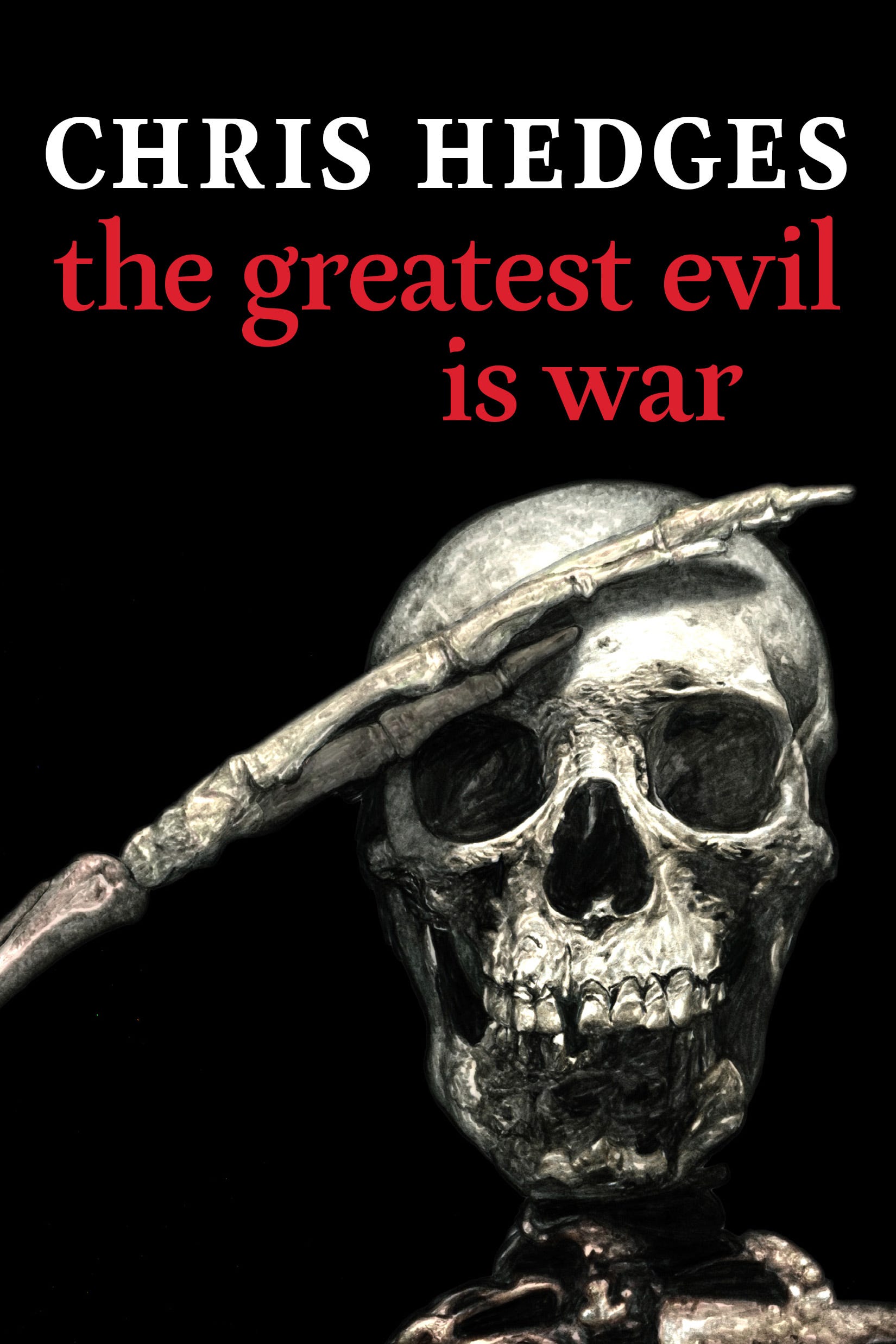
Narrated by Eunice Wong Cover Design by Mr. Fish Writing on War And Living in a World from Hell By Chris Hedges As this century began, I was writing War Is a Force That Gives Us Meaning, my reflections on two decades as a war correspondent, 15 of them with the New York Times, in Central America, the Middle East, Africa, Bosnia, and Kosovo. I worked in a small, sparsely furnished studio apartment on First Avenue in New York City. The room had a desk, chair, futon, and a couple of bookshelves — not enough to accommodate my extensive library, leaving piles of books stacked against the wall. The single window overlooked a back alley. The super, who lived in the first-floor apartment, smoked prodigious amounts of weed, leaving the grimy lobby stinking of pot. When he found out I was writing a book, he suggested I chronicle his moment of glory during the six days of clashes known as the Stonewall Riots, triggered by a 1969 police raid on the Stonewall Inn, a gay club in Greenwich Village. He claimed he had thrown a trash can through the front window of a police cruiser. It was a solitary life, broken by periodic visits to a small antique bookstore in the neighborhood that had a copy of the 1910-1911 Encyclopedia Britannica, the last edition published for scholars. I couldn’t afford it, but the owner generously let me read entries from those 29 volumes written by the likes of Algernon Charles Swinburne, John Muir, T.H. Huxley, and Bertrand Russell. The entry for Catullus, several of whose poems I could recite from memory in Latin, read: “The greatest lyric poet of Rome.” I loved the certainty of that judgment — one that scholars today would not, I suspect, make, much less print. Buy the Book There were days when I could not write. I would sit in despair, overcome by emotion, unable to cope with a sense of loss, of hurt, and the hundreds of violent images I carry within me. Writing about war was not cathartic. It was painful. I was forced to unwrap memories carefully swaddled in the cotton wool of forgetfulness. The advance on the book was modest: $25,000. Neither the publisher nor I expected many people to read it, especially with such an ungainly title. I wrote out of a sense of obligation, a belief that, given my deep familiarity with the culture of war, I should set it down. But I vowed, once done, never to willfully dredge up those memories again. To the publisher’s surprise, the book exploded. Hundreds of thousands of copies were eventually sold. Big publishers, dollar signs in their eyes, dangled significant offers for another book on war. But I refused. I didn’t want to dilute what I had written or go through that experience again. I did not want to be ghettoized into writing about war for the rest of my life. I was done. To this day, I’m still unable to reread it. The Open Wound of War Yet it’s not true that I fled war. I fled my wars but would continue to write about other people’s wars. I know the wounds and scars. I know what’s often hidden. I know the anguish and guilt. It’s strangely comforting to be with others maimed by war. We don’t need words to communicate. Silence is enough. I wanted to reach teenagers, the fodder of wars and the target of recruiters. I doubted many would read War Is a Force That Gives Us Meaning. I embarked on a text that would pose, and then answer, the most basic questions about war — all from military, medical, tactical, and psychological studies of combat. I operated on the assumption that the simplest and most obvious questions rarely get answered like: What happens to my body if I’m killed? I hired a team of researchers, mostly graduate students at Columbia University’s School of Journalism, and, in 2003, we produced an inexpensive paperback — I fought the price down to $11 by giving away any future royalties — called What Every Person Should Know About War. I worked closely on the book with Jack Wheeler, who had graduated from West Point in 1966 and then served in Vietnam, where 30 members of his class were killed. (Rick Atkinson’s The Long Gray Line: The American Journey of West Point’s Class of 1966 is the story of Jack’s class.) Jack went on to Yale Law School after he left the military and became a presidential aide to Ronald Reagan, George H.W. Bush, and George W. Bush, while chairing the drive to build the Vietnam Veterans Memorial in Washington. He struggled with what he called “the open wound of Vietnam” and severe depression. He was last seen on December 30, 2010, disoriented and wandering the streets of Wilmington, Delaware. The next day, his body was discovered as it was dumped from a garbage truck into the Cherry Island Landfill. The Delaware state medical examiner’s office said the cause of death was assault and “blunt force trauma.” Police ruled his death a homicide, a murder that would never be solved. He was buried in Arlington National Cemetery with full military honors. The idea for the book came from the work of Harold Roland Shapiro, a New York lawyer who, while representing a veteran disabled in World War I, investigated that conflict, discovering a huge disparity between its reality and the public perception of it. His book was, however, difficult to find. I had to get a copy from the Library of Congress. The medical descriptions of wounds, Shapiro wrote, rendered “all that I had read and heard previously as being either fiction, isolated reminiscence, vague generalization or deliberate propaganda.” He published his book, What Every Young Man Should Know About War, in 1937. Fearing it might inhibit recruitment, he agreed to remove it from circulation at the start of World War II. It never went back into print. The military is remarkably good at studying itself (although such studies aren’t easy to obtain). It knows how to use operant conditioning — the same techniques used to train a dog — to turn young men and women into efficient killers. It skillfully employs the tools of science, technology, and psychology to increase the lethal force of combat units. It also knows how to sell war as adventure, as well as the true route to manhood, comradeship, and maturity. The callous indifference to life, including the lives of our soldiers, sailors, airmen and marines, leapt off the pages of the official documents. For example, the response to the question “What will happen if I am exposed to nuclear radiation but do not die immediately?” was answered in a passage from the Office of the Surgeon General’s Textbook of Military Medicine that read, in part: Fatally irradiated soldiers should receive every possible palliative treatment, including narcotics, to prolong their utility and alleviate their physical and psychological distress. Depending on the amount of fatal radiation, such soldiers may have several weeks to live and to devote to the cause. Commanders and medical personnel should be familiar with estimating survival time based on onset of vomiting. Physicians should be prepared to give medications to alleviate diarrhea, and to prevent infection and other sequelae of radiation sickness in order to allow the soldier to serve as long as possible. The soldier must be allowed to make the full contribution to the war effort. He will already have made the ultimate sacrifice. He deserves a chance to strike back, and to do so while experiencing as little discomfort as possible. Our book, as I hoped, turned up on Quaker anti-recruitment tables in high schools. “I Am Sullied” I was disgusted by the simplistic, often mendacious coverage of our post-9/11 war in Iraq, a country I had covered as the Middle East bureau chief for the New York Times. In 2007, I went to work with reporter Laila Al-Arian on a long investigative article in the Nation, “The Other War: Iraq Veterans Bear Witness,” that ended up in an expanded version as another book on war, Collateral Damage: America’s War Against Iraqi Civilians. We spent hundreds of hours interviewing 50 American combat veterans of Iraq about atrocities they had witnessed or participa… This is a public episode. If you'd like to discuss this with other subscribers or get access to bonus episodes, visit chrishedges.substack.com/subscribe
Embed this episode
No transcript yet.