
EPISODE · Nov 26, 2025 · 9 MIN
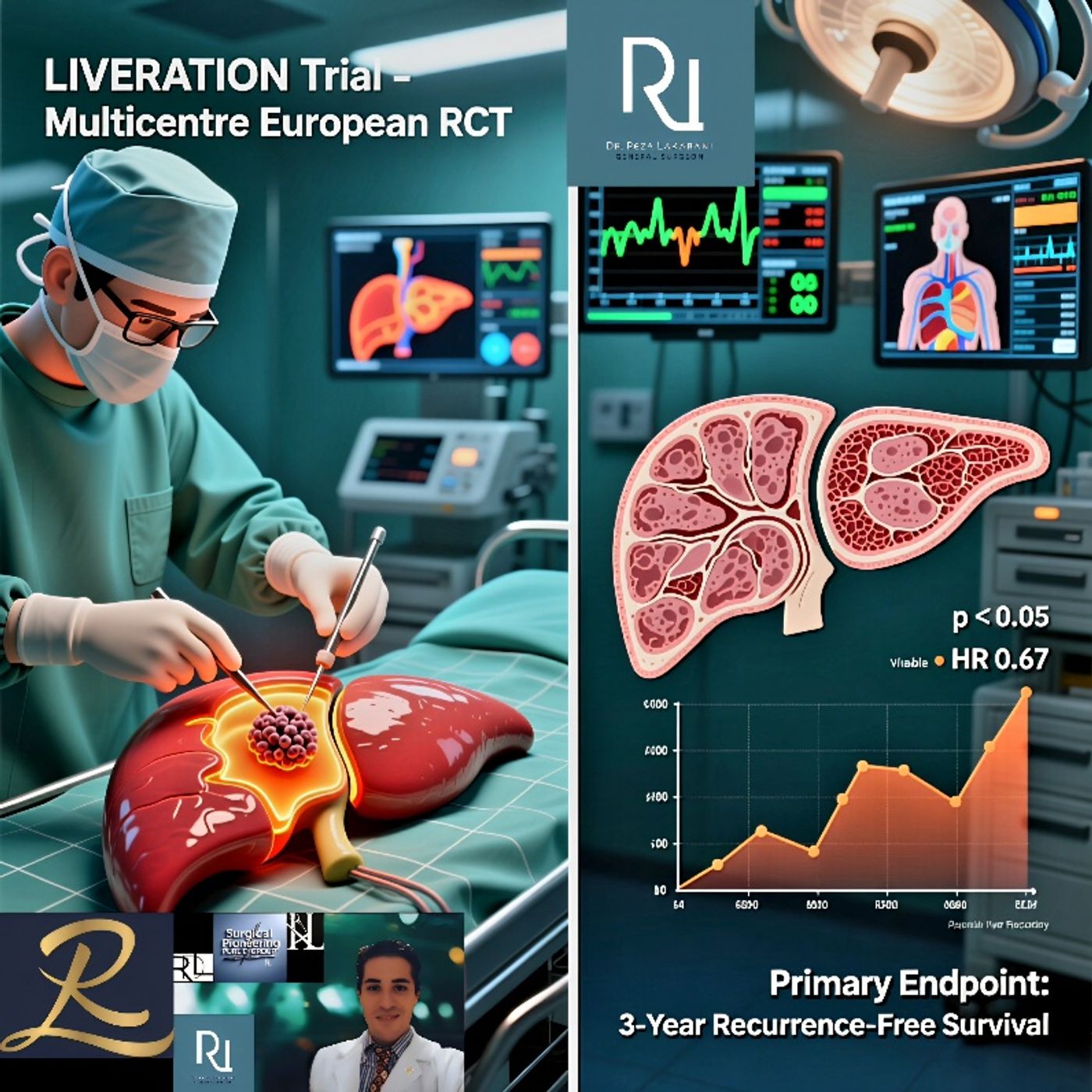
Liveration Trial: A Multicentre European Randomised Study on Radiofrequency Margin Coagulation and Its Impact on Oncological Outcomes
from Surgical Pioneering Podcast · host Dr. Reza Lankarani
Reviewed by Dr Reza Lankarani, General SurgeonFounder | Surgical Pioneering Newsletter and Podcast Series Editorial Board Member | Genesis Journal of Surgery and Medicine- Published online: 13 October 2025 - Citation: Luque Villalobos E et al. BMJ Open 2025;15:e100518.1. OverviewThe LIVERATION trial is a prospective, international, multicentre, single-blind, parallel-group, randomised clinical trial (RCT) funded by the Horizon Europe Programme (Grant 101104360). It aims to determine whether additional margin coagulation (AMC)—using approved radiofrequency (RF) devices (e.g., Coolingbis®, Aquamantys®)—reduces local recurrence (LR) after liver resection for colorectal liver metastases (CRLM) and hepatocellular carcinoma (HCC).- Design: 1:1 randomisation across 24 centres in 7 European countries.- Sample size: 698 patients (518 CRLM, 180 HCC), powered to detect absolute reductions in LR of 6.9% (CRLM: 10.2% → 3.3%) and 15.5% (HCC: 20% → 4.5%).- Primary endpoint: Incidence of LR within 3 years, centrally reviewed on standardized imaging.- Secondary endpoints: Overall survival (OS), disease-free survival (DFS), cancer-specific survival, complications (Clavien-Dindo/CCI), and quality of life (EORTC QLQ-C30/HCC18).- Follow-up: 30/90 days, then annually up to 3 years.- Trial registration: NCT05492136.The trial builds on earlier retrospective work by the same group, notably Villamonte et al. (2022) , which reported reduced LR with AMC, and Quesada et al. (2017) and Sui et al. (2019) , showing promising signals for RF-assisted transection and Aquamantys®, respectively.--- 2. Critical Assessment: Strengths and Weaknesses ✅ Strengths ⚠️ Weaknesses / Limitations--- 3. Comparative Analysis with Recent LiteratureBelow is a comparison of key AMC/RF-related studies: - LR rate (%) by intervention type: - Conventional resection (historical): ~10–20% (CRLM), ~20% (HCC) 1,28 - RF-assisted transection (Quesada): ~6.7% (CRLM) - Aquamantys® margin treatment (Sui): ~7.6% (HCC) - AMC (Villamonte): ~7.5% (mixed) - LIVERATION (target): 3.3% (CRLM), 4.5% (HCC) — most ambitious reduction yet proposed. ✅ LIVERATION’s contribution: - First trial powered to detect clinically meaningful LR reduction. - First to include both CRLM and HCC under unified AMC hypothesis. - First to integrate PROs + health economics into core endpoints.--- 4. Final Commentary 🔬 Expert OpinionThe LIVERATION trial represents a landmark effort in surgical oncology. It addresses a long-standing clinical dilemma: What to do when achieving a wide resection margin (1 cm) is anatomically or physiologically impossible? Surgeons have intuitively applied RF to "sterilise" narrow margins—but until now, lacked level I evidence.If positive, LIVERATION could redefine R0 criteria, shifting focus from anatomic width to functional adequacy of the margin—potentially expanding resectability for borderline cases. 🔮 Future Directions- If AMC proves effective, next steps include: - Biomarker studies (e.g., ctDNA clearance post-AMC). - Integration with neoadjuvant systemic therapy. - Expansion to intraoperative ablation of satellite lesions.- If negative, it will prompt re-evaluation of RF’s biological mechanism—e.g., whether thermal depth is insufficient to eradicate microscopic extensions.--- 🌟 Plain-Language Summary for Patients & General Public "When liver cancer—or cancer that has spread to the liver from the colon—is removed by surgery, doctors aim to cut out not just the visible tumour, but also a rim of healthy tissue around it. This 'safety margin' helps prevent the cancer from coming back right where it was removed (called local recurrence). But sometimes, due to the tumour’s location near vital blood vessels or because the remaining liver would be too small, surgeons can’t safely leave a wide margin. This study tests a simple idea: after the tumour is removed, gently 'seal' the cut surface of the liver with a special tool that uses controlled heat (like a precise, safe microwave). Think of it as giving the edge an extra layer of protection. The goal is to see whether this extra step can lower the chance of the cancer returning at the surgery site—especially for patients where a wide margin isn’t possible. Over 690 patients across Europe are helping answer this question. If it works, this could become a new standard step in liver surgery—helping more patients stay cancer-free, without needing more complex operations."---To access additional details, please refer to the Surgical Pioneering Podcast Series application available at the following link:https://Surgicalpioneer.codeadx.meBecome a supporter of this podcast: https://www.spreaker.com/podcast/surgical-pioneering-podcast--6733149/support.Dr. Reza Lankarani, a surgeon and musician, has released a new album showcasing a diverse range of musical styles, from soulful ballads to high-energy tracks. His music, available on iOS and Android platforms, is characterized as a deeply personal exploration, reflecting his unique perspectives as both a medical professional and a dedicated artist.Lankarani's music is described as a powerful exploration of identity, self-expression, and the struggle against societal expectations, blending various genresincluding folk, rock, and even jazz fusion.Reza Lankarani's music offers a compelling exploration of the struggle for self-identity in the face of societal pressures, employing powerful metaphors of masks and chisels to represent the inherent pain of conformity. His compositions reveal the internal conflict between externally imposed roles and one's authentic self, underscoring the universal experience of feeling constrained by external judgments. Ultimately, however, Lankarani's music celebrates resilience and the reclamation of personal narrative, affirming the transformative power of self-discovery and authenticity. Through evocative imagery and profound emotional depth, his songs provide a transformative journey toward self-actualization within a society that often seeks to define us.
Embed this episode
What this episode covers
Reviewed by Dr Reza Lankarani, General Surgeon Founder | Surgical Pioneering Newsletter and Podcast Series Editorial Board Member | Genesis Journal of Surgery and Medicine - Published online: 13 October 2025 - Citation: Luque Villalobos E et al. BMJ Open 2025;15:e100518. 1. Overview The LIVERATION trial is a prospective, international, multicentre, single-blind, parallel-group, randomised clinical trial (RCT) funded by the Horizon Europe Programme (Grant 101104360). It aims to determine whether additional margin coagulation (AMC)—using approved radiofrequency (RF) devices (e.g., Coolingbis®, Aquamantys®)—reduces local recurrence (LR) after liver resection for colorectal liver metastases (CRLM) and hepatocellular carcinoma (HCC). - Design: 1:1 randomisation across 24 centres in 7 European countries. - Sample size: 698 patients (518 CRLM, 180 HCC), powered to detect absolute reductions in LR of 6.9% (CRLM: 10.2% → 3.3%) and 15.5% (HCC: 20% → 4.5%). - Primary endpoint: Incidence of LR within 3 years, centrally reviewed on standardized imaging. - Secondary endpoints: Overall survival (OS), disease-free survival (DFS), cancer-specific survival, complications (Clavien-Dindo/CCI), and quality of life (EORTC QLQ-C30/HCC18). - Follow-up: 30/90 days, then annually up to 3 years. - Trial registration: NCT05492136. The trial builds on earlier retrospective work by the same group, notably Villamonte et al. (2022) , which reported reduced LR with AMC, and Quesada et al. (2017) and Sui et al. (2019) , showing promising signals for RF-assisted transection and Aquamantys®, respectively. --- 2. Critical Assessment: Strengths and Weaknesses ✅ Strengths ⚠️ Weaknesses / Limitations --- 3. Comparative Analysis with Recent Literature Below is a comparison of key AMC/RF-related studies: - LR rate (%) by intervention type: - Conventional resection (historical): ~10–20% (CRLM), ~20% (HCC) 1,28 - RF-assisted transection (Quesada): ~6.7% (CRLM) - Aquamantys® margin treatment (Sui): ~7.6% (HCC) - AMC (Villamonte): ~7.5% (mixed) - LIVERATION (target): 3.3% (CRLM), 4.5% (HCC) — most ambitious reduction yet proposed. ✅ LIVERATION’s contribution: - First trial powered to detect clinically meaningful LR reduction. - First to include both CRLM and HCC under unified AMC hypothesis. - First to integrate PROs + health economics into core endpoints. --- 4. Final Commentary 🔬 Expert Opinion The LIVERATION trial represents a landmark effort in surgical oncology. It addresses a long-standing clinical dilemma: What to do when achieving a wide resection margin (1 cm) is anatomically or physiologically impossible? Surgeons have intuitively applied RF to "sterilise" narrow margins—but until now, lacked level I evidence. If positive, LIVERATION could redefine R0 criteria, shifting focus from anatomic width to functional adequacy of the margin—potentially expanding resectability for borderline cases. 🔮 Future Directions - If AMC proves effective, next steps include: - Biomarker studies (e.g., ctDNA clearance post-AMC). - Integration with neoadjuvant systemic therapy. - Expansion to intraoperative ablation of satellite lesions. - If negative, it will prompt re-evaluation of RF’s biological mechanism—e.g., whether thermal depth is insufficient...
Ready to play
Liveration Trial: A Multicentre European Randomised Study on Radiofrequency Margin Coagulation and Its Impact on Oncological Outcomes
No transcript for this episode yet
Similar Episodes
No similar episodes found.
Similar Podcasts
No similar podcasts found.