
EPISODE · Apr 12, 2026 · 18 MIN
LLM Evaluation as Tensor Completion: Low-Rank Efficiency and Uncertainty Quantification
from Best AI papers explained · host Enoch H. Kang
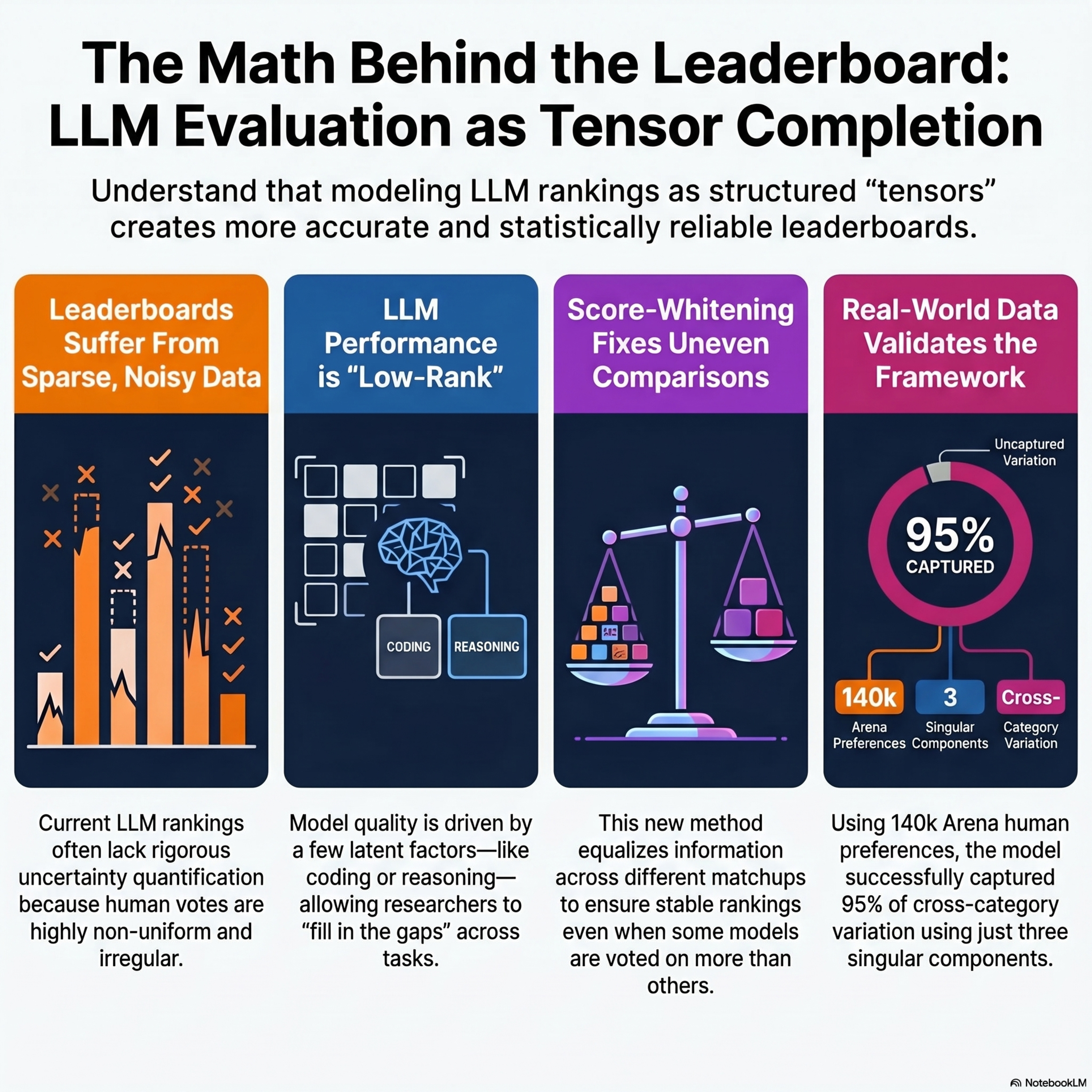
This paper introduces a rigorous statistical framework for evaluating Large Language Models (LLMs) by treating the problem as a low-rank tensor completion task. The researchers address the challenges of chatbot leaderboards, such as those on platforms like Chatbot Arena, which rely on noisy and sparse human preference data from pairwise model comparisons. By assuming that model performance across various tasks and contexts is driven by a small number of latent factors, the authors demonstrate how to "borrow strength" across categories to improve accuracy. They develop semiparametric efficiency bounds and a debiased one-step estimator to provide reliable confidence intervals and uncertainty quantification for model rankings. To resolve technical bottlenecks caused by non-uniform sampling, they introduce a score-whitening method that stabilizes inference across heterogeneous matchups. Their findings offer a principled approach to constructing more robust, statistically sound leaderboards for the rapidly evolving field of AI evaluation.
Embed this episode
Ready to play
LLM Evaluation as Tensor Completion: Low-Rank Efficiency and Uncertainty Quantification
No transcript for this episode yet
Similar Episodes
No similar episodes found.