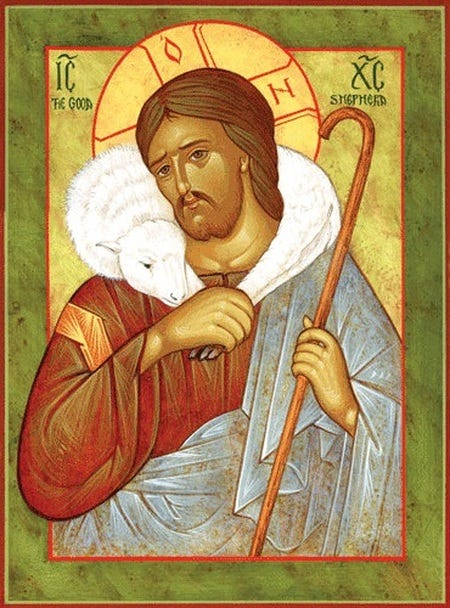
Lord, I Am Their Shepherd
from Speakeasy Theology Hosted by Chris EW Green
Reflections on the Readings for Good Shepherd Sunday. We begin with the Gospel (John 10:22-30) in the name of the Father, Son, and Holy Spirit. I want to focus on the final lines of the reading: My sheep hear my voice. I know them, and they follow me. I give them eternal life, and they will never perish. No one will snatch them out of my hand. What my Father has given me is greater than all else, and no one can snatch it out of the Father's hand. The Father and I are one." From these lines, I want to attend to the oddity of one detail: Jesus says that what his Father has given him is “greater than all else”—the realest of all realities. And he insists that no one can snatch it out of the Father’s hand. Consider that claim for a moment. What has been given to him is still kept for him. What is kept for him is what has been given to him. What is his is his. What is his is his because it is the Father’s. What he has received as his own remains in his Father’s care for him as Son. And because it remains in the Father’s care for him, what he receives is truly his, truly his own. What does this mean? It does not mean that the Father continues to clutch at what he has given, to hold it “over” the Son as leverage. The Father does not cling to the Son any more than the Son grasps at his equality with the Father. No, the gift the Father gives is given in such a way that it is securely the Son’s. Jesus is who he is because of how he is loved by the Father. And it is that love, which is greater than all else, that holds the Son in such a way that he is freed to be fully, excessively, abundantly himself. Precisely as the one so loved, Jesus loves us and shares with us his eternal life. Precisely as the one so held, he cannot be snatched out of the Father’s hand and we cannot be snatched out of his. In Revelation 7, John the Revelator sees a throng, all robed in white. He is asked who they are and where they’ve come from, but he is wise enough to admit he doesn’t know. He is told, "These are they who have come out of the great ordeal; they have washed their robes and made them white in the blood of the Lamb. For this reason they are before the throne of God,and worship him day and night within his temple,and the one who is seated on the throne will shelter them. They will hunger no more, and thirst no more;the sun will not strike them,nor any scorching heat; for the Lamb at the center of the throne will be their shepherd,and he will guide them to springs of the water of life, and God will wipe away every tear from their eyes." Notice, these white-robed overcomers are thronged before the throne. They are praised for worshipping within God’s temple. And for this reason, they are assured they will be sheltered by the One Seated on the Throne. But we know from John’s Gospel that Jesus’ body is the temple. So, we know that it is in him that these saints shall be sheltered. Again and again, including at the beginning of this reading, John has spoken of the Lamb as standing before or beside the throne, in the presence of the One Seated on the Throne. Now, however, John hears him named as the one standing at the center of the throne. What has happened? The Father, the One Seated on the Throne, has made room for the Lamb in his rule, his reign. Jesus has been sheltered and just in that way has become a shelter, the Father’s shelter. Earlier in the Apocalypse, he promised that those who overcome would be granted to sit with him on his throne. So, what we have described in Revelation 7 is the fulfillment of that promise. These overcomers are being moved to and into the center of the throne of God, made to share in God’s joy in being Christ’s and Christ’s joy in being God’s. The Lamb, the one who now stands with the Father at the center of the throne, is the one who shepherds us. The shepherd is himself a sheep. The messiah, the king, has been kind to us by become one of our kind, by making himself our kin. The creator has become a creature without in any way changing what it means for him to be creator. And in so doing he has changed forever everything about what it means for us to be creatures. He has become one of our kind, making us his kin, so we can share in his kingdom as co-heirs and co-regents, kinging with him. As the Father shepherded the Son, so the Son shepherds us. And we are as secure in him as he is in his Father. We cannot be snatched away from him any more than he can be sundered from the Father and the Spirit. John 1 makes clear that Jesus’ own human life, his creaturely liveliness, the liveliness which came alive in him in the beginning, is nothing but the Father’s gift. And that life, that liveliness, is what Jesus has shared with us. The Father has made room for the Son. And the Son has made room for us—and all of that is realized by the Spirit who is the roominess of God. Once we’ve gotten some sense of this logic, we can begin to hear Psalm 23 as promising not a good life, and anything but what we’ve been told is the good life, but a share in God’s life. The “right pathways” along which we are shepherded are the pathways opened up within God’s life with God. To be led by Jesus, to be shepherded by him, is to be caught up in the flow of his Spirit-enlivened communion with the Father, to be borne along with him and in him by the giddy giving and receiving that the eternal Spirit eternally makes possible. The Psalm begins with a profession: “The Lord is my shepherd.” In these opening lines, the psalmist speaks of God in the third person. He speaks about God. Suddenly, however, at the heart of the Psalm, he begins to speak to God: “you are with me.” What has changed? He has been led away from the still waters and green pastures down into the dark valley. His suffering has turned his profession into prayer. Now, I want to be as clear as I can: God does not bring suffering on us. God does not want us to suffer. Suffering, in itself, does no good for us. But God does bring the suffering ones to us, and God leads us to them. God does not want us to go through suffering. But God does want the suffering to go through us. God is the God of the suffering. God is the God who suffers with and in the suffering. So, if we are to know God as God is, if we are to become one with God as God wants us to be, then we cannot not suffer with God alongside those who’re hurting. Jesus is a guest who stays only in the house of the wounded. So, we cannot be with him unless we are willing to be with them. There is no other way to know God. There is no other God to know. We need to remember this, too: the shadow in the valley of death is cast by the wounded body of Jesus, hanging on that tree. The darkness of his sorrows is the deepest darkness, a darkness so deep it’s luminous. So, if we can learn to be at peace in the shadow of his body, suspended on the cross, then we can be at peace in any shadow, even the shadow of other deaths. In fact, we can learn to be even more at peace there, in that darkness, than we ever were beside the still waters. But we can learn that only after our professions, our declarations, have been shattered into desperate prayer. Anyone can speak of God in the third person. Indeed, everyone does! Wolves do that, as well as sheep. Hirelings do that, as well as shepherds. But what we need, obviously, especially in times like these, is to allow the good shepherd to lead us into the vicinity of those who’re suffering—especially those whom we think deserve their suffering—so we become so sick of what we’ve being saying about God that we have no choice but to speak to him on their behalf—and to listen to what he’s saying not about us, even less about others, but to us about ourselves for their sake. Then, and only then, we will find we have been led through the darkness into a new light: “You spread a table before me in the presence of those who trouble me.” Why? So we will make room for our enemies at his table, as he has made room for us on his throne. So we can serve the… This is a public episode. If you'd like to discuss this with other subscribers or get access to bonus episodes, visit cewgreen.substack.com/subscribe
Embed this episode
No transcript yet.