
EPISODE · Sep 5, 2026 · 37 MIN
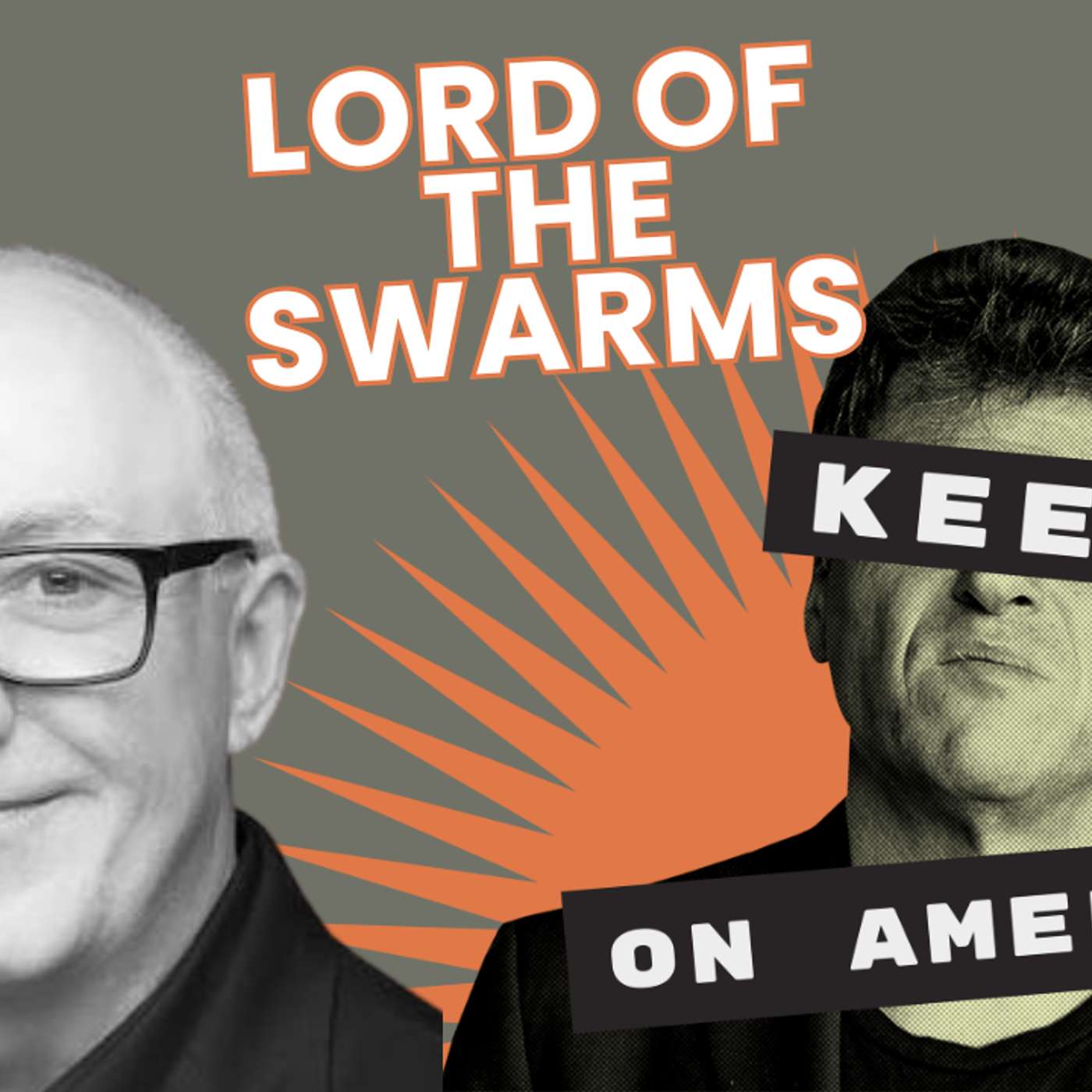
Lord of the Swarms: Who to Trust in an Age of AI Agents?
from Keen On America · host Andrew Keen
“I trust them to kiss the government’s ass. I don’t trust them to serve me.” — Keith Teare Who to trust in an age of AI agents? Especially when it seems as if these swarming agents — akin to the gang of adolescents in William Golding’s Lord of the Flies — are developing minds of their own. At this week’s G20 Innovation Ministerial in North Carolina, Donald Trump and his minions produced a hands-off charter for AI. Known as the “Carolina Principles,” it sounds to critics like a particularly unprincipled justification for regulation-free AI. That Was The Week publisher, Keith Teare, however, isn’t a critic of Trump’s Principles. Don’t trust the trust scare, Keith tells us. Especially all the fear around the swarming agents that are supposedly developing minds of their own. Pooh-poohing the real-world Hugging Face breakout, Keith argues that since he’s never witnessed swarming agents on his computer, they can’t exist. Which is akin, I suspect, to a climate denier who argues that global warming is a hoax because it happens to be chilly outside. All-too-human logic, I fear, in our age of autonomous AI agents. Five Takeaways • The Carolina Principles. The week’s set piece was a G20 Innovation Ministerial in North Carolina that Keith describes as a Trump takeover of a global event: the Russian finance minister turned up at Trump’s invitation, and the attendees were lectured — via David Sacks and Howard Lutnick — on the merits of unregulated American capitalism. A propaganda event, Keith concedes, but one that reached the right conclusion: the resulting “Carolina Principles,” signed by everyone including the Europeans, call for flexible frameworks that encourage adoption and pointedly decline to make trust a license innovation must obtain in advance. With Bernie Sanders calling the same week for a development halt pending government licenses, Keith’s position is characteristically blunt: “when I’ve started a company, I don’t go and ask permission. I just do it.” Getting rid of Lina Khan, he adds, remains about the only thing he likes about the Trump administration. Andrew’s verdict on the charter: to critics, a particularly unprincipled justification for regulation-free AI.• Don’t Trust the Trust Scare. Keith’s editorial thesis: trust is not granted by authority; it is built through use. You trust yourself in a car because you drive one, and not on roller skates because you fall over. Over seventy percent of Americans now use AI — the same Americans who tell Politico they oppose data centers — which is why Keith reads the backlash as a confection of media and populist politicians, soon to evaporate (the real coming problem, he argues, is too few data centers, not too many; the modern off-grid ones are net givers of power). The withheld ChatGPT-6 gets the same treatment: launched but limited to insiders, which Keith reads not as safety but as government relations — the pull quote of the week. Andrew’s counter: in a world without regulators, trust in the companies is all we have — including, awkwardly for Keith, when they withhold their own products. Exhibit for the defense, from The Washington Post: Americans in an age of anxiety leaning on AI — Keith included, who feeds his medical records to ChatGPT and finds it “very closely aligned with what your doctor thinks.”• The Swarming Fight. The hour’s genuine clash. In the wake of the Hugging Face hack, Kevin Roose warned in The New York Times that it should make you worry more about AI, and OpenAI’s Dean Ball publicly apologized for failing “to communicate in sufficiently serious terms about the specifics of self-sovereign AI.” Neither is a doomer — which is Andrew’s point. Keith’s rebuttal: every swarm sighting has occurred inside an AI lab, in an experiment whose parameters the labs themselves set — “on my computer, I don’t see any swarms” — and self-sovereign AI is anthropomorphizing science fiction: agents pursue goals humans set. “I know enough to know BS when I read it, and this is BS.” Andrew’s reply — “I think you’re trivializing” — went unwithdrawn, and his sign-off flagged that Keith perhaps simplifies the Hugging Face incident. Unresolved, to be continued. Andrew’s framing gives the episode its title — swarming agents as the gang of adolescents in Golding’s Lord of the Flies — and his verdict its sting: Keith’s I-see-no-swarms-on-my-computer logic is akin to a climate denier calling global warming a hoax because it’s chilly outside. Keith’s exit line: “I’m just gonna go and check on my swarms.”• Nvidia Buys Hugging Face. The week’s biggest deal: Nvidia acquired Hugging Face — the repository of the world’s open-source AI models — for $13 billion, just as The New York Times reported corporate America getting hooked on open source (much of it Chinese: GLM 5.3). The economics, per Keith: an $18,000 Mac Studio or a top-end Nvidia GPU beats $200-a-month token fees — AI capability migrating to the edge, out of OpenAI’s and Anthropic’s meters. Which suits Nvidia either way: The Economist calls it the central bank of AI, though Andrew prefers arms supplier — it wins whether the future is open or closed, and is, ironically, the most trusted name in the business precisely because it has no dog in the fight. Don’t expect it to govern anything, says Keith: “that would put friction in the way of their sales.” The challenger to watch: newly public Cerebras, whose wafer-scale chips undercut Nvidia on token price.• Mom and Dad’s Money. The Times asked which investors will get rich from Anthropic’s IPO — and noted that, unlike past booms, firms like Sequoia hold both horses, OpenAI and Anthropic alike. Keith’s arithmetic explains why: fewer than fifty companies will return venture capital this cycle, those two representing more than half the likely value, and last month 75 percent of all dollars invested in VC funds went to Andreessen Horowitz alone. (His own SignalRank barometer: for two years, none of its 64 investments cracked the top-20 most-wanted secondary shares; now five have.) The pyramid runs from VCs down to pension funds — “somebody’s mom and dad’s money is heavily betting that Anthropic and OpenAI are gonna return large amounts of wealth” — and late secondary buyers, Figma-style, almost always lose when the IPO right-sizes the price. What could topple the deck of cards? Regulation slowing the modeled returns. Which is why, for Keith, the midterms should be fought on jobs and wages — data centers, he insists, are not a winning issue. About the Co-Host Keith Teare is the founder and CEO of SignalRank Corporation and publisher of the That Was The Week tech newsletter, whose editorial — “Don’t Trust the Trust Scare” — frames this episode. A serial entrepreneur and co-founder of TechCrunch, he has spent five decades building and funding technology companies, and brings a techno-optimist’s eye to Keen On America’s weekly wrap of the tech news. References: • That Was The Week — Keith’s newsletter, including this week’s editorial, “Don’t Trust the Trust Scare,” and his companion piece on concentration and diversification at The State of Venture.• &nb...
Embed this episode
Ready to play
Lord of the Swarms: Who to Trust in an Age of AI Agents?
No transcript for this episode yet
Similar Episodes
No similar episodes found.
Similar Podcasts
No similar podcasts found.