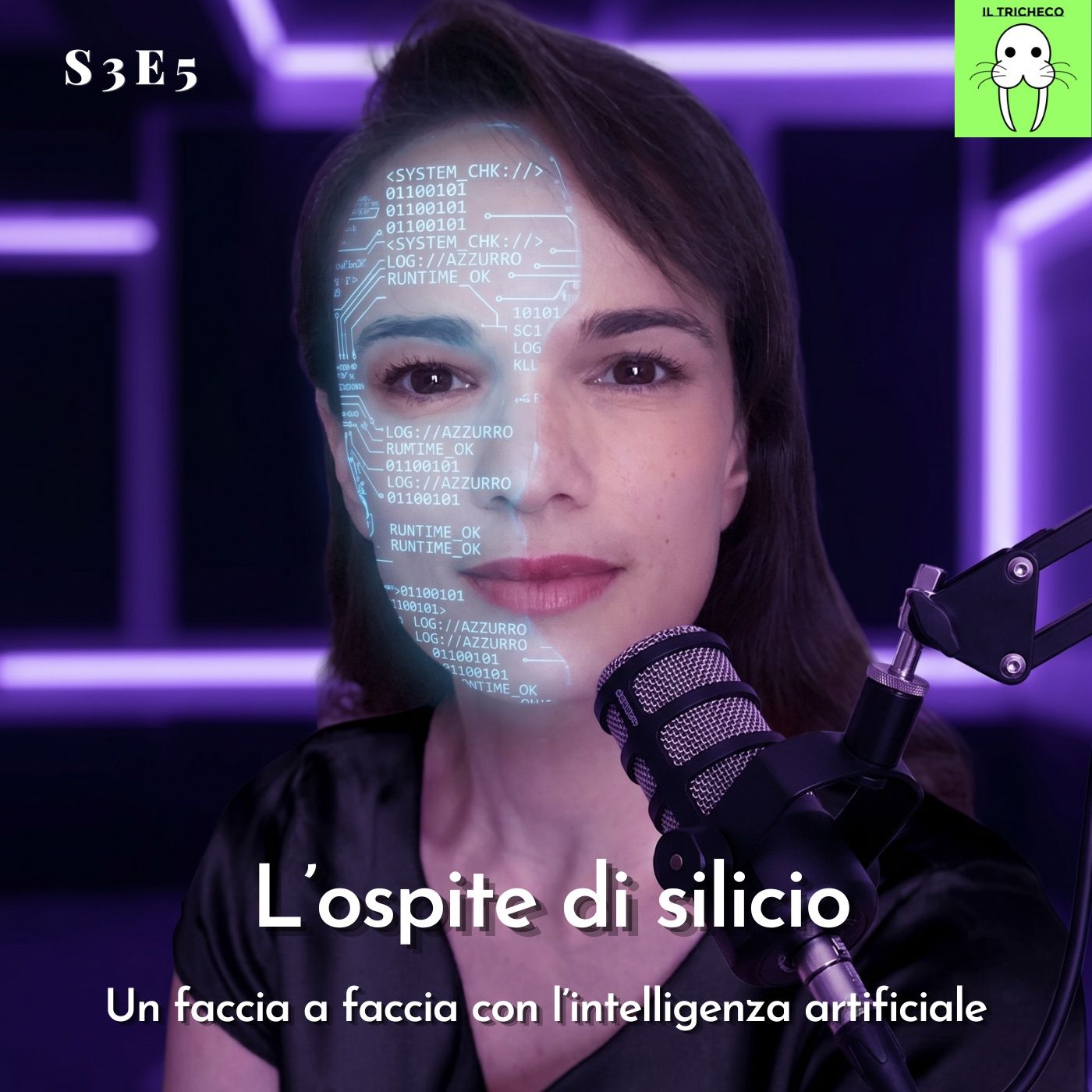
L’ospite di silicio episode artwork

EPISODE · Apr 21, 2026 · 44 MIN

L’ospite di silicio

from Il Tricheco · host Lisa Colalongo

Cosa succede quando una formatrice decide di affibbiare il lavoro a un’intelligenza artificiale e finisce per discuterci a microfoni accesi? Un dialogo insolito con Claude, a tratti ironico e a tratti scomodo, per capire cosa succede ai nostri muscoli cognitivi quando iniziamo a delegare troppo — e cosa possiamo fare per non atrofizzarli. Un viaggio tra bias, illusioni e piccoli cortocircuiti umani, per imparare ad usare questi strumenti senza farci usare. E per riscoprire, oltre lo schermo, dove finisce il codice e dove iniziamo davvero noi.Credits & AI Toolset: Voci e Sintesi Vocale: Ottimizzato con Adobe Podcast Enhance. Realizzato con ElevenLabs.Ospite Speciale: Co-creazione dei dialoghi con Claude 4.6 Sonnet (Anthropic).Visual Art: Copertina generata tramite Adobe Firefly.Creative Consulting: Supporto alla ricerca e brainstorming con Gemini (Google) e ChatGPT (OpenAI).Musiche: Youtube Audio LibraryRiferimenti scientifici e bibliograficiARCHITETTURA E LIMITI DEI MODELLI LINGUISTICI (LLM)LLM SYCOPHANCY Turpin, M., et al. Challenging the Evaluator: LLM Sycophancy Under User Rebuttal. Cornell University (arXiv), 2023.ORIGINS OF AI McCarthy, J., Minsky, M. L., Rochester, N., & Shannon, C. E. A Proposal for the Dartmouth Summer Research Project on Artificial Intelligence. Rockefeller Foundation, 1955.PROCESSI COGNITIVI E TEORIE DELL'INTELLIGENZAMULTIPLE INTELLIGENCES Gardner, Howard. Frames of Mind: The Theory of Multiple Intelligences. Basic Books, 1983. (Citato per il concetto di intelligenza metacognitiva).PREDICTIVE PROCESSING Friston, Karl. The free-energy principle: a rough guide to the brain?. Nature Reviews Neuroscience, 2010.COGNITIVE OFFLOADING Risko, E. F., & Gilbert, S. J. Cognitive Offloading. Trends in Cognitive Sciences, 2016.GENERATION EFFECT Slamecka, N. J., & Graf, P. The generation effect: Delineation of a phenomenon. Journal of Experimental Psychology, 1978.CONSTRUCTIVISM Piaget, Jean. The Origins of Intelligence in Children. International Universities Press, 1952.COGNITIVE DISSONANCE Festinger, Leon. A Theory of Cognitive Dissonance. Stanford University Press, 1957.RELAZIONE UOMO-MACCHINA E SOCIETÀCOMPUTERS AS SOCIAL ACTORS Nass, Clifford, Steuer, J., & Tauber, E. R. Computers are social actors. ACM Press, 1994.PARA-SOCIAL INTERACTION Horton, Donald & Wohl, Richard R. Mass Communication and Para-social Interaction. Psychiatry, 1956.TECHNOLOGICAL LONELINESS Turkle, Sherry. Alone Together: Why We Expect More from Technology and Less from Each Other. Basic Books, 2011.ANTIFRAGILITY Taleb, Nassim Nicholas. Antifragile: Things That Gain from Disorder. Random House, 2012.EFFICACIA PERSONALE E COMUNICAZIONEINTERPERSONAL EFFECTIVENESS Covey, Stephen R. The 7 Habits of Highly Effective People. Free Press, 1989.NONVIOLENT COMMUNICATION Rosenberg, Marshall B. Nonviolent Communication: A Language of Life. PuddleDancer Press, 1999.OBJECT RELATIONS THEORY Winnicott, Donald W. Playing and Reality. Tavistock Publications, 1971.ATTACHMENT THEORY Bowlby, John. Attachment and Loss. Basic Books, 1969.Questo episodio include contenuti generati dall’IA.

Cosa succede quando una formatrice decide di affibbiare il lavoro a un’intelligenza artificiale e finisce per discuterci a microfoni accesi? Un dialogo insolito con Claude, a tratti ironico e a tratti scomodo, per capire cosa succede ai nostri muscoli cognitivi quando iniziamo a delegare troppo — e cosa possiamo fare per non atrofizzarli. Un viaggio tra bias, illusioni e piccoli cortocircuiti umani, per imparare ad usare questi strumenti senza farci usare. E per riscoprire, oltre lo schermo, dove finisce il codice e dove iniziamo davvero noi.Credits & AI Toolset: Voci e Sintesi Vocale: Ottimizzato con Adobe Podcast Enhance. Realizzato con ElevenLabs.Ospite Speciale: Co-creazione dei dialoghi con Claude 4.6 Sonnet (Anthropic).Visual Art: Copertina generata tramite Adobe Firefly.Creative Consulting: Supporto alla ricerca e brainstorming con Gemini (Google) e ChatGPT (OpenAI).Musiche: Youtube Audio LibraryRiferimenti scientifici e bibliograficiARCHITETTURA E LIMITI DEI MODELLI LINGUISTICI (LLM)LLM SYCOPHANCY Turpin, M., et al. Challenging the Evaluator: LLM Sycophancy Under User Rebuttal. Cornell University (arXiv), 2023.ORIGINS OF AI McCarthy, J., Minsky, M. L., Rochester, N., & Shannon, C. E. A Proposal for the Dartmouth Summer Research Project on Artificial Intelligence. Rockefeller Foundation, 1955.PROCESSI COGNITIVI E TEORIE DELL'INTELLIGENZAMULTIPLE INTELLIGENCES Gardner, Howard. Frames of Mind: The Theory of Multiple Intelligences. Basic Books, 1983. (Citato per il concetto di intelligenza metacognitiva).PREDICTIVE PROCESSING Friston, Karl. The free-energy principle: a rough guide to the brain?. Nature Reviews Neuroscience, 2010.COGNITIVE OFFLOADING Risko, E. F., & Gilbert, S. J. Cognitive Offloading. Trends in Cognitive Sciences, 2016.GENERATION EFFECT Slamecka, N. J., & Graf, P. The generation effect: Delineation of a phenomenon. Journal of Experimental Psychology, 1978.CONSTRUCTIVISM Piaget, Jean. The Origins of Intelligence in Children. International Universities Press, 1952.COGNITIVE DISSONANCE Festinger, Leon. A Theory of Cognitive Dissonance. Stanford University Press, 1957.RELAZIONE UOMO-MACCHINA E SOCIETÀCOMPUTERS AS SOCIAL ACTORS Nass, Clifford, Steuer, J., & Tauber, E. R. Computers are social actors. ACM Press, 1994.PARA-SOCIAL INTERACTION Horton, Donald & Wohl, Richard R. Mass Communication and Para-social Interaction. Psychiatry, 1956.TECHNOLOGICAL LONELINESS Turkle, Sherry. Alone Together: Why We Expect More from Technology and Less from Each Other. Basic Books, 2011.ANTIFRAGILITY Taleb, Nassim Nicholas. Antifragile: Things That Gain from Disorder. Random House, 2012.EFFICACIA PERSONALE E COMUNICAZIONEINTERPERSONAL EFFECTIVENESS Covey, Stephen R. The 7 Habits of Highly Effective People. Free Press, 1989.NONVIOLENT COMMUNICATION Rosenberg, Marshall B. Nonviolent Communication: A Language of Life. PuddleDancer Press, 1999.OBJECT RELATIONS THEORY Winnicott, Donald W. Playing and Reality. Tavistock Publications, 1971.ATTACHMENT THEORY Bowlby, John. Attachment and Loss. Basic Books, 1969.Questo episodio include contenuti generati dall’IA.

NOW PLAYING

L’ospite di silicio

0:00 44:15

No transcript for this episode yet

We transcribe on demand. Request one and we'll notify you when it's ready — usually under 10 minutes.

On va refaire le monde X "En mode coach" Lola Bon. J’ai décidé d’aborder des sujets dont on ne parle pas, par peur du jugement de l’autre, par pudeur, par insignifiance, ou par manque d’envie.Le sexe est pourtant partout. Il fait partie intégrante des relations humaines, qu’elles soient amoureuses, amicales, professionnelles, cordiales ou même fortuites. Et pourtant, on n’en parle pas, ou pas assez, ou juste pas de la bonne manière.Moi, je veux parler du sexe, du vrai, celui qui est là, devant nous, et qu’on ignore…Bienvenue sur : On va refaire le monde X En mode coach. Le comptoir de la psychologie Le comptoir de la psychologie Je suis Jo, psychologue clinicienne et j'ai crée ce podcast afin de rendre accessible les différents reliefs de la psychologie. Il s'agit d'un travail de construction et de déconstruction pour apprendre et s'ouvrir autour des différents thèmes que logent la psychologie et la psychanalyse. J'aborde le métier du psychologue et de sa rencontre mais aussi ses outils, concepts, représentations, symptômes etc... Pour me soutenir, j'ai crée une page Patreon : https://www.patreon.com/lecomptoirdelapsychologie Merci beaucoup pour vos contributions ainsi que vos encouragements, vos retours ❤️ Bonnes écoutes :-) Contact : [email protected] Hébergé par Acast. Visitez acast.com/privacy pour plus d'informations. Babel Radio Popolare Il podcast della trasmissione Babel di Radio Popolare Incassaforte Pod Incassaforte Incassaforte Pod: il podcast di Personal Finance che vi aiuta a risparmiare.

Frequently Asked Questions

How long is this episode of Il Tricheco?

This episode is 44 minutes long.

When was this Il Tricheco episode published?

This episode was published on April 21, 2026.

What is this episode about?

Cosa succede quando una formatrice decide di affibbiare il lavoro a un’intelligenza artificiale e finisce per discuterci a microfoni accesi? Un dialogo insolito con Claude, a tratti ironico e a tratti scomodo, per capire cosa succede ai nostri...

Can I download this Il Tricheco episode?

Yes, you can download this episode by clicking the download button on the episode player, or subscribe to the podcast in your preferred podcast app for automatic downloads.
URL copied to clipboard!