
EPISODE · Jun 19, 2022 · 16 MIN
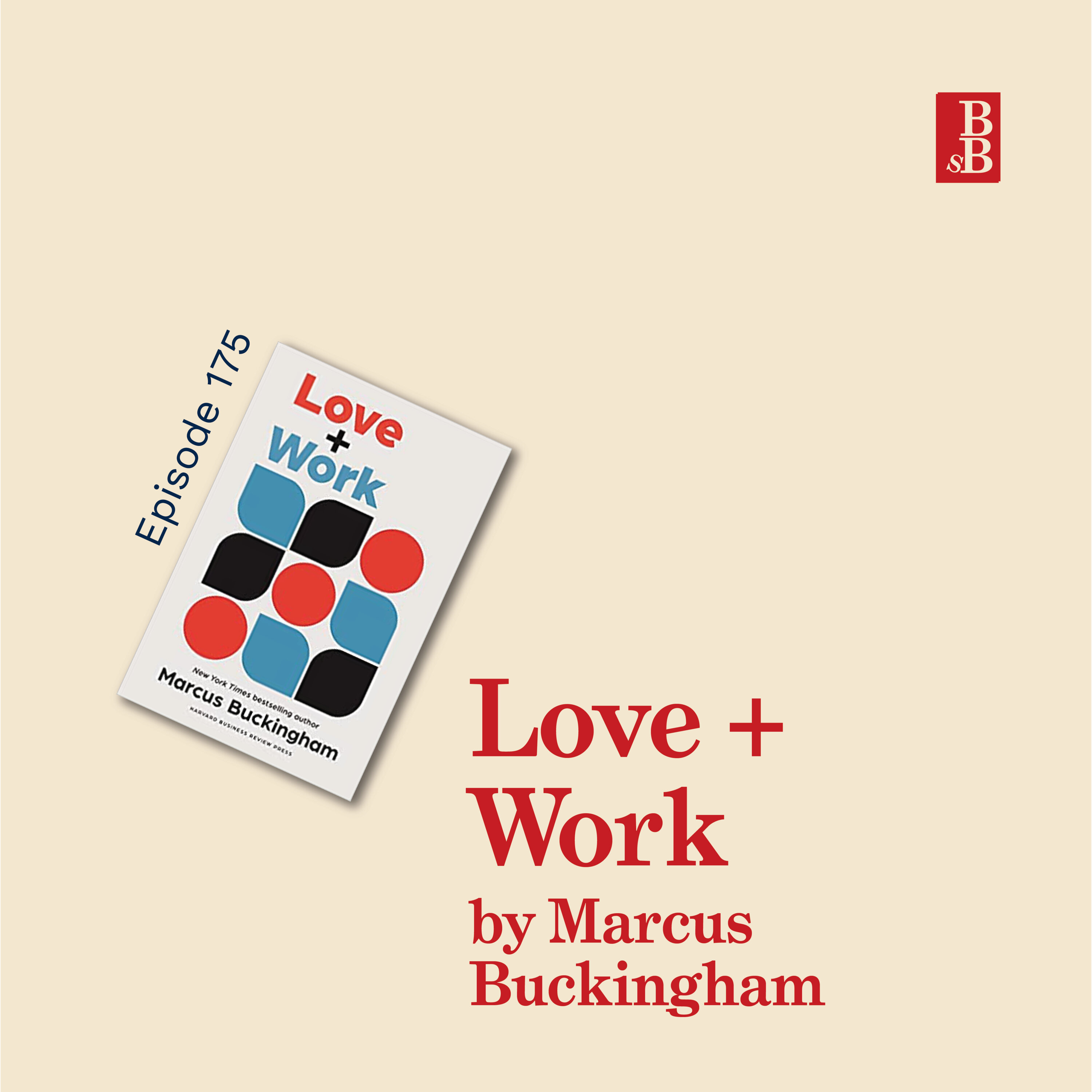
Love + Work by Marcus Buckingham: why your what is more important than your why
from Steph's Business Bookshelf Podcast · host Steph Clarke
Hey, have you subscribed to the bookmark newsletter? If you liked this, you might like my twice-monthly email with book reviews and ideas of what you should be reading, and listening to, next. Click here to subscribe. About the author Marcus Buckingham is the author of two of the best-selling business books of all time, has two of Harvard Business Review’s most circulated, industry-changing cover articles, and has been the subject of in-depth profiles in The New York Times, Wall Street Journal, USA Today, Forbes, Fortune, Fast Company, The Today Show, and The Oprah Winfrey Show. After spending two decades studying excellence at the Gallup Organization and co-creating the StrengthsFinder tool, he built his own Coaching + Education firm, The Marcus Buckingham Company. As CEO, he quickly turned it into a Human Capital Management company working with some of the world’s largest organizations. He is known as the world’s most prominent researcher on strengths and leadership at work, and today leads research at the ADP Research Institute. Challenging entrenched preconceptions about achievement to get to the core of what drives success, Marcus’s strengths- based approach is defining the future of work as we know it. Source: https://www.marcusbuckingham.com/about/ About the book You’ve long been told to “Do what you love.” Sounds simple, but the real challenge is how to do this in a world not set up to help you. Most of us actually don’t know the real truth of what we love — what engages us and makes us thrive — and our workplaces, jobs, schools, even our parents, are focused instead on making us conform. Sadly, no person or system is dedicated to discovering the crucial intersection between what you love to do and how you contribute it to others. In this eye-opening, uplifting book, Buckingham shows you how to break free from this conformity — how to decode your own loves, turn them into their most powerful expression, and do the same for those you lead and those you love. How can you use love to reveal your unique gifts? How can you pinpoint what makes you stand out from anyone else? How can you choose roles in which you’ll excel? Love + Work unlocks answers to these questions and others, so you can: Choose the right role on the team. Describe yourself compellingly in job interviews. Mold your existing role so that it calls upon the very best of you. Position yourself as a leader in such a way that your followers quickly come to trust in you. Make lasting change for your team, your company, your family, or your students. Love, the most powerful of human emotions, the source of all creativity, collaboration, insight, and excellence, has been systematically drained from our lives — our work, teams, and classrooms. It’s time we brought love back in. Love + Work shows you how. Source: https://loveandwork.org/about-the-book/ Further listening: I enjoyed this episode of Marcus Buckingham on the Diary of a CEO podcast, talking about some of the ideas from the book. Big idea #1 — You are wyrd (but nobody cares) From an early age, we’re pushed in certain directions. And often those directions have little to do with our unique strengths, preferences, loves, or desires. More often than not we are constantly pushed to work on our weaknesses or our ‘development areas’ rather than actually focusing on what we love and what we’re good at. When you get to work, you’re given goals from above, a performance review that ranks you soullessly against your peers, and pushed towards a fixed career path. Our education and work systems aren’t designed this way through malice, but through this relentless search for efficiency or standardisation, but at the cost of people’s unique contributions. The idea of wyrd is not ‘weird’, it’s wyrd; an ancient Norse term which means “the idea that each person is born with a distinct spirit, a spirit unique to you that guides you to love some things and loathe others.” Your wyrd can be found in your ‘red threads’; the situations where you lose track of time, you’re in that flow state, times where you’re the only one to notice something, or the only one who can come up with a new way of doing things and improving things. Big idea #2 — A little bit of love, every day Love belongs at work, without it work would be pretty miserable. But we don’t have to love all of it, all of the time. We know this because when we survey a group of people who are highly successful, resilient, and engaged, and a contrast group of people who are less so, the two best questions that separate these groups are these; - do you have a chance to play to your strengths every day?- were you excited to go to work every day, last week? The people who are thriving the most answer ‘strongly agree’ to both of those questions. So do you have a chance to play to your strengths every day? It shows that frequency trumps intensity when it comes to loving what you do. They reckon that you need to love what you’re doing around 20% of the time in order to thrive. It means that you, you don’t need ‘a whole quilt of red threads’ to thrive and be resilient, just enough of them every day. You can write a love note to dig a bit deeper. If you say you love helping people, ask if it matters who you’re helping, when you’re helping them, why you’re helping them, what you’re helping them with, and how you’re helping them? Your why matters, but your what matters so much more because that’s really what you think about when you answer the questions around enjoying what you did that day / if you’re excited to go to work. It’s important to note that your strength is not something that you’re good at but you hate doing. You might be good at it, but it doesn’t count as a strength. Big idea #3 — Love and leadership If you think that love has no place at work, and that work is to be endured, then listen up. You don’t just need to ‘suckitup’, and love can be found in all kinds of jobs for different people. What one person loves, another will loathe, and vice versa. Love and work leaders prioritise their people as people. They push against some of the formulated systems and processes that exist in most workplaces and instead focus on the individuals, their loves, and what helps them contribute. Leaders who check in regularly with their team members get better results. There’s a particular check in formula that he suggests; a weekly 15 minute conversation held each week about the upcoming week. The conversation is built on four short questions (two about last week and two about the next coming week). What activities did I love last week? What activities did I loathe last week? What am I priorities this coming week? What help do I need from my team leader? Team leaders who had this conversation every single week with their team members had engagement scores 77% higher than the control groups and attrition at 67% less than the control groups. This checking can be done in any manner of ways; email, text, voice, face-to-face… it doesn’t matter, as long as it happens. Marcus says that if you don’t want to do this, or the idea of this bores, you really need to consider your role as a leader. If you’ve got too many people reporting to you to make this possible, focus on fixing that. Marcus also presents some bold things that love and work organisations don’t do. They don’t cascade goals down from up high, because that interferes with people thinking about how they can bring what they love to do and bring it into contribution. They don’t use performance rating because no one trusts them and therefore it causes undesirable behaviours and outcomes. They don’t use performance feedback tools. They don’t do cascading talent reviews because it degrades trust across the entire organisation, nobody feels comfortable with them, and it drives this idea of completeness, or that you tick all of the different skills off the skills matrix in order to be a valued employee. They don’t conduct centralised employee opinion surveys because again it removes trust and the conversation should focus in teams instead. Read the book? Tell me what you thought: LinkedInInstagramSupport my book habit: https://www.buymeacoffee.com/stephsbookshelfSee omnystudio.com/listener for privacy information.
Embed this episode
NOW PLAYING
Love + Work by Marcus Buckingham: why your what is more important than your why
No transcript for this episode yet
Similar Episodes
No similar episodes found.
Similar Podcasts
No similar podcasts found.