
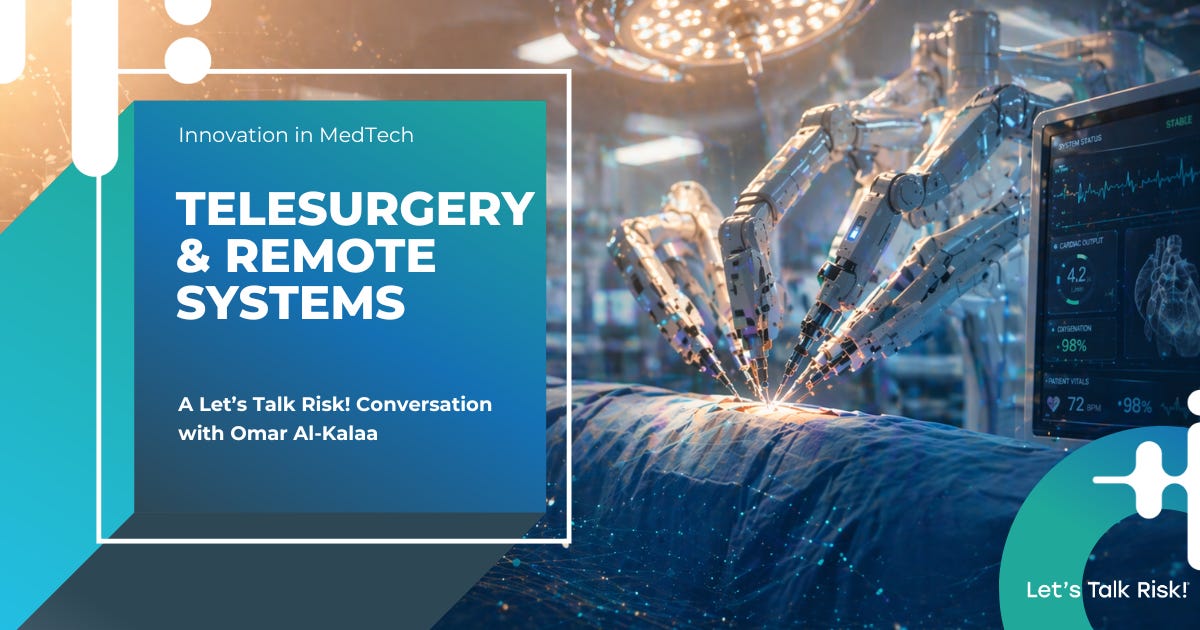
EPISODE · Apr 24, 2026 · 36 MIN
LTR 152: Omar Al Kalaa on Telesurgery and the Future of Remotely Controlled Medical Systems
from Let's Talk Risk! with Dr. Naveen Agarwal · host Naveen Agarwal, Ph.D.
Summary“FDA is still asking the same core question here: can the sponsor demonstrate that the full system is safe and effective for the patient?”In this episode of the Let’s Talk Risk Podcast, host Naveen Agarwal sits down with Dr. Omar Al Kalaa to talk about one of the most important emerging frontiers in MedTech: remotely controlled medical systems. From telesurgery to connected infusion therapy, these technologies are expanding what is possible in patient care—but they also introduce a very different kind of system risk.Omar brings a rare perspective at the intersection of medical devices and telecommunications. We explore why the real issue is not just connectivity, but control; why access to care is a major driver of these technologies; and why companies entering this space must think beyond the device itself to the broader ecosystem of networks, partners, responsibilities, and safeguards.Chapters00:00 – Introduction01:56 – What “remote control” really means in MedTech04:36 – Telesurgery vs. interoperable connected care systems08:30 – Why access to healthcare is driving adoption11:31 – Connectivity failure modes and misunderstood telecom concepts13:47 – What fail-safe means in a telesurgery environment18:24 – Risk ownership, contracts, and service level agreements22:01 – How sponsors should think about FDA for novel connected systems30:13 – Practical advice for engaging FDA in a stressed environment32:35 – Why partnership, not silos, will shape the future of this fieldIf you enjoyed this podcast, consider subscribing to the Let’s Talk Risk! newsletter.Suggested links:* LTR: Wireless coexistence and risk in connected medical devices.* LTR: A new paradigm for building connected medical devices.* Advent Health News: Historic telesurgery connects Central Florida and Angola in world-first medical breakthrough.Key Takeaways* Remotely controlled medical systems are defined by control across distance, not just data transfer.* Access to healthcare is one of the strongest drivers behind telesurgery and other remote-care models.* The biggest risks are not limited to “connectivity problems”; they include misunderstood failure modes, unclear terminology, and weak cross-functional alignment between medical and telecom teams.* Fail-safe behavior cannot be defined in the abstract. It depends on intended use, clinical context, and what the system should do when communication degrades or fails.* In distributed systems, risk ownership is shared. That makes contracts, partner roles, and service expectations critical design inputs—not afterthoughts.* FDA is still asking the same core questions it always does: is the system safe, and is it effective? The challenge is showing evidence across components the sponsor does not fully own.* Sponsors should engage FDA early, bring a structured plan, and ask targeted questions grounded in a clear understanding of the broader ecosystem.* The future of this space will belong to organizations that can collaborate across silos instead of trying to build everything alone.KeywordsTelesurgery, remotely controlled medical systems, connected medical devices, healthcare connectivity, telecom, system safety, interoperability, risk ownership, service level agreements, FDA, IDE, systems engineering, cybersecurity, access to careAbout Omar Al KalaaOmar Al Kalaa is the Founder and Principal of Inovectrum, a technology advisory and innovation practice bridging MedTech and telecom. He advises companies on the design and deployment of high-performance connectivity solutions for medical devices, clinical environments, and digital health systems.The team at Inovectrum supports clients across the full product lifecycle, from early design decisions through regulatory strategy and FDA submissions, with a focus on how connectivity, EMC, and system behavior translate into real-world performance. The practice also extends into interoperability and electrical safety, enabling a more complete evaluation of devices as they operate within complex, interconnected environments.Before founding Inovectrum, Omar spent over eight years at the FDA, where he led regulatory science initiatives on 5G-enabled medical devices, developed wireless coexistence standards, and guided industry on complex compliance challenges. With a PhD in Electrical and Computer Engineering from the University of Oklahoma, he combines deep technical expertise with regulatory insight to advance future-ready connected health technologies.DisclaimerInformation and insights presented in this podcast are for educational purposes only. Views expressed by all speakers are their own and do not reflect those of their respective organizations.Parts of this article were created using AI-generated content, which was subsequently reviewed, edited, and fact-checked by the author to ensure accuracy and alignment with our standards. This is a public episode. If you'd like to discuss this with other subscribers or get access to bonus episodes, visit naveenagarwalphd.substack.com/subscribe
Embed this episode
NOW PLAYING
LTR 152: Omar Al Kalaa on Telesurgery and the Future of Remotely Controlled Medical Systems
No transcript for this episode yet
Similar Episodes
No similar episodes found.
Similar Podcasts
No similar podcasts found.