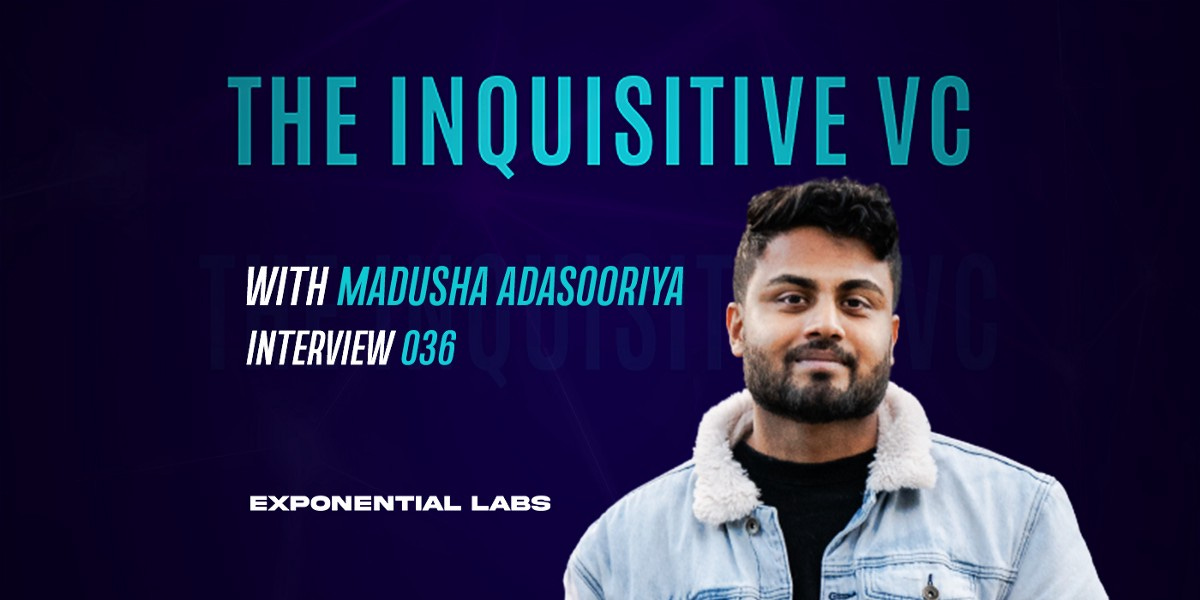
Madusha Adasooriya - Exponential Labs
from The Inquisitive VC Hosted by Nawaz Ahmed
This is the first episode on The Inquisitive VC Podcast, which you can find on all major streaming channels including Spotify, Apple Podcast, Google Podcasts and more! Over the next few months we will also attempt to publish the audio of some of our older conversations while working to bring on exciting new guests 🚀 Make sure to subscribe and rate the podcast so that we can keep bringing you conversations from the best founders and investors! 🙏 Madusha is the founder and CEO of Expo Labs, an Auckland-based venture studio. Currently, Expo Labs is building and scaling in-house brands but will soon invest in and help grow other products and technologies. Previously Madusha was a founder of EMGN.com, an entertainment, media and gaming site which in 2015 was the 15th most viewed mobile website in the USA. After successfully exiting EMGN, Madusha went on to grow a range of successful e-commerce businesses. We talk about his journey scaling EMGN, bootstrapping vs raising VC, crypto, e-commerce and more! NA: Thanks for joining. I thought it would be great to start with how you started EMGN and then started to essentially go into that full-time and start building it out as a proper business? MA: Yeah, sure. So, with EMGN, it was a site that I was running from quite a young age. I was in Intermediate when I first started it, so I would have been about 10-12 years old. It just started as a little gaming blog that I was running, after school and started getting quite a bit of momentum. I was seeing actual money coming from it for the first time, which was, you know, quite a thing at that age. I sort of started getting into that world of online advertising, monetizing websites, you know, SEO at the time was big, still is, but not as relevant, I would say. But it was one of those things that just started growing because it was always something I was interested in. To give a background on what it was, EMGN was basically a viral news site. If you're familiar with Buzzfeed, it was quite similar to that. What we did was we created, basically any news that was out there, we created short-form, easy to read digestible, viral pieces on them. We monetized it through Google ads on different platforms. We promoted it quite heavily through Facebook ads and influencers. It was generating quite a lot of traffic. We were seeing 10 million a day at one point, which is some pretty insane numbers, and in our best year, we did close to $20 million. So it went from this thing that I did after school to something pretty massive. NA: How'd you decide to get into it full-time and start building it like a real business, rather than a side blog thing that you started to do. MA: Well, I got to uni and I wasn't very impressed with uni. I was studying programming at uni and it was just not really what I wanted to be doing. I always had this passion for the news area and publishing in general. So, that’s sort of what led me into saying, “Hey, let's give it a shot, let's try give this more time and let's see if I can make this work”. That was 2013 and, yeah, it exploded from there. I mean within a year we had, I think five full-time staff and then within two years we had a team of 15. NA: How did you get towards the stage of thinking about, if you want to grow this into a bigger business, think about raising funding or, eventually lead you to the sale of the business? What was your thought process on how to decide which way to kind of go forward with? MA: Yeah, the funding route was something we were always looking at. Basically, we were seeing a lot of the companies around us that raised big numbers. I think Buzzfeed raised about $20 million, so it was something we were considering. One thing that we thought about was, we'd like to have to relocate to the US if we were to do that. Again, back in those days, I mean, especially with that industry in New Zealand, there weren’t many investors in NZ that would have been too keen on it. That was sort of where we decided, an exit might be something that we'll look at. I mean, we ran it from 2013 to the end of 2016, so a good three years. That’s sort of when we were deciding on the exit because things were changing with Facebook. Along those times you'd basically have zero organic reach. You would have to pay Facebook if you want anything out. There was also a whole bunch of things with Facebook, sort of filtering certain things, right? For example, only CNN will be seen on your feed and the smaller sites wouldn't really be seen. So, there was a lot going on that side of things. We could see the writing on the wall with how that was going. We were sort of in this area where we had to be paying Facebook for traffic to our site. Right? It was sort of a no brainer at that point with seeing where it was going and we'd say, “Hey, look, now is probably the best time to exit.” Looking back on it, it was a really good decision. A lot of the sites, a lot of the competitors were wiped out completely, or they are still in that sort of route towards trying to raise more funds and just trying to survive at the moment. So, there was sort of a good decision looking back on it, and it was probably the right time. NA: It's great that you went through that whole process in an accelerated time period, three years is quite quick for you to go from, you know, from a really early-stage company to ending up exiting it. How did you essentially deal with that speed of growth? You know, in three years you said you hired five full-time staff. How was that process from, you know, not really running a business before to hiring, managing, and then eventually negotiating exits? MA: Yeah, at our peak, we had 15 people actually. Most in the writing department or full-time writers. I mean, it was pretty crazy. We never went into it thinking it will grow that fast, from zero to $20 million a year, which is insane. and it was completely bootstrapped. We didn't raise a single dollar funding. We didn't really go into it expecting that, it was quite a surprise to us. NA: For sure. Let's talk about what you decided to do after EMGN. You ended up selling it and then how did you decide what to do next? MA: Yeah, that was interesting. I wanted it to stay in digital marketing. I mean through EMGN I had racked up about, close to $12 million in Facebook ad spend. Just myself, managing the ads for EMGN. So, I had quite a bit of experience behind me. At that time, E-commerce was booming, right? E-commerce sites for everywhere. There was a big thing with dropshipping as well back in those days, when that was all just starting and growing, on Facebook. So that's sort of where I transitioned into e-commerce, it's sort of an extension of what I was already doing and it just seemed like the perfect fit. NA: Yeah. Fair enough. And how have the businesses you've built in that space over the past few years being, what are your experiences with it? MA: E-commerce is so a massively growing area. There's still a lot of growth left. I think the, I mean the latest stats, I think more than 50% is still offline transactions and retail. So, there's still a lot of growth left, and this whole COVID thing has accelerated all that thought. There's still a ton of high growth there. In terms of my businesses, we've had a lot of success. I mean, some of the biggest ones, Slick Lane, which grew to 30,000 customers within its first two years. Right now we've got, EzToned which is a at-home fitness brand, we've done within the first year, just over $2 million in revenue, New Zealand dollars. Pretty good, again these are all bootstrapped brands, and there's a lot of growth potential left in all of them. Yeah, it's quite an exciting time and there's a couple of new brands we have launched as well. One being Turbist, which is a hair towel brand, and that's also had a great success. We have sold out within the first couple of months and now we are looking and grow that a bit further. So, it's an area that I think has a lot of potential and … This is a public episode. If you would like to discuss this with other subscribers or get access to bonus episodes, visit theinquisitivevc.substack.com
Embed this episode
No transcript yet.