At MedCan, we know that life's greatest moments are built on a foundation of good health, from the big milestones to the quiet winds. That's why our annual health assessment offers a physician-led, full-body checkup that provides a clear picture of your health today and may uncover early signs of conditions like heart disease and cancer. A healthier you means more moments to cherish. Take control of your well-being and book an assessment today. MedCan. Live well for life. Visit MedCan.com slash moments to get started.
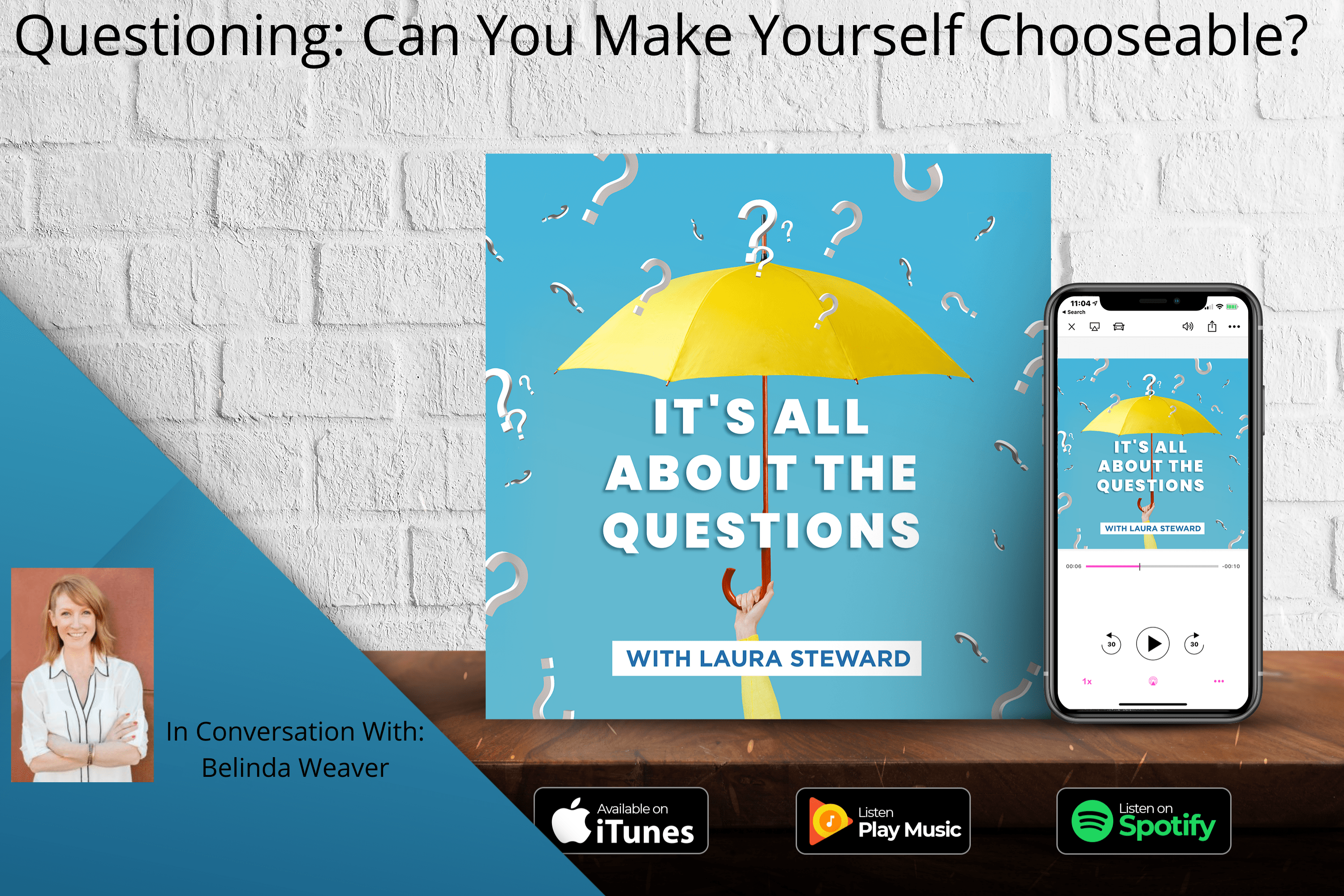
Welcome to It's All About the Questions, where learning to ask the right questions can help you achieve lifelong success. Now, here to help you ask all the right questions is award-winning author, international speaker, and business strategist, Laura Stewart. Good morning, afternoon, and evening, everyone. And welcome, welcome, welcome to the show. I am like just so excited to be here with you today in spite of still not feeling so great post-surgery, but I get energized by doing this show. It doesn't matter if I have to crash for hours and hours after this. I love being able to be here with you all to hear all your feedback. And I am especially excited because the promotion for the show where I just shared the links so you could watch it live stream, even though it was not unusual Tuesdays, we're doing this on Monday Labor Day in the United States.
The enthusiasm for the topic was was mind blowing to me, but really not, because when my guest on the show today, Belinda Weaver, copywriter extraordinaire, coach extraordinaire and, you know, Australian living in California. we were talking because we met through a group called tight nights founded by marcella allison and i don't know we just like really hit it off and i'm like oh you have to come on the show so we had a conversation about what she was going to talk about on the show because there's so many brilliant amazing things that she has done in her long career and not just with copywriting and we started talking and did you ever when you hear something get goosebumps all over your entire body like you get these chills and shakes and you're going oh my god why did i never think of it that way before i that is just brilliance beyond brilliance. Well, that's why Melinda's on the show today. And we're going to talk about something that I think is a game changer in the way we think about growing our businesses. You've probably heard the phrase, what is your unique value proposition? You probably sat there trying to lay out your marketing messages saying, well, if I just explain why I'm unique, then they are going to select my product, my company, my business, whatever it is. But what if what was really important is to be thought about how to make yourself
And with that thought, let's bring Belinda on camera. Belinda, thank you for being on the show and for just mind blowing me. Thanks, Laura. I really hope I live up to that because that was an incredible introduction. So get ready, everyone. You know, when we first started talking about this topic and we were because there's so much, you know, we're like, OK, what's the one thing that Belinda Weaver does that we can talk about that is relevant to my listeners that can shift perspectives? I mean, anything you talk about would.
do great on the show, right? But then you started talking about this idea you have. And I'm like, it has to be a book. Remember that? You have to write this as a book. What made you think of this idea? And you're a renowned copywriter. I mean, you've written copies, some of the biggest names in the business to help them be choosable, right? But yet everybody still talks about unique value proposition. Where did this come from? Well, it's really a personal story for me because when I
found out copywriting was a thing. I've changed careers, you know, made two big shifts in my career. And then I found copywriting and I was like, this is it. This is the thing. And it became a question of how I would become a copywriter, not if I would become a copywriter. And I dedicated all my attention to it. And in the first couple of years of being a copywriter, I just wanted to not go back to my day job. I just wanted to get enough money to make it successful enough.
that I could keep doing it. But then I hit a point in my career where I wanted to become a bit choosier about the kind of work I was doing and the kind of people I was working with. And that's when I had to look at myself and I had to ask myself the question, well, why would a very desirable client for me choose me over every other copywriter? Because I'm not the only copywriter in town. There are millions of us, which is very exciting. But when you have to look inside and go, why would someone choose me? It can be a bit of a soul-destroying question and it can bring up a lot of mindset junk. And over the next couple of years, what I realized is that I wasn't.
necessarily particularly unique, but by taking care of some low-hanging fruit in my marketing, by being consistent and looking after the details, and I'm talking about the details that help us connect and build trust and make clients feel less anxious when they're making a choice, if I could take care of those details all the time, I didn't actually have to be different to everyone else. And that's the seed. It came in those kind of years two, three and four of my business evolving and growing. And over the years, I've coached many, many copywriters who have been fearful because they don't have a USP. They don't know what makes them different, what makes them unique. They think, I don't know what niche I should be in. And I love being able to turn around and go, it's all right. It's all right. You don't actually have to be different in order to be successful, profitable and have lots and lots of work. So that is how the idea has evolved. Well, I find that really fascinating because as I was listening to what you were talking about.
You say you don't have to be different. Yet, in some ways, you were different because you look at your business differently than all the other copywriters that were focused on what is unique about me. You were focused on, I don't know, is the right word, delivery and how you delivered your services to make you chooseable. There was something unique in its own way about. you and your mindset maybe I don't know let's let's talk some more about this I think it's a valid point but I have to um realize as well as I've been thinking about this the ideas have really pulled together relatively recently for me I didn't have this idea of being choosable in that kind of articulated way when I first started doing it to be honest I was thinking I don't know what's different about me so I'm just going to do the best I can at my craft I'm going to do the best I can at delivering a service um And I thought, I'm just going to control the things I can control, and that's my work. But it's really come together as I've looked back on that and thought, yeah, actually, I stopped worrying about being different and just did good work, the best work I could do. You know, that is so powerful because my listeners that have been listening to me for, what, six years now or seven years now, that...
I had a tech company, a tech services company, and it was a multi-state tech services company, woman owned, which was unusual back when I started it, before I sold it, you know, I'd go to events and I'd be the only woman. So that was sort of like my unique value proposition, a woman in tech with all the degrees and certifications. But I was a small fish. compared to a lot of the other players where I started the business. But I kept landing client after client, after client, after client, grew my staff, used newer tools and stuff like that. And one day somebody said to me, well, how do you land the size clients you land when you only have a few employees and you're not making $10 million in revenue a year? And I started thinking about it. And that's what this how to be choosable thing has got me thinking about since we spoke the other week and what we talked about.
I made myself choosable without thinking about it. You know, we asked the questions nobody else asked because we really cared. You know, we figured every other player was going in there pitching tech, pitching this or just doing what the client said. Instead, we just sat there and said, so what are your goals? And nobody had asked him that question. And installing tech really should be about meeting the business goals versus I need a new computer. It makes a huge difference, right? So when we talk about the mindset and I was like, I'll go in after a, you know, Fortune 50, Fortune 100 company, I don't care.
So what if they say, no, I would learn something and make a connection. You never know. So how do you begin thinking about that for yourself? I mean, there had to be a letting go that you started to describe, a letting go in your brain. But then there had to be some other thing you started doing that you can expand upon. Yeah, absolutely. So one thing I really started to think about in those early years is how can I make little moments?
important? How can I make the client feel like they've made the best choice? And that's all about understanding how we make decisions, especially when we're laying down some cash. So at the end of the day, clients in any industry with any purchase, they're looking for some assurances. They're looking for assurances that you have products and services that actually solve the problem that they have, the reason they started searching for a solution in the first place. They're looking for assurances that you have solved these problems before with other people.
successfully and they're looking for assurances that the experience of working with you will be a positive one and those ideas have helped me zone in on some specific details that you can shine a spotlight on that make you the benchmark when we're making decisions because I like to think of this as when I'm choosing a service provider or a product I'm often looking at a few different options and I have all the tabs open when I'm looking at people's websites I'm looking for certain clues and signals of those assurances that they have the thing that will solve my problem that they've done it before and that I connect with them on a kind of human to human level. And when someone doesn't meet that kind of conscious and subconscious criteria I have, I close the tab. And so that's the process. We want to be the last tab open as the most choosable option. And so I have this three spotlight system framework where I encourage people to shine a spotlight on their business.
shine a spotlight on their customers and shine a spotlight on themselves. And the last one is usually the ickiest, but we can dig into some really easy details. And that's why I called it the low hanging fruit. This is not difficult stuff. But when you take care of all the little details consistently, you send off signals that you can be trusted, that you are legit, and the experience of working with you will be a good one. I want to expand on those three elements because
I know I've been trying to redo my profile on all of my social media and my bio. And, you know, Marcella Allison has been really pushing a number of us to, you know, really write something that reflects the reality of who we are versus this tiny part that we're willing to say. OK, what I hear you saying, Belinda, is that when it comes to making yourself choosable, your company or whatever. the human part of it is a major player in that. Correct? Not correct? Yes, absolutely. And it's the bit we usually shy away from because, and that's why I start with the spotlight, shine a spotlight on your business because that's usually a lot easier for us. Then your customers, again, a lot easier. And then when I say, now we need to spotlight you, people go, oh no. But it is a really huge element because if I've got two choices to make and on paper, they're exactly the same, it will absolutely come down to whether I feel like I could work with you or not, you as a human being. And if you've got teams and teams of people, you're not the only person. It will be whether I,
find an affinity with the vibe of your business and brand with the company values and how you operate, which is the human side of your brand. That's really important. It sounds like it goes opposite to what a number of business exit strategy people say, which is don't make it about yourself because if you ever want to sell, you're selling the brand, not you. And if you're too tightly tied to the brand, then you're never going to be able to sell it because if you're gone, how do you link that together? In an entrepreneur world, a lot of entrepreneurs never plan on selling. They're just solo practitioners, solo entrepreneurs. But this how to be choosable factors in for people growing their businesses and for large corporations too. So how do you...
I'm trying to think of the word. How do you reconcile? that aspect of it, which were bringing the human elements of the people in the business while still maintaining that brand the way it is? Well, there's lots of different ways you can do it. But, you know, I have an example where I was looking for an accountant and I had to look at a lot. I looked at a lot of different accountants and some are very small, like, you know, just one person and some were very big corporations. And the choice, regardless of which choice I made, I got a very clear impression very quickly about the vibe and the values of the brand.
through their copy, through the design, but also through things like photos of the teams and the people and the humans, the way the values of the business were described in the About page, but also the use of pronouns. And this is where we sort of talk about shining a spotlight on customers. The way you use pronouns in your copy can really change the way I hear the conversation. So using a lot more we and us and the team and all that kind of language makes it much clearer that these are a bunch of people with the same vision working together. for the same goal. And so even if you have lots of people or one people, when I get the sense as a customer that there's a bunch of real people who enjoy what they do and are working towards a common goal, that creates a very distinct vibe and personality to a business with none of those human elements in the marketing. I love it. I keep saying that a lot.
There's just so much to unpack in like every nugget you throw out there and answer to some of my questions, Belinda. So I'm like, okay, focus, Laura, focus. Don't just be sitting there going, oh yeah, wait, I have to throw another question in there or I have to lead off of what she just said. You know, for those listening out here, you know, I've been hosting shows for seven years and doing this show for six years, one show before it for a year. But sometimes I get so wrapped up in the conversation, I forget that, you know, I'm doing a show. I love it. Oh my God. Okay. All right. So
You talk about this idea of showing the human element behind your business. What if you're afraid to show it? Because maybe there's something in the background that didn't go so well. Maybe there was, you know, you want to be choosable. But there was some failure somewhere along the cycle of your personal life or your business. I mean, we can think of so many companies that had, let's go way, way, way back when I was a little kid and Tylenol and somebody was contaminating Tylenol. This was way before they had the tamper-proof evident things and all of that stuff, right? Tylenol stepped up and immediately.
explained what happened and said, this is what we're doing, right? And then now that the advent of cameras are everywhere, you see anything that happens on an airline, anything that happens in a retail store, people can say whatever they want on social media, even if it's not true. So how do you suggest somebody who perhaps has got through something like that? try to make themselves choosable? Well, I think it ties back into the humanness because mistakes are made. Things happen to us. We do things that we wish we hadn't done. That's just life. And I think as a business, if something happens, you have to jump in and try and control the narrative, not as a stifling point of view, but go, this is happening. Or if it was in your past, this is something that happened. You can't try and whitewash it and pretend it didn't exist. What you can do is go, this is what we learned. This is what we changed. This is how we evolved as a business. Because as soon as you see...
negative comments online and you see the companies try and block them, delete them, that becomes just as big a deal as the thing that caused the negative comments. So as soon as you try and pretend something isn't happening or didn't happen, people start mistrusting you. And with all the stuff we're doing in the marketing, the whole premise of being choosable is really... Transparency is where credibility and trust comes from. So if you have something in your company history where you're like, yeah, wish that hadn't happened, you do get to control the narrative, but you get to also express how you evolved, how you grew, what you changed, what you learned. Because then people go, ah, this is a company who is adapting and evolving. This is a company I can trust not to screw me over if something bad happens. They're looking for a positive outcome regardless. And so I think you just have to own it. And that's, you know.
Us as humans, we have to own the things that happen and ask ourselves what we can learn and how we can evolve. That's our own journey of personal development. And it's the same with our company. And when you see a company who owns up and says, this is what we're trying to do about it, this is what we're going to change, the swell of support for that is usually much greater than the haters. Yeah, unfortunately, there's so many haters out there nowadays. And they're like, I can yell fire in a movie theater if I want on social media, even if it's not true, because First Amendment says I can do whatever the heck I want. And that delves into a whole nother topic for another show of moral and ethical kind of things. All right, let's let's shift a little bit. Okay. I'm trying to think of how a listener.
of the episode today, right? They're sitting here going, oh, okay, forget unique value proposition. I want to make myself choosable. Yeah, I get I need to put some of my own humanness into it, my team's humanness into it. It doesn't matter that I'm selling these pens. You know, it's that I got this one in the mail the other day. So it's got my company name on it and everything. And I was like, oh, they're sending me a free pen. Of course, they want me to buy the pens. I know nothing about the company. I'm using the pen. I like it. It's got like a little flashlight on one end and on the cap is a stylus. Really kind of cool. And it writes nice.
They're not telling me anything about them. There's no making themselves choosable other than the fact that they sent me something. Yeah. That's how they got your attention. Right. But that might really simply just spark you with the idea of like, actually, I wouldn't mind some pens. Now I'm going to go to the internet and see what are my other options. How much do these things cost? Where can I get them from? What are the customizations can I get? And then you're in the decision-making thing.
where you've got a lot of options and you need to make a choice. And so when I'm talking about being choosable, I mentioned the spotlights, shine a spotlight on your business, on your customers, on yourself. And I'd love to just doll out some of these really tangible things that people can do. Yeah, dive in, please. Excellent. So when we're shining a spotlight on our business, we have to think about like our branding, how we look, but also how we sound. You know, is it, I want to use the word authentic, but that's the way we can stand out from other people in the industry. And as a copywriter, I'm always encouraging people to be more conversational. Write your marketing as if you're having a conversation with someone. Imagine your very best salesperson is in the room.
You know, they're not stilted. They're not formal. They're not aggressive, hopefully. They're persuasive and charming and friendly. They ask questions, like you said. You know, they get to know what is happening and they present a solution in a way that fits the person. That's how you can make your coffee sound, right? But there are other ways that you can help your business be more choosable. And a big one is explaining how and why you do something. So a lot of- Okay, now we're about to do something that I normally never do during the show, but it looks like we're about to get a storm. I need to turn another light on. Oh, okay. Nice. Well, going off camera, revealing the behind the scenes. Okay, I'm back. Okay.
So when we think about how and why we do something, why we do something, the story of our origin shows people that there was a beginning. A humble beginning. And that's a good thing to do. When we talk about how we do something, when I'm working with someone for the first time, I don't really know what's going to happen. And that makes me anxious. So whenever you're thinking about your customers, they are naturally going to be a little bit anxious about what happens next because they don't know. A way that you can relieve that anxiety is explaining your process. First, we do this. Then we do this. Then you're going to confirm this. Then we have an invoice. Finally, we have a wrap-up session. And I'm like, now I have a path. I have a journey that...
makes me feel safer. So if you, your business has a process on how you work with customers, even if it's just the ordering process, if yours is the only business that explains that process, I instantly feel more safe with you. So that's another way you can differentiate your business, explain your process. How do you... Oh, okay. All right. Let me just give an example and see if this fits with what you just said. I, a couple of months ago, my house needs to be painted, the outside of my house. I live in Florida. We were entering hurricane season. I noticed some stucco was rising off the side of the house. So I called a number of painting companies in.
One person said, well, yeah, that's probably nothing. We're just going to patch it and whatever. And here's my coats and then we'll just schedule you. Another person, when they were walking around the house, said, well, you know, looking at what's going on, I think what we're going to need to do is bring our stucco person in. to look at why this might be happening. I also noticed that one of your soffits has black tape on it from when it looks like your new AC went in wrong. I think that we should consider replacing that, no extra charge, so that you don't have that eyesore on the side of your house. And once we start doing it, here's what's going to happen. The stucco man's going to come first. Once he's done his thing, then our painters come in and they...
patch everything else. Then they come in and they seal. So he went through and explained the whole process. And then his wife constantly communicated with me. These other people, they just sent a quote and that was it. Never communicated with me again. So that's kind of an example of what you were just talking about. I hired, by the way, those other guys with the separate person. Which one did you trust more? Which one did you hire? And it was clearly the ones that gave you more information. And I'm not talking about fire hosing your clients and customers with information, but empower them with the information they need to make a choice. And if that takes a little bit of extra effort, do it.
Because you felt more safe with the guy or the company, the partnership, who said, I'm actually looking beyond the lens of the specific problem and we can help you fix that. But also, this is exactly how it's going to happen. And that makes you feel safe. And that is a great way, as this example has just shown, to make your business chooseable. Because so many businesses just skip over that. It's something that they leave as a bit of a mystery, but it makes clients feel nervous and anxious. Even if they can't articulate it, it just makes them feel a bit uncomfortable. And if you think about how you deliver your process, there's often little details that you can shine a spotlight on.
that no one else actually does or no one else is talking about. And a great example to show this, Coors Beer, years ago, they had a marketing campaign called, and it had like a big poster with a mountain river, and it said, brewed with rocky mountain water. Now, beer is brewed with water that either comes from the sky, it comes from the mountains, all the brewers were using the same water, really, especially in that region. But they made a big deal about the source. And that became a differentiator, even though it wasn't really. So I often talk to clients, I'm like, walk me through the service, exactly what happens every single step.
And there's more often than not one or more things that I go, that's amazing. Do you do that alone or does everyone do that? And a client might say, oh, well, no one else does that. That's what we talk about. That needs a spotlight. Or they might come up with a detail that, oh, no, it's nothing special. Everyone does this, but no one else is talking about it. So you can actually shine a spotlight on different aspects of your production and service delivery and product creation. And even if everyone else is doing it, if no one else is talking about it, it pops out.
to customers. So that's a few different ways that you can make your business usable. And what I guess the takeaway here is look at your business, your products, your service, how you do it, why you do it from all different angles, as if you were explaining it to someone who doesn't know any of this. And when you have all the details laid out, more often than not, you'll have a few things that either no one else does or no one else is talking about. Never thought of it as looking at what no one else is talking about. I think that's real. And this is not like the fake packaging in the grocery stores where
you see a can of corn and it says vegan. Yes. No, this is not, we're not manipulating and telling them we're putting BS spin on it. But more often than not, clients and businesses who really look after their clients, like for you, Laura, you were saying, we ask the questions that figure out the root of the problem. Now that could be something that no one else did, but people did, but they didn't really emphasize it. But that became your thing, your jam, the thing that people knew you for, probably because you did better than anyone else. But that's easily a detail that you could go.
I'm going to shine a spotlight on this little splice of our process and make that a really, the factor that people use in their decision-making process. I'm going to control that and make a shine a spotlight on it. But it comes from laying out, going through your whole service product creation delivery process and looking at it step-by-step. Get into the details and shine a spotlight on some of those. And it's really easy stuff. And it really takes the pressure off having to be completely unique in the marketplace. It could be something small.
or it can end up being something large. But I love the process of sitting there and looking at every step of your process, your manufacturer, your delivery, if you're writing copy, if you're coaching or consulting, you know, I do a lot of consulting with businesses and a lot of individual consulting as well, coaching, I mean, as well. But maybe there's something in the process that you go, oh, I'm comparing myself to. the big guns in the world, but you know, they're not talking about X. I'm holding my fingers up because some people are just going to listen to this on the audio only podcast and they're not going to see my fingers. That's right. What's the gift of playing small? What's the gift of playing a little bit different? What's the gift of leaning in to the thing that you fixed that no one else fixes?
I interviewed the CEO of headsets.com. Have you ever heard of that company? No. If you're looking for headsets of any kind, these guys started out as they resold everybody else's headsets and now they make their own. And I had the CEO on the show and we talked about something that they do differently than everybody else. They give Tootsie Rolls with every purchase. I love that. And we're not just talking the plain chocolate Tootsie Rolls. They're the...
you know, variety pack, unless you say to them, you only like like the vanilla or the chocolate or the whatever. And you can even call them up and say, can I have some Tootsie Rolls? And they will send you a packet of Tootsie Rolls. And if you're a really good customer, one day I got a box, I swear it was like four pounds and it was just filled with Tootsie Rolls. Yeah. I got the beautiful moment of delight. Yeah. And people started sharing pictures of their headset boxes with Tootsie Rolls as like cushioning and packaging. They made themselves choosable for, you know, something.
That really had nothing to do with their products, but had to do with their process and who they are. And, you know, that's not about the candy. That is about a company who is saying, we care so much about the experience of our customers that we are conscientiously and proactively thinking about ways we can delight and surprise them. That's not about the Tootsie Roll. It's about we're going to make time and set aside money to delight our customers beyond the quality of our product. Okay, that's like so tweetable. How do we delight our customers?
To make yourself choosable, you need to delight your customers. But I feel like delight, like a lot of the things we're talking about is proactive stuff you can promote from one hanging marketing fruit. Delight is something that you can keep in your pocket to build up your almost post-purchase goodwill and that referral network. Delight comes from surprise. And what we should be doing is setting accurate expectations for our customers. That's why we explain our process. Because the number one influence, this is not a surveyed result, this is Belinda's number one reason for customer dissatisfaction, is because I didn't get what I was expecting. Now, if you've told me exactly what to expect.
and you deliver what I expect, the idea of me being satisfied is like a 90% hit it out of the park thing. What that means then is you have this extra time. If you have a really well systemized business and you're not trying to remember your process and systems from your head, that gives you brain space and creativity to go, now that we're meeting expectations, what can we do to exceed them? That's where the surprise and delight come in. And it can be something unexpected and awesome.
Or it could be a little treat. Or it could be just over-delivering in some way. There's lots of different ways we can do that. But you don't have the brain space to think about that unless your product and service delivery is really strongly process-driven. But that little thing can be the difference between someone looking somewhere else for the next time they need the thing or absolutely coming back to you and telling everyone they know. And that is a huge and very powerful referral machine to drive sales. And that makes you choosable over and over and over again. Over again, yeah. And that might be, as you just indicated,
Just simply delivering time after time after time exactly as you promised or communicating when maybe something doesn't quite go the way you'd like it to, as we're all seeing in the world today. But not everything happens the way you'd like it to happen. That's right. And it's nicely back to the, sorry if I can go, you know, I guess I'll go, go, go. But there, you know.
Thinking about our customers. And that's the second spotlight. It's shining a spotlight on our customers. And that's, you know, it's actively thinking about their experience and how you can level it up. Not just the baseline is meeting expectations and that means setting them. But then we want to exceed them. We want to talk to people in our copy and our marketing. Not about them, but to them. And that's why we use our pronouns again. I use a lot of you words in my copy because the moment of someone reading your marketing and engaging in your marketing material, it's a conversation between you and them, but you're not there for it. So the more we can make our marketing feel like a conversation, the more people let their...
guard down, not in a manipulative way, but in a, oh, I feel relaxed with this. We want to connect with people's pains and frustrations without shaming them or embarrassing them. But we want people to know, I get it. This is where you're coming from. This is what your life is like. And that's where getting to know your customers is really, really important. But we want to focus on the impact, not just the solution. The impact the solution can have in their lives.
This is all, you know, kind of marketing 101 stuff, certainly copywriting 101 stuff. A lot of people skip it over. But the big part of shining a spotlight on your customers is sharing their stories, giving them a floor space to share the experience of working with you and sharing their stories across your marketing, not just once when it happens, but all the time. And a lot of people start feeling a bit uncomfortable at this point because they're like, that feels like bragging. I like to think about it as celebrating my clients and their awesomeness across my marketing all the time. What it's really doing, though, is helping more and more people see themselves in the process, the product, and the results.
your business makes possible. That's what clients are looking for, to see themselves in your marketing. And that's down to the stories you share, the images you choose, and how thoughtfully you approach working with your customers. I can hear my listeners saying, I can't possibly share customer stories because then my competitors will know who my customers are. Oh, that's interesting. You know what? I've never felt that way because if I lose a customer to somebody else, then obviously I'm not doing that great job. I'm not staying choosable. But how do you respond to that? Well,
My brain is like, you have to get over that because there's going to be confidentiality and all that kind of stuff. But if you are going to hide your gold and say no one else can see it. How are potential customers going to see it? How are they going to know what you can do? How are they going to know what's possible? And how are they going to know that you're not just spinning them a story if you're not sharing real customer stories and testimonials and case studies and details? Now, if you're afraid of what your competition is going to do, then you need to make yourselves more choosable all the time. You also need to focus on being more awesome because there is always going to be people who copy us. It just is a nature. Like as a copywriter, as a freelancer, as a small business owner, as a product creator, it's just the nature of doing business.
I like to think I just got to be more awesome than everyone else and show up in the way that's authentic for me. And I've got to focus on doing good work because if I start worrying about what everyone else is doing too much, I'm just going to dim my light just in case the wrong people see it. And I just think that's a very closed in way to spread what you do with more people. Don't dim your light because you think the wrong people will see it. Yeah. That's beautiful. And I get the impression throughout the conversation so far that
if you want to make yourself choosable, you can't dim your light. You need to actually turn it up a few notches. Don't be afraid to put yourself out there because you're awesome. Your product, now this precludes the idea that your services, your products, everything that you are putting out there into the world are, should be choosable, right? You're not putting out. We're assuming you're awesome, right? Okay, so we talked a bit about customers, about business. What's the last part? We've tipped throughout all of these in the last, oh my gosh, 45 minutes already.
The last one is shining a spotlight on yourself. And whether it's you as a human, the solo, the face of your business, or it's the human aspect of your branding, this is where some people think, oh, no, no, no, I don't want to be in the spotlight. I just do my thing and I don't want to have my face plastered over everything. Or a business says, well, this core values stuff is a bit woo-woo. We don't need to focus on it just as much. But it's absolutely the last place where...
people make the decision. If I look at your website and your marketing and you solve all my problems and the product looks amazing and I'm thinking, I think this is the one. And then maybe I listen to you, I hear you, I look at your about page, I see some of the reviews of your business and I'm like, hang on, this does not jam with my vibe at all. I'm not going to choose you. And so when you are looking at your marketing, you have to give people hooks like Velcro hooks to connect with you, you as a brand and you as a human, and you don't want to be vanilla. And this is something very early in my copywriting career.
I was so worried about being professional, in air quotes, that I was like, well, I can't be too goofy. I can't be too ginger. I can't be too funny. I can't be too loud. You can't be yourself. I can't be myself. And it just ended up in this little sweet vanilla, you know, biscuit of marketing when I'm actually all ginger snap with a bitch of spice in, you know. That's what you need your marketing to be. And I don't mean you need to be loud or quirky or anything like that. But if you are, embrace it. Embrace it. You need to give people reasons, little hooks to go, I like the cut of their jib. I think they're a lot like me.
And that's what we need to do when we shine a spotlight on yourself. Like I talk, I mean, I talk a lot about Doctor Who. I talk a lot about pugs because I have a pug. I talk a lot about working around my family and I have very Nana TV tastes and I obsess over tea. Now, these might be very trivial details and it might make some listeners go, who cares whether she likes tea or coffee? But incrementally over my marketing, I'm dropping little Velcro hooks for people to go, me too.
We're kind of alike. And for a big business, you can do that in your core values. These are the things we believe in. And we work with people whose values align with our values. And so it could be little details. If you have like an exec team, I've read some wonderful profiles of, you know, a couple of lines about the exec team where at least one sentence had, in his spare time, Paul goes mountain biking, rock climbing, and owns a dog called Surprise. Now that might seem a trivial detail, but it means that...
I know something about this person. I have a dog, so we already have something in common. I go rock climbing. We have two things in common. Now, if I'm faced with another business who I don't get any sense of the people behind the teams.
I'm not going to choose them. And so that's what we want to do. We want to share little hooks in our marketing that make us seem like actual humans, but also give people reasons to go. That's like me. I believe in that too. I do that too. I like that too. We have something in common. That's a much stronger bond than anything else. And it's also the stories you share about how you work, why you work, why you keep doing what you're doing, what you love about your work more than anything. They're stories that let people see you as a person, your passion and your purpose.
They're really important to share just as much as your features and benefits and all those other parts of your marketing. I had Angie Coley on a couple of months ago, and it's one of super, super popular episode. And I called it Permission to Succeed, right? Because Angie's just totally flat out off the wall, insane, brilliant, whatever. And as I'm listening to you speak, Belinda, I know you know, Angie, as you indicated, in order to become choosable.
to make your company choosable, to make you choosable in every aspect of your life, right? So that you're not the last kid picked in a game or whatever it may be, right? In business, you don't really want to be the last one unless you're the last one and then they keep using you over and over and over and over again, right? Is we have to give ourselves permission to be choosable. So how do you recommend somebody give themselves permission to be choosable, to let go all of these ideas that they've had for years about it has to be a unique...
value proposition. I have to do all these things everybody else said rather than what we've just talked about today, which is another way of looking at it. And I know it's hard because I'm basically saying the marketing tombs that we've heard since day dot are wrong. And I'm not really saying that because if you actually do something unique, you should celebrate it. That is killer. But for most of us, we don't have that thing in our pocket. And sometimes, and I know startups, like I'm in Silicon Valley, a lot of startups here have this market struggle where if they're doing something that no one else is doing, they have to educate the market. That is time consuming and expensive. Look at Amazon. Uber, right?
They had a unique value proposition, but they certainly weren't choosable in the early days. No, they had to teach us all why we needed them. Now, of course, the market leaders, there's lots of people who have come in behind them and it's much easier. It's much cheaper and faster and easier if someone is already doing it in the marketplace. So take that as the gift. You're in a proven space, which takes the pressure off. The other thing is...
that the idea of this kind of unique unicorn complex can cause us stress. And it's something, Laura, I want to flip to something you said when we chatted before this. Sometimes the most powerful moment is hearing, and it doesn't necessarily need to be the first time you've heard it, but the right message from the right person at the right time. And so when you focus... on the low hanging fruit of your marketing that show people that you're a bunch of humans with a clear purpose, that you've got products and services that have solved problems, that you've solved them for other people. And the experience of working with you is going to be a positive one. If you focus on all those details, you can stop being anxious about being unique and you have something to take care of now. But it also means you can focus on just delivering good work, doing the best you can do and always looking to improve it. And I just personally find that idea of narrowing the focus of what I should be looking at.
really freeing. I stop worrying about me not being good enough compared to everyone else because I'm not different. And I begin to focus on what I have control over. And that is how I deliver my service, how I talk about my service and how I focus on my customers. That's what I can do. And so I would say it's actually quite releasing, freeing and empowering to let go of how you compare to everyone else and just focus on reaching the right people with the right message at the right time.
I had totally forgotten that I had said that. Ever since we chatted, it really has. Wow. And that was something I had heard from Les Brown from the very first time. And that always stuck with me. And that leads to really enforcing what we've been talking about all day, which is.
You never know when somebody is going to need what you do or who you are to help with them. So don't just give up either because maybe you're not marketing to the right people. Maybe there's something in your messaging that you're still trying to find this unicorn. Maybe I know this because a lot of my listeners talk to me about this, Belinda. They're not putting themselves out there because of what you just said about they have to be what the startup world is called. You have to be the unicorn. You have to be so different.
And forget it. If you're like everybody else, there's no way your business is going to thrive because what's to stop somebody going from the chain store to the small independent business to go from a large corporation to a small entrepreneurial startup or something like that. I really love this idea. that you talked about of, you know, be yourself, be clear about your business, be clear about who you are and your customers. But this is not go find your niche, right? This is not who's at the seat at the table. It's a completely different kind of story. Yeah. And it's take care of the details because the details is where you have your power. The details is where you begin to have your groundswell.
If you start thinking, oh, I've got to be unique, and I know we keep coming back to this, but it's just a really common pressure that we have in marketing. What makes you different to everyone else? If you let go of that idea and go, I'm going to take care of the little details of every single step of this process, and I'm going to take care of the details in my marketing and share small moments rather than waiting for grandiose moments, well, then the grandiose moments will come. So this is not about fixing and changing one thing. This is about paying attention to all the little things that make you deliver good work.
And when you pay attention to the details, the big outcomes will follow. Get your tribe, get your loyalists through delivering exceptional service and products in a way that, and being open and transparent that helps people make decisions, empower them with information and dial into the humans that you're helping. The rest will follow when you consistently show up with those things. Yeah. Every business starts with the first client and that first client doesn't have to be a fortune 50 company. Yeah. I mean, I can't tell you how many clients I've worked with that.
80% of their business was one client that was this big whale that they always wanted and they got it. And then other clients started dropping off because their sole focus was there. And then that big client pivoted and their income dropped 90%. And now they're having to scramble. maybe we need to stop looking for the one big whale and take the hundred other ones. Yeah, I absolutely agree with that because, you know, I always think about marketing like a big old, like a water wheel, which shows how old I am. My references are very old, like a steamboat thing. And it's the kind of thing that's really hard to get going. But once it's going, if you keep putting a little bit of effort into it really regularly, it keeps going with just a little bit of effort. But if you stop taking care of the things that make you choosable and you stop sharing them, then if you do have to get that going again.
It's a lot of work. And that's where solopreneurs up to big businesses as well. I'm always saying always be marketing, even when you're busy, especially when you're busy, because you never want to put all your eggs in one basket. But it also means that it starts to create a ripple effect, all these little story sharing and details. And, you know, you're maybe the three things that people know you for. It creates a ripple effect. It just keeps going as long as you keep the momentum going, too. All right. Well, we're almost at the end of the show. So I always like to ask this question. Is there anything that I didn't ask you that you wished I had?
No, you do ask good questions, Laura. I think one of the things I guess I would leave people with is something that you have already asked, how to actually get started with this is let go of the idea that it has to be big and it has to be different and just focus on little moments because small moments lead to big moments. Lean into what you do and what you love and why you love it. And I guess this is it. Enjoy the journey of your work rather than worrying about what everyone else is doing.
Beautiful thought. Now, Belinda, how do people find you? Reach out to you? I would love that. Copyright Matters is my website, copyrightmatters.com. So that's C-O-P-Y-W-R-I-T-E, matters.com. There's lots of stuff on there. I usually hang out on Facebook and Instagram way too much. And I have a free Facebook group called For the Love of Copy. So if you kind of like copywriting, if you're a bit of a word nerd, that's a great place to come and hang out with me. But yeah, I'm on social media probably a little too much. And I would love it if people say hello. I'm one of those people. I always reply to my emails. I always reply to my own DMs. And I would love to have some conversations with people about...
how your ideas have changed because of this. It's so great. I mean, so it's copyright, but spelled differently. So say the website again. C-O-P-Y-W-R-I-T-E-M-A-T-T-E-R-S. Copyrightmatters.com. Copyrightmatters.com. Perfect. And of course, Belinda Weaver everywhere on social media. I love that. And because you took your time out today on Labor Day, because tomorrow I have to go get a CAT scan, my usual show day. What are you and the family have planned for the rest of the day? I know camping was out because of the fires in California and I'm a Boston Terrier fan. So snub those dogs rule.
Well, I'm actually, I have a coaching membership. So I'm going to be doing a presentation in my private coaching membership about non-manipulative copywriting, like which are marketing techniques, how they can be used for good and how they can be used for evil and how we can make the internet a better space as copywriters. So I'm really looking forward to that chat. And actually this afternoon, I'm getting a new tattoo. Okay. Are you going to tell us what? Yes, I'm happy to share. I'm getting two hummingbirds done on my...
forearm here because I'd never seen a hummingbird before I came to California and I'm obsessed with them and I've got two daughters so I'll get two hummingbirds but you know I don't want to take up too much more of your time but it's a really interesting thing because I am choosing someone who is is making me feel very anxious and it's the nature of the tattoo industry I don't know how much it's going to cost I don't know how long it's going to take I haven't seen the design she's done yet and I feel very anxious about it and I feel like while the tattoo's being done I might drop some coaching ideas like hey you know how you can make yourself a little bit more chooseable but you still chose her so there's something about her that was chooseable her work. This is, this is the thing where the work is it. So I am making decisions on how flexible I'm prepared to be on other aspects in order to get the results that I want. But I'm really dialed into how I feel about this process. Yeah. Well, I just, I'd be so panicked and freaked at the idea of somebody tattooing my skin. So who knows to you, just the idea of all that pain. I went to get electrolysis once and almost leapt off the table. So this afternoon's about me and my husband and the kids will be hanging out and maybe trying to cool down because it's really hot here today.
All right. Well, I want to see a picture of the hummingbirds when they're up there. Maybe I'll post it on the post with this because everybody's heard all about that after the tattoos have healed. And I'll be thinking good thoughts and sending your way. And thanks so much for being on the show. Oh, no, thank you for finding this conversation useful and inviting me here. I really, really enjoyed the last hour. It's been awesome. You're going to have to come back on the show again, Belinda. Talk about some more things. Yes. Like the evil marketing. Don't be that way. We might have to do a whole show on that one. That would be very cool. All right.
Okay, everybody, that was, you know, I always love my guests. I always rave about my guests, but I love guests who make me think about things differently, who give us a different, and I hate to use the word, but I'm going to say unique way at looking at something that we do on a daily basis. Words matter. Making yourself choosable over finding your unique value proposition. What does that stir up inside of you? I would love for you to share on social media or email me, Laura, at laurastewart.com.
what it is about this conversation that you made you realize what about you and your business are choosable. Let's share all that. Tell us what it is. And who knows? I may be talking about your business on another episode of It's All About the Question. Remember, everybody, the right questions can change your life. So what are you asking today? Have a great day, everyone. You've been listening to It's All About the Questions, starring Laura Stewart. Connect with Laura at itsallaboutthequestions.com and download a free workbook that will help you ask better questions starting today.
At MedCan, we know that life's greatest moments are built on a foundation of good health, from the big milestones to the quiet winds. That's why our annual health assessment offers a physician-led, full-body checkup that provides a clear picture of your health today and may uncover early signs of conditions like heart disease and cancer. A healthier you means more moments to cherish. Take control of your well-being and book an assessment today. MedCan. Live well for life. Visit MedCan.com slash moments to get started.